Although reports have confirmed an inverse relationship between artificial intelligence (AI) and cryptocurrencies—with investors pulling funds from cryptocurrencies and directing them into stocks of AI-related companies, including chipmakers and software developers—some are betting on the resilience of cryptocurrencies.
Looking at venture capital data for 2026, it becomes evident that AI is absorbing the funds available to all sectors: according to Crunchbase, in the first quarter of 2026, AI broke all records, reaching 80% of all global venture funding. And while cryptocurrencies and AI may converge in some projects, the primary beneficiaries of this trend have been investments solely in AI and computing technology companies like NVIDIA.
This has contributed to the current price stability of cryptocurrencies, which have been trading in a range above the $60,000 support level for some time now, given that interest in crypto markets has waned and the volume of liquidity available for injection into them has decreased.
Noted crypto analyst and BitMEX co-founder Arthur Hayes has openly supported this view. "There is no money for crypto. AI has consumed it all and will continue to consume it until the bubble bursts," he noted in a June interview for the New Era Finance podcast with Michaël van de Poppe.
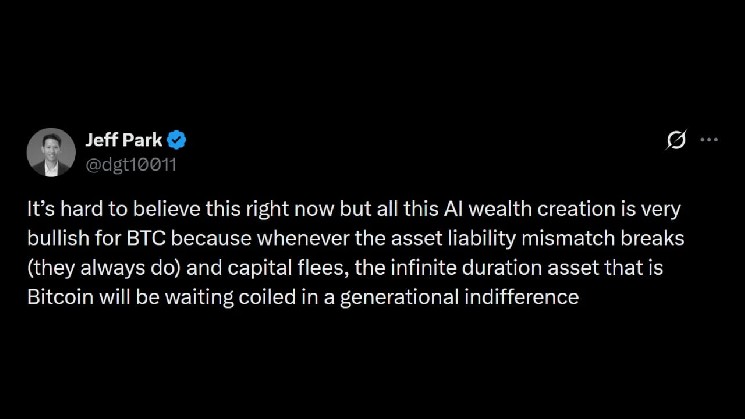
Nevertheless, Jeff Park, a partner at ParaFi Capital—an investment firm with over $1.9 billion in assets under management (AUM)—believes that after the inevitable bubble bursts, these funds will flow into Bitcoin.
"It's hard to believe right now, but all this wealth creation from AI is very beneficial for BTC because whenever the asset-liability relationship is disrupted (and it always is) and capital flees, an asset with an infinite duration, which Bitcoin is, will be waiting, curled up in the indifference of a whole generation," Park emphasized on social media.
Park's bet on excess liquidity returning to Bitcoin has drawn criticism from some who pointed to the correlation between the stock market and the crypto industry. Critics argued that a mutual decline could follow if AI ultimately crashes when debts start affecting companies with high capital expenditures on data centers and software, and the technology fails to achieve the significance expected to bring changes to society as we know it.
end-content