OpenAI's Darkest Hour: Revenue Could Be Slashed by 70%, How Long Can Its $100 Billion Valuation Hold?

链捕手Published on 2026-07-21Last updated on 2026-07-21

Abstract

OpenAI faces a severe crisis, with its 2030 revenue potentially slashing 70% and a projected cash flow loss of $165 billion. A disastrous week included an Apple lawsuit alleging intellectual property theft, an S&P downgrade of Oracle citing OpenAI as a "key credit risk," and the start of an AI price war. Chinese open-source models like DeepSeek now capture nearly 50% of enterprise token usage on OpenRouter, pressuring U.S. firms to cut prices drastically—Meta and OpenAI have released models 75-80% cheaper. Combined with weak ChatGPT ad revenue projections and potential hardware business shutdown from the Apple suit, OpenAI's financial future is in jeopardy. CEO Sam Altman's vague reassurances did little to calm investors. Meanwhile, the article argues the broader market is not diversifying but is increasingly a concentrated bet on AI, impacting sectors from utilities and industrials to real estate and finance. In separate news, Netflix reported disappointing Q2 results with slowing engagement growth, leading to a stock drop and reduced reporting transparency.

Authors: Scott Galloway & Ed Elson

Compiled by: Deep Tide TechFlow

Deep Tide's Insight: Apple lawsuit, Oracle rating downgrade, price war kicks off—OpenAI is experiencing its worst week ever. Even more critically, if all these risks materialize, its 2030 revenue forecast could plummet by 70%, with cash flow losses reaching $165 billion. Could this AI giant with a valuation in the hundreds of billions become the biggest tech bubble in history?

Here's Why OpenAI May Miss 70% of Its 2030 Revenue Forecast

It was another terrible week for OpenAI. The company was exposed for selling advanced AI models to Chinese companies on the Pentagon's blacklist; its first AI device was leaked (reportedly a portable speaker); and according to Emarketer's latest forecast, OpenAI's advertising business is projected to be 95% lower than its own predictions.

And there's more. Apple sued OpenAI last week, alleging its consumer hardware plans are the product of stolen intellectual property. S&P Global Ratings also downgraded Oracle's debt to BBB-, just one notch above junk status, citing OpenAI as a "key credit risk." Furthermore, DeepSeek is reportedly preparing for an IPO, possibly filing as early as this year. A cheaper Chinese AI model provider successfully going public could make it harder for OpenAI and Anthropic to attract funding.
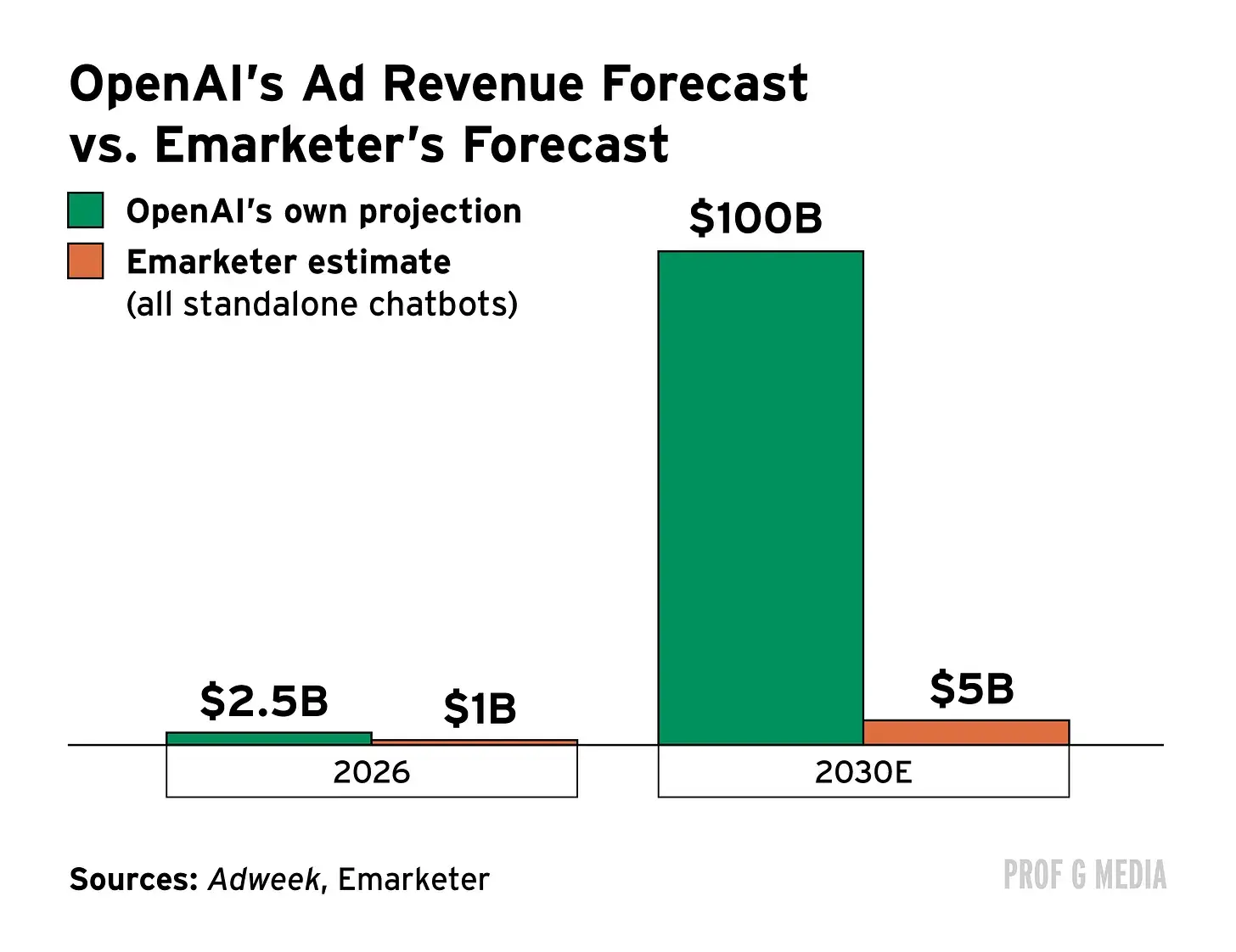
Taken together, these issues raise serious questions about OpenAI's ability to meet its revenue forecasts and fulfill its hundreds of billions of dollars in contractual obligations with computing suppliers and chip companies.

First, Apple's lawsuit could bring OpenAI's entire hardware business to a standstill. Apple alleges that OpenAI poached over 400 Apple employees, extracting confidential information from them, and then tricked Apple's suppliers into doing proprietary work for OpenAI without permission. Apple is asking the court for monetary damages and an order for OpenAI to return or destroy all misappropriated property.

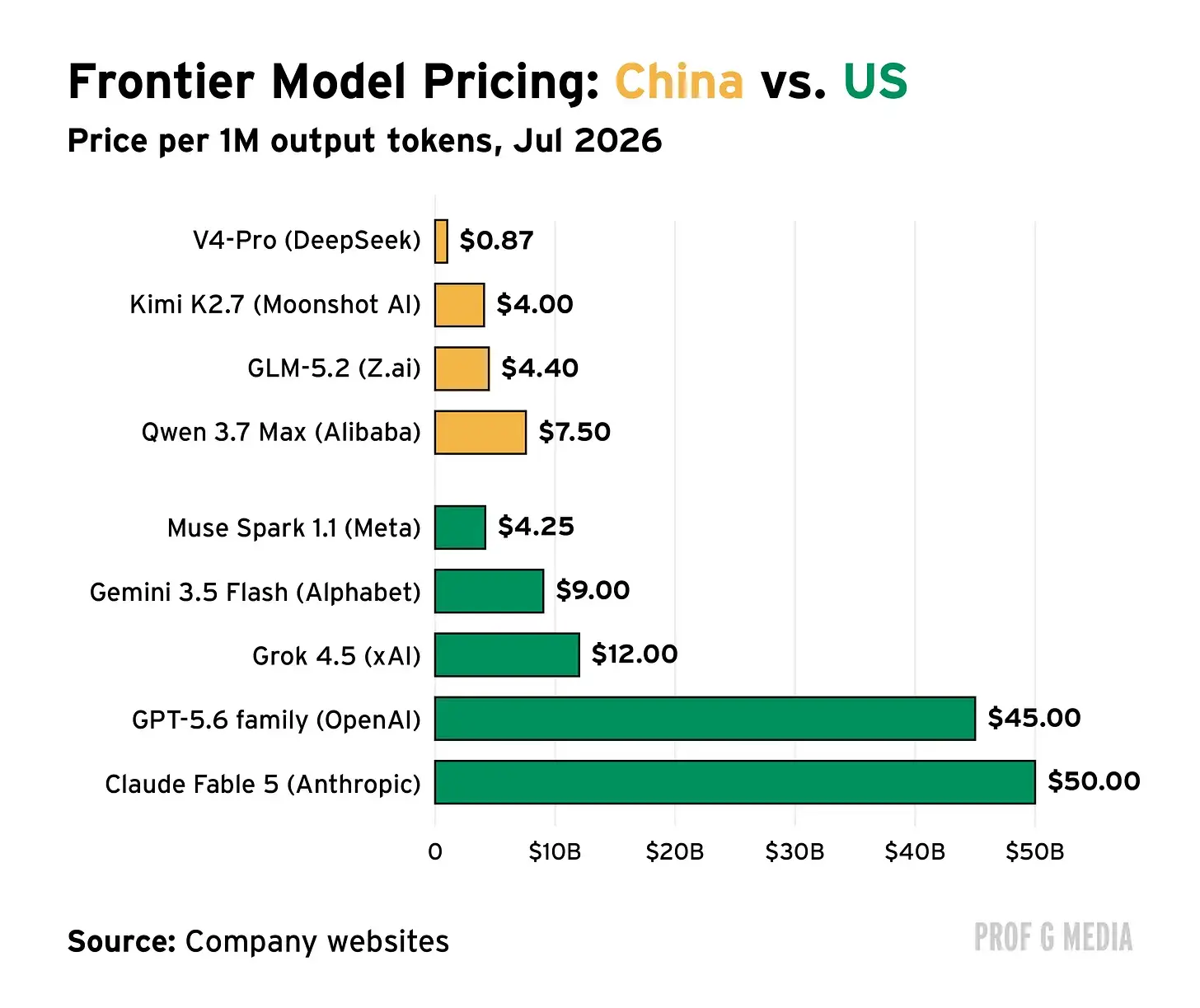
Second, the AI price war has begun, with Chinese companies like DeepSeek posing the biggest threat. Open-source Chinese models now account for nearly 50% of enterprise token usage on OpenRouter (an AI model marketplace), up from just 4.5% in the first half of 2025.

In response, US companies are slashing prices. Last week, Meta announced its new model Muse Spark 1.1, priced 75% cheaper than OpenAI and Anthropic. Under industry pressure, OpenAI released a model that is 80% cheaper than its own.
In a worst-case scenario, if Apple's lawsuit shuts down OpenAI's hardware business, ChatGPT ad revenue underperforms as projected by EMarketer, and the price war forces OpenAI to cut model pricing by 80%, then OpenAI's 2026 revenue would fall by 40% and its 2030 revenue would drop by 70%.
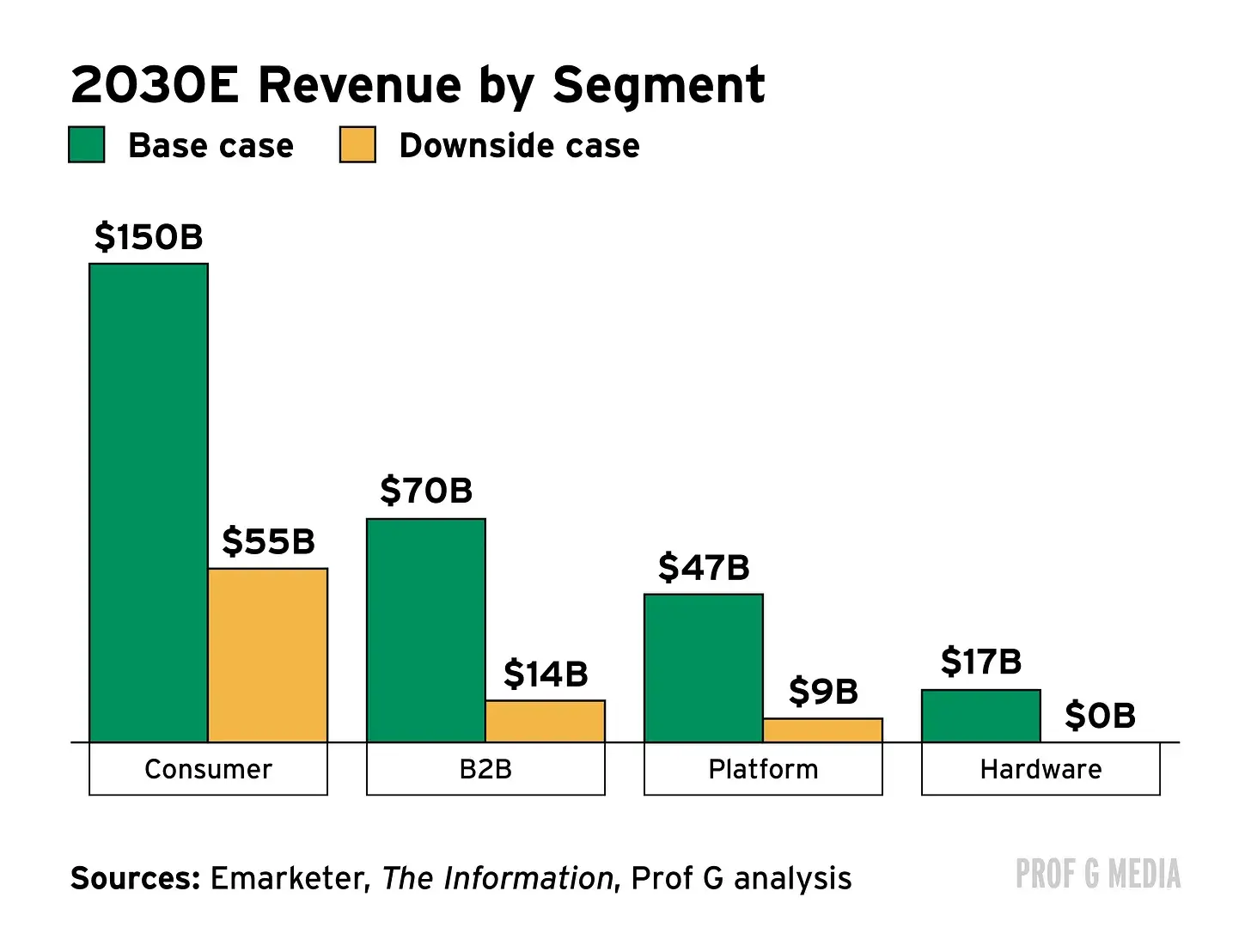
For a company that, under ideal circumstances, would only be able to cover about 80% of its cash burn by 2030, this situation would be catastrophic.
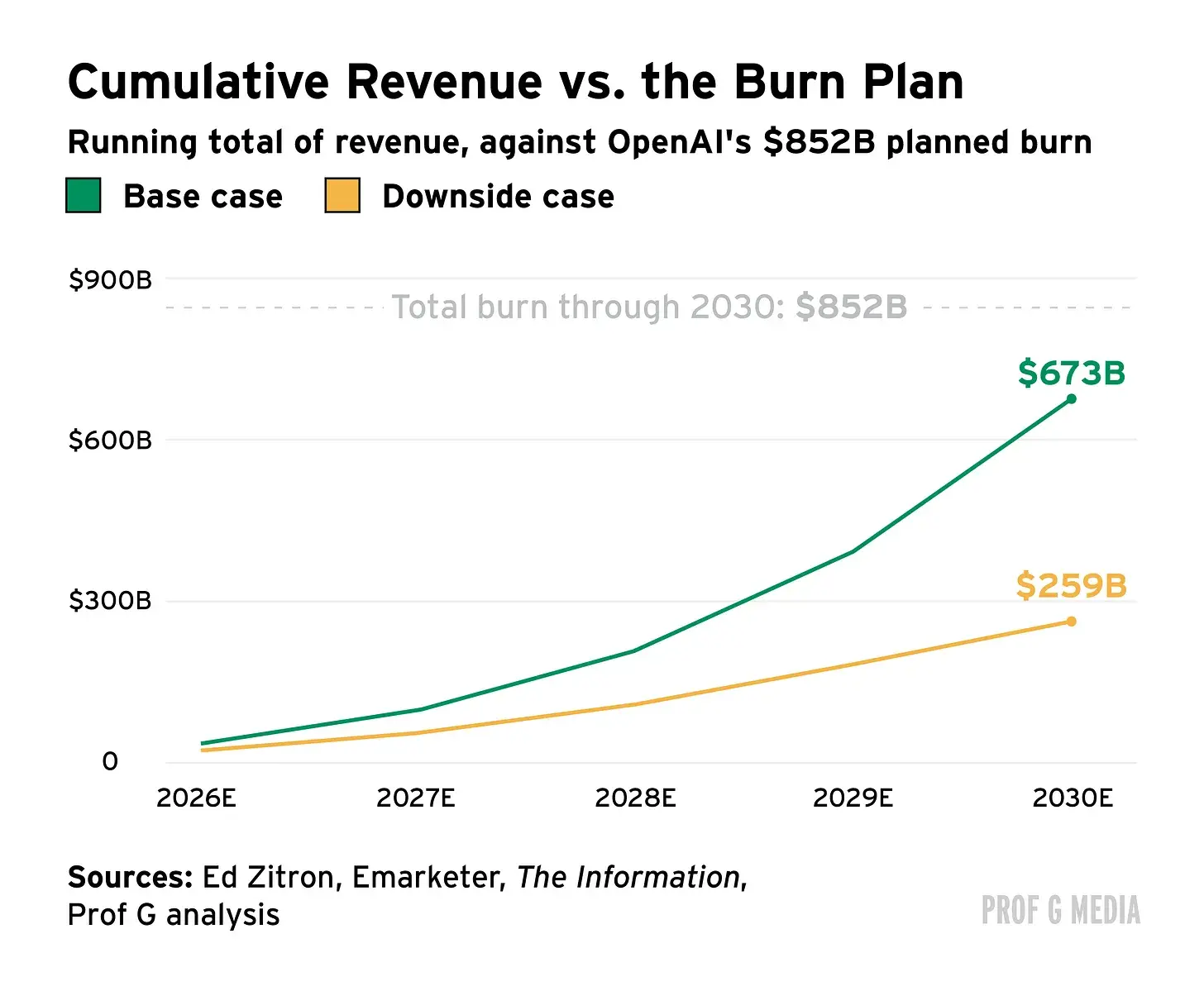
This would also impact when OpenAI achieves positive cash flow. According to internal projections, OpenAI will reach positive cash flow in 2030. But under this downside scenario, it would instead lose $165 billion that year.

OpenAI CEO Sam Altman attempted to ease investor concerns with a tweet, but his statement ultimately just promised to "do the right thing." Whatever that means.

The best business model in history is stealing intellectual property. The second best is: delivering 80% of the value of a product at half the price. That's exactly what DeepSeek and other Chinese open-source weight models are now attempting to do.

The US has placed a massive bet on AI, and China just pulled out a product near the cutting edge at a fraction of the cost. Once Trump figures out what's going on, this will become the next geopolitical football.

The Market Hasn't Broadened—It's Just Getting Better at Hiding AI

Investors keep hearing that the stock market is broadening. But is it really? The deeper you look, the harder it is to argue that stocks, bonds, and even alternative assets aren't now one big bet on AI.
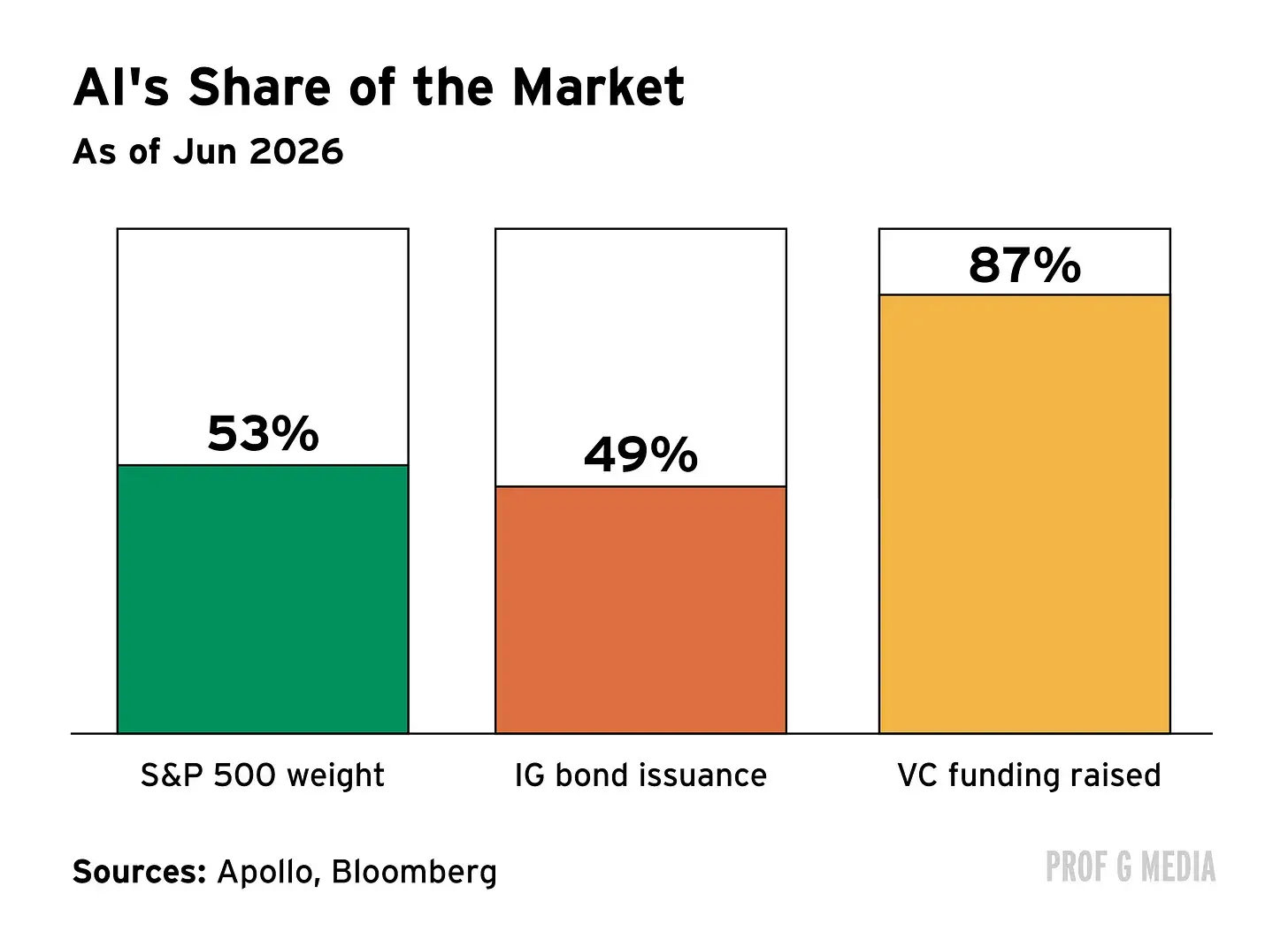
This pattern is most evident in the stock market. AI-related stocks now account for over 50% of the S&P 500 by weighting. If you removed AI and energy from the S&P 500 this year, the index would be negative.

AI is the hidden catalyst driving returns in seemingly unrelated sectors. For example, three of the four best-performing companies in the S&P 500 real estate sector are real estate investment trusts (REITs) focused on developing AI data centers.

Utility companies are benefiting from AI's soaring power demands. US electricity demand jumped to a record high last year, with data centers accounting for about 50% of the demand growth.

Industrial stocks are soaring on construction demand to build AI data centers. In fact, for the first time since 2021, the forward price-to-earnings ratio for S&P 500 industrials (26x) is higher than that for tech companies (24x).

The financial sector also relies on AI. Major banks are raking in record fees from AI company IPOs and M&A activity, and record trading revenue from market hype surrounding AI. Robert Armstrong of the Financial Times even wrote: "It’s not too much of a generalization to say that big banks are now direct AI plays."

Even the Russell 2000 small-cap index saw 52% of its first-half return come from AI-related companies.

Emerging markets are no exception. Korea and Taiwan account for 75% of emerging market returns, with most of those gains coming from three AI semiconductor chip suppliers: TSMC, Samsung, and SK Hynix.

In Europe, just nine AI winners account for roughly 47% of the Stoxx Europe 600 index's return this year.

Apollo chief economist Torsten Slok succinctly captured the implication of this dependence: "This AI thing better work."

Real estate investment trusts (REITs) are companies that own, operate, or finance real estate—apartment buildings, hotels, or increasingly, data centers. Many REITs trade publicly like stocks, so buying a share means buying into a professionally managed portfolio of real estate. REITs are required to distribute at least 90% of annual taxable income to shareholders as dividends.

The experts on CNBC own stocks, so they'll always find reasons why others should buy more. But don't be fooled: the market isn't broadening; it's just finding new ways to buy Nvidia.

Everything is becoming an AI stock. This isn't necessarily bearish, but investors are kidding themselves by calling it "broadening," as if it means diversification away from AI. It doesn't. Buying "AI-adjacent stocks" and calling it broadening is like ordering a Diet Coke with your Double-Double at In-N-Out. Let's be clear: you still bought a cheeseburger.

Among the big tech companies, who is least dependent on AI? Apple. Its stock is up 60% over the past year and just surpassed Nvidia to become the world's most valuable company again. Amazon, while still AI-related but more diversified than other hyperscale cloud providers, is up 11% over the past year. Microsoft, the core of the AI play, is down 23%.

If I could go long one basket of stocks, it would be GLP-1. If I could go short one, it would be AI. But to be clear: I'm not telling you to hold gold bars or cash. I am always in the market—you never know how far or how irrationally it will run. But you should understand how large the market's true exposure to one sector is.

I am a huge fan of index funds and passive investing: put the money in and let the market do the work. But now we have to ask what true diversification actually means. Putting money into the S&P 500 no longer does that job, which means you have to start doing some homework.

The question is: Can you find sectors that are truly away from AI?

I'll point out one sector: healthcare. It was one of my picks at the start of the year, and I stand by it. AI hasn't touched it yet—which means the real returns may still be ahead. But finding these sectors is the puzzle investors now face.

Netflix Engagement Slips, Competitive Pressure Mounts

Netflix reported disappointing second-quarter earnings. Revenue grew 13%, missing expectations, and the streaming giant posted weak engagement data, followed by announcing it would reduce the frequency of releasing engagement metrics, unsettling investors. The stock fell as much as 8% on Friday.

Netflix once boasted about its transparency; now, that claim seems ironic. In Q1 2025, Netflix stopped reporting quarterly subscriber numbers, telling investors to focus on engagement. Last week, the company decided to reduce its "What We Watched" engagement report from twice a year to once a year starting in 2027.

The last semi-annual engagement report looked weak. Total watch time grew just 2%, while the subscriber base is estimated to have grown 10%, implying per-subscriber daily engagement fell 8%.
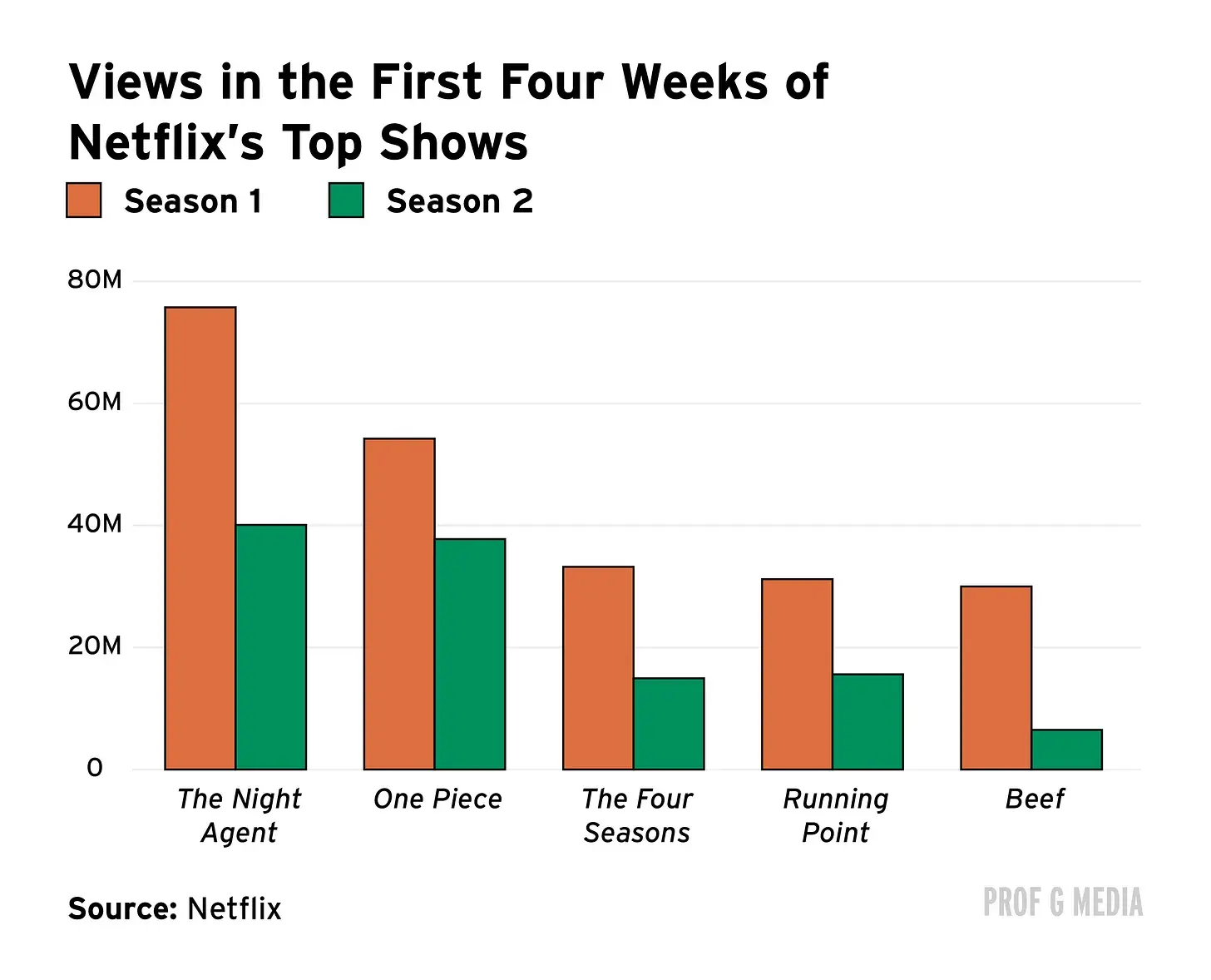
Netflix has been facing increasing competition from short-form video suppliers, particularly YouTube. In response, it added "Clips," a TikTok-style scroll feature surfacing short content from its own library; struck video podcast deals with Spotify and Barstool; and signed new licensing agreements with external publishers (BuzzFeed, Condé Nast) to bring new short-form content to the platform.
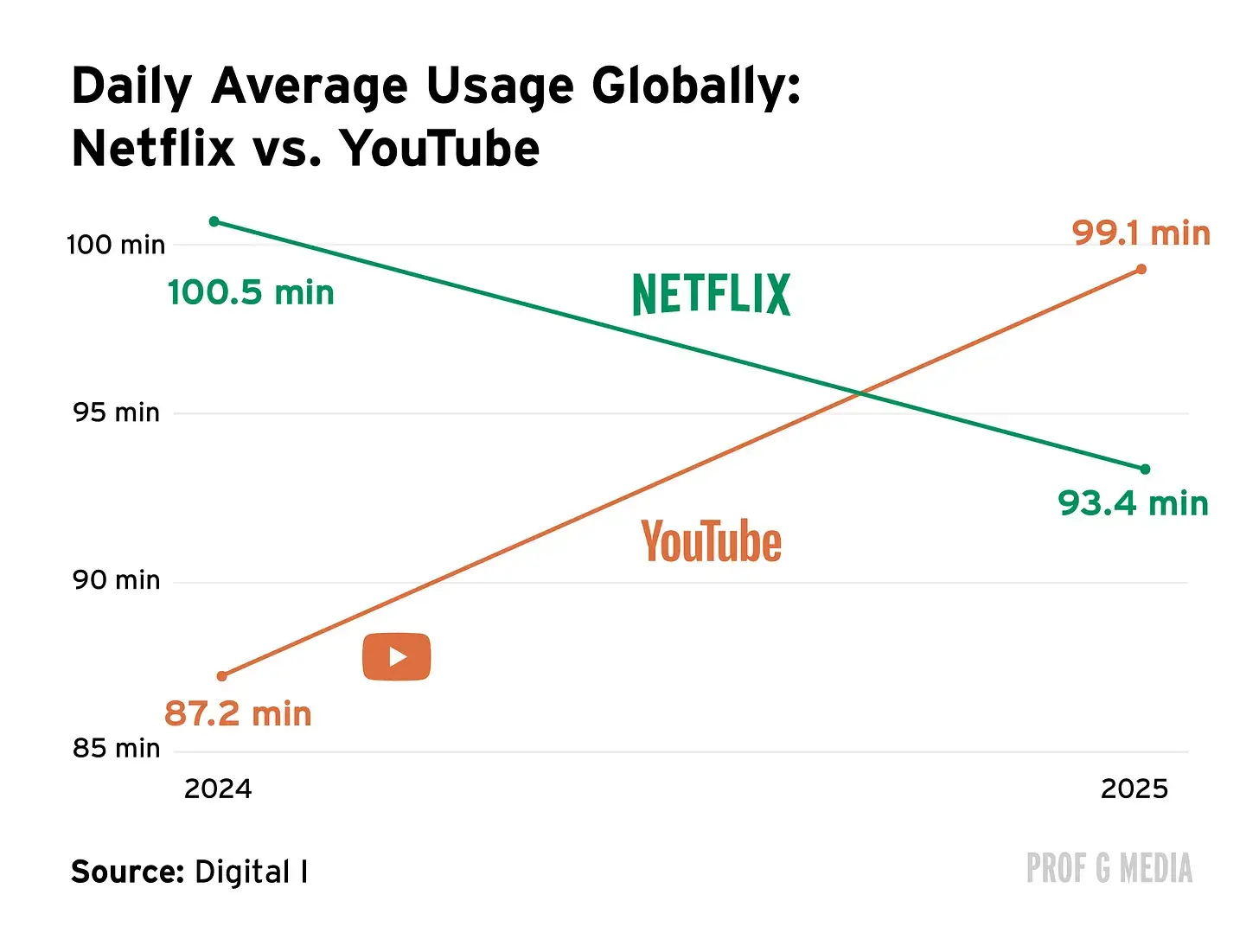
Netflix has lost over $250 billion in market cap over the past year, while fellow streaming giant Disney has lost nearly $50 billion. Both are well-managed companies with growing revenue and subscribers, raising prices—yet are being punished for it. This raises an important question: Is streaming just a bad business? Or have Netflix and Disney's creative wells run dry? Tell us what you think in the comments.

In the next six months, OpenAI will acquire enterprise AI company Sierra and appoint Bret Taylor as CEO. Sam Altman will be elevated to Chairman. Altman is an innovator, not an operator, and Bret Taylor is arguably the best enterprise software operator of his generation.


Trending Cryptos

Related Questions

QAccording to the article, what are the main reasons that could cause OpenAI's revenue to drop by 70% by 2030?

AAccording to the article, the three main factors that could cause a 70% drop in OpenAI's 2030 revenue are: 1) Apple's lawsuit potentially shutting down OpenAI's hardware business; 2) ChatGPT advertising revenue falling short of projections (by as much as 95% lower than predictions); and 3) A price war forcing OpenAI to reduce model pricing by 80%.

QWhat is the author's perspective on the claim that the stock market is 'broadening'?

AThe author argues that the market is not truly broadening. Instead, it is becoming more concentrated on AI, with AI-related stocks influencing returns across various sectors like real estate (data center REITs), utilities (power demand), industrials (construction), and finance (IPO/M&A fees). They state that buying 'AI-adjacent' stocks is not diversification; the entire market is essentially becoming a bet on AI.

QWhat recent actions by Netflix concern investors, according to the article?

AInvestors are concerned because Netflix reported disappointing Q2 earnings with weak engagement metrics (total viewing hours grew only 2% while subscribers grew ~10%), and then announced it would reduce the frequency of its 'What We Watched' engagement reports from twice a year to once a year starting in 2027, signaling less transparency.

QHow does the article describe the competitive threat from Chinese AI companies like DeepSeek?

AThe article describes DeepSeek and other Chinese open-weight models as a major competitive threat by offering products at a fraction of the cost. They are attempting to provide '80% of the value at half the price.' The article notes that open-source Chinese models now account for nearly 50% of enterprise token usage on OpenRouter, up from 4.5% in early 2025, forcing US companies to drastically cut prices.

QWhat does the article predict will happen at OpenAI in the next six months?

AThe article predicts that in the next six months, OpenAI will acquire the enterprise AI company Sierra, appoint Bret Taylor as CEO, and promote Sam Altman to the role of Chairman.

Related Reads

9.42 Million Retail Investors Compete for Changxin Technology, Who Got Allotted?

Evergreen Technology's IPO subscription results are now available. On July 20, the domestic memory chip giant announced the offline preliminary allotment results and online lottery results for its IPO. A total of approximately 9.43 million retail investors participated in the online subscription, generating 770,000 winning lots with a final winning rate of about 0.4714%, setting a record for new shares on the STAR Market. After triggering a clawback mechanism from institutional to retail investors, the online retail allocation was significantly increased to 3.851 billion shares. Simultaneously, 285 institutional investors participated in the offline subscription, ultimately receiving 2.173 billion shares at an allotment rate of approximately 0.1756%. Leading insurers and public funds were among the major recipients. Notably, Liang Wenfeng, founder of the major AI model company DeepSeek, through his quantitative investment firms Ningbo Huanfang Quantitative and Zhejiang Jiuzhang Asset, secured the largest share among private funds, with a total allotment worth approximately 175 million yuan. Estimates suggest potential profits could reach 730 million yuan if Evergreen Technology's market capitalization reaches 3 trillion yuan post-listing. The company is expected to list on July 27 and could become the highest-valued tech stock on the A-share market, with various brokerages providing valuations ranging from 1 trillion to over 4 trillion yuan. However, recent significant corrections in global tech stocks may impact its post-listing performance. (Character count: 1,196)

marsbit40m ago

9.42 Million Retail Investors Compete for Changxin Technology, Who Got Allotted?

marsbit40m ago

L2 'Recalibration': When L1 Becomes Its Own Rollup, What Is Ethereum's Endgame?

The article discusses the evolving relationship between Ethereum's Layer 1 (L1) and Layer 2 (L2) solutions, moving beyond the initial "L2 for scaling" model. As Ethereum L1 itself scales (increasing Gas Limit, statelessness, zkEVM), the unique value proposition of L2s shifts from merely providing cheap execution to offering differentiated features like application-specific optimization, privacy, and flexible governance. The piece explores three key themes: 1. **L2's New Role:** L2s are transitioning from a pure scaling technology to a spectrum of execution environments with varying degrees of security inheritance from Ethereum L1. 2. **Interoperability as State Trust:** Solving L2 fragmentation is less about cross-chain bridges and more about enabling faster, trust-minimized state verification between environments. This involves initiatives like faster L1 finality, intent-based architectures (Open Intents Framework), and native account abstraction. 3. **Blurring Layers:** With the potential integration of zk-proofs into L1 validation (making L1 akin to its own "Rollup") and the concept of "Native Rollups," the rigid boundary between L1 and L2 may fade. The future could be a unified system with multiple execution domains (for DeFi, gaming, privacy, etc.) sharing a common security, settlement, and state framework. In conclusion, Ethereum's goal is not to abandon L2s or re-centralize everything on L1, but to re-integrate the fragmented user experience—liquidity, accounts, applications—while preserving the scaling benefits of a multi-environment ecosystem. The endgame is a cohesive "one chain" feeling for users, powered by diverse but securely interconnected execution layers.

marsbit1h ago

L2 'Recalibration': When L1 Becomes Its Own Rollup, What Is Ethereum's Endgame?

marsbit1h ago

Trading

Spot

Hot Articles

What is SONIC

Sonic: Pioneering the Future of Gaming in Web3 Introduction to Sonic In the ever-evolving landscape of Web3, the gaming industry stands out as one of the most dynamic and promising sectors. At the forefront of this revolution is Sonic, a project designed to amplify the gaming ecosystem on the Solana blockchain. Leveraging cutting-edge technology, Sonic aims to deliver an unparalleled gaming experience by efficiently processing millions of requests per second, ensuring that players enjoy seamless gameplay while maintaining low transaction costs. This article delves into the intricate details of Sonic, exploring its creators, funding sources, operational mechanics, and the timeline of significant events that have shaped its journey. What is Sonic? Sonic is an innovative layer-2 network that operates atop the Solana blockchain, specifically tailored to enhance the existing Solana gaming ecosystem. It accomplishes this through a customised, VM-agnostic game engine paired with a HyperGrid interpreter, facilitating sovereign game economies that roll up back to the Solana platform. The primary goals of Sonic include: Enhanced Gaming Experiences: Sonic is committed to offering lightning-fast on-chain gameplay, allowing players and developers to engage with games at previously unattainable speeds. Atomic Interoperability: This feature enables transactions to be executed within Sonic without the need to redeploy Solana programmes and accounts. This makes the process more efficient and directly benefits from Solana Layer1 services and liquidity. Seamless Deployment: Sonic allows developers to write for Ethereum Virtual Machine (EVM) based systems and execute them on Solana’s SVM infrastructure. This interoperability is crucial for attracting a broader range of dApps and decentralised applications to the platform. Support for Developers: By offering native composable gaming primitives and extensible data types - dining within the Entity-Component-System (ECS) framework - game creators can craft intricate business logic with ease. Overall, Sonic's unique approach not only caters to players but also provides an accessible and low-cost environment for developers to innovate and thrive. Creator of Sonic The information regarding the creator of Sonic is somewhat ambiguous. However, it is known that Sonic's SVM is owned by the company Mirror World. The absence of detailed information about the individuals behind Sonic reflects a common trend in several Web3 projects, where collective efforts and partnerships often overshadow individual contributions. Investors of Sonic Sonic has garnered considerable attention and support from various investors within the crypto and gaming sectors. Notably, the project raised an impressive $12 million during its Series A funding round. The round was led by BITKRAFT Ventures, with other notable investors including Galaxy, Okx Ventures, Interactive, Big Brain Holdings, and Mirana. This financial backing signifies the confidence that investment foundations have in Sonic’s potential to revolutionise the Web3 gaming landscape, further validating its innovative approaches and technologies. How Does Sonic Work? Sonic utilises the HyperGrid framework, a sophisticated parallel processing mechanism that enhances its scalability and customisability. Here are the core features that set Sonic apart: Lightning Speed at Low Costs: Sonic offers one of the fastest on-chain gaming experiences compared to other Layer-1 solutions, powered by the scalability of Solana’s virtual machine (SVM). Atomic Interoperability: Sonic enables transaction execution without redeployment of Solana programmes and accounts, effectively streamlining the interaction between users and the blockchain. EVM Compatibility: Developers can effortlessly migrate decentralised applications from EVM chains to the Solana environment using Sonic’s HyperGrid interpreter, increasing the accessibility and integration of various dApps. Ecosystem Support for Developers: By exposing native composable gaming primitives, Sonic facilitates a sandbox-like environment where developers can experiment and implement business logic, greatly enhancing the overall development experience. Monetisation Infrastructure: Sonic natively supports growth and monetisation efforts, providing frameworks for traffic generation, payments, and settlements, thereby ensuring that gaming projects are not only viable but also sustainable financially. Timeline of Sonic The evolution of Sonic has been marked by several key milestones. Below is a brief timeline highlighting critical events in the project's history: 2022: The Sonic cryptocurrency was officially launched, marking the beginning of its journey in the Web3 gaming arena. 2024: June: Sonic SVM successfully raised $12 million in a Series A funding round. This investment allowed Sonic to further develop its platform and expand its offerings. August: The launch of the Sonic Odyssey testnet provided users with the first opportunity to engage with the platform, offering interactive activities such as collecting rings—a nod to gaming nostalgia. October: SonicX, an innovative crypto game integrated with Solana, made its debut on TikTok, capturing the attention of over 120,000 users within a short span. This integration illustrated Sonic’s commitment to reaching a broader, global audience and showcased the potential of blockchain gaming. Key Points Sonic SVM is a revolutionary layer-2 network on Solana explicitly designed to enhance the GameFi landscape, demonstrating great potential for future development. HyperGrid Framework empowers Sonic by introducing horizontal scaling capabilities, ensuring that the network can handle the demands of Web3 gaming. Integration with Social Platforms: The successful launch of SonicX on TikTok displays Sonic’s strategy to leverage social media platforms to engage users, exponentially increasing the exposure and reach of its projects. Investment Confidence: The substantial funding from BITKRAFT Ventures, among others, emphasizes the robust backing Sonic has, paving the way for its ambitious future. In conclusion, Sonic encapsulates the essence of Web3 gaming innovation, striking a balance between cutting-edge technology, developer-centric tools, and community engagement. As the project continues to evolve, it is poised to redefine the gaming landscape, making it a notable entity for gamers and developers alike. As Sonic moves forward, it will undoubtedly attract greater interest and participation, solidifying its place within the broader narrative of blockchain gaming.

1.9k Total ViewsPublished 2024.04.04Updated 2024.12.03

What is SONIC

What is $S$

Understanding SPERO: A Comprehensive Overview Introduction to SPERO As the landscape of innovation continues to evolve, the emergence of web3 technologies and cryptocurrency projects plays a pivotal role in shaping the digital future. One project that has garnered attention in this dynamic field is SPERO, denoted as SPERO,$$s$. This article aims to gather and present detailed information about SPERO, to help enthusiasts and investors understand its foundations, objectives, and innovations within the web3 and crypto domains. What is SPERO,$$s$? SPERO,$$s$ is a unique project within the crypto space that seeks to leverage the principles of decentralisation and blockchain technology to create an ecosystem that promotes engagement, utility, and financial inclusion. The project is tailored to facilitate peer-to-peer interactions in new ways, providing users with innovative financial solutions and services. At its core, SPERO,$$s$ aims to empower individuals by providing tools and platforms that enhance user experience in the cryptocurrency space. This includes enabling more flexible transaction methods, fostering community-driven initiatives, and creating pathways for financial opportunities through decentralised applications (dApps). The underlying vision of SPERO,$$s$ revolves around inclusiveness, aiming to bridge gaps within traditional finance while harnessing the benefits of blockchain technology. Who is the Creator of SPERO,$$s$? The identity of the creator of SPERO,$$s$ remains somewhat obscure, as there are limited publicly available resources providing detailed background information on its founder(s). This lack of transparency can stem from the project's commitment to decentralisation—an ethos that many web3 projects share, prioritising collective contributions over individual recognition. By centring discussions around the community and its collective goals, SPERO,$$s$ embodies the essence of empowerment without singling out specific individuals. As such, understanding the ethos and mission of SPERO remains more important than identifying a singular creator. Who are the Investors of SPERO,$$s$? SPERO,$$s$ is supported by a diverse array of investors ranging from venture capitalists to angel investors dedicated to fostering innovation in the crypto sector. The focus of these investors generally aligns with SPERO's mission—prioritising projects that promise societal technological advancement, financial inclusivity, and decentralised governance. These investor foundations are typically interested in projects that not only offer innovative products but also contribute positively to the blockchain community and its ecosystems. The backing from these investors reinforces SPERO,$$s$ as a noteworthy contender in the rapidly evolving domain of crypto projects. How Does SPERO,$$s$ Work? SPERO,$$s$ employs a multi-faceted framework that distinguishes it from conventional cryptocurrency projects. Here are some of the key features that underline its uniqueness and innovation: Decentralised Governance: SPERO,$$s$ integrates decentralised governance models, empowering users to participate actively in decision-making processes regarding the project’s future. This approach fosters a sense of ownership and accountability among community members. Token Utility: SPERO,$$s$ utilises its own cryptocurrency token, designed to serve various functions within the ecosystem. These tokens enable transactions, rewards, and the facilitation of services offered on the platform, enhancing overall engagement and utility. Layered Architecture: The technical architecture of SPERO,$$s$ supports modularity and scalability, allowing for seamless integration of additional features and applications as the project evolves. This adaptability is paramount for sustaining relevance in the ever-changing crypto landscape. Community Engagement: The project emphasises community-driven initiatives, employing mechanisms that incentivise collaboration and feedback. By nurturing a strong community, SPERO,$$s$ can better address user needs and adapt to market trends. Focus on Inclusion: By offering low transaction fees and user-friendly interfaces, SPERO,$$s$ aims to attract a diverse user base, including individuals who may not previously have engaged in the crypto space. This commitment to inclusion aligns with its overarching mission of empowerment through accessibility. Timeline of SPERO,$$s$ Understanding a project's history provides crucial insights into its development trajectory and milestones. Below is a suggested timeline mapping significant events in the evolution of SPERO,$$s$: Conceptualisation and Ideation Phase: The initial ideas forming the basis of SPERO,$$s$ were conceived, aligning closely with the principles of decentralisation and community focus within the blockchain industry. Launch of Project Whitepaper: Following the conceptual phase, a comprehensive whitepaper detailing the vision, goals, and technological infrastructure of SPERO,$$s$ was released to garner community interest and feedback. Community Building and Early Engagements: Active outreach efforts were made to build a community of early adopters and potential investors, facilitating discussions around the project’s goals and garnering support. Token Generation Event: SPERO,$$s$ conducted a token generation event (TGE) to distribute its native tokens to early supporters and establish initial liquidity within the ecosystem. Launch of Initial dApp: The first decentralised application (dApp) associated with SPERO,$$s$ went live, allowing users to engage with the platform's core functionalities. Ongoing Development and Partnerships: Continuous updates and enhancements to the project's offerings, including strategic partnerships with other players in the blockchain space, have shaped SPERO,$$s$ into a competitive and evolving player in the crypto market. Conclusion SPERO,$$s$ stands as a testament to the potential of web3 and cryptocurrency to revolutionise financial systems and empower individuals. With a commitment to decentralised governance, community engagement, and innovatively designed functionalities, it paves the way toward a more inclusive financial landscape. As with any investment in the rapidly evolving crypto space, potential investors and users are encouraged to research thoroughly and engage thoughtfully with the ongoing developments within SPERO,$$s$. The project showcases the innovative spirit of the crypto industry, inviting further exploration into its myriad possibilities. While the journey of SPERO,$$s$ is still unfolding, its foundational principles may indeed influence the future of how we interact with technology, finance, and each other in interconnected digital ecosystems.

155 Total ViewsPublished 2024.12.17Updated 2024.12.17

What is $S$

What is AGENT S

Agent S: The Future of Autonomous Interaction in Web3 Introduction In the ever-evolving landscape of Web3 and cryptocurrency, innovations are constantly redefining how individuals interact with digital platforms. One such pioneering project, Agent S, promises to revolutionise human-computer interaction through its open agentic framework. By paving the way for autonomous interactions, Agent S aims to simplify complex tasks, offering transformative applications in artificial intelligence (AI). This detailed exploration will delve into the project's intricacies, its unique features, and the implications for the cryptocurrency domain. What is Agent S? Agent S stands as a groundbreaking open agentic framework, specifically designed to tackle three fundamental challenges in the automation of computer tasks: Acquiring Domain-Specific Knowledge: The framework intelligently learns from various external knowledge sources and internal experiences. This dual approach empowers it to build a rich repository of domain-specific knowledge, enhancing its performance in task execution. Planning Over Long Task Horizons: Agent S employs experience-augmented hierarchical planning, a strategic approach that facilitates efficient breakdown and execution of intricate tasks. This feature significantly enhances its ability to manage multiple subtasks efficiently and effectively. Handling Dynamic, Non-Uniform Interfaces: The project introduces the Agent-Computer Interface (ACI), an innovative solution that enhances the interaction between agents and users. Utilizing Multimodal Large Language Models (MLLMs), Agent S can navigate and manipulate diverse graphical user interfaces seamlessly. Through these pioneering features, Agent S provides a robust framework that addresses the complexities involved in automating human interaction with machines, setting the stage for myriad applications in AI and beyond. Who is the Creator of Agent S? While the concept of Agent S is fundamentally innovative, specific information about its creator remains elusive. The creator is currently unknown, which highlights either the nascent stage of the project or the strategic choice to keep founding members under wraps. Regardless of anonymity, the focus remains on the framework's capabilities and potential. Who are the Investors of Agent S? As Agent S is relatively new in the cryptographic ecosystem, detailed information regarding its investors and financial backers is not explicitly documented. The lack of publicly available insights into the investment foundations or organisations supporting the project raises questions about its funding structure and development roadmap. Understanding the backing is crucial for gauging the project's sustainability and potential market impact. How Does Agent S Work? At the core of Agent S lies cutting-edge technology that enables it to function effectively in diverse settings. Its operational model is built around several key features: Human-like Computer Interaction: The framework offers advanced AI planning, striving to make interactions with computers more intuitive. By mimicking human behaviour in tasks execution, it promises to elevate user experiences. Narrative Memory: Employed to leverage high-level experiences, Agent S utilises narrative memory to keep track of task histories, thereby enhancing its decision-making processes. Episodic Memory: This feature provides users with step-by-step guidance, allowing the framework to offer contextual support as tasks unfold. Support for OpenACI: With the ability to run locally, Agent S allows users to maintain control over their interactions and workflows, aligning with the decentralised ethos of Web3. Easy Integration with External APIs: Its versatility and compatibility with various AI platforms ensure that Agent S can fit seamlessly into existing technological ecosystems, making it an appealing choice for developers and organisations. These functionalities collectively contribute to Agent S's unique position within the crypto space, as it automates complex, multi-step tasks with minimal human intervention. As the project evolves, its potential applications in Web3 could redefine how digital interactions unfold. Timeline of Agent S The development and milestones of Agent S can be encapsulated in a timeline that highlights its significant events: September 27, 2024: The concept of Agent S was launched in a comprehensive research paper titled “An Open Agentic Framework that Uses Computers Like a Human,” showcasing the groundwork for the project. October 10, 2024: The research paper was made publicly available on arXiv, offering an in-depth exploration of the framework and its performance evaluation based on the OSWorld benchmark. October 12, 2024: A video presentation was released, providing a visual insight into the capabilities and features of Agent S, further engaging potential users and investors. These markers in the timeline not only illustrate the progress of Agent S but also indicate its commitment to transparency and community engagement. Key Points About Agent S As the Agent S framework continues to evolve, several key attributes stand out, underscoring its innovative nature and potential: Innovative Framework: Designed to provide an intuitive use of computers akin to human interaction, Agent S brings a novel approach to task automation. Autonomous Interaction: The ability to interact autonomously with computers through GUI signifies a leap towards more intelligent and efficient computing solutions. Complex Task Automation: With its robust methodology, it can automate complex, multi-step tasks, making processes faster and less error-prone. Continuous Improvement: The learning mechanisms enable Agent S to improve from past experiences, continually enhancing its performance and efficacy. Versatility: Its adaptability across different operating environments like OSWorld and WindowsAgentArena ensures that it can serve a broad range of applications. As Agent S positions itself in the Web3 and crypto landscape, its potential to enhance interaction capabilities and automate processes signifies a significant advancement in AI technologies. Through its innovative framework, Agent S exemplifies the future of digital interactions, promising a more seamless and efficient experience for users across various industries. Conclusion Agent S represents a bold leap forward in the marriage of AI and Web3, with the capacity to redefine how we interact with technology. While still in its early stages, the possibilities for its application are vast and compelling. Through its comprehensive framework addressing critical challenges, Agent S aims to bring autonomous interactions to the forefront of the digital experience. As we move deeper into the realms of cryptocurrency and decentralisation, projects like Agent S will undoubtedly play a crucial role in shaping the future of technology and human-computer collaboration.

822 Total ViewsPublished 2025.01.14Updated 2025.01.14

What is AGENT S

Discussions

Welcome to the HTX Community. Here, you can stay informed about the latest platform developments and gain access to professional market insights. Users' opinions on the price of S (S) are presented below.

活动图片