Ondo wallet activity surges after DTCC, SBI deals as ONDO eyes $0.38

ambcryptoPublished on 2026-07-17Last updated on 2026-07-17

Abstract

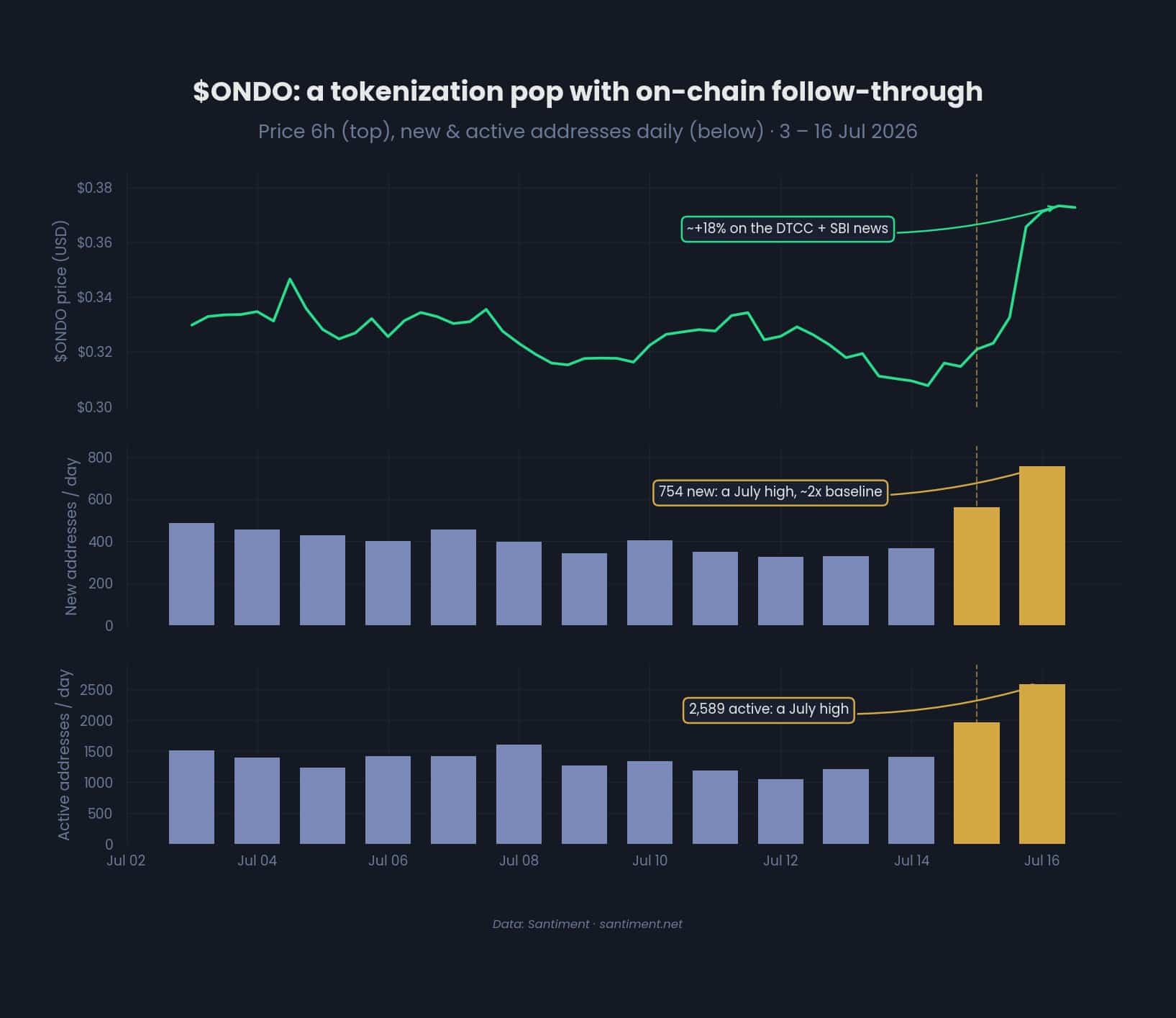
Activity around Ondo Finance is surging, with new wallet addresses doubling to 754 and daily active addresses jumping from 1,410 to 2,589 over a three-day period ending July 16. This spike in on-chain activity coincides with key new developments from the platform. Ondo recently launched tokenized stock representations using DTCC's infrastructure, aligning its products more closely with traditional U.S. markets and joining ranks with firms like BlackRock and JPMorgan. Additionally, a partnership with Japan's SBI Group aims to bring Japanese equities onchain and explore using a yen-backed stablecoin for settlement. This flurry of institutional deals and infrastructure expansion has drawn significant attention to ONDO as the token eyes a test of the $0.38 price level.

Activity around Ondo Finance [ONDO] is picking up! This is happening in tandem with its new infrastructure and partnerships, so it looks like good days are ahead.

Here’s the latest.

Ondo Finance’s on-chain activity shoots up

Per Santiment Intelligence, new addresses have increased for three straight days. The metric hit 754 on July 16; that’s about twice the pace seen earlier in the month. Daily active addresses also followed the pattern, going from 1,410 to 2,589 over the same period.
Source: Santiment Intelligence

The key inference here, is that new developments have attracted attention to the platform.

Ondo recently launched tokenized stock representations using entitlements generated through DTCC’s tokenization infrastructure. This connects its products more closely with the systems used in traditional US markets.

The company stated that with this, they’re joining a select club of leading TradFi and DeFi firms. Some of the other well known names include BlackRock, JPMorgan, Goldman Sachs, Nasdaq, and the NYSE.

It also partnered with Japan’s SBI Group to bring Japanese equities onchain. The aim is to distribute Ondo products through SBI’s network and explore the use of a yen-backed stablecoin for settlement.

About the same, Ian De Bode, CEO, Ondo Finance, said,

This collaboration creates a path to bring Japanese assets onchain and to connect Japan with the global tokenized economy.

A test at $0.38

Trending Cryptos

Related Questions

QWhat are the two key partnerships or developments mentioned that have increased activity around Ondo Finance?

AThe two key developments are: 1) The launch of tokenized stock representations using entitlements generated through DTCC's tokenization infrastructure. 2) A partnership with Japan's SBI Group to bring Japanese equities onchain and explore using a yen-backed stablecoin for settlement.

QAccording to Santiment Intelligence data, how did new addresses and daily active addresses change around July 16th?

ANew addresses hit 754 on July 16th, which was about twice the pace seen earlier in the month. Daily active addresses increased from 1,410 to 2,589 over the same three-day period leading to July 16th.

QWhat is the significance of Ondo Finance's integration with DTCC's infrastructure according to the article?

AThe significance is that it connects Ondo's products more closely with the systems used in traditional US markets and places the company among a select group of leading TradFi and DeFi firms, including names like BlackRock, JPMorgan, and Nasdaq.

QWhat did Ondo Finance's CEO, Ian De Bode, say about the collaboration with SBI Group?

AIan De Bode stated, 'This collaboration creates a path to bring Japanese assets onchain and to connect Japan with the global tokenized economy.'

QWhat is the price level that ONDO token is said to be eyeing, as indicated in the article title?

AThe article title indicates that the ONDO token is eyeing a price of $0.38.

Related Reads

Same $5 Rate, Bill Differs by 30%, OpenAI Exec: Token Pricing Is Never Directly Comparable

Here is a summary of the article in English: **Title: Priced at $5, Bills Vary by 30%. OpenAI Executive: Token Prices Are Not Directly Comparable** A key takeaway from OpenAI's Codex lead, Tibo, is that a "token" is not a standardized unit for comparing AI model costs, akin to grams or kilowatt-hours. He uses an analogy: two identical pizzas priced per slice can yield different total costs depending on how they're cut. Similarly, different models use different "tokenizers" to segment text, meaning the same input text can produce vastly different token counts. For instance, the same text was tokenized as 766 tokens by GPT-5.6 Sol and 1170 tokens by Claude Opus 5—a 34.5% difference—despite both models advertising the same input price of $5 per million tokens. This discrepancy arises because each company trains its own tokenizer based on its training data, affecting how common or rare word combinations are split. The problem isn't cross-vendor only. Even Anthropic warns that its newer models (Claude 4.7+) use a different tokenizer, producing roughly 30% more tokens for the same text than earlier versions, so cost estimates shouldn't be reused across model generations. Bill differences stem from four main factors: 1) Tokenizer efficiency (input token count), 2) Caching (e.g., GPT-5.6 Sol offers a much lower cache input rate), 3) Output pricing (which can outweigh input savings in agent workflows), and 4) Context length pricing tiers (e.g., GPT-5.6 Sol charges double the input rate for entire requests exceeding 272K tokens). Tibo also addressed user reports of GPT-5.6 Sol's context window being limited in practice, sharing configuration code to manually expand it to 1 million tokens. However, he cautioned that larger windows increase the risk of hitting higher pricing tiers as longer session histories are processed repeatedly. The article concludes that the true metric should shift from "price per million tokens" to "price per successful outcome." The most accurate way to compare costs is to run identical real-world tasks (with the same prompts, tools, and data) through different models, accounting for all variables like tokenization, caching, output length, and context pricing. Ultimately, what matters is the total cost to complete a specific job, not the nominal token price.

marsbit16m ago

Same $5 Rate, Bill Differs by 30%, OpenAI Exec: Token Pricing Is Never Directly Comparable

marsbit16m ago

Are Big VC Funds Monopolizing the Seed Round, Leaving Small VCs with No Choice but to Give Up?

**Title: Are Big VCs Monopolizing Seed Rounds? Is Giving Up the Only Path for Small VCs?** In a frank and critical commentary, the author argues that the venture capital landscape has shifted dramatically: large, multi-stage funds are aggressively moving into seed-stage investing, leveraging their brand recognition, massive capital, and resources to dominate deals. They outcompete smaller, specialized funds for stakes in even the earliest startups, as founders increasingly prefer established names. The piece asserts that success in VC now hinges almost entirely on securing a position in the handful of globally transformative companies each year (e.g., OpenAI, Anthropic). For funds that miss these "winner-takes-most" opportunities, relevance fades. The author sarcastically suggests small fund managers should advise their portfolio companies to seek acquisition by such giants and then invest via SPVs, or abandon early-stage investing altogether to chase less ambiguous growth rounds. Further, the author claims the "best" founders—those from elite backgrounds—command premium valuations and align with top-tier funds, leaving little room for others. The relentless focus on AI is presented as another pressure point; not dedicating a fund entirely to AI is deemed a path to irrelevance, akin to missing prior cycles like SaaS or crypto. Ultimately, the letter delivers a cynical conclusion: with capital and power concentrating, true differentiation is nearly impossible. It suggests that for many small VCs, surrendering to this new reality—rather than evolving, competing, or trying something different—might be the most rational, if grim, course of action. The piece serves as a stark warning about capital concentration and the existential challenges facing smaller investment firms.

marsbit16m ago

Are Big VC Funds Monopolizing the Seed Round, Leaving Small VCs with No Choice but to Give Up?

marsbit16m ago

Bank of Russia: 12 Largest Banks to Connect Digital Ruble from September 1, 2026

The Central Bank of Russia (CBR) announced that all 12 of the country's systemically important banks will be ready to offer clients digital ruble accounts and transactions starting September 1, 2026. According to Alla Bakina, director of the CBR's national payment system department, these banks cover over 80% of the domestic payment market. The digital ruble is described as a new form of the existing currency, functioning as a cashless payment method but held directly in a user's wallet on the CBR platform. Nine other banks designated as significant payment market participants are also expected to provide access, with most aiming to complete integration by autumn 2026. Starting from the September launch date, major retail chains with annual revenue exceeding 120 million rubles will be required to accept digital ruble payments, though adoption for citizens remains voluntary. The rollout follows a delayed pilot phase, with mass implementation postponed from 2025. The CBR's model currently offers basic account functionality without interest accrual, unlike China's digital yuan, which began paying interest in early 2026. The announcement positions Russia among dozens of countries testing Central Bank Digital Currencies (CBDCs), though the digital ruble's potential role in cross-border settlements, particularly within BRICS, remains an open question for its future international relevance.

cryptonews.ru22m ago

Bank of Russia: 12 Largest Banks to Connect Digital Ruble from September 1, 2026

cryptonews.ru22m ago

Trading

Spot

Hot Articles

How to Buy ONDO

Welcome to HTX.com! We've made purchasing OndoFinance (ONDO) simple and convenient. Follow our step-by-step guide to embark on your crypto journey.Step 1: Create Your HTX AccountUse your email or phone number to sign up for a free account on HTX. Experience a hassle-free registration journey and unlock all features.Get My AccountStep 2: Go to Buy Crypto and Choose Your Payment MethodCredit/Debit Card: Use your Visa or Mastercard to buy OndoFinance (ONDO) instantly.Balance: Use funds from your HTX account balance to trade seamlessly.Third Parties: We've added popular payment methods such as Google Pay and Apple Pay to enhance convenience.P2P: Trade directly with other users on HTX.Over-the-Counter (OTC): We offer tailor-made services and competitive exchange rates for traders.Step 3: Store Your OndoFinance (ONDO)After purchasing your OndoFinance (ONDO), store it in your HTX account. Alternatively, you can send it elsewhere via blockchain transfer or use it to trade other cryptocurrencies.Step 4: Trade OndoFinance (ONDO)Easily trade OndoFinance (ONDO) on HTX's spot market. Simply access your account, select your trading pair, execute your trades, and monitor in real-time. We offer a user-friendly experience for both beginners and seasoned traders.

6.5k Total ViewsPublished 2024.03.29Updated 2026.06.02

How to Buy ONDO

Discussions

Welcome to the HTX Community. Here, you can stay informed about the latest platform developments and gain access to professional market insights. Users' opinions on the price of ONDO (ONDO) are presented below.

活动图片