"Old Money" Sells Off, "New Money" Shrinks: Bitcoin Struggles to Find Support

华尔街日报Published on 2025-12-18Last updated on 2025-12-18

Abstract

Bitcoin is experiencing a sustained decline due to a significant supply-demand imbalance, with long-term holders selling at the fastest pace in over five years while market demand weakens. Since hitting its all-time high of $126,000 in January, Bitcoin has fallen nearly 30% and is struggling to find support around $85,000. Data shows that early holders ("OGs") have been liquidating their holdings aggressively, with $300 billion worth of dormant Bitcoin re-entering circulation in 2025 alone. Meanwhile, demand from key sources like ETF inflows, institutional interest, and retail participation has dried up. This was exacerbated by a market shock on October 10, when former President Trump’s tariff remarks triggered a record $19 billion liquidation. Despite a brief rally to $90,000, the market quickly resumed its downward trend. Analysts note that this cycle’s sell-off is unique—driven not by altcoin trading or protocol incentives, but by deep liquidity from U.S. ETFs and institutions, allowing early holders to realize profits. While some believe long-term holder selling may soon ease, Bitcoin continues to face pressure from weak demand and thin market liquidity. The market’s ability to stabilize remains uncertain.

Long-term Bitcoin holders are continuing to sell, while the market's capacity to absorb these sales is rapidly shrinking. This supply-demand imbalance has plunged the cryptocurrency market into a slow and persistent decline. Since hitting its all-time high of $126,000 in January this year, Bitcoin has fallen nearly 30%, currently hovering around $85,000 and struggling to find effective support.
As reported by Bloomberg on Thursday, blockchain data shows that those "OGs" (early Bitcoin holders who have held for years) are cashing out at the fastest pace in recent years. A report from K33 Research points out that since the beginning of 2023, the number of Bitcoins that haven't moved for at least two years has decreased by 1.6 million, worth approximately $140 billion. In 2025 alone, nearly $300 billion worth of Bitcoin, dormant for over a year, re-entered circulation. Data from blockchain analytics firm CryptoQuant shows that the past 30 days have seen one of the most intense selling periods by long-term holders in over five years.

At the same time, the demand forces that had been absorbing this selling pressure over the past year are fading. Exchange-traded fund (ETF) flows have turned negative, derivatives trading volume has dropped significantly, and retail participation has noticeably decreased. The same supply is now hitting a more fragile market with fewer active buyers.

This pressure became particularly pronounced after October 10th. Unexpected comments from President Trump about punitive tariffs at that time triggered $19 billion in liquidations, setting a record for the largest single-day leveraged crash in cryptocurrency history. Since then, traders have been withdrawing from the derivatives market, with no significant rebound in sight.

Chris Newhouse, Research Director at Ergonia, a research firm focused on decentralized finance, stated that the market is experiencing a kind of slow bleed, characterized by persistent spot selling meeting weak buy-side liquidity, creating a gradual decline that is harder to reverse than a leverage-driven crash.

For most of the past period, this selling was absorbed by demand from newly launched exchange-traded funds and inflows from crypto investment institutions. But now, this demand has subsided. ETF flows are negative, derivatives trading volume is down, retail participation is thinning, and the market's absorption capacity has been significantly weakened.

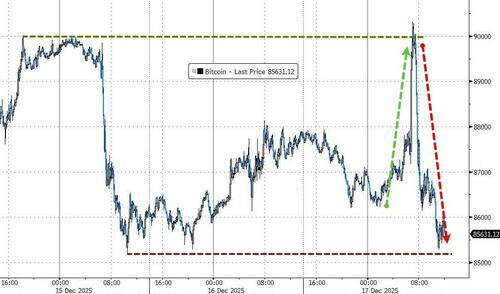
Bitcoin briefly jumped to $90,000 on Wednesday, which traders attributed to the liquidation of a large number of short positions, but it quickly resumed its decline. The original cryptocurrency fell back to the lower end of the trading range seen since the October crash, dropping as much as 2.8% to $85,278.

Vetle Lunde, Senior Analyst at K33, pointed out that the current selling wave is historically rare in scale. Unlike previous cycles, these reactivated Bitcoins were not driven by altcoin trading or protocol incentives, but by the deep liquidity brought by U.S. ETFs and institutional demand, allowing OG holders to realize profits at six-figure prices and significantly reduce ownership concentration. OG is slang used by cryptocurrency enthusiasts to describe early adopters and investors.

He stated that the selling volumes this year and last represent the second and third largest reactivations of long-term holder supply in Bitcoin's history, second only to 2017.

According to data from Coinglass, the open interest in Bitcoin options and perpetual futures remains well below pre-October crash levels. This decline indicates that most traders are still on the sidelines, and such markets account for the majority of cryptocurrency trading volume. Meanwhile, basis trades, a strategy commonly used by hedge funds to profit from the price difference between spot and futures markets, have also become unprofitable.

Despite the heavy selling pressure, Lunde believes the selling by long-term holders may be nearing its end. Based on observations of historical on-chain flows, this reactivation is approaching a threshold.

"Looking ahead, selling pressure from long-term holders appears closer to saturation, with roughly 20% of the Bitcoin supply reactivated over the past two years," Lunde wrote. "The selling by OGs is expected to subside in 2026, as Bitcoin shifts to net buyer demand amid deeper institutional integration, and the two-year+ supply will begin to rise."

However, before that, it must still face the reality test of the supply-demand imbalance. Whether the market can find stable support at current price levels, in the absence of new demand, remains an open question.

Trending Cryptos

Related Questions

QWhat are the main reasons for Bitcoin's continuous price drop according to the article?

AThe main reasons are sustained selling by long-term holders (OGs) and rapidly shrinking market demand, creating a supply-demand imbalance. ETF flows have turned negative, derivatives trading volume has declined significantly, and retail participation has diminished.

QHow significant is the selling by long-term Bitcoin holders currently?

AThe selling is historically significant. Over the past 30 days, it has been one of the most intense periods of long-term holder selling in over five years. Since 2025, nearly $300 billion worth of Bitcoin dormant for over a year has re-entered circulation.

QWhat event on October 10th exacerbated the market's decline?

AOn October 10th, former President Trump's unexpected comments about punitive tariffs triggered $19 billion in liquidations, marking the largest single-day leveraged liquidation event in cryptocurrency history.

QHow does the current sell-off differ from previous cycles, as explained by K33 analyst Vetle Lunde?

AUnlike previous cycles, this sell-off is not driven by altcoin trading or protocol incentives. Instead, it's fueled by the deep liquidity provided by U.S. ETFs and institutional demand, allowing early holders to realize profits at high prices and significantly reduce ownership concentration.

QWhat is the future outlook for Bitcoin's price pressure from long-term holders, according to the analysis?

AAnalyst Vetle Lunde believes the selling pressure from long-term holders is nearing saturation, with about 20% of the supply reactivated over the past two years. He expects OG selling to subside in 2026 as Bitcoin shifts to net buyer demand with deeper institutional integration.

Related Reads

Bessent's True Agenda

U.S. Treasury Secretary Besant's recent interventions in the bond market are seen by some as an attempt to artificially trigger a massive short squeeze before the midterm elections. The alleged goal is to push the 10-year yield toward 5% initially, then use covering by short sellers to drive it down to around 4.3%, providing political breathing room for the Trump administration. Analysts point to near-record short positions held by CTA trend-following funds. According to Goldman Sachs data, a price rally of two standard deviations could trigger historically large short-covering. Besant's tactics reportedly include bond buybacks, shifting issuance toward shorter-term debt, and potentially canceling ultra-long bond auctions to pressure these market positions. So far, interventions like modest buybacks have had limited effect on yields, with the Treasury later hinting at using its General Account (TGA) cash for support. Critics argue these measures cannot address structural pressures like large deficits and high inflation. Instead, the strategy appears tactical—aimed at buying time and exploiting technical market vulnerabilities rather than reversing the underlying yield trend. The political timeline is clear: achieve lower yields ahead of the midterms to help lower mortgage rates and craft a favorable narrative. However, analysts warn that once the election passes, structural upward pressure on yields and equity valuations could reassert themselves more forcefully. Market signals suggest this potential short-squeeze dynamic could intensify in the coming days.

marsbit53m ago

Bessent's True Agenda

marsbit53m ago

Jackson Hole Speech Preview: Is the Fed Seeking Justification for a Rate Hike?

"Jackson Hole Speech Preview: Is the Fed Looking for Reasons to Raise Rates?" Ahead of the key Jackson Hole symposium, Federal Reserve officials and the IMF are signaling heightened concern over persistent inflation, with some advocating for tighter policy. Boston Fed President Susan Collins, in a recent article, supported holding rates steady only if evidence of falling inflation continues. Otherwise, she argues for prompt tightening, noting inflation has been above target for over five years and warning that prolonged deviation could entrench consumer expectations. Although not a voting member this year, her stance aligns with several officials; three FOMC voters dissented in July, favoring a rate hike. Richmond Fed's Tom Barkin warned of a future "reckoning" regarding the $40 trillion public debt, while IMF Managing Director Kristalina Georgieva urged central banks to maintain a laser focus on price stability. The core dilemma lies in the sources of inflation: Trump-era tariffs, Middle East conflict-driven oil prices, and surging AI investment. Collins believes the first two factors are fading, but identifies AI infrastructure spending as exerting "upward pressure" on core goods inflation. The problem is that interest rate hikes primarily curb demand, not these supply-side shocks. Georgieva framed it as a "tug of war" between negative supply shocks from the Middle East and positive demand shocks from AI. Meanwhile, economic data shows strain. The August Consumer Confidence Index fell to a seven-month low of 89.4. While the present situation index improved, future expectations plummeted. Consumers expect higher inflation (5.8% vs. 5.6% last month), likely influenced by high gas prices. Other data points are weak: July retail sales saw the largest drop in over a year, and job growth stalled. Key upcoming events include the July PCE inflation data (expected to remain well above the 2% target) and new Fed Chair Kevin Warsh's first major speech at Jackson Hole. Market pricing remains conflicted, showing a high probability of a December hike but expecting no move in September. Gold prices, however, have surged over 7% to near three-month highs, signaling market anxiety.

marsbit1h ago

Jackson Hole Speech Preview: Is the Fed Seeking Justification for a Rate Hike?

marsbit1h ago

Today, HYPE Activates Its Second Buyback Engine

"Hyperliquid Activates Second Buyback Engine with AQAv2 Launch" On August 26th, Hyperliquid officially activated its Aligned Quote Assets v2 (AQAv2) mechanism, introducing a major new source of revenue and buyback power for its native token, HYPE. Unlike the existing revenue stream from trading fees, AQAv2 generates income by sharing approximately 90% of the adjusted reserve earnings from stablecoins (primarily USDC) circulating on the Hyperliquid chain. This income is settled every 30 days and automatically funneled into the Assistance Fund for HYPE buybacks, with the first expected distribution on October 3rd. Through a partnership with Circle (issuer of USDC) and Coinbase (treasury manager), Hyperliquid leverages its user base and financial infrastructure to share in the yield generated by stablecoin reserves. This transforms its liquidity and distribution capabilities into a scalable business model. Initial estimates project AQAv2 could generate $150-200 million in annual buyback funds, based on the current ~$6.43 billion USDC supply on Hyperliquid and an assumed reserve yield. Crucially, this revenue is weakly correlated with trading activity and grows directly with the platform's stablecoin adoption. With HYPE recently reaching an all-time high, AQAv2 provides a new fundamental support layer. It shifts Hyperliquid's value capture beyond just transaction fees, anchoring HYPE's long-term buyback potential to the expanding scale of its stablecoin ecosystem.

marsbit1h ago

Today, HYPE Activates Its Second Buyback Engine

marsbit1h ago

Trading

Spot

Hot Articles

What is $BITCOIN

DIGITAL GOLD ($BITCOIN): A Comprehensive Analysis Introduction to DIGITAL GOLD ($BITCOIN) DIGITAL GOLD ($BITCOIN) is a blockchain-based project operating on the Solana network, which aims to combine the characteristics of traditional precious metals with the innovation of decentralized technologies. While it shares a name with Bitcoin, often referred to as “digital gold” due to its perception as a store of value, DIGITAL GOLD is a separate token designed to create a unique ecosystem within the Web3 landscape. Its goal is to position itself as a viable alternative digital asset, although specifics regarding its applications and functionalities are still developing. What is DIGITAL GOLD ($BITCOIN)? DIGITAL GOLD ($BITCOIN) is a cryptocurrency token explicitly designed for use on the Solana blockchain. In contrast to Bitcoin, which provides a widely recognized value storage role, this token appears to focus on broader applications and characteristics. Notable aspects include: Blockchain Infrastructure: The token is built on the Solana blockchain, known for its capacity to handle high-speed and low-cost transactions. Supply Dynamics: DIGITAL GOLD has a maximum supply capped at 100 quadrillion tokens (100P $BITCOIN), although details regarding its circulating supply are currently undisclosed. Utility: While precise functionalities are not explicitly outlined, there are indications that the token could be utilized for various applications, potentially involving decentralized applications (dApps) or asset tokenization strategies. Who is the Creator of DIGITAL GOLD ($BITCOIN)? At present, the identity of the creators and development team behind DIGITAL GOLD ($BITCOIN) remains unknown. This situation is typical among many innovative projects within the blockchain space, particularly those aligning with decentralized finance and meme coin phenomena. While such anonymity may foster a community-driven culture, it intensifies concerns about governance and accountability. Who are the Investors of DIGITAL GOLD ($BITCOIN)? The available information indicates that DIGITAL GOLD ($BITCOIN) does not have any known institutional backers or prominent venture capital investments. The project seems to operate on a peer-to-peer model focused on community support and adoption rather than traditional funding routes. Its activity and liquidity are primarily situated on decentralized exchanges (DEXs), such as PumpSwap, rather than established centralized trading platforms, further highlighting its grassroots approach. How DIGITAL GOLD ($BITCOIN) Works The operational mechanics of DIGITAL GOLD ($BITCOIN) can be elaborated on based on its blockchain design and network attributes: Consensus Mechanism: By leveraging Solana’s unique proof-of-history (PoH) combined with a proof-of-stake (PoS) model, the project ensures efficient transaction validation contributing to the network's high performance. Tokenomics: While specific deflationary mechanisms have not been extensively detailed, the vast maximum token supply implies that it may cater to microtransactions or niche use cases that are still to be defined. Interoperability: There exists the potential for integration with Solana’s broader ecosystem, including various decentralized finance (DeFi) platforms. However, the details regarding specific integrations remain unspecified. Timeline of Key Events Here is a timeline that highlights significant milestones concerning DIGITAL GOLD ($BITCOIN): 2023: The initial deployment of the token occurs on the Solana blockchain, marked by its contract address. 2024: DIGITAL GOLD gains visibility as it becomes available for trading on decentralized exchanges like PumpSwap, allowing users to trade it against SOL. 2025: The project witnesses sporadic trading activity and potential interest in community-led engagements, although no noteworthy partnerships or technical advancements have been documented as of yet. Critical Analysis Strengths Scalability: The underlying Solana infrastructure supports high transaction volumes, which could enhance the utility of $BITCOIN in various transaction scenarios. Accessibility: The potential low trading price per token could attract retail investors, facilitating wider participation due to fractional ownership opportunities. Risks Lack of Transparency: The absence of publicly known backers, developers, or an audit process may yield skepticism regarding the project's sustainability and trustworthiness. Market Volatility: The trading activity is heavily reliant on speculative behavior, which can result in significant price volatility and uncertainty for investors. Conclusion DIGITAL GOLD ($BITCOIN) emerges as an intriguing yet ambiguous project within the rapidly evolving Solana ecosystem. While it attempts to leverage the “digital gold” narrative, its departure from Bitcoin's established role as a store of value underscores the need for a clearer differentiation of its intended utility and governance structure. Future acceptance and adoption will likely depend on addressing the current opacity and defining its operational and economic strategies more explicitly. Note: This report encompasses synthesised information available as of October 2023, and developments may have transpired beyond the research period.

2.1k Total ViewsPublished 2025.05.13Updated 2025.05.13

What is $BITCOIN

Discussions

Welcome to the HTX Community. Here, you can stay informed about the latest platform developments and gain access to professional market insights. Users' opinions on the price of BTC (BTC) are presented below.

活动图片