New York Lawsuit Takes Aim At 3.79 Million Dormant Bitcoin

bitcoinistPublished on 2026-05-25Last updated on 2026-05-25

Abstract

A lawsuit filed in New York by "Noah Doe" and two Wyoming LLCs seeks a court declaration that approximately 39,069 long-dormant Bitcoin wallets, allegedly holding about 3.79 million BTC, are legally abandoned property. The plaintiffs claim to have identified the wallets, reported them to the NYPD, and conducted a notification campaign via blockchain messages and a webpage. They argue this satisfies New York's lost-property laws, transferring ownership rights to them. The claim includes addresses linked to Satoshi Nakamoto and early miners, though the complaint itself does not specify these attributions or the total BTC amount. The case centers on the novel legal argument that inactive self-custodied crypto addresses constitute recoverable abandoned property, despite the practical impossibility of accessing the funds without private keys. The campaign was connected to Salomon Brothers Strategic Advisors, a firm separate from the historic Wall Street entity.

A New York lawsuit is seeking a court declaration over tens of thousands of long-dormant Bitcoin addresses that one outside analysis says collectively hold about 3.79 million BTC. The case, brought by “Noah Doe” and two Wyoming LLCs, attempts to frame inactive self-custodied crypto addresses as abandoned property under New York lost-and-found law.

The filing, submitted in the Supreme Court of the State of New York, County of New York, names ABC Company, XYZ Company and Noah Doe as plaintiffs, with “John Does 1–39,069” listed as respondents. It is not a court order awarding ownership. It is a summons and amended complaint seeking declaratory relief, meaning the plaintiffs are asking the court to recognize their claimed rights to the wallets and their contents.

According to the complaint, Doe allegedly identified three sets of dormant digital wallets between December 2024 and April 2025. The first group included 1,625 wallets, or 1,544 after duplicates were excluded. The second included 546 wallets. The third and largest group included 39,911 wallets. After exclusions and alleged owner responses, the plaintiffs say the case concerns 39,069 remaining wallets they describe as abandoned.

3.79 Million Bitcoin Caught In Bizarre NY Legal Fight

The complaint says Doe reported the wallet lists to the New York City Police Department on three separate occasions using USB drives. The NYPD later returned the drives, according to the filing. The plaintiffs argue that these steps satisfied New York lost-property procedures and that title vested in Doe under New York Personal Property Law § 257 before later assignments moved most of the claimed rights into ABC Company and XYZ Company.

The size of the claim is what has drawn attention across Bitcoin circles. Sani, the operator of TimechainIndex.com, said on X that the addresses listed in the case hold 3,791,121.17697938 BTC and include addresses attributed to Satoshi Nakamoto, early miners, Casascius Coins, lost coins, hackers and unidentified entities. That aggregate BTC figure and those attributions do not appear in the complaint’s body. The filing itself lists addresses and lays out the legal theory, but it does not state “Satoshi Nakamoto,” “Casascius,” or the 3.79 million BTC total.

The legal argument is unusual because it treats dormant Bitcoin addresses as recoverable property, even though the complaint acknowledges that cryptocurrency cannot be withdrawn without the relevant private key. The filing compares wallets to bank accounts, arguing that a digital wallet can be uniquely identified by blockchain protocol, address and transaction history. But that analogy is likely to draw scrutiny from Bitcoin-native observers because ownership of a bank account and control over a self-custodied Bitcoin UTXO operate very differently in practice.

The background to the lawsuit appears to trace back to a broad on-chain notice campaign tied to Salomon Brothers Strategic Advisors. The complaint says Doe retained Salomon Brothers in February 2025 as a strategic consultant to help develop a plan for notifying potential wallet owners and identifying wallets incorrectly included in the allegedly abandoned group. It later says a cyber/blockchain expert sent messages to wallet holders using OP_RETURN, while Salomon Brothers hosted a notice webpage.

Salomon Brothers publicly framed the campaign as an effort to address risks around abandoned wallets. In an August 2025 press release, the firm said abandoned wallets could become vulnerable to better-resourced attackers and argued that “securing wallets protects” other wallet holders. The release said notices had been inserted into long-dormant wallets and gave owners at least 90 days to respond, either by conducting an on-chain transaction with the private key or by using a form on a Salomon Brothers webpage.

That Salomon Brothers connection requires careful context. Galaxy Research described the entity involved as not the historic Wall Street firm that became part of Citigroup, but a newer organization that acquired the Salomon name. Salomon Brothers’ current website describes the firm as an “alliance of professional practices” providing services including financial advisory, real estate finance and research.

Galaxy’s analysis of the related OP_RETURN campaign described it as the “Great Bitcoin Dusting.” According to Galaxy, an unknown actor sent 41,523 OP_RETURN messages from 3,738 sender addresses to 39,423 recipient addresses, which together held 2,334,482.52 BTC when the messages were transmitted. Galaxy said the campaign had two phases: initial trial messages without Salomon links, followed by waves of messages that included links to Salomon’s website.

Galaxy also found that 98.82% of the notified addresses were legacy P2PKH addresses and that the average adjusted dormancy was about 2,171 days, or roughly 5.95 years. That detail matters because Sani separately argued that, for many old coin holders, including wallets attributed to Satoshi Nakamoto, notices were sent to P2PKH versions of addresses with no or only dust balances, while the real balances sit in older P2PK outputs. If accurate, that distinction could become central to the crypto community’s assessment of whether meaningful notice was ever delivered to the relevant holders.

The case now sits at the intersection of legal doctrine and protocol reality. The plaintiffs are asking a New York court to treat inactivity as abandonment and to recognize claimed ownership over wallets that have not moved for years. Bitcoin users, meanwhile, are likely to focus on a narrower but more fundamental issue: an address can be dormant because its owner is gone, because keys are lost, or because the holder has no intention of moving coins. On-chain, those cases can look identical.

At press time, BTC traded at $77,441.
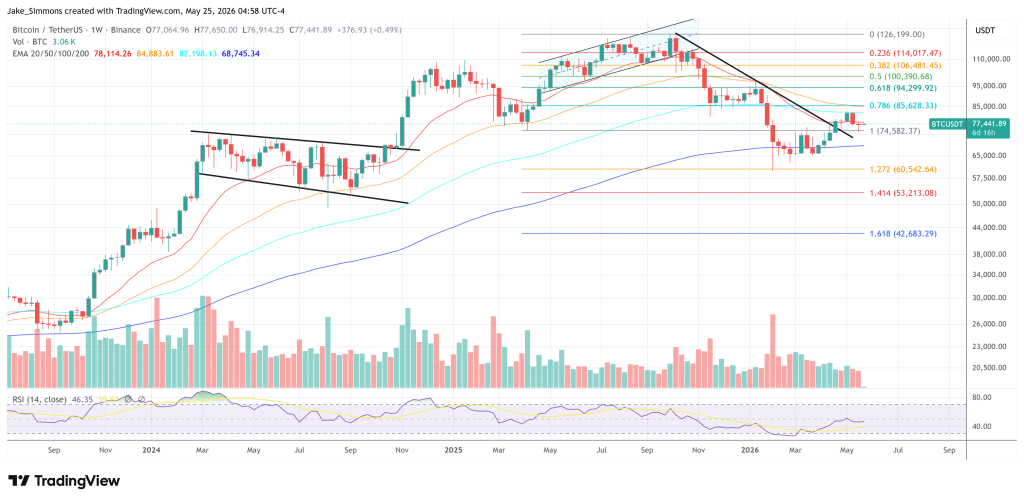
Bitcoin hovers below the 20-week EMA, 1-week chart | Source: BTCUSDT on TradingView.com

Trending Cryptos

Related Questions

QWhat is the core legal claim in the 'Noah Doe' New York lawsuit regarding dormant Bitcoin addresses?

AThe lawsuit argues that tens of thousands of long-dormant, self-custodied Bitcoin addresses constitute 'abandoned property' under New York lost-and-found law. The plaintiffs seek a court declaration recognizing their claimed ownership rights to these wallets after allegedly following state procedures for reporting found property.

QApproximately how much Bitcoin is implicated in the lawsuit according to an outside analysis, and what notable addresses are mentioned?

AAccording to an analysis by Sani of TimechainIndex.com, the addresses listed in the complaint collectively hold approximately 3.79 million BTC. The analysis states these include addresses attributed to Satoshi Nakamoto, early miners, Casascius Coins, lost coins, hackers, and other unidentified entities.

QWhat entity was involved in the notification campaign to the dormant wallet owners, and what method was used?

AThe plaintiffs retained Salomon Brothers Strategic Advisors to help develop a notification plan. A cyber/blockchain expert sent messages to wallet holders using OP_RETURN transactions on the Bitcoin blockchain, and Salomon Brothers hosted a webpage for owners to respond.

QWhat key distinction did the analysis from Galaxy Research make about the notification campaign's effectiveness?

AGalaxy Research noted that 98.82% of the notified addresses were legacy P2PKH addresses. Sani further argued that for many old coin holders (including those attributed to Satoshi), notices were sent to P2PKH versions of addresses with little to no balance, while the real balances resided in older, non-standard P2PK outputs, questioning whether meaningful notice was delivered.

QWhat is a fundamental practical challenge to the lawsuit's claim of ownership over these dormant wallets?

AA fundamental challenge is that ownership/control of a self-custodied Bitcoin wallet is cryptographically secured by a private key. The complaint acknowledges the coins cannot be withdrawn without the key. Therefore, a court order granting ownership does not inherently grant the ability to spend the coins, unlike with a traditional bank account.

Related Reads

Bitcoin Boom in Full Swing: Saylor's Latest Statement Fuels Buying Speculation

MicroStrategy's Executive Chairman Michael Saylor has fueled speculation about a new Bitcoin purchase by posting "Bitcoin Drive engaged" on August 2, accompanied by the company's customary purchase tracker. This aligns with his pattern of hinting at treasury changes ahead of weekly reports. The accompanying report showed MicroStrategy's Bitcoin holdings at 843,775 BTC, with an average cost of $75,653 per coin and an unrealized loss of -$10.58B. A similar signal preceded the company's July 27 announcement, strengthening expectations for a treasury update on Monday. However, MicroStrategy's real-time ledger reflects two recent Bitcoin sales totaling 3,588 BTC, reducing holdings from 847,363 BTC to the current 843,775 BTC. The company stated these sales funded preferred stock dividends and replenished its U.S. dollar reserve. Recent reports indicate the company made no Bitcoin purchases the week ending July 26 while increasing its dollar reserve to approximately $3.75B. The company faces financial headwinds after reporting an $8.33B operating loss for Q2 2026, including an $8.32B unrealized loss on its digital assets. Management may sell up to $1.25B more in Bitcoin to meet cash obligations. The expected Monday update will reveal if the "Bitcoin Drive" signal marks a return to accumulation as MicroStrategy balances its massive Bitcoin stash against growing cash commitments.

cryptonews.ru2h ago

Bitcoin Boom in Full Swing: Saylor's Latest Statement Fuels Buying Speculation

cryptonews.ru2h ago

Trading

Spot

Hot Articles

What is $BITCOIN

DIGITAL GOLD ($BITCOIN): A Comprehensive Analysis Introduction to DIGITAL GOLD ($BITCOIN) DIGITAL GOLD ($BITCOIN) is a blockchain-based project operating on the Solana network, which aims to combine the characteristics of traditional precious metals with the innovation of decentralized technologies. While it shares a name with Bitcoin, often referred to as “digital gold” due to its perception as a store of value, DIGITAL GOLD is a separate token designed to create a unique ecosystem within the Web3 landscape. Its goal is to position itself as a viable alternative digital asset, although specifics regarding its applications and functionalities are still developing. What is DIGITAL GOLD ($BITCOIN)? DIGITAL GOLD ($BITCOIN) is a cryptocurrency token explicitly designed for use on the Solana blockchain. In contrast to Bitcoin, which provides a widely recognized value storage role, this token appears to focus on broader applications and characteristics. Notable aspects include: Blockchain Infrastructure: The token is built on the Solana blockchain, known for its capacity to handle high-speed and low-cost transactions. Supply Dynamics: DIGITAL GOLD has a maximum supply capped at 100 quadrillion tokens (100P $BITCOIN), although details regarding its circulating supply are currently undisclosed. Utility: While precise functionalities are not explicitly outlined, there are indications that the token could be utilized for various applications, potentially involving decentralized applications (dApps) or asset tokenization strategies. Who is the Creator of DIGITAL GOLD ($BITCOIN)? At present, the identity of the creators and development team behind DIGITAL GOLD ($BITCOIN) remains unknown. This situation is typical among many innovative projects within the blockchain space, particularly those aligning with decentralized finance and meme coin phenomena. While such anonymity may foster a community-driven culture, it intensifies concerns about governance and accountability. Who are the Investors of DIGITAL GOLD ($BITCOIN)? The available information indicates that DIGITAL GOLD ($BITCOIN) does not have any known institutional backers or prominent venture capital investments. The project seems to operate on a peer-to-peer model focused on community support and adoption rather than traditional funding routes. Its activity and liquidity are primarily situated on decentralized exchanges (DEXs), such as PumpSwap, rather than established centralized trading platforms, further highlighting its grassroots approach. How DIGITAL GOLD ($BITCOIN) Works The operational mechanics of DIGITAL GOLD ($BITCOIN) can be elaborated on based on its blockchain design and network attributes: Consensus Mechanism: By leveraging Solana’s unique proof-of-history (PoH) combined with a proof-of-stake (PoS) model, the project ensures efficient transaction validation contributing to the network's high performance. Tokenomics: While specific deflationary mechanisms have not been extensively detailed, the vast maximum token supply implies that it may cater to microtransactions or niche use cases that are still to be defined. Interoperability: There exists the potential for integration with Solana’s broader ecosystem, including various decentralized finance (DeFi) platforms. However, the details regarding specific integrations remain unspecified. Timeline of Key Events Here is a timeline that highlights significant milestones concerning DIGITAL GOLD ($BITCOIN): 2023: The initial deployment of the token occurs on the Solana blockchain, marked by its contract address. 2024: DIGITAL GOLD gains visibility as it becomes available for trading on decentralized exchanges like PumpSwap, allowing users to trade it against SOL. 2025: The project witnesses sporadic trading activity and potential interest in community-led engagements, although no noteworthy partnerships or technical advancements have been documented as of yet. Critical Analysis Strengths Scalability: The underlying Solana infrastructure supports high transaction volumes, which could enhance the utility of $BITCOIN in various transaction scenarios. Accessibility: The potential low trading price per token could attract retail investors, facilitating wider participation due to fractional ownership opportunities. Risks Lack of Transparency: The absence of publicly known backers, developers, or an audit process may yield skepticism regarding the project's sustainability and trustworthiness. Market Volatility: The trading activity is heavily reliant on speculative behavior, which can result in significant price volatility and uncertainty for investors. Conclusion DIGITAL GOLD ($BITCOIN) emerges as an intriguing yet ambiguous project within the rapidly evolving Solana ecosystem. While it attempts to leverage the “digital gold” narrative, its departure from Bitcoin's established role as a store of value underscores the need for a clearer differentiation of its intended utility and governance structure. Future acceptance and adoption will likely depend on addressing the current opacity and defining its operational and economic strategies more explicitly. Note: This report encompasses synthesised information available as of October 2023, and developments may have transpired beyond the research period.

1.4k Total ViewsPublished 2025.05.13Updated 2025.05.13

What is $BITCOIN

Discussions

Welcome to the HTX Community. Here, you can stay informed about the latest platform developments and gain access to professional market insights. Users' opinions on the price of BTC (BTC) are presented below.

活动图片















