New Ledger Scan Shows How Much XRP Is Quantum-Exposed

bitcoinistPublished on 2026-05-01Last updated on 2026-05-01

A full-history scan of the XRP Ledger has put fresh numbers on one of crypto’s more uncomfortable long-term security questions: how exposed current accounts may be to a future quantum-computing threat. The analysis, shared by dUNL validator Vet on X, examined all 7,810,364 XRP Ledger accounts and found that 76.82 billion tokens is currently held in accounts whose public keys have already been exposed through signed transactions.

The thread does not argue that quantum-capable attackers are an immediate operational risk. Instead, it frames the issue as a future migration and governance problem. Once quantum-resistant cryptography is implemented, active users can move funds to new quantum-safe accounts. The harder question is what happens to accounts that cannot move.

“What’s the problem with the Quantum threat that is so difficult to agree on how to solve?” Vet wrote. “We’ll need Quantum proof encryption eventually. That is most likely outcome. This means, once we implement such encryption, everyone can transfer their funds to a Quantum threat proof XRP account.”

The difficulty, he argued, starts where user agency ends. Dormant accounts may belong to people who lost keys, forgot about holdings, died, or are temporarily unable to act. In a future where quantum computers can exploit exposed public keys, those funds could become vulnerable while the owner remains silent.

“Here is already the Problem though,” Vet wrote. “People who can’t move their funds to a Quantum threat proof XRP account are at risk to have their funds stolen in a future with capable enough Quantum computers.”

Why Exposed Public XRP Keys Matter

Vet’s analysis rests on a key distinction: an account is considered “quantum exposed” only if it has submitted a signed transaction that revealed its public key on-ledger. Accounts that have never signed a transaction have not exposed that public key and are therefore treated as quantum safe under the framework used in the scan.

That distinction creates a split across the ledger. According to Vet, 5.6 million accounts holding 76.82 billion tokens are quantum exposed when dormancy is not considered. However, he said 96% of that exposed XRP is held by active accounts, meaning those users would be expected to migrate once a quantum-resistant account model becomes available.

The more contentious slice is dormant supply. Accounts that are both quantum exposed and dormant for at least five years hold 3.83% of all quantum-exposed XRP supply. Against total XRP supply, that represents 2.94%. The oldest dormant category, accounts dating back to the ledger’s 2013 genesis year, represents 0.03% of exposed XRP supply and 0.024% of total supply.

The account count follows the same pattern. Vet identified 1.33 million accounts in the five-year dormant and exposed bucket, while the 2013 dormant group contains roughly 15,000 accounts.

A Smaller Dormant Risk Than Bitcoin?

Vet positioned the XRP Ledger’s dormant exposure as materially smaller than Bitcoin’s most discussed quantum-risk edge case: early unmoved BTC, including coins attributed to Satoshi Nakamoto.

“Massively lower than Bitcoin, where genesis accounts alone aka Satoshi BTC are about 5% of supply,” he wrote. “That’s supply that is expected to not move to quantum safe addresses. This is not even including BTC sitting in P2PK accounts outside of Satoshi holdings.”

The comparison is important because the quantum debate in crypto is not only technical. It is social. If a network introduces quantum-resistant account types, active users can rotate. Dormant users cannot. That raises a difficult governance question: should untouched funds remain exposed, should protocol rules somehow protect them, or should the network accept the risk that future attackers may drain accounts whose owners never migrated?

Related Reading: XRP Sentiment Tanks To A 2-Year Low—But History Hints At Major Bullish Comeback

Vet described the dormant-account issue as a “litmus test for blockchains social layer,” noting that the XRP Ledger community faces the same type of question Bitcoiners have debated around early wallets.

Multi-Sig Is Not Automatically Safe

The scan also found that around 27% of XRPL accounts are already quantum safe, collectively holding approximately 23.16 billion XRP. Vet said these accounts either never signed a transaction, meaning their public key never appeared on the ledger, or they disabled their master key and now sign through a fresh RegularKey or SignerList that has not been exposed.

But the analysis also cautions against assuming that more sophisticated wallet setups are protected by default. Vet said 242 multi-signature wallets hold 36.60 billion XRP, equal to 36.6% of total supply, in a state where a quorum of signer public keys is already visible on-ledger. The largest examples, he said, include Ripple’s escrow distribution wallets.

“So even sophisticated multi-sig setups aren’t automatically safe — they require disciplined signer-key rotation,” Vet wrote.

The key nuance is operational. A single-key account can remain safe until it needs to spend, but spending reveals the relevant public key. Multi-signature setups can preserve safety if the quorum threshold is not yet exposed. Vet gave the example of a 4-of-8 SignerList with the master key disabled and only three signers’ keys visible on-ledger: the account can remain quantum safe because the exposed keys are still below the signing threshold.

At press time, XRP traded at $1.3758.
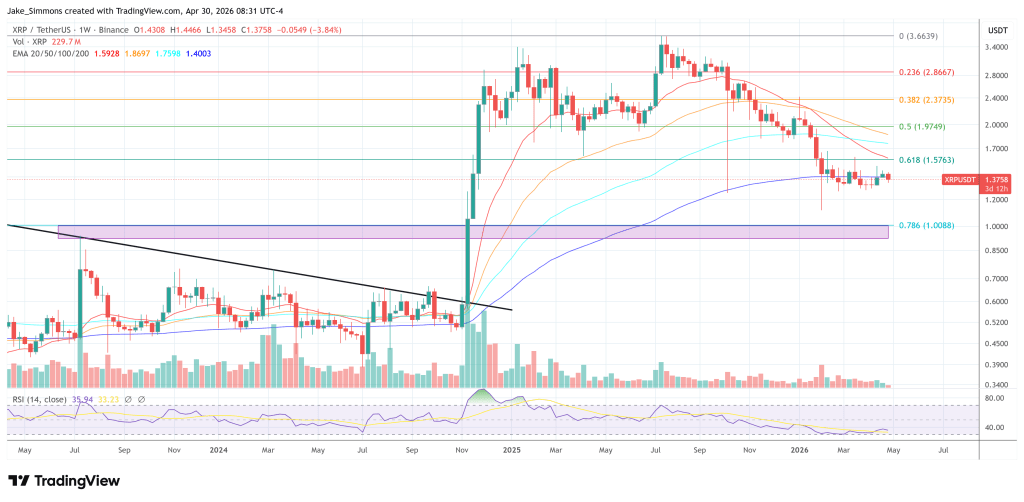
XRP trades below the 200-week EMA again, 1-week chart | Source: XRPUSDT on TradingView.com

Trending Cryptos

Related Reads

Elon Musk Building Terafab: The Largest Chip Factory for AI, Robots, and Space Data Centers

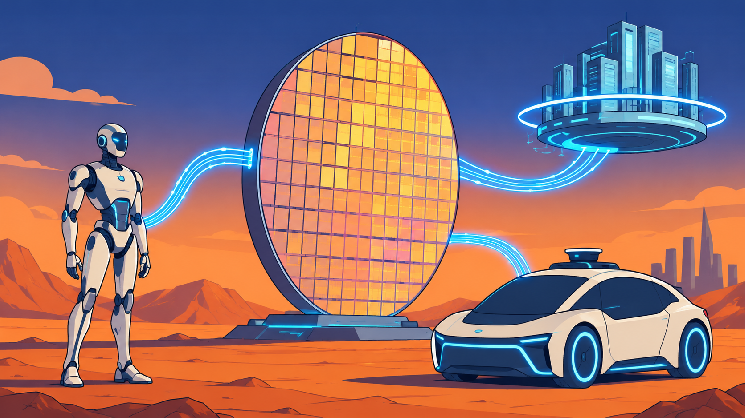
Elon Musk's SpaceX and Tesla have launched the Terafab project to build a massive semiconductor facility in Grimes County, Texas. The plant, exceeding 9.3 million square meters, aims to integrate logic chip manufacturing, memory production, advanced packaging, and testing. The initial phase requires $16.8 billion in capital investment, with a long-term goal of producing over 1 terawatt of computing power annually. This capacity will support Tesla's Optimus robots and Cybercab autonomous vehicles, as well as SpaceX's orbital data centers. Texas Governor Greg Abbott confirmed the project's start in August 2026, highlighting 3,000 new jobs and a $30 million state grant. Elon Musk emphasized the strategic advantage of combining logic, memory, and packaging under one roof. Musk called the future complex the "largest and most valuable building on Earth," with an area roughly 50 times that of the Pentagon. Intel is the key technology partner, with plans to use its 14A process node for chip production. This partnership aims to diversify supply chains currently dominated by TSMC. The project aligns with the U.S. Pax Silica initiative to secure semiconductor supply chains. An AI analysis notes the project's scale and potential challenges, comparing it to delays seen in other U.S. megafab projects like Intel's Ohio facility. It questions whether Terafab can avoid similar pitfalls related to timelines, budgets, workforce, and supply chain stability. The facility's success could significantly shift the global semiconductor balance and strengthen the U.S. position in the tech race.

cryptonews.ru2h ago

Elon Musk Building Terafab: The Largest Chip Factory for AI, Robots, and Space Data Centers

cryptonews.ru2h ago

Trading

Spot

Hot Articles

What is XRP 2.0

XRP 2.0: A New Frontier in the Cryptocurrency Landscape Introduction to XRP 2.0 In the ever-evolving realm of cryptocurrency, new projects continuously emerge, vying for attention and adoption. One such promising initiative is XRP 2.0, a novel cryptocurrency project designed to leverage advanced blockchain technology and robust encryption methodologies. While the name draws parallels with Ripple’s XRP, it’s crucial to note that XRP 2.0 operates independently, focusing on enhancing transaction security, privacy, and scalability. As the digital financial landscape increasingly embraces decentralized solutions, XRP 2.0 aims to contribute meaningfully to web3 and the overall expansion of crypto projects. What is XRP 2.0? At its core, XRP 2.0 is a cryptocurrency project that aims to create a secure and decentralized digital currency ecosystem. Its foundational technology integrates sophisticated blockchain principles with cutting-edge encryption techniques. The overarching goal of XRP 2.0 is to establish itself as a reliable and efficient platform enabling swift transaction execution while prioritizing enhanced privacy protections for its users. The project is promoted as a solution to many limitations faced by existing cryptocurrencies, proposing a system that can handle a higher volume of transactions with improved speed and privacy. This versatility positions XRP 2.0 as a significant contender in a marketplace riddled with various digital currencies. Who is the Creator of XRP 2.0? The identity of the creator behind XRP 2.0 has been flagged as ‘Wilbur.’ However, comprehensive details regarding Wilbur or their associated entity remain elusive. The anonymity of many cryptocurrency creators is not an uncommon phenomenon in the industry, often designed to maintain a degree of privacy and security. Who are the Investors of XRP 2.0? As of now, specific information related to the investment foundations or organizations supporting XRP 2.0 is not publicly available. In the cryptocurrency sector, the backing by reputed investors can significantly influence a project's credibility and success, yet the transparency regarding the financial supporters of XRP 2.0 has not been established. How Does XRP 2.0 Work? XRP 2.0 stands out by employing a combination of blockchain technology and advanced encryption algorithms that ensures secure and decentralized transactions. Its innovative structure includes unique features designed to foster user engagement and broaden functionalities beyond conventional cryptocurrency transactions. Among these features, XRP 2.0 incorporates AI-powered capabilities, such as text-to-image and text-to-speech functionalities. These additions are designed to enhance the interactive experience for users, promoting broader applicability across various sectors. By bridging technological advancements with user-centered design, XRP 2.0 aims to capture the attention of a diverse range of individuals and enterprises looking to integrate cryptocurrency solutions into their operational frameworks. Timeline of XRP 2.0 Understanding XRP 2.0 requires examining the milestones that have defined its journey thus far: July 23, 2023: XRP 2.0 is introduced as a novel cryptocurrency project, aiming to revolutionize secure and decentralized transaction capabilities in the blockchain domain. September 8, 2023: The launching of another project, XRP20, occurs, marking the emergence of an ERC-20 token on the Ethereum blockchain that remains unrelated to XRP 2.0. November 13, 2023: The XRP Ledger undergoes a significant update with the release of rippled server software version 2.0.0. It is essential to note that this development is disconnected from the XRP 2.0 cryptocurrency project. Key Points About XRP 2.0 To distill the essence of XRP 2.0, several critical factors emerge: Unique Features: The inclusion of features like AI-powered text-to-image and text-to-speech further diversifies the potential applications of XRP 2.0. Blockchain Technology: The framework utilizes advanced blockchain mechanisms and encryption protocols, ensuring a secure and decentralized environment for transactions. Scalability and Privacy: XRP 2.0 prioritizes enhanced privacy protections in transaction processes and the scalability necessary to accommodate a growing user base. No Affiliation with Ripple: Importantly, despite its name, XRP 2.0 does not have any allegiance or collaboration with Ripple’s XRP, distinguishing its operational framework and objectives within the cryptocurrency ecosystem. Conclusion XRP 2.0 represents an ambitious venture into the cryptocurrency sphere, aiming to offer a combination of security, privacy, and efficiency in digital transactions. By integrating sophisticated technologies and user-friendly features, the project sets out to broaden the horizons of what cryptocurrency can achieve in today's digital economy. While the anonymity of its creator and lack of disclosed investors might raise questions for some, XRP 2.0's focus on advanced functionalities and decentralisation enhances its appeal amidst an increasingly crowded crypto market. As the cryptocurrency landscape continues to evolve, XRP 2.0 may yet emerge as a pivotal player in the expansion of secure and scalable blockchain solutions.

1.5k Total ViewsPublished 2024.04.01Updated 2024.12.03

What is XRP 2.0

Discussions

Welcome to the HTX Community. Here, you can stay informed about the latest platform developments and gain access to professional market insights. Users' opinions on the price of XRP (XRP) are presented below.

活动图片