"Mysterious Whale" Dumps $486 Million Worth of Bitcoin in Three Weeks

cryptonews.ruPublished on 2026-08-10Last updated on 2026-08-10

Abstract

In three weeks, a mysterious "Bitcoin whale" has sold 7,513 BTC, worth approximately $486.9 million, with a single transaction of 1,019 BTC ($66.4 million) noted just hours before a warning. Despite these significant sales, the Bitcoin price remained relatively stable, suggesting the volume was absorbed by over-the-counter buyers or exchange order books without causing a sharp decline. This activity coincides with other large holders reducing positions, including MicroStrategy, which sold 1,638 BTC (~$104.7 million) between July 27 and August 2. MicroStrategy's monetization program, approved for up to $5 billion in sales by 2026, involves selling at a paper loss relative to its average acquisition cost of $75,419 per coin, framed as routine treasury management. The market impact appears muted so far, with Bitcoin trading in a narrow range and no cascading liquidations triggered. This resilience may stem from deeper liquidity from spot ETF inflows and institutional buyers absorbing supply. The changing ownership structure, where whale behavior is gaining significance and long-term holder supply is at a record high, makes such large movements noteworthy, though current sales seem to involve newer, more price-sensitive coins rather than deeply dormant holdings.

The blockchain analytics company Lookonchain recorded a new transfer from a "Bitcoin whale" that has been quietly selling off coins for several weeks. The wallet transferred another 1,019 $BTC, worth approximately $66.4 million at the time, just seven hours before the warning appeared. This single transaction increased the wallet's total sales over three weeks to 7,513 $BTC, or roughly $486.9 million.
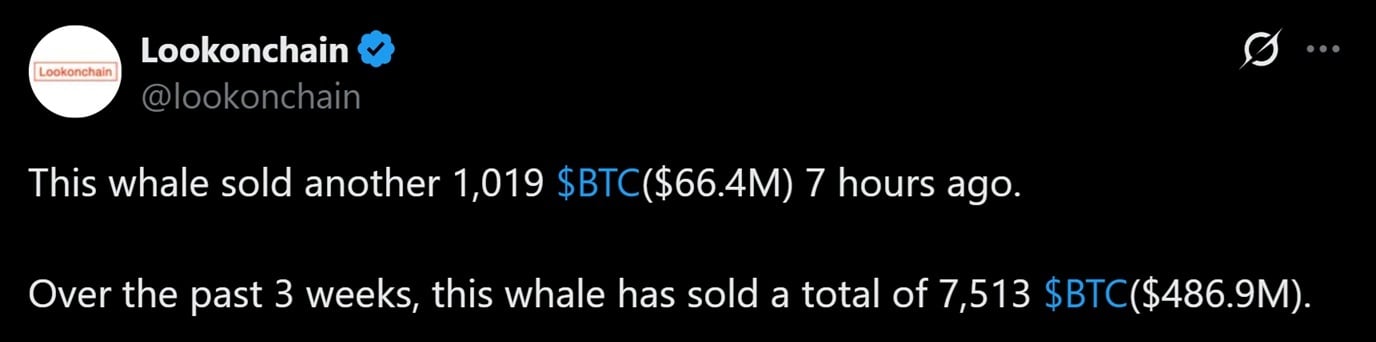
Image source: X

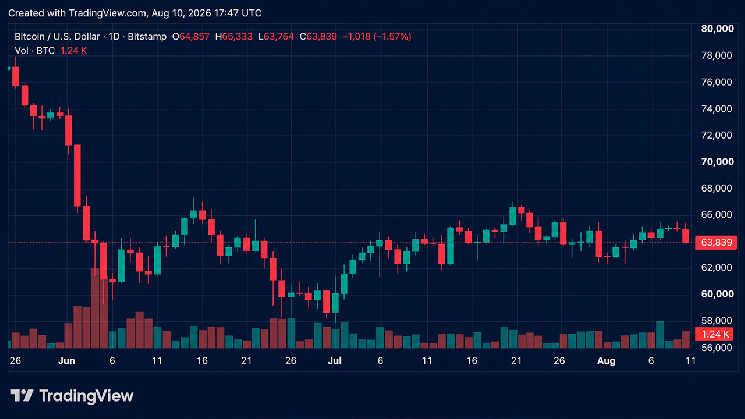
Bitcoin's price remained relatively stable amid the sales, suggesting that over-the-counter buyers or exchange order books were able to absorb this volume without a sharp price drop.

This unidentified wallet is not the only large Bitcoin holder reducing its positions this month: Strategy, the company managing Bitcoin reserves under the leadership of Michael Saylor, is also executing its own Bitcoin monetization program. Approved in June, it allows the company to sell Bitcoins to fund preferred stock dividends and other obligations.

The latest confirmed Strategy sale of 1,638 $BTC for approximately $104.7 million was executed at an average price of $63,957 between July 27 and August 2. In any case, all the aforementioned sales fit into the same overall picture captured by Bitcoin.com News when Saylor's cryptic "Doing Business" post reignited speculation about the company's Bitcoin balance.

The company's monetization program, limited to authorized Bitcoin sales of up to $5 billion, still leaves significant room for further sales until the end of 2026, and Strategy's average acquisition cost of $75,419 per coin means each sale below that level locks in a paper loss, even as the company positions these actions as routine treasury management rather than a shift in its convictions.

What This Sale Means for the Market Overall

Timing matters, as Bitcoin's ownership structure is changing in a way that makes whale behavior more significant than usual. For example, this year has seen a sharp divergence between whales and mid-tier holders: large wallets are accumulating coins even as small holders capitulate, so any shift in whale positioning is worth closely tracking.

At the same time, the supply volume held by long-term holders (i.e., coins that haven't moved for years) recently reached a new all-time high, meaning the coins moving now are likely newer, more price-sensitive assets, rather than deeply dormant ones.

So far, the broader market has shrugged off the latest wave of selling, as Bitcoin traded in a relatively narrow range until early August, and neither the disclosed Strategy sales nor the three-week sell-off by the anonymous "whale" triggered the cascade of liquidations that similarly sized moves have caused in past cycles.

This resilience may reflect deeper liquidity due to inflows into spot market ETFs and the entry of institutional buyers absorbing supply, or it may simply mean the market has not yet priced in the full scale of the volume being sold.


Trending Cryptos

Related Questions

QHow much Bitcoin (in both quantity and USD value) did the 'mysterious whale' reportedly sell over three weeks according to the article?

AThe 'mysterious whale' wallet sold 7,513 BTC, worth approximately $486.9 million, over a three-week period.

QWhat company, besides the anonymous whale, is mentioned as selling Bitcoin through a monetization program, and what is the stated purpose of its sales?

AThe company is MicroStrategy. Its approved monetization program allows it to sell Bitcoin to fund preferred stock dividends and other corporate obligations.

QDespite the large sales by the whale and MicroStrategy, how did the Bitcoin market react according to the article?

AThe Bitcoin market remained relatively stable. The price did not experience a sharp drop, suggesting that over-the-counter buyers or exchange order books were able to absorb the selling volume without causing a major cascade of liquidations.

QWhat is one potential reason given in the article for the market's resilience to the recent large-scale Bitcoin sales?

AOne potential reason is deeper market liquidity due to inflows into spot Bitcoin exchange-traded funds (ETFs) and institutional buyers absorbing the available supply.

QWhat recent milestone related to long-term Bitcoin holders does the article mention, and what does it imply about the coins being moved now?

AThe supply held by long-term holders (coins not moved for years) recently reached a new all-time high. This implies that the coins currently being moved are likely newer, more price-sensitive assets rather than deeply dormant holdings.

Related Reads

Trading

Spot

Hot Articles

What is $BITCOIN

DIGITAL GOLD ($BITCOIN): A Comprehensive Analysis Introduction to DIGITAL GOLD ($BITCOIN) DIGITAL GOLD ($BITCOIN) is a blockchain-based project operating on the Solana network, which aims to combine the characteristics of traditional precious metals with the innovation of decentralized technologies. While it shares a name with Bitcoin, often referred to as “digital gold” due to its perception as a store of value, DIGITAL GOLD is a separate token designed to create a unique ecosystem within the Web3 landscape. Its goal is to position itself as a viable alternative digital asset, although specifics regarding its applications and functionalities are still developing. What is DIGITAL GOLD ($BITCOIN)? DIGITAL GOLD ($BITCOIN) is a cryptocurrency token explicitly designed for use on the Solana blockchain. In contrast to Bitcoin, which provides a widely recognized value storage role, this token appears to focus on broader applications and characteristics. Notable aspects include: Blockchain Infrastructure: The token is built on the Solana blockchain, known for its capacity to handle high-speed and low-cost transactions. Supply Dynamics: DIGITAL GOLD has a maximum supply capped at 100 quadrillion tokens (100P $BITCOIN), although details regarding its circulating supply are currently undisclosed. Utility: While precise functionalities are not explicitly outlined, there are indications that the token could be utilized for various applications, potentially involving decentralized applications (dApps) or asset tokenization strategies. Who is the Creator of DIGITAL GOLD ($BITCOIN)? At present, the identity of the creators and development team behind DIGITAL GOLD ($BITCOIN) remains unknown. This situation is typical among many innovative projects within the blockchain space, particularly those aligning with decentralized finance and meme coin phenomena. While such anonymity may foster a community-driven culture, it intensifies concerns about governance and accountability. Who are the Investors of DIGITAL GOLD ($BITCOIN)? The available information indicates that DIGITAL GOLD ($BITCOIN) does not have any known institutional backers or prominent venture capital investments. The project seems to operate on a peer-to-peer model focused on community support and adoption rather than traditional funding routes. Its activity and liquidity are primarily situated on decentralized exchanges (DEXs), such as PumpSwap, rather than established centralized trading platforms, further highlighting its grassroots approach. How DIGITAL GOLD ($BITCOIN) Works The operational mechanics of DIGITAL GOLD ($BITCOIN) can be elaborated on based on its blockchain design and network attributes: Consensus Mechanism: By leveraging Solana’s unique proof-of-history (PoH) combined with a proof-of-stake (PoS) model, the project ensures efficient transaction validation contributing to the network's high performance. Tokenomics: While specific deflationary mechanisms have not been extensively detailed, the vast maximum token supply implies that it may cater to microtransactions or niche use cases that are still to be defined. Interoperability: There exists the potential for integration with Solana’s broader ecosystem, including various decentralized finance (DeFi) platforms. However, the details regarding specific integrations remain unspecified. Timeline of Key Events Here is a timeline that highlights significant milestones concerning DIGITAL GOLD ($BITCOIN): 2023: The initial deployment of the token occurs on the Solana blockchain, marked by its contract address. 2024: DIGITAL GOLD gains visibility as it becomes available for trading on decentralized exchanges like PumpSwap, allowing users to trade it against SOL. 2025: The project witnesses sporadic trading activity and potential interest in community-led engagements, although no noteworthy partnerships or technical advancements have been documented as of yet. Critical Analysis Strengths Scalability: The underlying Solana infrastructure supports high transaction volumes, which could enhance the utility of $BITCOIN in various transaction scenarios. Accessibility: The potential low trading price per token could attract retail investors, facilitating wider participation due to fractional ownership opportunities. Risks Lack of Transparency: The absence of publicly known backers, developers, or an audit process may yield skepticism regarding the project's sustainability and trustworthiness. Market Volatility: The trading activity is heavily reliant on speculative behavior, which can result in significant price volatility and uncertainty for investors. Conclusion DIGITAL GOLD ($BITCOIN) emerges as an intriguing yet ambiguous project within the rapidly evolving Solana ecosystem. While it attempts to leverage the “digital gold” narrative, its departure from Bitcoin's established role as a store of value underscores the need for a clearer differentiation of its intended utility and governance structure. Future acceptance and adoption will likely depend on addressing the current opacity and defining its operational and economic strategies more explicitly. Note: This report encompasses synthesised information available as of October 2023, and developments may have transpired beyond the research period.

1.7k Total ViewsPublished 2025.05.13Updated 2025.05.13

What is $BITCOIN

Discussions

Welcome to the HTX Community. Here, you can stay informed about the latest platform developments and gain access to professional market insights. Users' opinions on the price of BTC (BTC) are presented below.

活动图片