Author:CryptoSlate
Compiled by: Deep Tide TechFlow
Deep Tide TechFlow Insight: SpaceX's stock has surged over 50% in its first week of trading, propelling Elon Musk's personal wealth to $1.32 trillion, exceeding Bitcoin's $1.29 trillion market capitalization. This isn't a failure for Bitcoin, but rather a sign that speculative capital is withdrawing from the crypto market and flooding into SpaceX, this "$2 trillion meme stock." However, the company reported nearly $5 billion in losses in 2025, and its current valuation hinges on Musk's promise of $1 trillion in revenue by 2030—how long can this gamble last?
According to the Bloomberg Billionaires Index, as SpaceX's share price surpassed $200, Musk's net worth has risen to approximately $1.32 trillion, surpassing Bitcoin's roughly $1.29 trillion market cap.
This milestone highlights how SpaceX's post-IPO meteoric rise is reshaping wealth rankings and shifting the focus of market discussions on speculative risk.
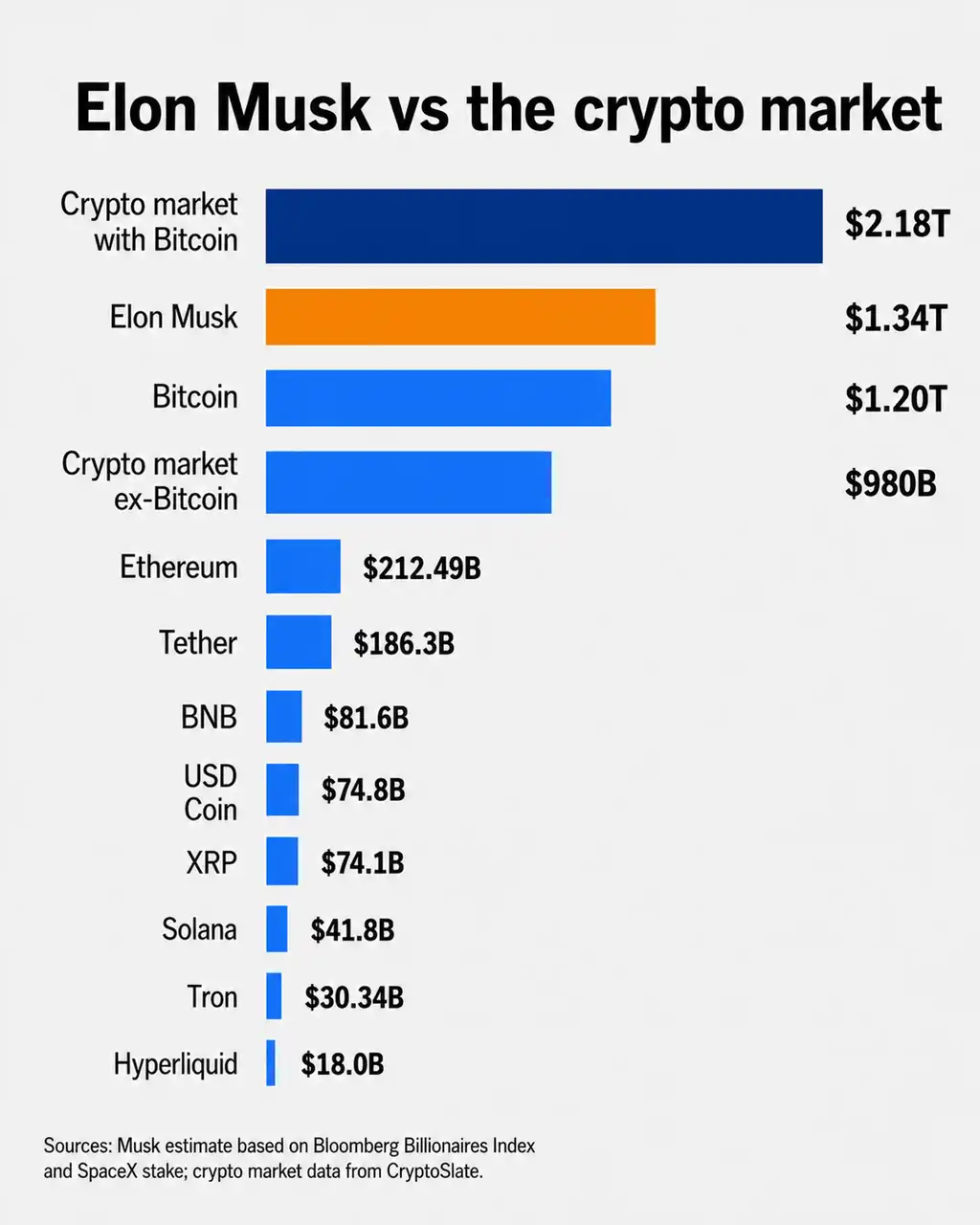
While such a comparison is not precise, it vividly illustrates how SpaceX's rapid ascent has become a focal point for global markets, pushing Musk's wealth to unprecedented heights.
Bitcoin Pullback Makes the Comparison Possible
Bitcoin remains the largest digital asset by market cap, but its lead has narrowed as the broader crypto market retreated from last year's highs.
According to CryptoSlate data, the total cryptocurrency market cap has fallen from a peak of about $4.21 trillion to around $2.23 trillion over the past year. During the same period, Bitcoin declined over 50% from its late-2025 all-time high near $126,000, experiencing months of selling pressure and waning risk appetite.
This reversal followed a strong rally that began during Trump's 2024 presidential campaign and extended into his return to the White House. At that time, Bitcoin first broke through $100,000 as investors reacted to expectations of industry-friendly appointments, regulatory proposals, and a more lenient stance from Washington on digital assets.
However, those gains have faded this year, with crypto exchange volumes declining, leveraged positions being liquidated, and capital flowing back into big tech stocks, private market proxies, and newly listed growth companies.
Against this backdrop, Musk's wealth milestone reflects less about Bitcoin losing its crypto benchmark status and more about SpaceX's astonishing speed in becoming the outlet for competing speculative capital.
Meanwhile, the comparison is even more stark beyond Bitcoin. The total crypto market is valued at about $2.23 trillion, with Bitcoin accounting for roughly $1.29 trillion. This means Musk's estimated wealth now exceeds the combined value of all other digital assets.
SpaceX Becomes the Market's New Crowded Trade
The direct driver behind Musk's wealth surge is SpaceX, which trades on Nasdaq under the ticker SPCX.
The company's IPO was priced at $135 per share and has since climbed more than 50%, pushing its market cap to approximately $2.7 trillion. This places SpaceX among the world's most valuable public companies, surpassing Amazon and nearing Microsoft's market cap.
This rally stems from a rare combination of scarcity, brand power, and momentum. As CryptoSlate previously reported, only a small portion of SpaceX equity entered public trading, sending investors scrambling for the limited float of one of the most anticipated public listings in years. This imbalance helped turn demand into price pressure.
Meanwhile, retail investors have been central to the stock's rapid ascent.
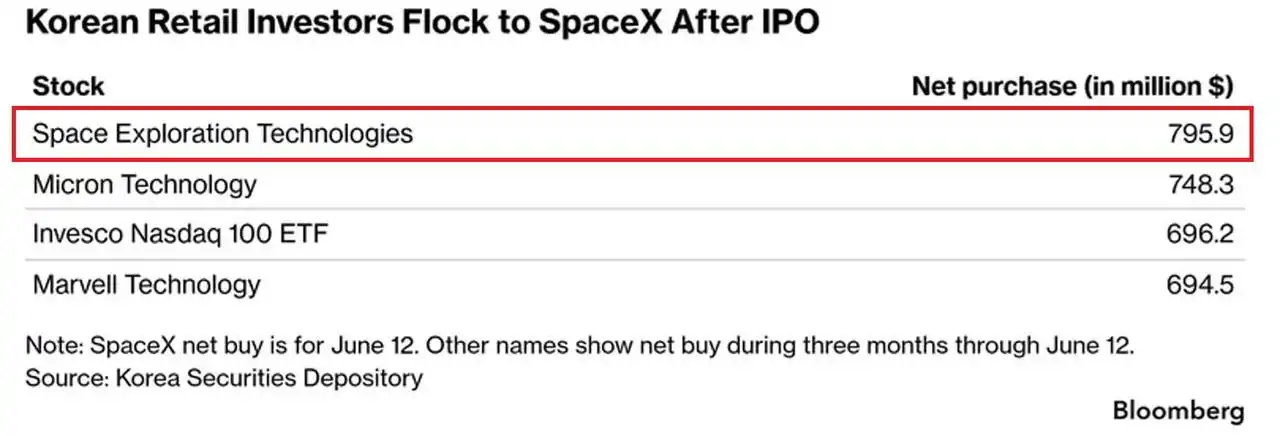
According to market flow data cited by Global Market Investor, South Korean retail investors purchased about $795.9 million worth of SpaceX shares on its first trading day, June 12. This made SPCX the most-purchased U.S. stock by South Korean retail investors in a single day.
This buying volume surpassed the net purchases of several major U.S. tech stocks over three months. According to the same data, over the past three months, South Korean retail bought $748.3 million of Micron Technology, $696.2 million of the Nasdaq 100 ETF, and $694.5 million of Marvell Technology.
Simultaneously, the frenzy for SPCX has manifested in leveraged exchange-traded funds tied to the company, which traded briskly in their first few days of listing.
Eric Balchunas, Senior ETF Analyst at Bloomberg Intelligence, noted that total trading volume for 2x SpaceX ETFs broke $3 billion, up from about $1 billion the previous day.
A product with the ticker SPCH saw about $1.3 billion in volume on its second day. Balchunas called this the second-highest day-two trading volume for an ETF ever, exceeding the roughly $500 million volume of BlackRock's spot Bitcoin ETF (IBIT) on its second day.
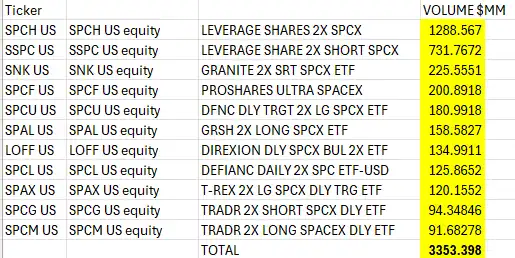
This demand is notable because many products track the same underlying stock and offer similar leverage. It suggests investors aren't just seeking long-term exposure to SpaceX; many are using these funds to express short-term directional bets.
Ultimately, these figures indicate SpaceX is being treated as a global momentum trade, not a traditional aerospace public company.
Investors who missed out on IPO allocations have been buying shares in the open market, while others have turned to exchange-traded funds, options, and crypto derivatives to get exposure to the same play.
Growing Questions Over SpaceX's Valuation
The speed of the rally has intensified questions about whether SpaceX's valuation has outrun its business fundamentals.
Musk has stated SpaceX could achieve $1 trillion in annual revenue by 2030, a target that has helped investors price the company as more than just a rocket and satellite business. The market is also assigning value to Starlink, artificial intelligence, launch infrastructure, and Musk's broader tech ecosystem.
Current financials show the company is still spending heavily to build that future. SpaceX recorded a net loss of $4.94 billion on $18.67 billion in revenue for 2025. The company posted another $4.27 billion loss in Q1 2026, reflecting capital expenditures on Starlink, launch capacity, computing infrastructure, and AI initiatives.
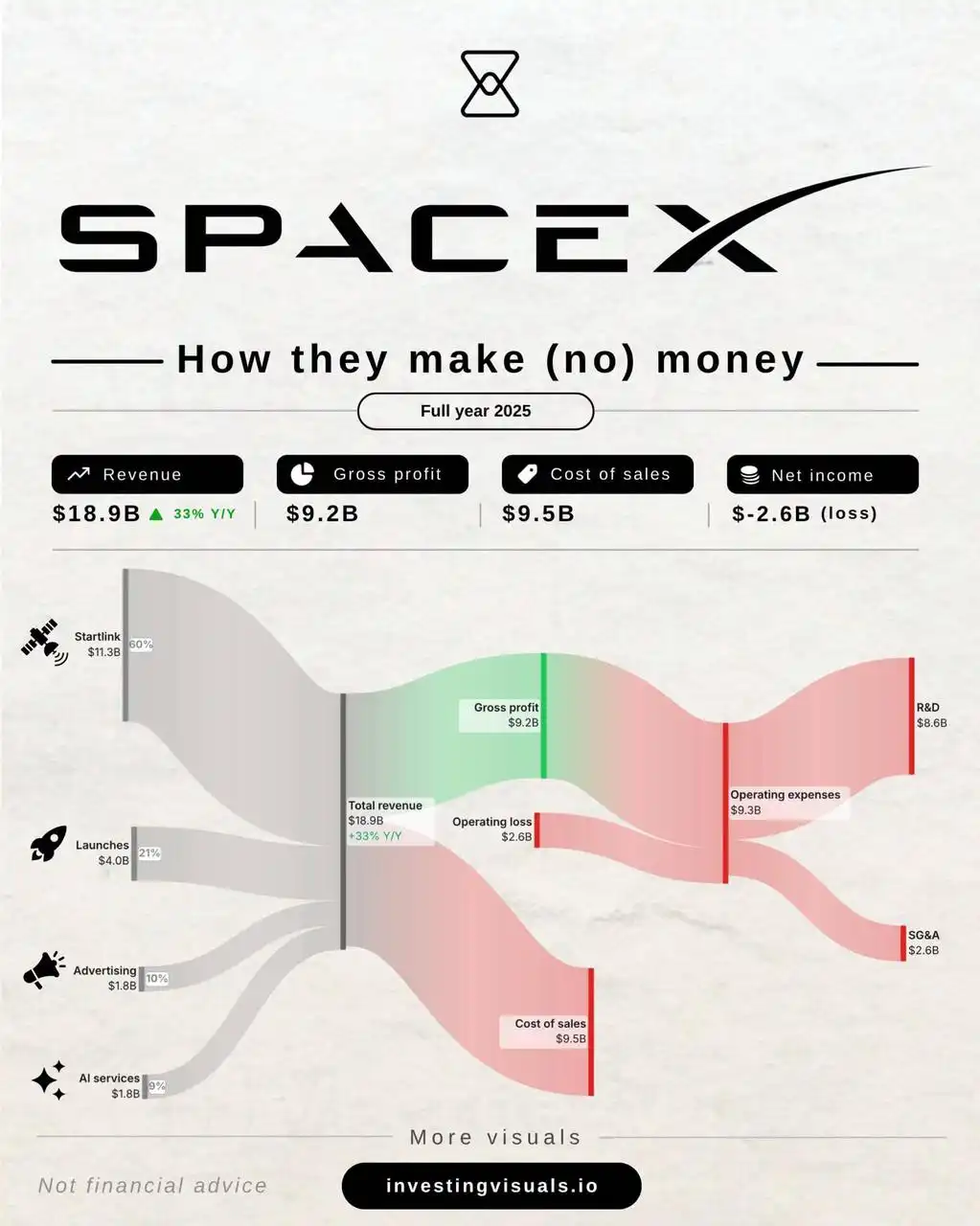
These losses haven't stopped the rally. But they widen the gap between SpaceX's current reality and the price investors are paying for its future.
This is where the comparison with Bitcoin becomes useful. Bitcoin's market cap has long hinged on what buyers are willing to pay for scarcity, network strength, and future monetary relevance. SpaceX is now being priced on a similar forward-looking logic, just through a public-company structure tied to Musk.
For now, public markets are rewarding this story more aggressively than crypto markets.
While Musk's wealth may not forever exceed Bitcoin's market cap—as SpaceX shares could fall, Bitcoin could rebound, or both could swing sharply in opposite directions—this milestone captures the current state of risk appetite: the biggest speculative trade in the market is no longer necessarily a token, but a rocket company.