Author: Rita
Gold has reached Morgan Stanley's fourth-quarter target price of $4450 per ounce, achieving this faster than anticipated.
On August 20, Morgan Stanley released a commodities quick take. From July to August, a decline in the probability of Fed rate hikes drove a net inflow of 70 tonnes into gold ETFs, reversing the net outflow of 93 tonnes seen from May to June.
Central banks are also taking action. The People's Bank of China purchased 60 tonnes of gold this year, the highest level since 2023; Poland increased its holdings by 82 tonnes, bringing its total reserves to 632 tonnes and approaching its target of 700 tonnes.
Morgan Stanley expects the gold price to surpass $5000 per ounce by 2027. The upward trajectory carries volatility risks.
Gold Price Movement Is Decoupling from the Real Interest Rate Framework
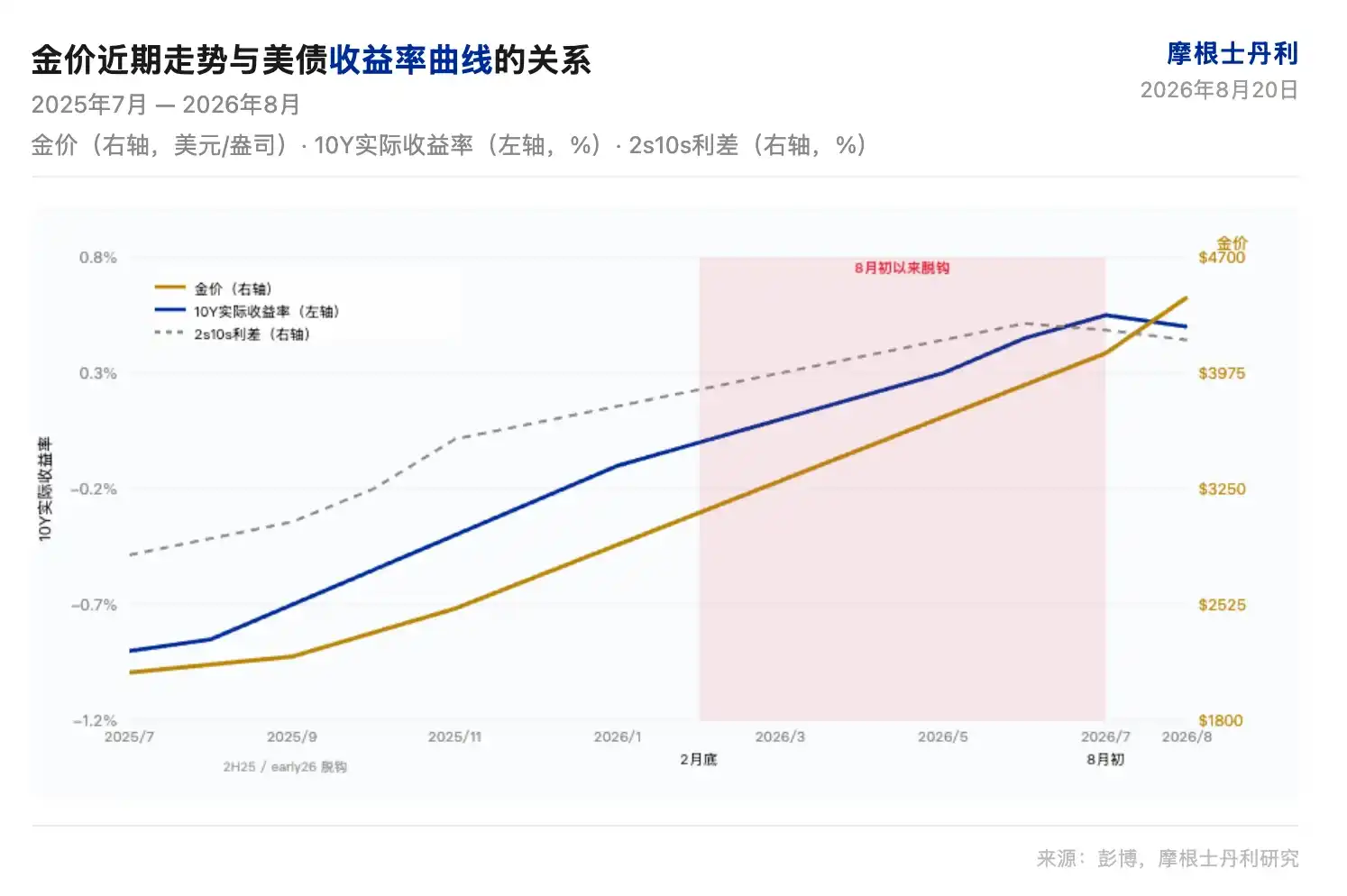
From late February to early August, gold maintained a stable negative correlation with the 10-year real interest rate. Since early August, the gold price has continued to rise even as long-term rates remained flat. A similar decoupling occurred in the latter half of 2025 and early 2026.
During that period, Fed rate cuts lowered short-term rates, while concerns over rising government debt, currency depreciation, and inflation expectations collectively supported long-term rates, leading to a steepening yield curve and simultaneous strength in gold prices. This time, the rise in long-term rates is driven more by oil prices and tech bond issuance, but market attention to government debt is also resurging.
Morgan Stanley judges that the gold price is now pricing in the fiscal concerns behind the rising yields, rather than the yields themselves.
The Fed Path Remains Dominant, While Structural Factors Are Emerging as New Support
The Federal Reserve's policy path dominates ETF fund flows. Upcoming US inflation data and communication signals from Fed officials will determine the direction of rate hike expectations. Morgan Stanley's US economists expect the Fed to hold rates steady throughout 2026, implying limited pressure from the interest rate side.
The drivers for gold are changing. Beyond the real interest rate framework, three structural factors provide new support: continued central bank purchases, with global central banks net buying 345 tonnes in H1 2026, consistent with Morgan Stanley's full-year forecast of 700 tonnes; COMEX (New York Commodity Exchange) gold futures short positions have fallen to their lowest level since April 2020, narrowing the room for short-term short-covering, but short-side pressure has been largely absorbed; and fiscal concerns underpinning the steepening yield curve are becoming an invisible catalyst for the gold price.
Path to $5000 Is Open, Short-Term Volatility Is Normal
US inflation data is the primary source of short-term volatility. If inflation exceeds expectations, markets may reprice the Fed's rate hike path, triggering a gold price correction. With COMEX short positions at historically low levels, the space for rapid price increases driven by short-covering is limited. Gold ETF inflows are more a reaction to reduced rate hike probabilities rather than expectations of rate cuts. This differs from the typical pattern during a rate-cutting cycle, creating uncertainty about the sustainability of these inflows.
Morgan Stanley's base case judgment: A combination of the Fed holding steady, continued central bank purchases, and deepening pricing of fiscal concerns will push the center of gravity for gold prices higher. Short-term volatility will not alter this direction.

Disclaimer
This article is a compilation and interpretation by Chaoxiang Research of a third-party brokerage research report (Morgan Stanley, August 20, 2026), combined with the organization of publicly available market information. The ratings, target prices, earnings forecasts, and related judgments cited in the text are the views of the analysts at that brokerage firm, representing only the stance of their affiliated institution. They do not represent the views of Chaoxiang Research and do not constitute any investment advice.
Markets carry risks, and investment decisions should be made independently. This article should not be used as a basis for trading any securities.