Month-old Ethereum client bug blamed for Prysm outage

cointelegraphPublished on 2025-12-15Last updated on 2025-12-15

Abstract

A month-old bug in the Prysm Ethereum client caused a significant outage on December 4, leading to resource exhaustion and performance degradation. The issue occurred when Prysm nodes processed attestations from out-of-sync nodes, forcing them to recompute expensive state transitions. Although the bug had been present on testnets for a month prior, it wasn’t triggered until the mainnet incident. The network experienced an 18.5% missed slot rate for over 42 epochs, with participation dropping to 75%, resulting in approximately 382 ETH lost in attestation rewards. A patch was quickly deployed to resolve the issue. Developers emphasized that client diversity helped prevent a more severe impact, as Prysm only holds a 17.6% share of the network. However, they warned that Lighthouse, the dominant client with 52.6% share, is nearing a dangerous threshold where a single bug could finalize an invalid chain.

Prysm has revealed that a bug introduced in a testnet a month before Ethereum’s Fusaka upgrade was the cause of an Ethereum node validation issue that affected its client earlier this month.

Ethereum developer Terence Tsao posted a post-mortem on Sunday detailing the Fusaka mainnet Prysm incident that impacted the network on Dec. 4.

Prysm nodes experienced “resource exhaustion” when processing attestations from out-of-sync nodes, it stated. This caused Prysm to replay past epoch blocks and recompute expensive state transitions, resulting in a significant impact on performance due to the excessive workload.

The post-mortem revealed that the bug had been present on testnets for a month before the incident, but wasn’t triggered.

“The bug was introduced in Prysm PR 15965 and deployed to testnets a month before the incident without the trigger happening.”

Testnets are designed to identify bugs, but they aren’t a foolproof method.

In May 2023 — a month after the Shanghai hard fork — Ethereum developers were sent into a frenzy when the network temporarily lost transaction finality for around 25 minutes, then again for over an hour the following day, before the blockchain recovered on its own.

Prysm has been patched

Instead of using the current head state, Prysm regenerated prior states from scratch, creating a massive computational burden.

For more than 42 epochs, the network saw an 18.5% missed slot rate with participation dropping to 75% while validators lost approximately 382 Ether (ETH) in attestation rewards, it said.

Related: Vitalik Buterin says Ethereum can handle temporary loss of finality

Node operators were instructed to deploy a temporary solution while developers worked on an update patch for Prysm clients.

Client diversity saved the day

The incident could have been much worse if it had hit Ethereum’s dominant consensus client, Lighthouse, said developers.

Offchain Labs’ Prysm is the second-largest Ethereum client with a 17.6% share, according to ClientDiversity.

“Client diversity prevented a noticeable impact on Ethereum users. A client with more than 1/3rd of the network would have caused a temporary loss in finality and more missed blocks.”

However, the incident highlighted that Lighthouse is dangerously close to the two-thirds threshold where a single client bug could finalize an invalid chain.

Lighthouse currently has a client share of 52.6%, down from around 56% at the time of the incident.
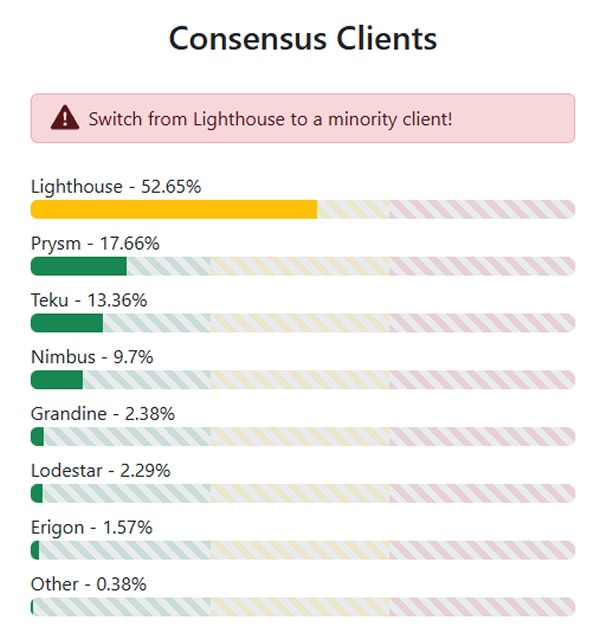
Ethereum developers are pushing for more client diversity. Source: ClientDiversity


Magazine: Big questions: Would Bitcoin survive a 10-year power outage?

Trending Cryptos

Related Reads

U.S. Tax Service Details New Cryptocurrency Fraud Scheme

The U.S. Internal Revenue Service (IRS) has warned of a new cryptocurrency fraud scheme. Scammers are sending paper letters impersonating official U.S. Department of the Treasury and IRS correspondence. These letters urge Americans to urgently register on a non-existent platform called the "Digital Asset Compliance Portal." The fraudulent letters contain QR codes linking to a phishing website disguised as the official IRS site. Victims are prompted to disclose their cryptocurrency exchange or wallet provider (examples given include Coinbase, Kraken, and Ledger) and the amount of crypto assets they hold. Jarod Koopman, Chief of the IRS Criminal Investigation Division, stated that criminals are exploiting public trust in government institutions by creating convincing fake websites and official-looking correspondence. According to the investigation, the infrastructure for this scam was set up just days before the mailing campaign began, using a domain registered through a Hong Kong-based registrar. The IRS assured taxpayers that it does not require them to provide wallet information via third-party sites or to click links from suspicious messages. The agency advised Americans to verify the authenticity of any notifications through official channels, such as making a phone call. This alert follows a recent FBI warning about a separate fraudulent scheme targeting cryptocurrency wallet holders on the Tron network.

cryptonews.ru2m ago

U.S. Tax Service Details New Cryptocurrency Fraud Scheme

cryptonews.ru2m ago

Has Bitcoin Bottomed, or Is a 'Shakeout' Approaching? What's the Situation with XRP?

Cryptocurrency analytics platform Santiment shared key insights on Bitcoin and altcoin markets, highlighting significant signals from on-chain data. Analysis shows Bitcoin's 365-day MVRV ratio has fallen to -26%, indicating substantial losses for long-term holders, a level historically associated with market bottom formations and long-term buying opportunities. While short-term MVRV is near breakeven, suggesting no clear directional signal, the annual perspective points to a bottom before bullish cycles. On-chain data reveals divergent behavior: large wallets (10-10,000 BTC) have been accumulating, adding ~18,500 BTC in 10 days, while smaller retail investors continue buying dips. Analysts caution that high retail demand can sometimes create a risk of a final market shakeout or correction. The altcoin market shows a mixed picture. Ethereum's 365-day MVRV is around -33%, but recent monthly gains combined with overly optimistic social sentiment pose a short-term correction risk. XRP is in oversold territory with 30-day and 365-day MVRVs at -57.5% and -45.5% respectively, signaling potential for a strong mid-to-long term rebound. Social activity and optimism are rising for Solana, while investor sentiment remains calmer towards Cardano. Future direction for Bitcoin and altcoins depends not only on on-chain metrics but also on macroeconomic and regulatory developments. The Federal Reserve's interest rate decision and upcoming policy rulings are increasing market volatility expectations, while uncertainty around the U.S. Congressional clarity process continues to pressure pricing. *This is not investment advice.

cryptonews.ru1h ago

Has Bitcoin Bottomed, or Is a 'Shakeout' Approaching? What's the Situation with XRP?

cryptonews.ru1h ago

Trading

Spot

Hot Articles

Discussions

Welcome to the HTX Community. Here, you can stay informed about the latest platform developments and gain access to professional market insights. Users' opinions on the price of ETH (ETH) are presented below.

活动图片