Michael Saylor Pitched Bitcoin To ‘Every’ Middle East Sovereign Wealth Fund

bitcoinistPublished on 2025-12-09Last updated on 2025-12-09

Abstract

In a fireside chat at BTC MENA 2025, Michael Saylor pitched Bitcoin to Middle East sovereign wealth funds and banks, framing it as "digital capital" and advocating for the creation of Bitcoin-backed "digital credit" to generate yield. He detailed his meetings with numerous regional investors, funds, and regulators, presenting a blueprint for banks to custody Bitcoin and offer low-volatility, high-yield credit products. Saylor argued that such a strategy could attract trillions in capital, positioning a nation or bank as a dominant global financial hub—the "Switzerland of digital capital." He expressed strong optimism about the region's enthusiastic response. Bitcoin traded at $90,164 at press time.

In a fireside chat with Metaplanet CEO Simon Gerovich at BTC MENA 2025, Michael Saylor turned a technical conversation about Bitcoin treasuries into a direct pitch to the Middle East’s sovereign wealth funds and banks, outlining how a nation or large financial institution could attract tens of trillions of dollars and become the “Switzerland” of digital capital.

Saylor and Gerovich began by framing Bitcoin as “digital capital.” As Saylor put it, “Our company pursued a strategy of accumulating digital capital. Bitcoin is digital capital. What do you do when you have capital? You issue credit against it.” Both MicroStrategy and Metaplanet are building balance sheets of Bitcoin and then issuing perpetual preferred instruments as “digital credit” backed by that capital.

Gerovich described Japan as a massive but yield-starved market. “There’s $7 trillion of cash sitting on personal bank accounts, bank balance sheets earning nothing, and corporates have another $4 or $5 trillion.” A Japanese family that puts money in the bank gets “zero.” Even as deflation fades, investors remain “accustomed to zero” and are “desperately looking for yield.”

Metaplanet’s answer is to connect that idle capital to Bitcoin. It launched “Mercury,” a perpetual preferred paying 4.9% in yen with convertibility into equity, which Gerovich called “probably one of the cheapest call options on Bitcoin out there.” Its follow-up product, “Mars” – Metaplanet Adjustable Rate Securities – is designed as a high-yield, Bitcoin-backed instrument that Japanese investors can hold in their securities accounts as a kind of supercharged bank deposit.

Inside Saylor’s Bitcoin Talks With Sovereign Funds

Saylor used this as a template for the Middle East, explaining that he has been on an intensive tour of the region’s power centers. “I’ve been meeting with all the sovereign wealth funds. I’ve been meeting with, I don’t know, 50, 100 different investors, hedge funds, family office investors... I’ve been meeting with regulators in every jurisdiction.” His message is “very, very straightforward”: “We now have digital capital. Bitcoin is digital capital, is digital gold. On top of digital capital, we have a new asset class called digital credit. Digital credit strips the volatility from the capital and provides yield, income.”

To illustrate the appeal, he contrasted capital and credit. Giving a child $1 million of Manhattan land is pure capital with no cash flow. “Or you can give them a credit instrument that pays them $10,000 a month forever, starting now. And so most people want the credit instrument. They don’t want the capital instrument... They’d rather have 10% non-volatile than 30% volatile with no cash flows.” Treasury companies like MicroStrategy and Metaplanet “exist to convert capital into credit.”

Saylor then laid out the blueprint for any ambitious bank in the region: “Have the bank custody Bitcoin. Everybody talks about self-custody. Self-custody for the bank in the country. Buy Bitcoin, have your bank custody the Bitcoin, and then start to offer credit networks on top of the Bitcoin.” If a national bank extends loans such as “SOFR plus 50 basis point loans on Bitcoin,” he argued, then as Bitcoin’s market grows from $2 trillion to $20 trillion, that bank could attract “5% or 10% of it,” pulling in “a trillion dollars or a few trillion dollars” simply because “most big conventional regulated banks don’t handle Bitcoin.”

The “biggest idea” is to turn Bitcoin-backed credit into a bank account that outcompetes the entire global deposit system. By taking digital credit instruments like Stretch or Mars, placing them in a fund that is mostly credit with a currency buffer and reserve layer, Saylor envisions a regulated account that pays around 8% with “vol of zero.” In that setup, “I wire you my billions of dollars or tens of billions of dollars, and you pay me 8% interest every day, zero vol, in a regulated bank, powered by digital credit, which is in turn powered by a treasury company with 5x as much digital capital, over-collateralized.”

In such a regime, he argued, “you could presumably attract 20 trillion dollars or 50 trillion dollars.” For depositors, “the perfect product is a bank account with zero volatility that pays you 400 basis points more than the risk-free rate in your favorite currency.” For Saylor, that account is “the lightsaber of money, the laser beam of money, the nuclear fusion reactor of money.”

He framed it as an open race: “The question is, who wants to be the Switzerland of the 21st century and attract all the money in the world?” In his view, “the answer is going to be whoever appreciates money the most, wants the money the most, that understands technology the best, that is willing to take a courageous stance of conviction with a degree of clarity,” he said.

He concluded: “That is the opportunity, and all the conversations have been extraordinarily energetic, enthusiastic, and I couldn’t be more excited. I think it will happen somewhere in this region. We’ll see where.”

At press time, Bitcoin traded at $90,164.
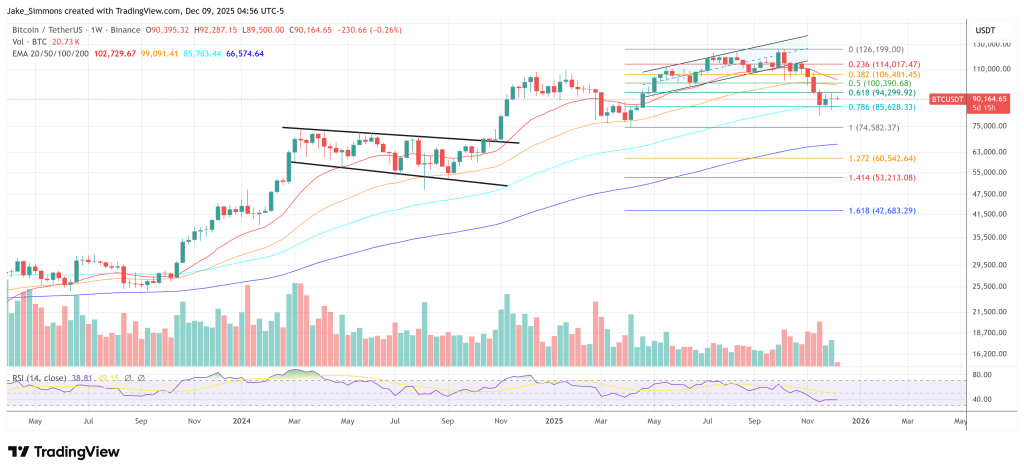
Bitcoin remains below the 0.618 Fib, 1-week chart | Source: BTCUSDT on TradingView.com

Trending Cryptos

Related Reads

Circle CEO: Stablecoins Are at the Internet's 2002 Stage, Will Reach Trillions of Dollars in the Future

Circle CEO Jeremy Allaire, in a Q2 2026 earnings AMA, discussed the current state and future of stablecoins and Circle's strategy. He compared stablecoins today to the internet in 2002, predicting they will grow from hundreds of billions to trillions of dollars. Key points include: * **Current Use Cases**: Stablecoins have achieved product-market fit in digital asset markets (for trading/settlement), as a digital dollar store of value in emerging markets, and for cross-border payments and settlement. * **Future Growth Areas**: Allaire highlighted opportunities in the AI agent economy, merchant payments (especially via QR codes and stablecoin cards), and the convergence of traditional and on-chain finance. * **Circle's Strategy**: Circle aims to grow USDC through global partnerships. Its economic engines will include reserve income, transaction fees from its on-chain payment network (CPN), and its upcoming "economic operating system," Arc. * **Arc's Vision**: Arc, launching its mainnet on September 16, is a stablecoin-native blockchain designed for seamless user and developer experience. It aims to power the future "on-chain" economy where businesses and AI agents operate. * **Global Adoption**: Allaire emphasized that stablecoin adoption is a global phenomenon, driven by regulatory clarity in regions like Europe (MiCA) and the US (GENIUS Act), and will continue regardless of specific US legislation like the CLARITY Act. * **EURC Growth**: Circle's euro stablecoin, EURC, has surpassed €400 million in circulation, benefiting from early preparation for European regulations and existing distribution networks. Allaire expressed confidence in Circle's execution, citing strong team cohesion and the adoption of AI tools, while identifying cybersecurity and global local operations as key areas for continued strengthening.

marsbit13m ago

Circle CEO: Stablecoins Are at the Internet's 2002 Stage, Will Reach Trillions of Dollars in the Future

marsbit13m ago

With Revenue 3.8 Billion Lower Than CXMT, Net Profit Is 8.6 Billion Higher: What Secrets Are Hidden in YMTC's IPO?

Chinese NAND flash giant Changcun Holdings has submitted its IPO prospectus to the Shanghai Stock Exchange. In Q1 2026, the company reported revenue of 47.042 billion yuan and a net profit attributable to parent company shareholders of 33.379 billion yuan. This presents a striking contrast with its competitor Changxin Technology, which had higher revenue (50.8 billion yuan) but a significantly lower net profit of 24.762 billion yuan. The key to this discrepancy lies in their ownership structures of core assets. Changcun Holdings fully owns its main operating entity, Yangtze Memory Technologies Co., Ltd., allowing nearly all group profits to flow to the parent company. In contrast, Changxin Technology controls but does not fully own its key production subsidiaries, meaning a substantial portion of its consolidated profits (approximately 8.25 billion yuan in Q1 2026) belongs to minority shareholders, reducing its reported net profit. Despite Changcun's higher net profit, its pre-IPO valuation is estimated lower than Changxin's. Analysts attribute this to differing market expectations: Changxin, focused on DRAM and the high-growth HBM market for AI servers, is seen as having greater long-term growth potential. Changcun, while dominant in NAND flash, operates in a market with inherent size constraints, making its future valuation more dependent on successfully upgrading its product mix toward higher-value segments like enterprise SSDs.

marsbit25m ago

With Revenue 3.8 Billion Lower Than CXMT, Net Profit Is 8.6 Billion Higher: What Secrets Are Hidden in YMTC's IPO?

marsbit25m ago

Perpetual Contract Liquidation Wave Resurges, Bitcoin $62k - $67k May Become the 'Disaster Zone'

A wave of liquidations has hit the crypto perpetual futures market, with analysts warning of continued volatility. Following Bitcoin's drop below $76,000 and subsequent rebound, over $84 million in long positions were liquidated in one hour, demonstrating the amplified impact of leverage. The U.S. CFTC's recent approval of a spot Bitcoin perpetual contract on the Kalshi exchange has opened this "previously closed" asset class to American institutions, with the platform reporting $5.5 billion in volume in its first two weeks. However, critics like Better Markets warn that perpetuals are "among the most dangerous crypto products" for retail investors due to a lack of enhanced protections. Recent price action saw a massive $529 million in hourly liquidations, predominantly longs. Analysts note that while a $3.3 billion short squeeze cleared liquidity above $80,000, a significant pool of long liquidations now sits between $62,000 and $67,000, posing a downside risk if key resistance holds. Experts caution new traders against using leverage or options, which can expire worthless, without proper experience and risk management. Despite the dangers, the demand for leveraged products persists, with some institutional players preferring on-chain platforms for their transparency and self-custody. As Kalshi expands its perpetual offerings beyond crypto, the core warning remains: leverage can lead to sudden, severe losses for unprepared investors.

marsbit25m ago

Perpetual Contract Liquidation Wave Resurges, Bitcoin $62k - $67k May Become the 'Disaster Zone'

marsbit25m ago

Trading

Spot

Hot Articles

What is $BITCOIN

DIGITAL GOLD ($BITCOIN): A Comprehensive Analysis Introduction to DIGITAL GOLD ($BITCOIN) DIGITAL GOLD ($BITCOIN) is a blockchain-based project operating on the Solana network, which aims to combine the characteristics of traditional precious metals with the innovation of decentralized technologies. While it shares a name with Bitcoin, often referred to as “digital gold” due to its perception as a store of value, DIGITAL GOLD is a separate token designed to create a unique ecosystem within the Web3 landscape. Its goal is to position itself as a viable alternative digital asset, although specifics regarding its applications and functionalities are still developing. What is DIGITAL GOLD ($BITCOIN)? DIGITAL GOLD ($BITCOIN) is a cryptocurrency token explicitly designed for use on the Solana blockchain. In contrast to Bitcoin, which provides a widely recognized value storage role, this token appears to focus on broader applications and characteristics. Notable aspects include: Blockchain Infrastructure: The token is built on the Solana blockchain, known for its capacity to handle high-speed and low-cost transactions. Supply Dynamics: DIGITAL GOLD has a maximum supply capped at 100 quadrillion tokens (100P $BITCOIN), although details regarding its circulating supply are currently undisclosed. Utility: While precise functionalities are not explicitly outlined, there are indications that the token could be utilized for various applications, potentially involving decentralized applications (dApps) or asset tokenization strategies. Who is the Creator of DIGITAL GOLD ($BITCOIN)? At present, the identity of the creators and development team behind DIGITAL GOLD ($BITCOIN) remains unknown. This situation is typical among many innovative projects within the blockchain space, particularly those aligning with decentralized finance and meme coin phenomena. While such anonymity may foster a community-driven culture, it intensifies concerns about governance and accountability. Who are the Investors of DIGITAL GOLD ($BITCOIN)? The available information indicates that DIGITAL GOLD ($BITCOIN) does not have any known institutional backers or prominent venture capital investments. The project seems to operate on a peer-to-peer model focused on community support and adoption rather than traditional funding routes. Its activity and liquidity are primarily situated on decentralized exchanges (DEXs), such as PumpSwap, rather than established centralized trading platforms, further highlighting its grassroots approach. How DIGITAL GOLD ($BITCOIN) Works The operational mechanics of DIGITAL GOLD ($BITCOIN) can be elaborated on based on its blockchain design and network attributes: Consensus Mechanism: By leveraging Solana’s unique proof-of-history (PoH) combined with a proof-of-stake (PoS) model, the project ensures efficient transaction validation contributing to the network's high performance. Tokenomics: While specific deflationary mechanisms have not been extensively detailed, the vast maximum token supply implies that it may cater to microtransactions or niche use cases that are still to be defined. Interoperability: There exists the potential for integration with Solana’s broader ecosystem, including various decentralized finance (DeFi) platforms. However, the details regarding specific integrations remain unspecified. Timeline of Key Events Here is a timeline that highlights significant milestones concerning DIGITAL GOLD ($BITCOIN): 2023: The initial deployment of the token occurs on the Solana blockchain, marked by its contract address. 2024: DIGITAL GOLD gains visibility as it becomes available for trading on decentralized exchanges like PumpSwap, allowing users to trade it against SOL. 2025: The project witnesses sporadic trading activity and potential interest in community-led engagements, although no noteworthy partnerships or technical advancements have been documented as of yet. Critical Analysis Strengths Scalability: The underlying Solana infrastructure supports high transaction volumes, which could enhance the utility of $BITCOIN in various transaction scenarios. Accessibility: The potential low trading price per token could attract retail investors, facilitating wider participation due to fractional ownership opportunities. Risks Lack of Transparency: The absence of publicly known backers, developers, or an audit process may yield skepticism regarding the project's sustainability and trustworthiness. Market Volatility: The trading activity is heavily reliant on speculative behavior, which can result in significant price volatility and uncertainty for investors. Conclusion DIGITAL GOLD ($BITCOIN) emerges as an intriguing yet ambiguous project within the rapidly evolving Solana ecosystem. While it attempts to leverage the “digital gold” narrative, its departure from Bitcoin's established role as a store of value underscores the need for a clearer differentiation of its intended utility and governance structure. Future acceptance and adoption will likely depend on addressing the current opacity and defining its operational and economic strategies more explicitly. Note: This report encompasses synthesised information available as of October 2023, and developments may have transpired beyond the research period.

2.1k Total ViewsPublished 2025.05.13Updated 2025.05.13

What is $BITCOIN

Discussions

Welcome to the HTX Community. Here, you can stay informed about the latest platform developments and gain access to professional market insights. Users' opinions on the price of BTC (BTC) are presented below.

活动图片