Metaplanet Bets On Japan’s Bitcoin Boom With ¥4 Billion Infrastructure Push

bitcoinistPublished on 2026-03-12Last updated on 2026-03-12

Abstract

Metaplanet, a Tokyo-listed company, is expanding its Bitcoin strategy beyond treasury accumulation by establishing two new subsidiaries: Metaplanet Ventures and Metaplanet Asset Management. With a ¥4 billion infrastructure push, Metaplanet Ventures will invest in Japan's Bitcoin financial ecosystem, including lending, payments, custody, stablecoins, derivatives, and compliance. It will also launch an incubator and a grants program. The company believes Japan's regulatory framework for digital assets is already best-in-class and now requires execution at scale. An initial investment of up to ¥400 million will go to JPYC, Japan's first licensed yen stablecoin, highlighting a focus on building the financial rails needed for institutional Bitcoin adoption. The broader ambition is to position Metaplanet as a vertically integrated player—accumulating BTC, backing infrastructure, and acting as a capital markets intermediary—betting that Japan is Bitcoin's next major growth market.

Metaplanet is widening its Bitcoin strategy beyond treasury accumulation, setting up two wholly owned subsidiaries aimed at building out the financial rails it believes Japan will need as institutional adoption of BTC deepens. The move pairs a domestic infrastructure push with a new cross-border capital markets platform, giving the Tokyo-listed company a broader claim on what it sees as Bitcoin’s next growth market.

Metaplanet Deepens Bitcoin Play

In a post on X early Thursday, CEO Simon Gerovich said the company’s board had approved the creation of Metaplanet Ventures and Metaplanet Asset Management. The first will focus on Japan’s domestic ecosystem. The second, based in Miami, is designed as a digital credit and Bitcoin capital markets business linking Asian and Western markets across “yield, equity, credit, and volatility strategies.”

The more immediate signal came from Metaplanet Ventures. Gerovich said the subsidiary will invest ¥4 billion over the next few years into firms building Bitcoin financial infrastructure in Japan, spanning “lending, payments, custody,stablecoins, derivatives, compliance.” He added that the company is also launching an incubator for early-stage founders and a grants program for open-source developers, educators and researchers.

Gerovich framed the bet as a wager that regulation is no longer Japan’s bottleneck. “Japan has built the best regulatory framework in the world for digital assets. Now it needs the companies, the builders, and the infrastructure to match. We want to help make that happen,” he wrote. That positioning matters. Rather than pitching the market as one still waiting for legal clarity, Metaplanet is arguing that the rules are already in place and the missing piece is execution at scale.

Its first allocation reflects that thesis. Gerovich said Metaplanet Ventures plans to invest up to ¥400 million in JPYC, which he described as Japan’s first licensed yen stablecoin. He tied the investment directly to the institutionalization of markets: “Every Bitcoin transaction has two sides. Bitcoin and a currency. As this market goes institutional, that currency side goes digital. JPYC is building that rail in Japan and we want to be part of it.”

That stablecoin angle is notable because it suggests Metaplanet is not treating Bitcoin adoption as a single-asset story. The company appears to be building around the surrounding market structure: settlement, custody, payments, compliance and funding infrastructure that institutional participants would need if Bitcoin-denominated activity expands inside Japan.

Dylan LeClair, Director of Bitcoin Strategy at Metaplanet, cast the broader ambition in more aggressive terms. “Metaplanet is a perpetual Bitcoin accumulation machine. Our unwavering mandate is to utilize every capital markets tool available in one of the world’s deepest financial markets to acquire BTC, relentlessly and at scale,” he wrote. “The US had its moment in 2024; Japan is next, and our aim is vertical integration across the ecosystem to be ready for it.”

Taken together, the announcements suggest Metaplanet wants to be more than a listed BTC proxy. It is trying to position itself as a treasury vehicle, infrastructure backer and capital markets intermediary all at once, betting that Japan’s next phase of Bitcoin adoption will reward firms that own not just the asset, but the rails around it.

At press time, BTC traded at $70,135.
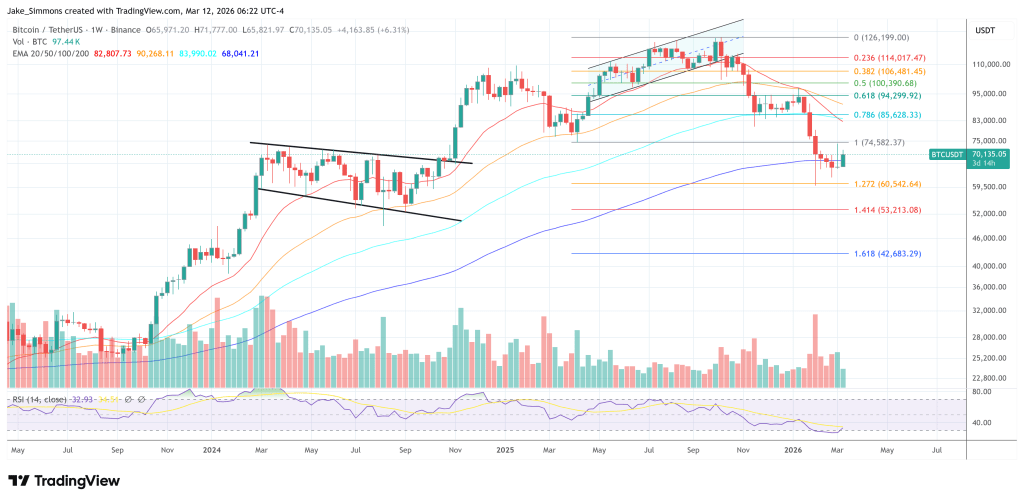
BTC faces the 1.0 Fib level, 1-week chart | Source: BTCUSDT on TradingView.com

Related Questions

QWhat are the two new subsidiaries established by Metaplanet as part of its expanded strategy?

AMetaplanet established Metaplanet Ventures, focused on Japan's domestic Bitcoin ecosystem, and Metaplanet Asset Management, a Miami-based digital credit and Bitcoin capital markets business linking Asian and Western markets.

QHow much does Metaplanet Ventures plan to invest in Japan's Bitcoin infrastructure, and what areas will it focus on?

AMetaplanet Ventures plans to invest ¥4 billion into firms building Bitcoin financial infrastructure in Japan, spanning lending, payments, custody, stablecoins, derivatives, and compliance.

QWhy does Metaplanet believe Japan is ready for Bitcoin infrastructure development, according to CEO Simon Gerovich?

ACEO Simon Gerovich stated that Japan has built the best regulatory framework in the world for digital assets and now needs the companies, builders, and infrastructure to match, indicating that regulation is no longer a bottleneck.

QWhat is the significance of Metaplanet's investment in JPYC, and how does it relate to institutional adoption?

AMetaplanet's investment of up to ¥400 million in JPYC, Japan's first licensed yen stablecoin, is tied to the institutionalization of markets, as every Bitcoin transaction requires a currency side, which goes digital as the market institutionalizes.

QHow does Dylan LeClair, Director of Bitcoin Strategy at Metaplanet, describe the company's broader ambition?

ADylan LeClair described Metaplanet as a 'perpetual Bitcoin accumulation machine' with an unwavering mandate to utilize every capital markets tool available to acquire BTC relentlessly and at scale, aiming for vertical integration across the ecosystem in Japan.

Related Reads

From Madison Square Garden to Kalshi: Prediction Markets Break into the NBA Finals

From Madison Square Garden to Kalshi: Prediction Markets Break into the NBA Finals Prediction markets are playing a significant role in the 2026 NBA Finals, particularly around the New York Knicks' unexpected 2-0 series lead. Platforms like Kalshi and Polymarket have seen massive trading volumes, exceeding hundreds of millions of dollars on championship and related markets. Their influence extends beyond online trading. Kalshi's official partnership with Madison Square Garden has given it prominent physical branding at the arena. Furthermore, local businesses like The Jeffrey bar are using prediction market contracts to hedge the risk of game-result-based promotions, turning potential losses into manageable costs—a concept similar to the famous "Mattress Mack" strategy from traditional sports betting. These markets differentiate themselves by offering a wider, more entertainment-focused range of "event contracts" beyond typical game outcomes, such as predicting celebrity attendance. They also have broader accessibility across the U.S. compared to age- and location-restricted traditional sportsbooks. However, their rapid integration into sports raises regulatory and ethical questions. The NBA is cautiously engaging, discussing integrity frameworks with regulators like the CFTC. While the league permits minor investments like Giannis Antetokounmpo's stake in Kalshi, it advocates for strict rules to prevent insider trading. Many fans express concern on platforms like Reddit, fearing that the close ties between prediction markets, the league, and players could compromise the game's integrity. The NBA Finals has thus become a high-stakes testing ground, showcasing prediction markets' commercial potential while challenging traditional boundaries between financial trading, entertainment, and gambling.

marsbit1h ago

From Madison Square Garden to Kalshi: Prediction Markets Break into the NBA Finals

marsbit1h ago

Recursive Self-Improvement AI Gains Traction, Google Pours Cold Water, While DeepSeek and Others Approach the Fringes

The term "recursive self-improvement" (RSI), where AI improves itself autonomously, is gaining momentum in the AI industry. Startups like Recursive Superintelligence and projects such as Andrej Karpathy's Auto-Research aim to create systems where AI designs, implements, and validates its own research, moving toward superintelligence. While Google CEO Sundar Pichai cautions that such exponential acceleration is not yet a reality, progress is evident. For instance, Anthropic reported its Claude Code writes nearly 100% of the team's code, though it still lacks true self-direction. Analysts frame RSI development in stages: "adequacy" (systems functioning without humans), "parity" (matching human research quality), and "supremacy" (exceeding human-AI collaboration). Reaching parity could trigger rapid, unpredictable advancement due to AI's continuous operation. In China, companies like DeepSeek and Baidu incorporate self-optimization techniques without explicitly branding them as RSI, focusing on algorithmic efficiency and reinforcement learning. However, challenges remain, including "model collapse" from training on AI-generated data and the immense computational and open-collaboration requirements. Ultimately, RSI represents a trend of increasing automation in AI development, potentially reducing human oversight in the creation process itself.

marsbit1h ago

Recursive Self-Improvement AI Gains Traction, Google Pours Cold Water, While DeepSeek and Others Approach the Fringes

marsbit1h ago

Trading

Spot
Futures

Hot Articles

How to Buy PUSH

Welcome to HTX.com! We've made purchasing Push Protocol (PUSH) simple and convenient. Follow our step-by-step guide to embark on your crypto journey.Step 1: Create Your HTX AccountUse your email or phone number to sign up for a free account on HTX. Experience a hassle-free registration journey and unlock all features.Get My AccountStep 2: Go to Buy Crypto and Choose Your Payment MethodCredit/Debit Card: Use your Visa or Mastercard to buy Push Protocol (PUSH) instantly.Balance: Use funds from your HTX account balance to trade seamlessly.Third Parties: We've added popular payment methods such as Google Pay and Apple Pay to enhance convenience.P2P: Trade directly with other users on HTX.Over-the-Counter (OTC): We offer tailor-made services and competitive exchange rates for traders.Step 3: Store Your Push Protocol (PUSH)After purchasing your Push Protocol (PUSH), store it in your HTX account. Alternatively, you can send it elsewhere via blockchain transfer or use it to trade other cryptocurrencies.Step 4: Trade Push Protocol (PUSH)Easily trade Push Protocol (PUSH) on HTX's spot market. Simply access your account, select your trading pair, execute your trades, and monitor in real-time. We offer a user-friendly experience for both beginners and seasoned traders.

3.6k Total ViewsPublished 2024.03.29Updated 2026.06.02

How to Buy PUSH

Discussions

Welcome to the HTX Community. Here, you can stay informed about the latest platform developments and gain access to professional market insights. Users' opinions on the price of PUSH (PUSH) are presented below.

活动图片













