Meme Wrapped Contracts: Is alt.fun Real Innovation or Pseudo-Demand?

Odaily星球日报Published on 2026-05-18Last updated on 2026-05-18

Abstract

"Last week, the new Meme token launch platform alt.fun on Hyperliquid gained significant attention. Its flagship token ALT reached a peak market cap of $8.8 million. The platform's novelty lies in combining the mechanics of Pump.fun with leveraged trading on Hyperliquid. When a user creates a Meme token on alt.fun, they must also open a leveraged long/short position (2x, 3x, or 5x) on an underlying asset like HYPE. The platform then mints a corresponding leveraged token (LT) on BounceTech, which represents that perpetual contract position. Essentially, users are trading a tokenized derivative. This creates a dual price driver: the token's value is influenced both by market buying/selling via a bonding curve and by the performance of its underlying leveraged position. Hence the slogan: 'Your token pumps even when nobody's buying.' Tokens 'graduate' to a liquidity pool when their market cap (effectively the LT's value) reaches $9,000, achievable through either mechanism. However, this model faces key challenges. Gains are amplified only in strong, one-directional markets for the underlying asset. In volatile conditions, the mandatory 'rebalancing' of LTs leads to value decay. More fundamentally, alt.fun struggles to foster the community consensus vital for Meme tokens. Investment is driven primarily by price speculation on the underlying asset, not by narrative or cultural appeal. With limited underlying assets, token differentiation is low. The article concludes that while m...

Original | Odaily Planet Daily (@OdailyChina)

Author | Golem (@web3_golem)
Last week, a new Meme launch platform on the Hyperliquid ecosystem called alt.fun attracted significant attention from Meme players. Within just one week of launch, its leading token ALT reached a peak market cap of $8.8 million. Its price has since retraced, with the market cap currently hovering around $6.7 million.

The novelty of alt.fun can be understood as a combination of Pump.fun and Hyperliquid, allowing users on this platform to experience the dual thrill of playing with Memes and opening leveraged contracts simultaneously.

Introduction to the alt.fun Platform Mechanism

Specifically, each Meme token launched on alt.fun has a corresponding contract position on Hyperliquid as its underlying asset.

Similar to Pump.fun, any user can launch a Meme coin on HyperEVM with one click via the alt.fun platform. The token price is still influenced by a bonding curve. The total supply of a created Meme coin is 1 billion tokens. When 75% of the tokens are sold, the token successfully "graduates" and is migrated to the HyperSwap V2 liquidity pool.

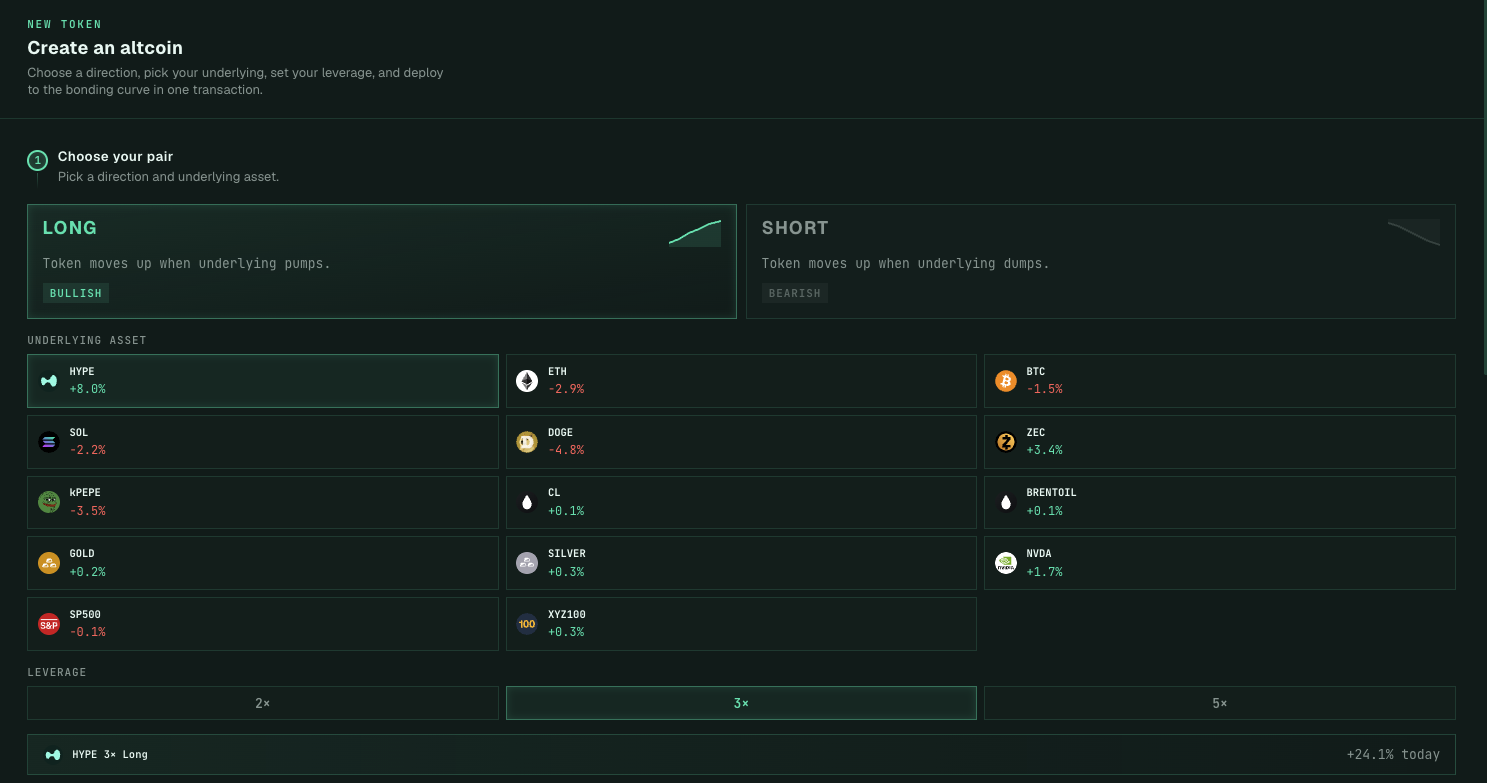
The difference from Pump.fun is that when creating a token on alt.fun, the user also needs to select an underlying asset and specify a leverage level (2x/3x/5x) for a short/long position. At the exact moment of token creation, the platform mints a corresponding amount of Leveraged Tokens (LT) on BounceTech(Odaily note: a permissionless leveraged token platform on Hyperliquid) and sends them to the user. These leveraged tokens represent perpetual contract positions on Hyperliquid. For example, if a user chooses to create a token based on a 3x long HYPE position, what they receive is essentially a leveraged token tracking the returns of a 3x long HYPE position.

As shown in the figure below, currently on alt.fun, users can choose from 14 underlying assets when creating a token. Similarly, when a player buys a Meme coin on this platform, the platform also mints the corresponding leveraged tokens on BounceTech. If a player sells, this process is reversed—the leveraged tokens are redeemed, and the user receives the corresponding USDC.
This model of packaging leveraged tokens as underlying assets and then selling them is similar to the securitization of specific risk exposures like futures and options in traditional finance, such as 3x short Nasdaq ETF, 5x short crude oil products, etc. In this process, the alt.fun platform acts as a role similar to an asset management company, managing the long-term positions behind the leveraged tokens for users.

The core price of such financial products follows the net asset value. However, because the token price on the alt.fun platform is also simultaneously influenced by the Meme coin bonding curve mechanism, the graduation model and price drivers for tokens on this platform are not singular.

Dual Graduation Modes and Price Driving Factors

This also means that token prices on the alt.fun platform are influenced by two factors: first, by market sentiment from buying and selling; second, by the performance of the underlying asset. So now you might understand the meaning of alt.fun's slogan, "Your token pumps even when nobody's buying."

For example, if a user creates a token based on a 3x long HYPE position with an initial investment of $20 (the platform's minimum buy-in size), and subsequently HYPE rises by 10%, then even if no one else buys the token, the user's holding value increases by 30% to $26.

Based on this dual price driver, the graduation model for tokens on the alt.fun platform is also not limited to one method. Specifically, the graduation condition for its tokens is reaching a market cap of $9,000. This essentially calculates the value of the leveraged token. Besides achieving graduation through token purchases, if the token's own value driven by the underlying asset's rise reaches a $9,000 market cap, it can also graduate smoothly. Therefore, whether a token reaches the graduation threshold is often a combined result of both price mechanisms.

Of course, ideally, the underlying asset's rise drives the leveraged token's increase, which, combined with the emotional catalyst from the Meme market, might cause the token's price to spiral upward rapidly. However, once the underlying asset falls, the leveraged token's value continues to shrink, potentially causing market panic and a sell-off, leading to the token's price crashing instantly.

Therefore, although alt.fun's mechanism can effectively leverage amplification effects, this only works in one-directional market trends and requires users to accurately catch the trend. If encountering volatile market conditions for the underlying asset, users must also bear the decay loss from leverage. This is because when the underlying asset price fluctuates, the platform needs to perform "rebalancing" to manage positions to avoid liquidation. This means that even if the underlying asset falls and then recovers to its original price, the leveraged token will suffer losses and gradually depreciate due to forced position reductions during the dip.

Furthermore, in cases of sudden price spikes or flash crashes, the platform might fail to react in time, potentially leading the leveraged token's value to zero.

Meme or not Meme

The alt.fun platform currently has a total of 41 graduated tokens. Only two have a market cap exceeding one million: ALT (based on 5x long HYPE) and STONKS (based on 5x long S&P 500). The total number of users is around just over 1,000. Although alt.fun is still in its early stages, we can already identify its current development bottlenecks.

First, the platform has too few underlying assets. With the current 14 underlying assets, there can be at most 84 different combinations of leveraged tokens. alt.fun has already seen leveraged tokens with the same leverage level (short/long) on the same underlying asset. For instance, the current top token ALT is based on 5x long HYPE, while another token, ATH, with a certain market cap, is also based on 5x long HYPE. Apart from the token name and creation time, there is no difference between them. In that case, why wouldn't an investor buy the lower-market-cap ATH?

Although alt.fun may support more underlying assets in the future, its core pain point is its inability to foster Meme coin community consensus.

The essential reason investors choose to buy leveraged tokens on the alt.fun platform instead of opening leveraged positions directly on Hyperliquid is to obtain greater price leverage and, because the platform manages position rebalancing on the backend, individual users can act as "hands-off managers," not worrying about individual liquidation risks.

But this is also the issue. Investors buying an alt.fun token are essentially doing so based on future price expectations for its underlying asset, not based on narrative, market games, attention—these "meaningless things" that ironically are the core value supporting Memes. A Meme's ability to rise or gain market recognition often isn't due to any actual value backing or financial design behind it; what's more important is its community propagation attribute.

As a Meme player, it's difficult for me to develop a love for a leveraged token similar to the passion for a particular Meme community's culture. If someone truly has faith in the underlying asset of a leveraged token, they might as well issue their own leveraged token rather than buying an existing one and bearing unnecessary premiums.

Therefore, the mechanism of the alt.fun platform appears novel, but in my view, it's merely a mechanical innovation. If alt.fun focuses on developing towards a DeFi platform in the future, there might be an opportunity. However, if it insists on forcing its way into the Meme launch platform track, it is destined to be a flash in the pan.


Trending Cryptos

Related Questions

QAccording to the article, what is the core innovation of the alt.fun platform and which two platforms does it combine?

AThe core innovation of the alt.fun platform is that it packages leveraged tokens as underlying assets and sells them as meme coins, combining the meme coin launch mechanism of Pump.fun with the perpetual contract (leveraged trading) functionality of Hyperliquid.

QWhat are the two main factors that drive the price of a meme coin on the alt.fun platform?

AThe price of a meme coin on the alt.fun platform is driven by two main factors: 1) Market sentiment and buying/selling pressure on the meme coin itself (via the bonding curve). 2) The performance of the underlying asset that the coin's leveraged token is tracking (e.g., if the coin is based on a 5x long position on HYPE, its value is affected by HYPE's price movement).

QWhat is one of the key risks or disadvantages mentioned regarding the alt.fun leveraged token model, especially in volatile market conditions?

AA key risk is the potential for "leverage decay." In volatile or choppy market conditions where the underlying asset price fluctuates up and down, the platform must perform "rebalancing" to manage the leveraged position. This process can cause the leveraged token to slowly lose value over time, even if the underlying asset's price eventually returns to its original level.

QWhat is identified in the article as the core dilemma or fundamental weakness of alt.fun's approach to being a meme coin platform?

AThe core weakness is that alt.fun's model lacks the ability to build true meme coin community consensus. Investors buy these tokens primarily based on price expectations for the underlying financial asset, not for the narrative, cultural elements, or community hype that are essential to sustaining a successful meme coin. It's more of a packaged financial product than a true community-driven meme.

QWhat are the two conditions under which a meme coin on alt.fun can 'graduate' (be successfully launched into a liquidity pool)?

AA meme coin on alt.fun graduates when its market capitalization reaches $9,000. This can happen in two ways: 1) Through purchases on the bonding curve, which increases the token's price and market cap. 2) Through the increase in value of the underlying leveraged token itself, driven by favorable price movement of the underlying asset, even without new buyers on the bonding curve.

Related Reads

From Gold to Bitcoin: Fixed Supply + Institutional Frenzy, Might It Repeat the 'Explosive' Price Trend?

"From Gold to Bitcoin: Fixed Supply and Institutional Frenzy May Lead to 'Explosive' Price Rally Analysts suggest Bitcoin's price action could mirror gold's over the past two decades, following the launch of spot Bitcoin ETFs. Gold ETFs, introduced in 2004, drove gold's price surge to a current market cap near $28 trillion. Both gold and Bitcoin are non-yielding stores of value, with prices driven purely by investor sentiment rather than cash flows or credit. Gold ETFs experienced dramatic cycles: explosive growth, painful drawdowns, and slow recoveries, with each cycle reaching higher peaks. Bitcoin ETFs, approved in early 2024, saw rapid institutional adoption but are now facing similar volatility. Recent warnings highlight the risk of significant ETF outflows disrupting the current rebound. BlackRock's IBIT, a leading Bitcoin ETF, has sold nearly 100,000 BTC to meet redemptions while still holding over 733,000. The core parallel is fixed supply: when demand surges, prices explode, but demand is often volatile and wave-like, not steady. Institutional interest, through ETFs and corporate adoption, remains a key support pillar, helping to cushion sell-offs. If Bitcoin captures even a fraction of gold's role as a store of value, its upside potential is immense, though the path will be marked by high volatility. For investors, focusing on long-term trends and managing risk is crucial as this 'price explosion' narrative unfolds."

Foresight News27m ago

From Gold to Bitcoin: Fixed Supply + Institutional Frenzy, Might It Repeat the 'Explosive' Price Trend?

Foresight News27m ago

Why Is AI Agent Shopping Hard to Popularize?

The article argues that the popular narrative of "AI agent shopping" – equipping AI with a wallet to autonomously handle purchases – is fundamentally flawed and oversimplifies the complexity of shopping. It deconstructs shopping into two core actions: **information retrieval** (standardized, easily automated) and **value judgment** (deeply subjective and human-centric). The narrative mistakenly assumes AI can fully handle both. Value judgment itself has two layers: **evaluation** (assessing options against criteria) and **demand definition** (setting the criteria, weights, and values). The latter is inherently human and dynamic, as preferences are not fixed but constructed during the decision-making process ("constructive preferences"). The real dividing line for automation is not product standardization, but whether the **act of choosing** itself holds experiential value. For mundane purchases (e.g., printer paper), full AI delegation works. For experiential goods (e.g., wine, furniture), the joy of selection is core to consumption, so AI should act as an assistant that narrows options, leaving the final choice to humans. The "AI wallet" concept confuses three separate elements: decision-making, execution, and fund custody. Current payment industry solutions (e.g., from Stripe, Mastercard, Google, Visa) show that limited, scoped payment authorization tokens are sufficient for most consumer scenarios, not full fund custody. The true use case for autonomous AI wallets is in **B2B procurement** and **machine-to-machine (M2M) settlements** for standardized, high-frequency, low-value transactions. The real bottlenecks for AI shopping are not payment technology, but **1) the lack of trusted data sources** (e.g., fake reviews, counterfeit goods) and **2) the impossibility of automating human demand definition**. The conclusion is that the focus should be on safely automating the assessment and filtering process while reserving for humans the rights to define their criteria and enjoy the final act of choice. For experiential goods, the platform's competitive advantage shifts to providing a superior selection experience.

Foresight News1h ago

Why Is AI Agent Shopping Hard to Popularize?

Foresight News1h ago

After Nine Months of Shorting, a Full Turn to Long: Renowned Trader Opens Bitcoin Positions Around 64K, Crypto Market Long-Short Divergence Intensifies

After nine months of being short, prominent crypto trader Doctor Profit has closed all his bearish positions and started buying Bitcoin near $64,000, signaling a complete bullish reversal. He argues that structural market changes—such as impending U.S. regulation (CLARITY Act) and institutional adoption via securities tokenization—are rewriting the traditional four-year cycle script, potentially bringing the market bottom forward from the widely expected September/October timeframe. This view finds some technical support from on-chain analyst gumsays, who notes a bullish divergence on Bitcoin's weekly chart has persisted for 147 days, nearing the 161-day duration seen before the 2022 cycle low. However, cycle researcher Jake Pahor presents a counter-argument based on historical data. Analyzing patterns since 2014, he identifies three common features of past bear market bottoms: a ~12-month duration from peak to trough, a sustained period of extreme fear (with a proprietary risk score below 20), and the price falling below Bitcoin's realized price (~$53,000 currently). The current cycle, only nine months from its October 2025 peak, meets none of these conditions. The debate highlights a market torn between "front-running" a potential early bottom driven by new fundamentals and waiting for confirmation through traditional on-chain and sentiment metrics. While Doctor Profit opts for aggressive buying, Pahor maintains a disciplined, tiered accumulation strategy, continuing weekly buys at current risk levels but reserving larger orders for if more extreme fear emerges.

marsbit1h ago

After Nine Months of Shorting, a Full Turn to Long: Renowned Trader Opens Bitcoin Positions Around 64K, Crypto Market Long-Short Divergence Intensifies

marsbit1h ago

Trading

Spot

Hot Articles

Discussions

Welcome to the HTX Community. Here, you can stay informed about the latest platform developments and gain access to professional market insights. Users' opinions on the price of MEME (MEME) are presented below.

活动图片