Meme Cultivation Manual: Reborn as a Diamond Hand (Part 4) | Produced by Nan Zhi

marsbitPublished on 2026-01-04Last updated on 2026-01-04

Abstract

"Meme Cultivation Guide: Reborn as a Diamond Hand (Part 4)" by Nan Zhi updates the progress of a meme coin copy-trading experiment on Solana. After implementing a depth evaluation system, Copy 1 and 2 accounts showed improved stability, providing steady returns, while Copy 6 saw a nearly 5x gain in a week (though this was partly due to an unexpected profit event from a split account strategy). As of November 4, the author details various copy-trading strategies: Accounts 1 and 2 follow low-frequency, high-profit-ratio "diamond hand" addresses; Account 5 follows an extremely low-frequency, high-risk address; and test accounts 1-6 track promising but unstable addresses with very small amounts to avoid significant losses. The depth evaluation system was upgraded with two new modules: a "copy-trading effect test" (calculating profit per initial trade round) and an "internal market performance evaluation" (assessing performance on Pump.fun to identify potential scam risks or poor internal trading skill). The author cautions that the system is still in early stages (28 days of operation) and lacks sufficient data for rigorous conclusions. Future plans include further system refinements to improve the copy-trading strategy.

Original | Odaily Planet Daily (@OdailyChina)

Author | Nan Zhi (@Assassin_Malvo)

Last week, after introducing the in-depth evaluation system, the stability of Copy Trading Accounts 1 and 2 significantly improved, beginning to provide sustained funding support for other test accounts. Furthermore, Copy Trading Account 6 achieved a nearly 5x increase in one week.

In this installment, the author will update the progress of each wallet, display the copy trading address tracking charts, and detail the upgrades to the in-depth evaluation system along with future plans.

Risk Warning: This system was launched on October 8th and has only been running for 28 days. While it has achieved certain results, objectively speaking, the data volume and controlled experiments are insufficient, and the rigor is limited. This is for readers' information only.

Funding Progress and Strategy Showcase

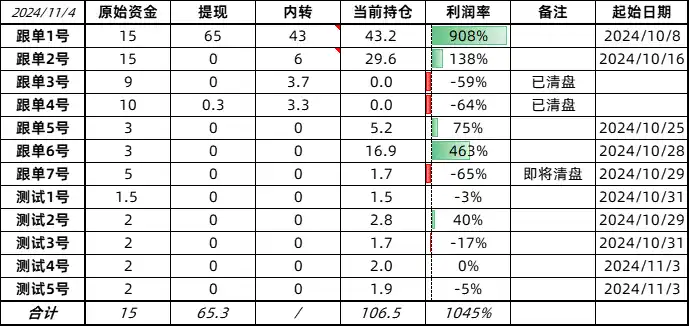
The funding status of each address as of November 4th, 17:30 (UTC+8) is shown below. The profit potential and growth curve vary significantly across accounts based on the style and strategy of the copied target. Notably, Copy Trading Account 6 achieved a nearly fivefold gain in one week under specific circumstances. For details, please refer to the next subsection.

This section will further elaborate on the specific copy trading strategies, showcasing the author's thought process.
The details of the tracked copy trading targets are shown in the figure below:

  • The left column is the strategy column, with different settings based on the wallet's profitability, purchase frequency, and on-premises market (Pump.fun) profitability.
  • The middle section shows the practical results and preliminary evaluation system labels.
  • The right column shows labels based on the In-depth Evaluation System I, with the label categories as shown in the legend in the top right corner.

(Note: The rationale for the left column settings is detailed in "Diamond Hands, High Profit Ratio? What are the Winning Factors in Solana Meme Trading?" and "Meme Cultivation Manual: Reborn as a Diamond Hand (Part 2)". The right column is detailed in "Meme Cultivation Manual: Reborn as a Diamond Hand (Part 3)".)
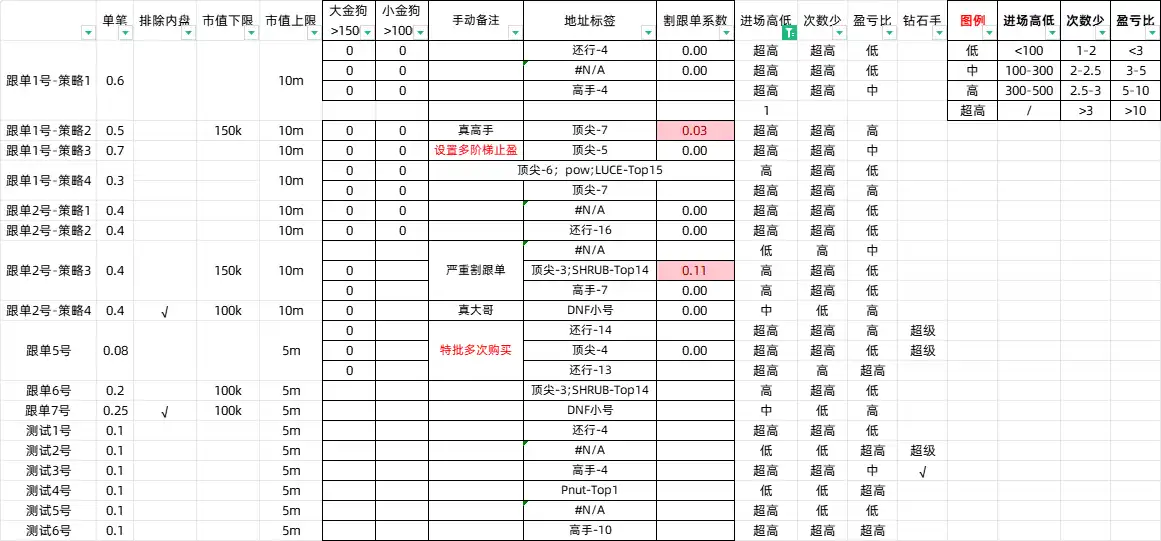
Copy Trading Strategy Overview

  • Copy Trading Accounts 1 and 2 are addresses selected early on for their low frequency, high profit ratio, and diamond hand behavior. Furthermore, addresses with high drawdowns were removed based on the guiding principles from Part 3. The results so far are acceptable: Account 1's profit rate increased from 725% to 908% in 6 days, and Account 2's increased from 84% to 138%.
  • Copy Trading Account 5 is an extremely low-frequency (only 11 buy operations to date), high profit ratio, extreme diamond hand address. Because these addresses have historically successfully added positions at highs multiple times, they are the only addresses for which multiple purchases are enabled, and the single purchase amount has been reduced. However, due to the limited total number of transactions, no conclusions can yet be drawn regarding their impact on the system's profitability.
  • Before the split, Wallet B (i.e., Account 7) purchased a certain token. Wallet B performed numerous profit-taking operations on this token, but after the split, Wallet B's operations were no longer copied. This resulted in unexpected gains and profits (accounting for about 50% of Account 6's total profit). Therefore, although Account 6 achieved a fivefold gain in a week, Accounts 6 and 7 should actually be combined with Account 2 for comparison. The combined weekly growth was 10.6 SOL (a 132.5% increase), still showing a certain advantage compared to Account 2's growth of 8.1 SOL.
  • Test Accounts 1-6 are used to test addresses that have outstanding strengths but lack stability. They use ultra-small amounts to test their long-term purchasing ability. If an account gets liquidated (goes to zero), it is cleared and marked as unsuitable for copy trading.

Version Iteration

In-depth Evaluation System (I)

In Part 3, the author introduced the In-depth Evaluation System (I) to further analyze an address's ability to "buy at the bottom," the risk of losing money by "FOMOing at highs," the ability to achieve high returns with small capital, stop-loss style, and the degree of "diamond hands."

Last week, the system was further enhanced with two new sub-modules: "Copy Trading Effect Test" and "On-Premises (Pump.fun) Performance Evaluation." The complete evaluation results of the system are shown in the figure below.

The "Copy Trading Effect Test" is currently still relatively rudimentary. Its calculation method is: Total profit provided by GMGN ÷ Number of first-round transactions. The converted profit for each token is then summed to obtain the "Converted Profit" for each address.

(Number of first-round transactions = the number of transactions from the first buy to the first sell, sourced from GMGN - Address Data - Token Transaction Details. Transferring tokens is also considered a sell.)

The reason for adopting this calculation method is that the copy trading system mostly only copies the buy action once, so it's necessary to evaluate the profit change under this style. A small decrease or even an increase in the converted profit is the ideal scenario. This ideal scenario occurs because the high-profit tokens of the copied target are a result of "buying once after identifying an opportunity," while the high-loss tokens are caused by "multiple additions to the position."

The calculation method for the "On-Premises Performance Evaluation" is also currently quite straightforward. First, it statistics whether the token was purchased on the Pump.fun on-premises market. Then, the win rate and multiple are calculated based on the token's total profit and total cost. The purpose of this data is to evaluate whether to copy on-premises trades. If a situation arises where "on-premises participation rate" is too high + "on-premises win rate" is high + "on-premises multiple" is too low, then this address carries the risk of cutting (scamming) copy traders. In cases where the win rate is low and the profit ratio is not high, it indicates poor on-premises trading skills, and their on-premises trades should not be copied.

Future Outlook

The copy trading system still has many areas that need improvement. Those currently planned include:


Related Questions

QWhat is the main topic of the article 'Meme修炼手册:重生之我要做钻石手(四)'?

AThe article provides an update on the progress of a copy-trading system for Solana Meme coins, detailing the performance of various copy-trading wallets, the upgrades to a deep evaluation system, and future plans.

QWhich copy-trading wallet achieved a nearly 5x increase in one week according to the article?

ACopy-trading Wallet No. 6 achieved a nearly 5x increase in one week.

QWhat new sub-modules were added to the Deep Evaluation System (一) in the past week?

ATwo new sub-modules were added: 'Copy-trading Effect Test' and 'Internal Market Performance Evaluation'.

QWhat is the purpose of the 'Internal Market Performance Evaluation' sub-module?

AIts purpose is to assess whether to follow an address's trades on internal markets (Pump fun) by evaluating their win rate and profit multiple there, helping to identify addresses that might be 'cutting off' copy-traders or have poor trading skills in that specific environment.

QWhat is the calculated metric for the 'Copy-trading Effect Test' sub-module?

AThe metric is 'Converted Profit', calculated as the total profit provided by GMGN divided by the number of first-round transactions (from first buy to first sell, where transferring tokens also counts as a sale), with the converted profit for each token then summed up.

Related Reads

GitHub, Transfixed by AI

On the night of February 9th, GitHub suffered a major outage caused by a simple configuration change—reducing a cache refresh interval from 12 to 2 hours—that triggered a cascade of failures. This was not an isolated event, but part of a broader pattern. In early 2026, GitHub experienced at least 8 major incidents, failing to meet its promised 99.9% availability. These outages stemmed from structural issues: explosive growth in load, tight service coupling, and insufficient protection against abnormal traffic. This unprecedented load is driven by AI Agents. In 2025, GitHub handled ~1 billion commits. By 2026, weekly commits reached 275 million, projecting to ~14 billion for the year—a 14x increase. AI tools like Claude Code now contribute 4.5% of all public repository commits, with weekly submissions surging 25x in just three months. AI-generated pull requests jumped from 4 million to 17 million per month in half a year. Unlike human developers, AI Agents work continuously, generating commits at a scale that overwhelms infrastructure designed for human rhythms. The surge also shattered GitHub's business model. Copilot's flat-rate pricing, based on assisting human developers, became unsustainable as Agentic AI sessions consumed resources worth hundreds of dollars for a few dollars in fees. In response, GitHub imposed usage limits and, by June 1st, shifted to a pay-per-use "AI Credits" system. Facing this new reality, GitHub realized a 10x scaling plan was insufficient. It announced a need to *redesign* its architecture for 30x current scale—decoupling services, adding fault isolation, and improving change management to prevent cascading failures. Other platforms like Stripe and AWS are facing similar challenges with AI Agents. Fundamentally, GitHub is transitioning from a human collaboration platform to an "exhaust pipe" for automated AI workflows. Its detailed post-mortem reports aim to maintain trust during this turbulent rebuild. The February outage was not just a technical glitch, but a signal of the software industry's entry into a new, AI-driven era.

marsbit30m ago

GitHub, Transfixed by AI

marsbit30m ago

Both Suffer Massive Losses Exceeding $90 Billion, Which Is in Greater Peril: Strategy or Bitmine?

Facing massive paper losses exceeding $90 billion each amidst a sharp market downturn, "Digital Asset Treasury" (DAT) giants Strategy and Bitmine find themselves in a precarious position, but with different underlying risks. Strategy, heavily invested in Bitcoin (BTC), faces significant financial strain. Its strategy relies heavily on debt, including convertible notes and preferred stock (STRC) requiring substantial dividend payments. With its cash reserves dwindling and BTC offering no staking yield for cash flow, Strategy's high leverage makes it vulnerable. A continued price decline could force asset sales to meet obligations, potentially creating a negative feedback loop. Its market value has already fallen sharply. In contrast, Bitmine, an Ethereum (ETH) holder, appears on firmer financial ground. It primarily funds its purchases through equity offerings (like ATM programs), avoiding debt pressure. It also generates income by staking a large portion of its ETH holdings. While not immune to market drops and shareholder dilution concerns, Bitmine maintains more flexibility, recently announcing a new preferred share offering to raise further capital. The core divergence lies in their financing: Bitmine uses equity (investor money), while Strategy uses debt (borrowed money). Consequently, Bitmine currently faces less immediate liquidity pressure than Strategy, which must navigate the dual challenge of servicing debt/dividends and a declining core asset (BTC) price.

marsbit37m ago

Both Suffer Massive Losses Exceeding $90 Billion, Which Is in Greater Peril: Strategy or Bitmine?

marsbit37m ago

Trading

Spot
Futures

Hot Articles

Discussions

Welcome to the HTX Community. Here, you can stay informed about the latest platform developments and gain access to professional market insights. Users' opinions on the price of MEME (MEME) are presented below.

活动图片