Meme Coin Watchlist: Who's Cultivating Real Fans, Who's Inflating Data?

marsbitPublished on 2026-03-10Last updated on 2026-03-10

Abstract

Meme coins are analyzed as a persistent and high-beta segment of the crypto market, with a focus on identifying tokens with strong community backing and holder conviction. The report examines BONK, PEPE, SPX6900, PENGU, and USELESS, selected based on liquidity, global appeal, cultural roots, historical volatility, and transparent on-chain data. Key on-chain metrics reveal distinct holder profiles. While BONK, PENGU, and PEPE have large, established holder bases, SPX6900 stands out with exceptionally high retention rates among both its $1,000 and $100,000+ holder cohorts, indicating a deeply committed community. Its holders have retained the highest percentage of their token units since all-time highs, even as its price shows relative resilience with a smaller drawdown from its peak compared to others. Current market conditions show all tokens are trading significantly below their 50-week moving averages (down 57-64%) and are in or near oversold RSI territory, suggesting potential entry points. The conclusion is that meme coins serve as a valuable gauge for market risk appetite and, with careful position sizing and timing, can enhance a portfolio's risk-adjusted returns.

Authored by: Michael Nadeau

Compiled and Edited by: BitpushNews

Whether you like it or not, we believe memecoins are here to stay. This article shares a macro view of the industry and delves into the meme coins we are closely monitoring.

Let's begin.

Why Focus on Meme Coins

Our Methodology

Some people love meme coins, others despise them deeply. We try to step outside this debate and simply observe the market. From our observations, meme coins have taken root. From a "Product-Market Fit (PMF)" perspective, they seem to be the ultimate crypto "game." People love trading, love gambling, love the social attributes, and love the risk-reward博弈 (game). And we believe participants are very aware of what kind of game they are playing.

After witnessing PEPE's success in the Ethereum ecosystem, we caught onto BONK and Solana in late 2023. This led us to research the field more deeply, including on-chain data and additional investments like GIGA, PEPE, and SPX6900. Our goal is to unearth unique properties in holder data that can indicate a token's Staying Power and the conviction of its holders.

Why BONK, PEPE, SPX6900, PENGU, and USELESS?

Liquidity: Each token has ample liquidity and is tradable on major exchanges and retail channels.

Audience Reach: Each token has global audience interest (not limited to niche memes like specific politics).

Leadership / Embedded Culture: Each token is supported by at least one of the following: 1) A highly influential leader/holder community; 2) An established internet meme/culture; or 3) An existing popular brand.

Historical Performance: Each token has experienced multiple massive rallies followed by sharp pullbacks. This price action shows broad market interest and helps distribute the holder structure, laying the foundation for the next expansion.

No Unlocks, No VCs: Only transparent on-chain data.

High Beta: Each token exhibits a high beta coefficient relative to BTC and the L1 assets of its ecosystem. With proper allocation (we target 3-5%), coin selection, and entry points, this can significantly enhance risk-adjusted returns.

Now, let's dive into the on-chain data and see if we can separate the real from the fake.

Total Token Holders
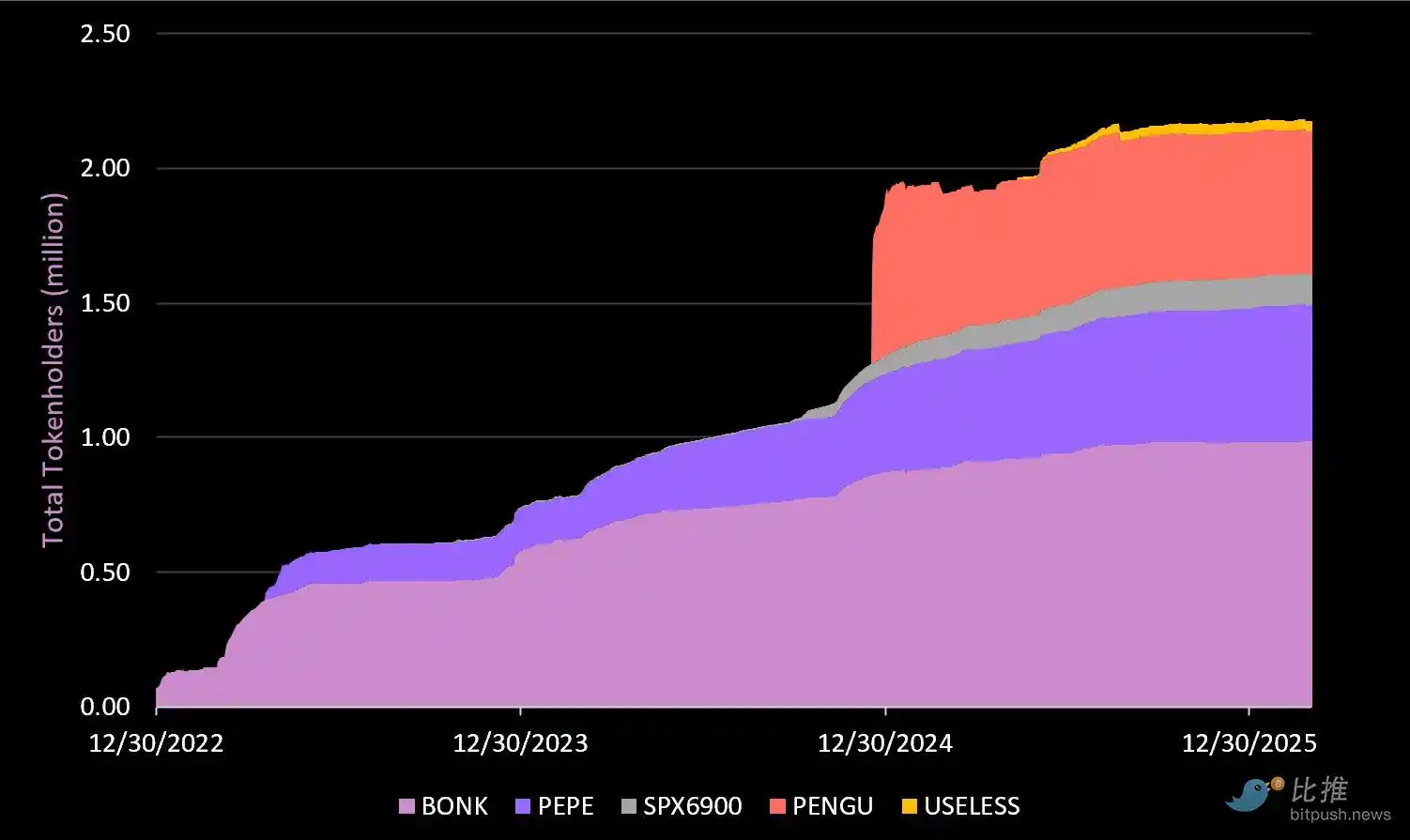
BONK: 985.9K current holders (at an all-time high in holdings). BONK launched in Dec '22, is the largest memecoin in the Solana ecosystem, deeply integrated into various apps and wallets. Note, BONK executed a community-driven airdrop, "seeding" a large number of wallets, which is reflected in the data in the table below.

PENGU: 534.1K holders (down 14% from peak). PENGU launched in Dec '24, represents social interest in the popular brand Pudgy Penguin. The total market cap of the Pudgy Penguin NFT series is currently about $78.5M, while its memecoin market cap is $454M (5.7x the NFT series, down from a peak of $2.7B). We believe the value of the Pudgy Penguin brand (a strong crypto brand that has broken into the mainstream) is likely to continue flowing to this memecoin.

PEPE: 505.7K current holders (down 1.51% from peak). PEPE launched in Apr '23. We believe PEPE is the purest expression of internet meme culture in cryptocurrency (especially Ethereum). It's based on the globally recognized "Pepe the Frog," which has maintained a strong internet presence since the late 2010s.

SPX6900: 113K current holders (down 0.33% from peak). SPX6900 launched in Sep 2023, spawning a fervent internet community led by Murad, with the core ethos of "Flipping the stock market." The brand seems to combine financial satire with a "BTC-like" holder base that is very serious (as shown in the data below). We successfully traded SPX6900 in the last bull run and have been analyzing its community and on-chain data since Aug '24.

USELESS: 38.6K current holders (down 5.2% from peak). USELESS launched in May '25, as a satirical "Anti-utility" memecoin. It attracted a vertical and seemingly loyal community after launching on LetsBONK last year (which took market share from Pump Fun at the time). Its current market cap is $44M with daily liquidity exceeding $10M (at bear market lows), we believe USELESS could present interesting opportunities under the right market conditions.

Holders with Balances Under $100
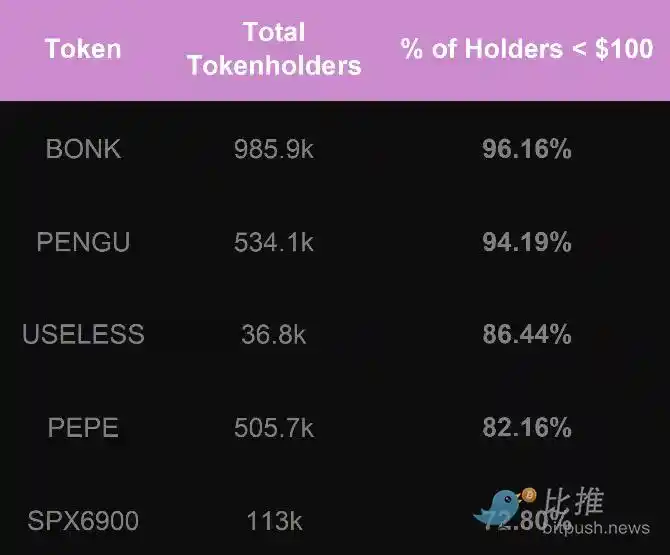
Conclusion:

BONK, PENGU, and PEPE already have very mature holder bases. SPX6900 shows a more resolute, loyal holder base (albeit smaller).

Holders with Balances Over $1,000
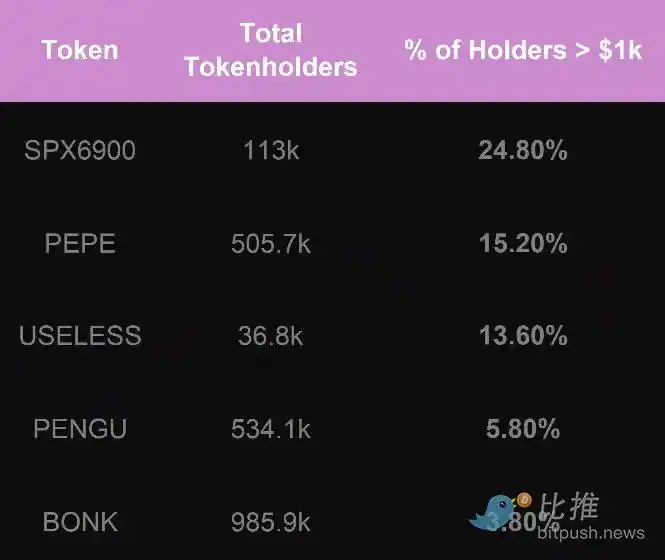
Note, $1,000 wallet categorization: Split by the number of token units held at the token's All-Time High (ATH) price equivalent to $1,000.

Conclusion:

SPX6900 stands out here, as it consistently has since we started tracking this metric.

To better understand the retention of $1,000 holders, we normalized the ATH data for each token, calculating the number of token units required to be a "$1,000 holder" at that time.

Then, we tracked the holdings (number of units) of these wallets over time. This aims to strip out the noise of price fluctuations to more accurately understand holders' willingness to retain.

Here are our findings:
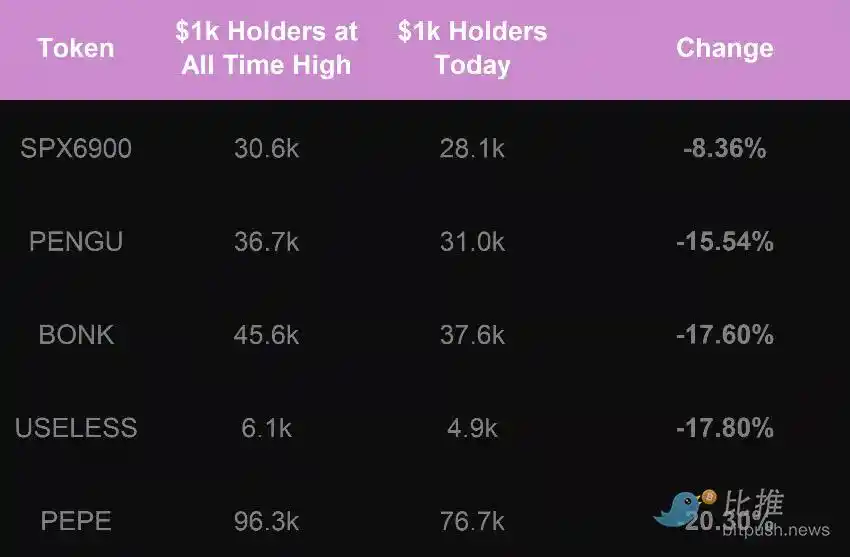
Conclusion:

In terms of "$1,000 holder" retention rate (measured in units to strip out price impact), SPX6900 seems to have separated itself from the pack.

Holders with Balances Over $100,000
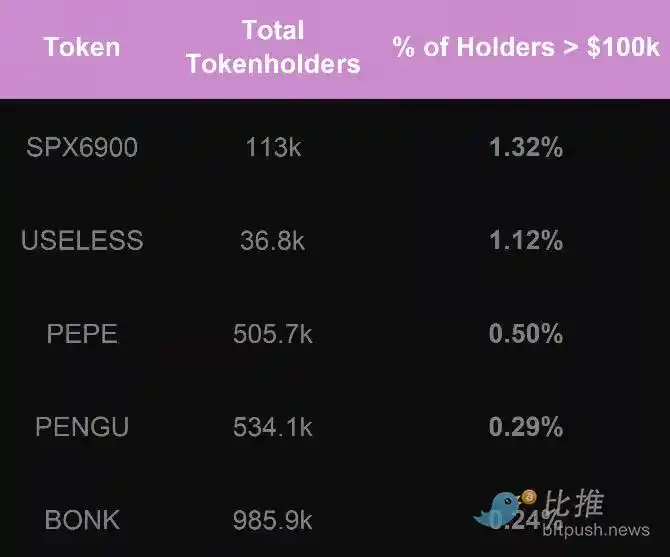
$100,000 wallet categorization: Split by the number of token units held at the token's All-Time High (ATH) price equivalent to $100,000.

Retention Rate

Similar to the $1,000 holder data, we categorized $100,000 wallets by their holding units at ATH.

Then, we tracked these wallets, determining the change in the total number of "$100,000 wallets" (by token units) over time.

Here are our findings:
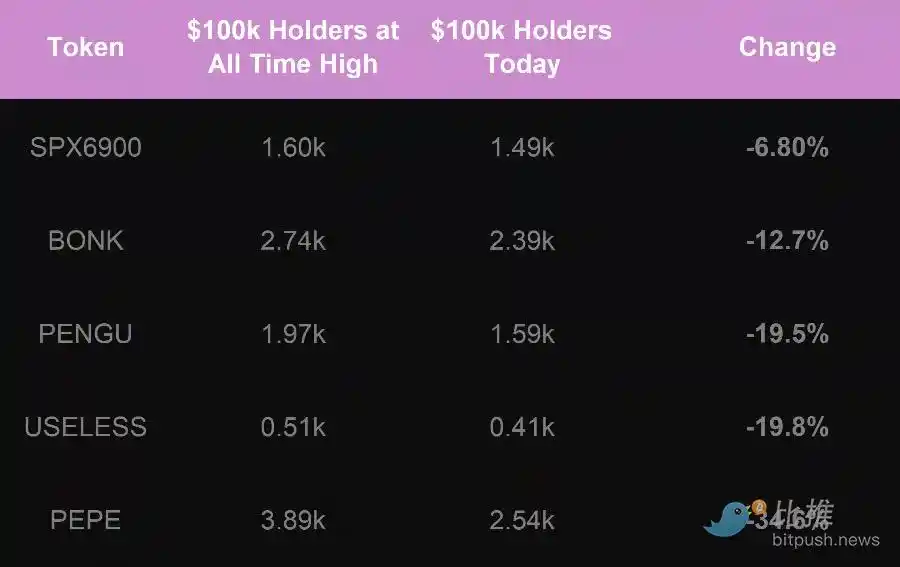
Conclusion:

Again, SPX6900 leads in the retention rate of token holders at the $100,000 level.

Whale Retention Rate

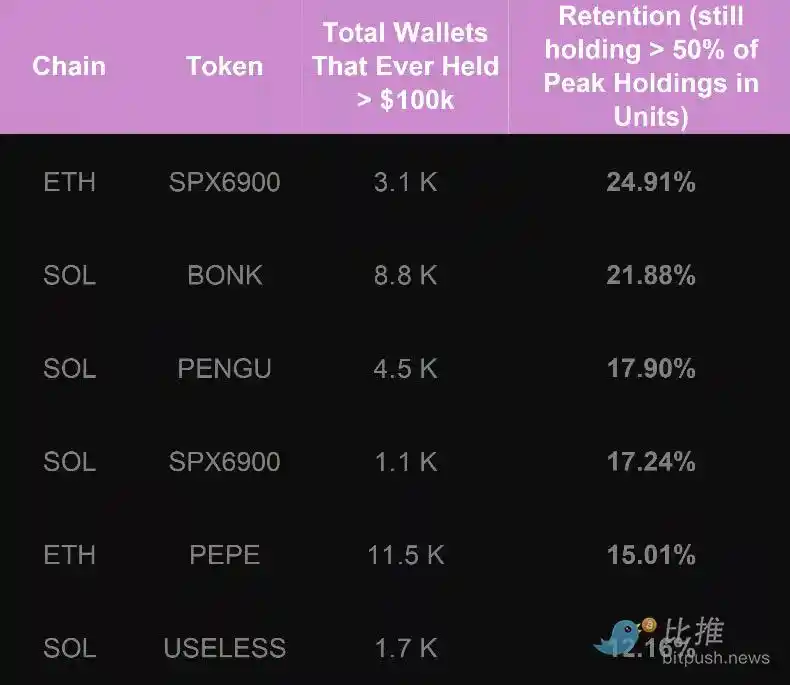
Another way to monitor whale retention is: Count all wallets that have ever held over $100,000 worth of the token, and compare that to the number of wallets that still hold more than 50% of their peak holdings (in units).

Here are our findings:
Momentum & 50-Week Moving Average (WMA)

Relative Strength
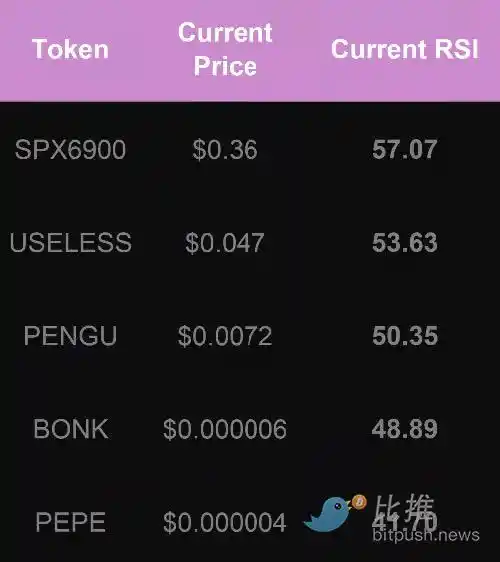
When we buy meme coins, we look for entry points where the 14-day RSI is at or near oversold territory (30).

50-Week Moving Average

SPX6900: Trading 64% below its 50 WMA.

BONK: Trading 62% below its 50 WMA.

PENGU: Trading 58% below its 50 WMA.

PEPE: Trading 57% below its 50 WMA.

Drawdown from All-Time High
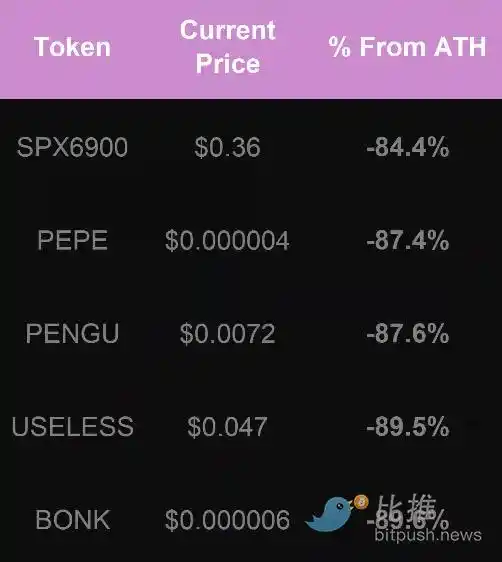
Given SPX6900's superior on-chain data, its relative resilience compared to the others is not surprising.

Conclusion

Given the industry's attention, we believe it is wise for crypto investors to pay attention to meme coins. We find them highly valuable for monitoring broad risk-on/off sentiment and liquidity conditions in the crypto market.

Not to mention, with appropriate position sizing and entry points, the right asset can provide a "powerful catalyst" for a portfolio.

We successfully captured BONK and SPX6900 in the last bull run (exiting with a small portfolio allocation for 10x+ gains). We will look for similar entry opportunities in the future.


Related Questions

QAccording to the article, which memecoin demonstrates the strongest holder retention rates for both $1,000 and $100,000 wallets?

ASPX6900 demonstrates the strongest holder retention rates for both $1,000 and $100,000 wallets, according to the on-chain data analysis.

QWhat are the three main criteria the author uses to select the memecoins (BONK, PEPE, SPX6900, PENGU, USELESS) for their watchlist?

AThe three main criteria are: Liquidity, Audience Range (global interest), and Leadership/Embedded Culture (backed by a charismatic leader/holder base, an established internet meme/culture, or an existing hot brand).

QWhat is the core concept or ideology behind the SPX6900 memecoin community?

AThe core ideology of the SPX6900 community is 'Flipping the stock market', led by an individual named Murad.

QHow does the market capitalization of the PENGU memecoin compare to the Pudgy Penguins NFT collection it is associated with?

AThe PENGU memecoin has a market capitalization of $454 million, which is 5.7 times larger than the $78.5 million market cap of the Pudgy Penguins NFT collection.

QWhat technical indicator level does the author look for as a potential entry point when buying memecoins?

AThe author looks for an entry point where the 14-day RSI is at or near the oversold region (a value of 30).

Related Reads

Will the Next Crypto Bull Run Start with On-Chain Trading of SpaceX?

This article presents a scenario-based forecast for the crypto industry from 2026 to 2029, arguing that the next major cycle will be driven not by technological narratives but by legal access to real-world assets. The author predicts that by mid-2026, pre-IPO perpetual contracts for top private companies like SpaceX, OpenAI, and Anthropic on platforms like Hyperliquid will become the primary gateway for accessing quality assets, as most crypto-native tokens fail to capture real value. The much-hyped AI x Crypto intersection largely fails except for prediction markets, which thrive on betting on AI model supremacy. By 2027, public blockchain foundations are forced to choose between catering to retail speculation or building compliant infrastructure for institutions, with many opting for the latter. Growth in stablecoins and tokenized private credit/equity hits a "triple ceiling" due to regulatory and political uncertainty rather than market demand. The pivotal shift is forecast for 2028. A major liquidation event in pre-IPO perpetuals exposes the structural flaw of synthetic markets lacking a real underlying asset anchor. In response, regulatory changes finally allow the public solicitation of private securities resales to verified accredited investors. This creates a legitimate secondary market for real company equity, which then becomes the core asset class of the new bull market, relegating synthetic perps to a niche role. By 2029, the industry becomes "boring" but foundational. Tokens without claims on real cash flows or assets cease trading. Stablecoin growth is steady but politically capped. Crypto infrastructure fades from view as it gets absorbed into traditional finance backends. The article's central thesis is that the key bottleneck for crypto's next phase is legal and regulatory channels for real asset ownership, not technology.

marsbit1h ago

Will the Next Crypto Bull Run Start with On-Chain Trading of SpaceX?

marsbit1h ago

The Value Distribution of Stablecoins

**Summary: The Value Distribution of Stablecoins** The article argues that stablecoins are evolving from mere trading tools into broader channels for dollar access. It divides the stablecoin ecosystem into four layers to analyze how value is distributed: 1. **Issuance Layer:** Mints stablecoins, holds reserve assets, and captures the spread between reserve yield and user costs (e.g., Tether, Circle). This layer currently earns the largest profit margin. 2. **Infrastructure Layer:** Connects stablecoins to the traditional financial system, handling fiat on/off-ramps, banking integration, compliance (KYC/AML), and asset management (e.g., Bridge, BVNK). This is the "unglamorous" but critical work, building the essential bridges between crypto and real-world finance. 3. **Acquiring/Distribution Layer:** Integrates stablecoins into merchant systems, manages payment flows, and provides enterprise financial software (e.g., Stripe, Coinbase). They act as the access point for businesses. 4. **Application Layer:** The end-users and businesses that ultimately use stablecoins for payments, settlements, or as a store of value. They benefit from convenience but have little pricing power. The core thesis is that while the issuance layer currently dominates profits, the often-overlooked **infrastructure layer holds significant long-term potential**. The real challenge and barrier to mass adoption is not the on-chain transfer of stablecoins (which is simple), but the complex "last mile" integration into existing business workflows, banking systems, and regulatory frameworks across different countries. Companies in this layer are currently in a "land grab" phase, investing heavily to build networks, secure bank partnerships, and establish compliance pathways. While their position is currently pressured by the profitable issuers above and distribution platforms below, the article suggests that if stablecoins become a default financial rail for businesses, the infrastructure providers who have done the hard work of integration will ultimately gain strong pricing power and become entrenched, essential players.

marsbit7h ago

The Value Distribution of Stablecoins

marsbit7h ago

The Value Distribution of Stablecoins

The Value Distribution of Stablecoins The article argues that stablecoins are evolving from a mere trading tool into a broad "dollar channel." It analyzes the industry's value chain through four layers: 1. **Issuance Layer (e.g., Tether, Circle):** The top layer that mints stablecoins, holds reserve assets, and captures the thickest interest rate spread. 2. **Infrastructure Layer (e.g., Bridge, BVNK):** Connects stablecoins to the traditional financial system, handling critical but complex "dirty work" like fiat on/off-ramps, banking integration, compliance (KYC/AML), and cross-border settlement. 3. **Acquiring/Distribution Layer (e.g., Stripe, Coinbase):** Embeds stablecoins into merchant systems, manages payment flows, and integrates with enterprise software. 4. **Application Layer:** End-users and businesses that ultimately use stablecoins for payments, settlement, or storing value. The author posits that while the issuance layer currently captures the most profit, the most overlooked and potentially critical layer is infrastructure. The core challenge for stablecoin adoption isn't the on-chain transfer (which is simple), but bridging the gap between blockchain and the real-world financial system. This involves solving practical problems for businesses: fiat conversion, reconciliation, tax handling, and user onboarding. Infrastructure companies are currently in a difficult "land-grab" phase—building networks, securing banking relationships, and achieving compliance country-by-country. They face pressure from both the profitable issuance layer above and distribution platforms below. However, the author suggests this layer is building a crucial moat. Once stablecoins become a default business rail, the infrastructure players who have done the hard work of integration may gain significant, durable value and pricing power.

链捕手7h ago

The Value Distribution of Stablecoins

链捕手7h ago

Trading

Spot
Futures

Hot Articles

Discussions

Welcome to the HTX Community. Here, you can stay informed about the latest platform developments and gain access to professional market insights. Users' opinions on the price of MEME (MEME) are presented below.

活动图片