Market Expert Reveals Why Ethereum Is A Better Bet Than Solana

bitcoinistPublished on 2026-06-04Last updated on 2026-06-04

Abstract

A market analyst argues that Ethereum (ETH) is a better long-term investment than Solana (SOL) despite recent price declines for both. While acknowledging Ethereum's weak price structure, falling network fees, and Solana's rapid growth in application fees, the analyst highlights key bullish factors for ETH. These include Ethereum's dominant share of on-chain stablecoin value (approximately $161.8 billion, or 50.7% of the total) and growing institutional interest, exemplified by BlackRock's recent filing for ERC-20 products on the Ethereum blockchain. The analyst projects that if the stablecoin market grows to $3 trillion by 2030 as forecasted, and Ethereum maintains its significant market share, over $1.5 trillion in value could be anchored to its network. This potential, coupled with the prospect of institutional asset tokenization, supports bullish long-term scenarios for Ethereum's market cap, ranging from 400% to 2,400% growth by 2029.

A crypto market expert has shared reasons why believes that despite the ongoing bearishness in the market right now, Ethereum (ETH) is still a better investment than Solana (SOL). Over the past few months, Ethereum has been in a slump, with its price falling below key support levels and underperforming the broader market. Meanwhile, Solana has seen its fair share of declines, plummeting by over 10% this past week. Despite the weakness across both assets, the analyst still picks Ethereum over Solana, citing ETH’s bullish drivers beyond price action and market trends.

Why Ethereum Is A Better Investment Than Solana

Emperor Osmo, a market analyst on X has presented a compelling case for why Ethereum remains a stronger bet than Solana despite ETH crashing more than 9.5% in the past week to trade near $1,870 at the time of writing. The analyst said he understands why many market participants and investors have turned bearish on the ETH price, pointing to weak price structure and declining network fees.

Osmo noted that Ethereum’s fee revenue has fallen sharply, while Solana continues to close the gap. According to him, Solana has generated about $3.859 billion in annual app fees compared to Ethereum’s $3.868 billion. The difference now stands at only $9 million after years of ETH maintaining a dominant lead.

The analyst also highlighted that Solana’s app fees are growing by roughly 9.5% per month, while ETH;s are declining by about 6.4%. Despite these trends, the analyst believes one key metric continues to support Ethereum’s long term bullish outlook. He revealed that the second largest cryptocurrency is currently sitting on about $161.8 billion in stablecoins, representing roughly 50.7% of all stablecoin value onchain.

Osmo also pointed to growing institutional interest in Ethereum’s ecosystem. He noted that BlackRock, the world’s largest asset manager, recently filed permissioned ERC-20 treasury products on Ethereum, picking the ETH blockchain above all others.

In addition, the analyst referenced projections from the U.S. Treasury Secretary, Scott Bessent, that the stablecoin market could eventually grow to $3 trillion by 2030. Based on those figures, Osmo argued that if Ethereum maintains its substantial stablecoin market share, more than $1.5 trillion in value could eventually be anchored to the network.

As a result, he believes that even if ETH’s current price reflects concerns around slowing fees and weak market structure, it does not represent its potential value backed by stablecoin growth and long term network retention.

Analyst Outlines Bull, Base, And Bear Case Scenarios For ETH

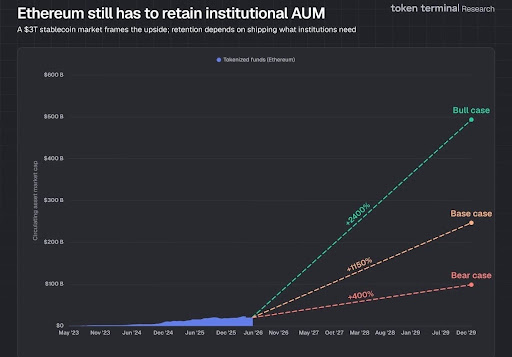
In an accompanying chart, Osmo mapped out bull, base, and bear case scenarios for Ethereum if it captures a significant slice of institutional stablecoin AUM. The analyst frames ETH’s potential upside against a projected $3 trillion stablecoin market, with retention hinging on whether the blockchain can ship what institutions need.
Source: Token Terminal

His bull case projects tokenized funds driving a 2,400% surge in ETH’s circulating asset market cap by December 2029. The base case puts that figure at 1,150%, while even the bear case holds upside at 400%.

ETH bears pull price below $2,000 | Source: ETHUSDT on Tradingview.com

Trending Cryptos

Related Questions

QAccording to the analyst Emperor Osmo, what is the main reason Ethereum is considered a better investment than Solana despite its recent price slump?

AThe analyst believes Ethereum's long-term bullish outlook is supported by its massive stablecoin holdings, which represent about 50.7% of all onchain stablecoin value, and growing institutional interest, such as BlackRock filing ERC-20 treasury products on Ethereum.

QWhat key metric does Emperor Osmo highlight where Solana is closing the gap with Ethereum?

AEmperor Osmo highlights that Solana is closing the gap in annual app fee revenue. Currently, the difference is only $9 million, with Solana generating about $3.859 billion compared to Ethereum's $3.868 billion.

QWhat are the projected growth trends for app fees on Ethereum and Solana according to the article?

AAccording to the article, Solana's app fees are growing by roughly 9.5% per month, while Ethereum's app fees are declining by about 6.4% per month.

QWhat potential future market size for stablecoins does the analyst reference, and what implication does this have for Ethereum?

AThe analyst references a projection from U.S. Treasury Secretary Scott Bessent that the stablecoin market could grow to $3 trillion by 2030. If Ethereum maintains its substantial market share, more than $1.5 trillion in value could be anchored to its network.

QWhat are the three scenarios (bull, base, bear) outlined by the analyst for Ethereum's potential market cap growth by December 2029?

AThe analyst's scenarios for Ethereum's circulating asset market cap growth by December 2029 are: a bull case projecting a 2,400% surge, a base case projecting a 1,150% surge, and a bear case projecting a 400% surge.

Related Reads

Bernstein Analysis: Can the $142 Billion Long-Term Order Hold Up the Memory Cycle?

Bernstein revisits long-term agreements (LTAs) in the memory industry, highlighting new contracts with purchase commitments, minimum prices, and financial guarantees signed by Micron and SanDisk. These aim to provide an earnings floor for the coming years. Micron has 16 strategic customer agreements, with 14 representing approximately $100 billion in minimum revenue and about $22 billion in cash deposits/commitments. SanDisk has contracts for around $42 billion in minimum revenue and over $11 billion in guarantees. Combined, these ~$33 billion in guarantees make it more costly for major clients to walk away. However, Bernstein models that the potential revenue needing protection over 3-5 years is around $5.2 trillion. The existing guarantees thus cover only about 0.6% of that scale. While LTAs provide a cushion, they cannot fully shield profits in a severe downturn, as clients may still find it cheaper to breach contracts if spot prices fall deeply below floor prices. LTAs are most suitable for large, credit-worthy customers like U.S. cloud service providers with stable, high-volume AI infrastructure needs. Consumer segments (phones, PCs) and some Chinese clients are less likely to adopt them, leaving an estimated 30-50% of the DRAM/NAND market exposed to spot price volatility. AI demand (e.g., HBM for training, storage for inference) supports higher valuations and makes LTAs more attractive for locking in high-demand customers. Yet, Bernstein stresses that LTAs soften, but do not eliminate, the memory cycle. Their true test will come in the next downturn, revealing whether clients honor contracts and whether guarantees provide sufficient pain to maintain supplier discipline.

marsbit24m ago

Bernstein Analysis: Can the $142 Billion Long-Term Order Hold Up the Memory Cycle?

marsbit24m ago

Dialogue with Jia Hang | Looking Back at Two Decades of Chinese Payment Going Global

**Summary: A Conversation with Jia Hang on Two Decades of China's Payment Globalization** Jia Hang, a veteran with over twenty years in payments, reflects on China's attempts to build a global payment network through three key phases: UnionPay (card networks), Alipay+ (digital wallets), and now, stablecoins. His journey began at UnionPay International, aiming to establish China's card network abroad. While successful in following Chinese tourists ("where Chinese go, UnionPay goes"), it struggled to achieve true global scale. The core lesson: card networks like Visa/Mastercard's unassailable advantage isn't just technical standards, but their deeply entrenched **governance and profit-sharing models** that create powerful network effects. Competing as the "same species" is nearly impossible. At Ant Group, he led Alipay+, a strategy to bypass card networks by interconnecting local e-wallets worldwide. While innovative, it faced a similar ceiling. Mobile QR payments and card swipes were essentially **the same species competing for the same pie**, lacking a disruptive value proposition for users or a sustainable new incentive model to replace the card networks' established flywheel. Today, at Singapore's DCS, Jia focuses on stablecoin-based payments. He argues stablecoins represent a fundamental shift. They are not competing with Visa for consumer payments but challenging the **traditional banking and account system for value movement**. Products like "U Cards" (stablecoin-linked payment cards) are transitional, leveraging existing card networks for acceptance while building new rails. The real potential lies in stablecoins enabling seamless, low-cost global value transfer, potentially reorganizing the financial infrastructure around **accounts rather than cards**. Jia believes stablecoin adoption for local retail payments, cross-border transactions, and as high-yield savings vehicles is becoming irreversible. This could gradually reduce reliance on traditional fiat channels, especially in regions with weak currencies or capital controls. The quest for the "next global payment network" continues, now centered on whether stablecoins can successfully bridge Web2 and Web3, establish new governance, and create compelling user value beyond mere cost reduction.

marsbit47m ago

Dialogue with Jia Hang | Looking Back at Two Decades of Chinese Payment Going Global

marsbit47m ago

Circle's Stock Price Plunges 76%, Hong Kong Dollar Stablecoin Set to Launch Within Two Weeks

Circle's stock price has plunged approximately 76% from its 2023 peak, reflecting a major market revaluation. Despite this, Circle President Heath Tarbert emphasized the company's focus on long-term execution and its dominant position with USDC's $73 billion circulation across 34 blockchains. The competitive landscape is intensifying. A new consortium-backed stablecoin, Open USD, is attempting to challenge incumbents by sharing reserve yields with partners. More significantly, Visa's new stablecoin platform, initially supporting Open USD while also being compatible with USDC, could erode Circle's network effects. In response, Circle is expanding into real-world payments through partnerships like the one with Japan's JCB. Separately, Tether (USDT) faces a two-year compliance window under new U.S. regulations, requiring it to adjust its reserve composition away from assets like Bitcoin and loans towards cash and U.S. Treasuries. Meanwhile, in Hong Kong, Standard Chartered-backed fintech firm Dian Dian is poised to launch a licensed HKD-pegged stablecoin (HKDAP), moving the industry into a phase where the real test is integrating licensed stablecoins into actual payment flows and corporate treasury systems. The sharp decline in Circle's stock underscores a broader shift: the stablecoin market is moving from a winner-takes-all dynamic to a multi-player competitive arena where execution, compliance, and real-world utility are becoming paramount.

marsbit48m ago

Circle's Stock Price Plunges 76%, Hong Kong Dollar Stablecoin Set to Launch Within Two Weeks

marsbit48m ago

Trading

Spot

Hot Articles

Discussions

Welcome to the HTX Community. Here, you can stay informed about the latest platform developments and gain access to professional market insights. Users' opinions on the price of ETH (ETH) are presented below.

活动图片