Lido: Revenue down 40%, market share intact – New report highlights mixed signals

ambcryptoPublished on 2026-03-25Last updated on 2026-03-25

Abstract

Lido, a leading Ethereum staking provider, reported a 23% year-on-year decline in annual revenue, falling to $40.5 million in 2025 from $52.4 million the previous year. The drop is attributed to staking outflows, a network-wide decrease in staking APR, and intensified competition from exchange and institutional staking services. Despite a broader surge in staking demand—driven by Spot ETH ETFs and corporate treasury activity—Lido experienced significant outflows, including 310,000 ETH in March 2026 alone. However, it maintained a dominant 24% market share with 8.8 million staked ETH. Looking ahead, Lido plans to diversify by expanding institutional distribution channels, scaling its validator marketplace, and enhancing its Lido Earn product. Additionally, the protocol aims to strengthen economic alignment with its LDO token through a proposed $10 million annual buyback program, expected to be formalized in Q2 2026. At the time of reporting, LDO was trading at $0.299, down 80% from its mid-2025 peak.

Ethereum staking provider Lido has reported a decline in annual revenue, citing a challenging macro landscape and competition.

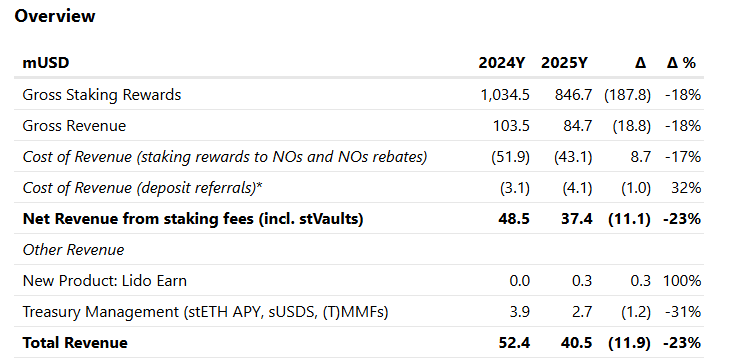
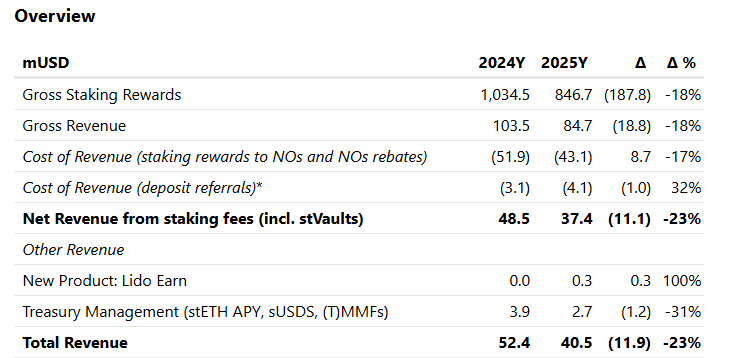
In its 2025 annual report, the Lido Foundation said that the protocol’s total revenue was $40.5 million, down from $52.4 million reached in 2024—a 23% decline in revenue on a year-on-year (YoY) basis.
Source: Lido

Lido’s market lead faces headwinds

Commenting on the revenue drop, Lido noted,

2025 unfolded under rewards compression driven by staking outflows and a network-wide decline in staking APR.

Regarding staking outflows, the protocol noted that this was further fueled by a structural shift towards exchange and institutional staking.

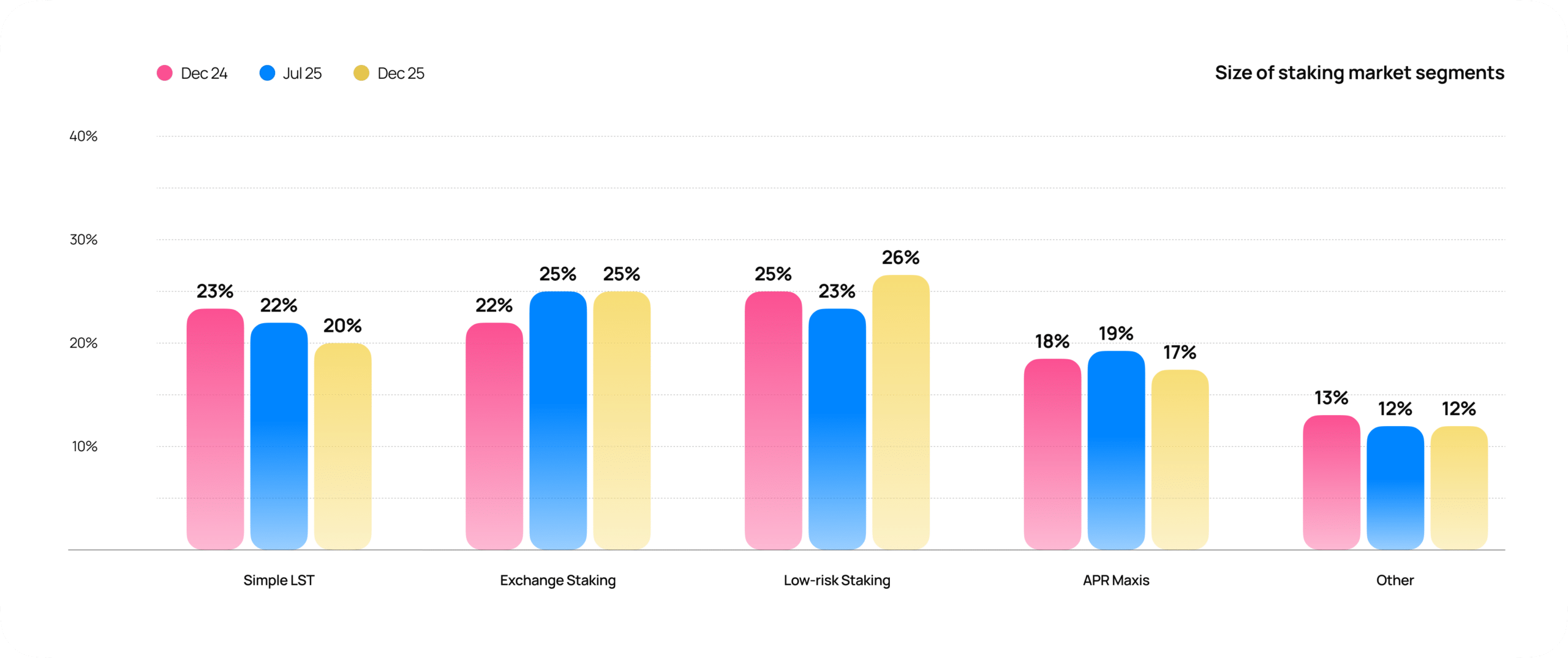
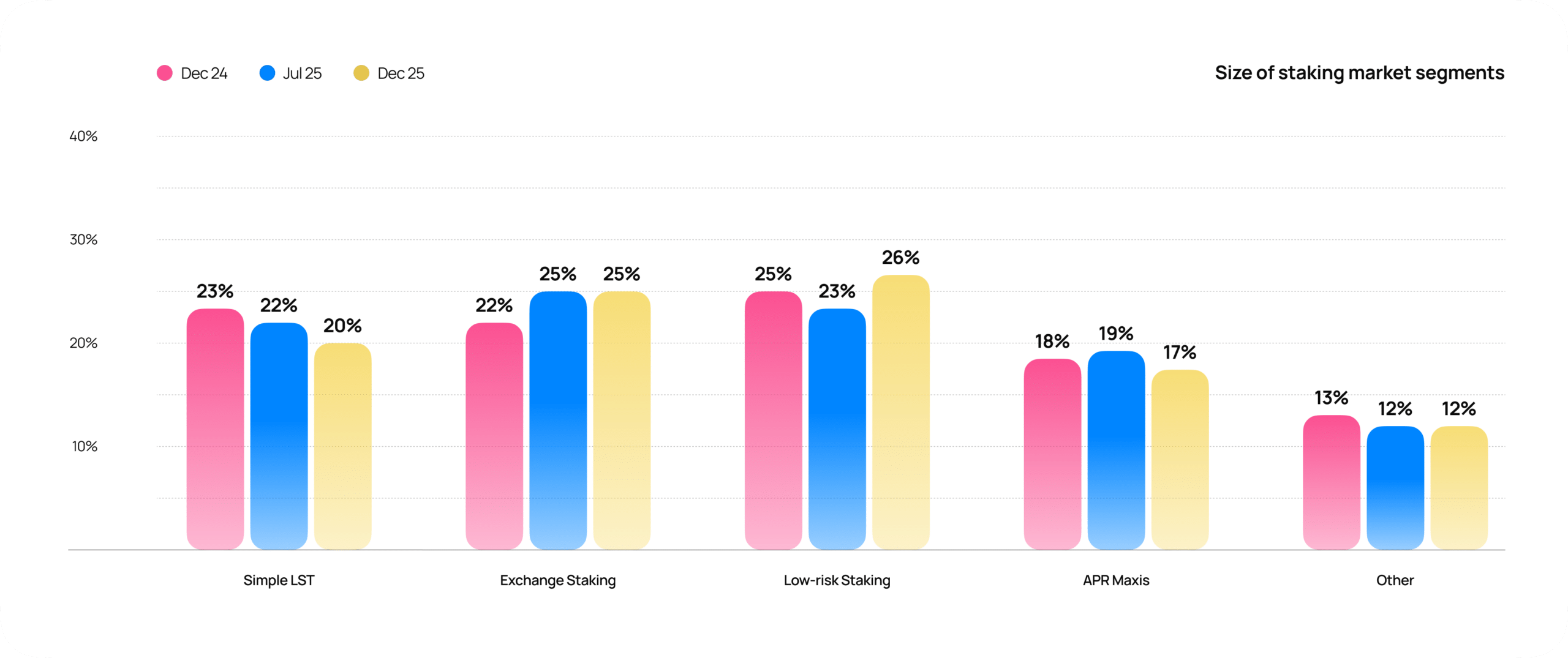
Capital rotation away from Simple LST toward exchange and institutional staking, and intensified competition, reduced the size of the segment where Lido holds category leadership.
Source: Lido

Well, the staking demand has soared in recent months, reaching a record 30.7% of total ETH supply (38.2 million staked ETH). The uptick was driven by Spot ETH ETFs and treasury firms activating the yield feature for their investors.

In contrast, Lido’s outflows haven’t abated even in 2026. In March alone, Lido led the staking outflows, with nearly 310K ETH leaving the protocol.
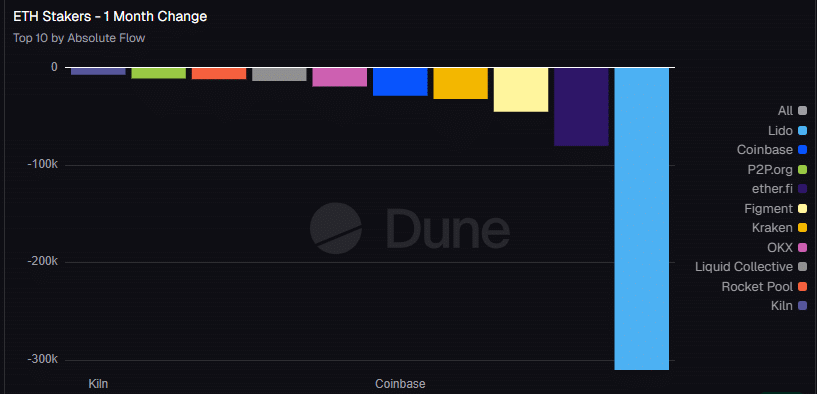
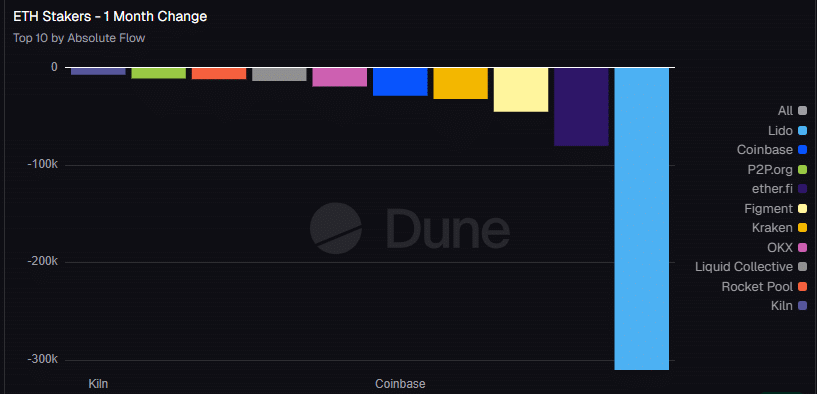
Source: Dune

Even so, Lido maintained its dominant market share at 24% (8.8 million staked ETH). However, it will focus on diversification in 2026.

These will include doubling down on institutional distribution channels for low-risk staking segments (e.g., via WisdomTree Physical Lido Staked Ether), expanding its Lido Earn product, and scaling its validator marketplace.
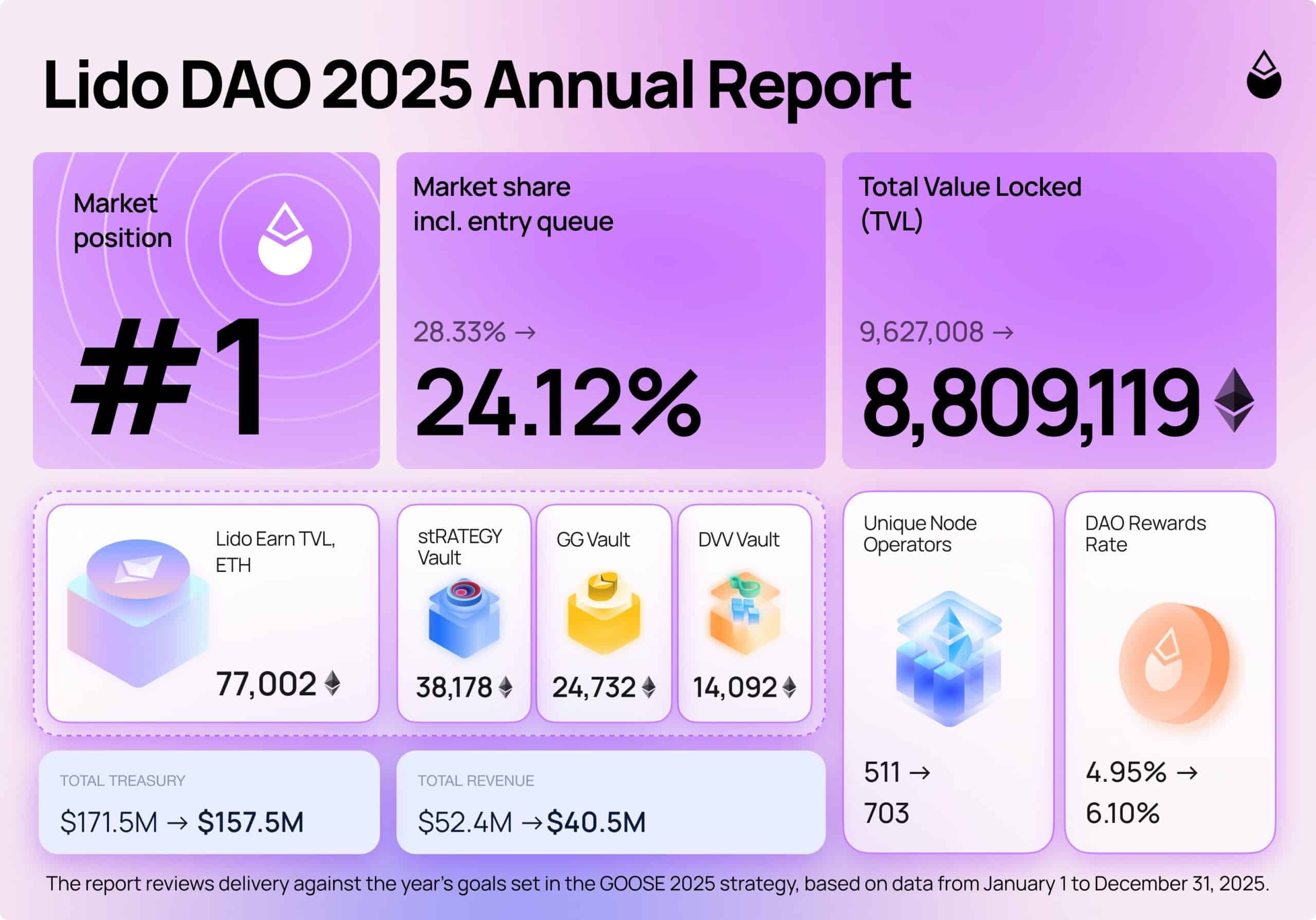
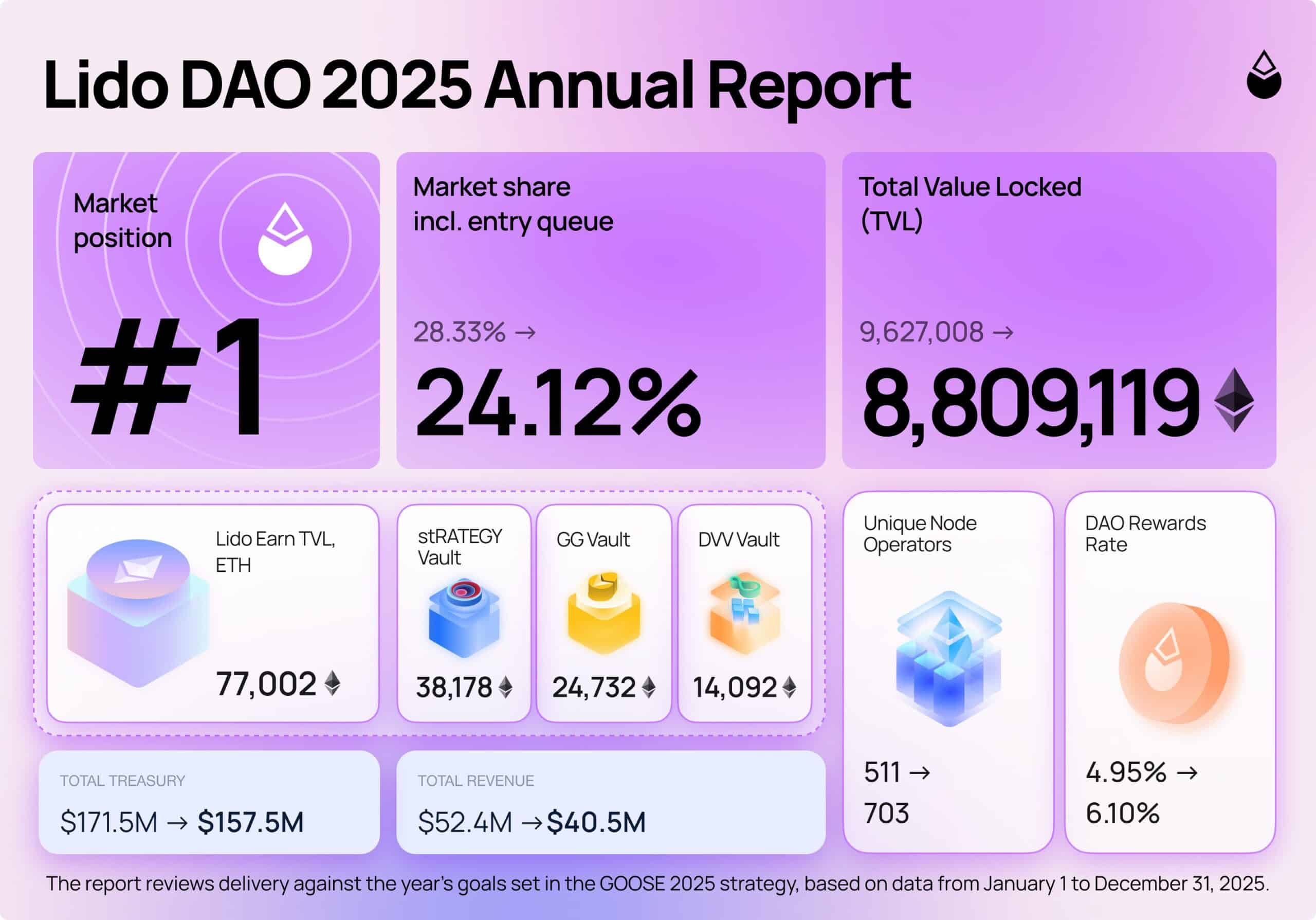
Source: Lido

LDO token alignment plans

Lido also noted that it will advance ‘stronger economic alignment’ between the protocol performance and LDO. According to ongoing discussions, part of the token accrual plan will include automated token buyback via a ‘treasury surplus fund.’

This proposal was floated last November, with an annual budget of $10 million for the buyback program. A formal plan for the same is expected in Q2 2026, but it remains to be seen how LDO, the protocol’s native token, will react to the update.

At the time of writing, LDO traded at $0.299 and was down 80% from the H2 2025 high of $1.5.


Final Summary

  • Lido revenue dropped by 23% to $40.5M amid rising staking competition from spot ETH ETFs, treasury firms, and centralized exchanges.
  • LDO token alignment and the $10M buyback program are expected to be formalized in Q2 2026.

Trending Cryptos

Related Questions

QWhat was the percentage decline in Lido's annual revenue from 2024 to 2025, and what were the total revenue figures for those years?

ALido's annual revenue declined by 23% year-on-year, from $52.4 million in 2024 to $40.5 million in 2025.

QWhat two main reasons did Lido cite for the decline in its revenue and the staking outflows?

ALido cited rewards compression driven by staking outflows and a network-wide decline in staking APR, which were further fueled by a structural shift towards exchange and institutional staking.

QDespite the outflows, what market share of the total ETH staking market did Lido maintain?

ALido maintained its dominant market share at 24%, representing 8.8 million staked ETH.

QWhat are Lido's three main areas of focus for diversification in 2026?

ALido's focus for 2026 includes doubling down on institutional distribution channels for low-risk staking, expanding its Lido Earn product, and scaling its validator marketplace.

QWhat is the key feature of the LDO token alignment plan, and when is a formal proposal for it expected?

AA key feature of the plan is an automated token buyback via a 'treasury surplus fund' with an annual budget of $10 million. A formal proposal for this is expected in Q2 2026.

Related Reads

Must-Watch Events Next Week|CLARITY Act Could Face Senate Vote; SpaceX, Circle to Report Earnings (8.3-8.9)

**Summary: Key Events and Developments to Watch (August 3-9)** The upcoming week is marked by significant financial disclosures, key legislative deadlines, and notable product updates. **Major Financial Events:** Several companies are scheduled to release their Q2 2026 earnings. American Bitcoin (ABTC) will report on August 3, followed by SpaceX and Hut 8 Mining Corp. on August 4, and Circle on August 5. Notably, a significant portion of SpaceX shares (up to 12% of total shares) will be unlocked on August 6 following their earnings release. **Key Legislative Deadline:** The U.S. Senate faces an August 7 deadline to secure 60 votes for the CLARITY Act, a bipartisan bill aiming to establish a federal regulatory framework for cryptocurrencies. The Senate may hold a full vote on the bill during the week. **Economic Data:** The U.S. July Non-Farm Payrolls report will be released on August 7, providing crucial labor market data. **Technology & Product Updates:** * **Shutdowns:** DeFi portfolio tracker Zapper and wallet app Ctrl Wallet will cease operations on August 3. * **Upgrades:** LayerZero will deprecate its v1 relayers on August 3. XRP Ledger's new version 3.3.0, featuring five new functions, is expected next week. * **AI:** Elon Musk announced that the advanced Grok 4.6 AI model is set for release around August 7. * **Bitcoin:** The BIP-110 forced signaling for a potential Bitcoin network change is scheduled to begin around August 8. **Other Notable Events:** Chinese robotics firm Unitree Tech has set its preliminary price inquiry for its IPO for August 5. South Korean exchange Upbit will delist AQT and AERGO tokens on August 3.

marsbit21m ago

Must-Watch Events Next Week|CLARITY Act Could Face Senate Vote; SpaceX, Circle to Report Earnings (8.3-8.9)

marsbit21m ago

Stocks Are Plummeting More Sharply Than Cryptocurrencies. Where Has the Money Gone?

Stock Markets Plunge Deeper Than Cryptocurrencies: Where Did the Money Go? In late July, Seoul's Kospi index triggered circuit breakers for two consecutive days, plummeting over 40% from its June high. The collapse was led by heavyweight stocks like SK Hynix, whose record profits still disappointed investors, and devastating leveraged ETFs, with one major product losing over 83% of its value. This signaled a global, forced deleveraging targeting the most crowded trades. Interestingly, while stocks exhibited extreme volatility akin to crypto markets, Bitcoin rose nearly 15% in July after a prior steep drop. Analysis shows the money fleeing equities did not flow into Bitcoin. Instead, Bitcoin had already absorbed its sell-off in May-June, when U.S. spot Bitcoin ETFs saw historic outflows. The true safe-haven beneficiary was gold, whose price rose over 20% year-on-year, highlighting a decoupling between Bitcoin and gold as "digital gold." The sell-off was a targeted unwinding of leveraged positions in tech and semiconductors, accelerated by broker-dealer risk management and shifts in the AI narrative, including new competition from Chinese memory chipmakers. The retreat path was clear: from high-valuation tech stocks to cash and U.S. Treasuries, then to gold. For Bitcoin to attract sustained institutional inflows, conditions like eased global liquidity pressure, a "soft-landing" Fed rate cut, and U.S. regulatory clarity via legislation like the stalled CLARITY Act are needed. Currently, Bitcoin is not a safe haven but an already-cleared asset. Its low correlation with tech stocks, however, makes it a potential diversification play for institutional portfolios once the storm passes. The money isn't here yet, but the positioning is underway.

marsbit21m ago

Stocks Are Plummeting More Sharply Than Cryptocurrencies. Where Has the Money Gone?

marsbit21m ago

In Conversation with Ray Dalio: We Are Currently in an AI Bubble, with 1% of My Portfolio in Bitcoin

Ray Dalio, founder of Bridgewater Associates, warns in an interview that the current AI boom shows classic bubble characteristics, which could lead to significant economic downturns as seen in past cycles like 1929 or 2000. He explains that speculative enthusiasm, fueled by debt and overvaluation, often precedes a crash when rising rates or taxation force asset sales, causing widespread losses and recession. Dalio also outlines his "Big Cycle" theory, describing an approximate 80-year pattern where widening wealth gaps, massive government deficits, and shifting geopolitical power (like China's rise) create internal conflict and global instability. He emphasizes that we are in a late-cycle, transitional phase where traditional powers like the US and UK face decline. For personal wealth protection, Dalio advises diversification beyond cash into assets like stocks, bonds, real estate, and particularly gold, which he prefers over Bitcoin. While he holds about 1% of his portfolio in Bitcoin as a non-printable hard asset, he views gold as more secure from technological or governmental threats. Regarding AI's impact, Dalio believes it will disproportionately benefit capital owners, worsening inequality by replacing both physical and cognitive labor. He suggests that human intuition and emotional intelligence, combined with AI, will be key for future workers. On taxation, Dalio argues that wealth taxes are impractical and risk triggering asset sell-offs, reducing productive investment. He points to the UK as a cautionary example of debt, low productivity, and political strife. Geopolitically, Dalio foresees a more regionalized world, with the US showing weakness in prolonged conflicts like with Iran, akin to past imperial declines. The ideal outcome, he suggests, is coexisting powerful blocs (e.g., Americas, China-Asia Pacific) without major war.

marsbit4h ago

In Conversation with Ray Dalio: We Are Currently in an AI Bubble, with 1% of My Portfolio in Bitcoin

marsbit4h ago

Daily 7.2 Trillion KRW: Foreign Capital's Record Net Buying on Friday! Wall Street Says Headwinds for Korean Stock Fund Flows Have Subsided

South Korean stock market sees a dramatic shift in fund flows. On July 31, foreign investors made a record net purchase of approximately KRW 7.2 trillion in KOSPI stocks, marking a fundamental reversal from the persistent large-scale net outflows seen in previous months. This contributed to a significant narrowing of foreign net selling in July to KRW 9.8 trillion, down sharply from KRW 48.4 trillion in June and KRW 44.5 trillion in May. Simultaneously, domestic institutional pressure eased. South Korean pension funds and asset managers turned to a net buying position in July, purchasing KRW 1.0 trillion worth of KOSPI shares, contrasting with net sales in May and June. Market volatility is expected to be dampened by new financial regulations. Effective July 31, the Financial Services Commission tightened access for retail investors to single-stock leveraged ETFs by raising the minimum cash deposit requirement. Trading volumes for these products subsequently dropped to about 50% of their monthly average. Citigroup Research maintains its year-end KOSPI target of 10,000 points. The firm cites several supportive factors: the substantial easing of headwinds from capital outflows, a robust fundamental outlook for the semiconductor sector, historically low market valuations, strong economic fundamentals, and the potential for policy support from financial authorities if needed.

marsbit4h ago

Daily 7.2 Trillion KRW: Foreign Capital's Record Net Buying on Friday! Wall Street Says Headwinds for Korean Stock Fund Flows Have Subsided

marsbit4h ago

Trading

Spot

Hot Articles

Discussions

Welcome to the HTX Community. Here, you can stay informed about the latest platform developments and gain access to professional market insights. Users' opinions on the price of ETH (ETH) are presented below.

活动图片















