Key Figure at xAI Departs, Dealing a Heavy Blow to Musk's AI Ambitions

marsbitPublished on 2026-02-12Last updated on 2026-02-12

Abstract

Elon Musk's AI ambitions face a major setback as Tony Wu, co-founder and head of AI reasoning at xAI, resigns. This marks the departure of a second co-founder within months, following Igor Babuschkin’s exit last August. Wu led a critical division focused on AI reasoning—a core capability for advancing toward artificial general intelligence. The loss is particularly damaging given the current competitive AI landscape, where reasoning is key to surpassing models like GPT-4 and Claude. Wu’s exit may delay xAI’s R&D progress by at least six months and weaken its position against rivals like OpenAI and Anthropic. The departures highlight potential internal challenges. Musk’s intense, top-down management style—effective in engineering-driven companies like Tesla and SpaceX—may clash with the creative, research-oriented culture required for breakthrough AI work. Of xAI’s original 12 founding members, five have now left. In a fiercely competitive AI talent market, top researchers prioritize environments that offer technical autonomy and clear direction—areas where xAI may struggle against more research-centric organizations. The repeated loss of key figures raises questions about xAI’s ability to compete long-term in the race toward AGI.

Author: Hua Lin Wu Wang, Geek Park

Editor: Jing Yu

Just as Musk was preparing to merge SpaceX and xAI to create a cosmic AI behemoth valued at $1.25 trillion, he never expected that not everyone could stomach his grand vision.

On February 10, 2026, local time, xAI co-founder Tony Wu announced his departure from Musk's AI company.

This marks the second co-founder to leave xAI since Igor Babuschkin's departure last August. Wu was responsible for AI reasoning capabilities—a key technical direction considered by the industry to be the core competitiveness of next-generation AI systems.

It is uncommon in Silicon Valley for an AI company, barely over two years old, to lose two co-founders in succession. More critically, this is happening at a time when AI competition is fiercest and talent is scarcest.

With founders leaving one after another, can Musk's AI ambitions continue?

01. Reasoning Expert Walks Away

Tony Wu's role at xAI was far more important than it appeared.

As the technical lead responsible for reasoning capabilities, Wu reported directly to Musk. At the current stage of AI development, reasoning capabilities are seen as the critical bridge between large models like GPT-4 and Claude and true "Artificial General Intelligence."

Simply put, Wu was tasked with making AI "think," not just "memorize and imitate."

Losing Wu at this juncture is a devastating blow to xAI.
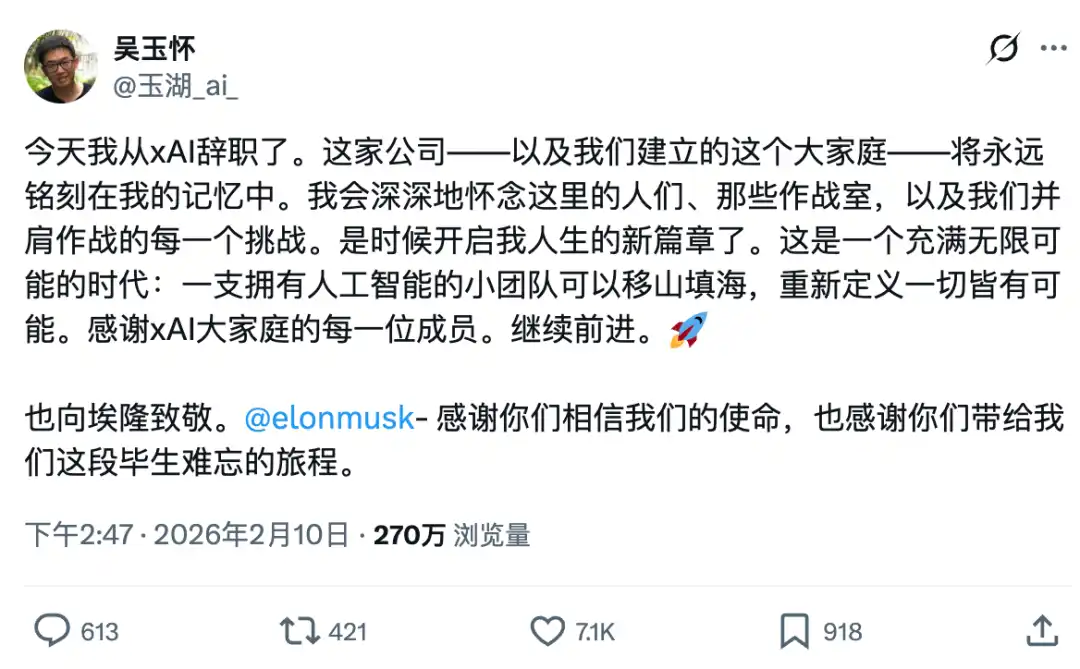
Tony Wu announced his departure on X | Image source: X

From a technical perspective, breakthroughs in AI reasoning require long-term accumulation and continuous iteration. The departure of a reasoning expert takes away not just individual expertise, but also entire technical approaches, experimental data, and judgment on future R&D directions. In the fast-paced AI industry, where progress is measured in months, losing a key technical lead often means at least six months of stalled development.

The timing is even more concerning. OpenAI just released a new code model, achieving significant breakthroughs in AI coding; Anthropic's Claude is performing increasingly well on reasoning tasks. Losing the core figure of the reasoning team at this point could easily cause xAI to fall behind in the most critical technological race.

One developer bluntly stated on X: "Losing Tony Wu is like Tesla losing its head of battery technology. On the surface, the company keeps operating, but its core competitiveness has been hit."

Tony Wu isn't the only one. In fact, over the past year, 5 out of the 12 founding members of xAI have left—a nearly 50% attrition rate, matching the efficiency of Musk's massive Twitter layoffs.

Why are top AI talents unwilling to follow Musk's AI vision?

02. The "Side Effects" of Musk-Style Management

The consecutive departures of two co-founders force a re-examination of what is really happening inside xAI.

Although the specific reasons for leaving were not disclosed officially, judging from Musk's management style at Twitter, Tesla, and SpaceX, the issue might not be compensation, but a clash of management philosophies.

Musk is known for his "extreme pressure" management style.

During the overhaul of Twitter, he once had employees sleeping in the office and conducted large-scale layoffs with an "extremely hardcore or leave" approach. This management style might work in manufacturing or relatively mature tech products, but AI R&D requires creative thinking and long-term focus, not just execution efficiency.

A former OpenAI researcher said in an interview: "AI research has its own rhythm. Sometimes a algorithmic breakthrough requires months of quiet contemplation; other times it requires repeated trial and error. If management is always催促 ('faster, even faster'), it's easy for researchers to feel frustrated."

More critical are divergences in technical路线 (roadmaps).

Musk has publicly stated that xAI pursues "maximum truth-seeking" and "understanding the universe." Such a grand vision is inspiring, but its technical implementation often requires more pragmatic path choices.

When the CEO's vision conflicts with the technical team's judgment, who has the final say?

In traditional AI research institutions, technical experts usually have greater say. But in Musk's companies, the final decision-making power often rests with him.

03. The "Bloodbath" for AI Talent

Viewing xAI's brain drain in a broader context, it is a microcosm of the "bloodbath" for talent across the entire AI industry.

In today's AI industry, top talent is as rare as nuclear physicists were in the last century.

A talented AI researcher might receive offers from OpenAI, Anthropic, and Google DeepMind simultaneously, with an annual salary easily exceeding $500,000, not to mention equity packages worth astronomical figures.

In this environment, the key to retaining talent isn't just money, but also the platform and culture. Researchers prefer places where they can focus on technology, have clear R&D paths, and aren't frequently disturbed by management.

From this perspective, OpenAI and Anthropic do have an advantage.

These two companies are led by AI researchers, where the technical team has sufficient say in key decisions. In contrast, xAI seems more like a "CEO-driven" company—Musk's personal will often overrides the technical team's judgment.

This isn't to say Musk's approach is wrong, but in the unique context of the AI industry, this management style might not be optimal.

A Reddit user hit the nail on the head: "Musk excels at engineering and productization, but the first half of AI research is more like scientific research, requiring patience and room for trial and error."

The question now is, how much time does xAI have to adjust?

In the "winner-takes-all" game of AI, falling behind by six months could mean complete elimination. Losing two co-founders could be a heavier price than imagined for an AI company still searching for its technological breakthrough.

After all, in this AI arms race, the scarcest resource has never been money, but the people who truly know how to make machines "think."

Related Questions

QWho is the co-founder that recently left xAI, and what was his key responsibility?

ATony Wu, who was responsible for AI inference capabilities, a key technology considered the core competitiveness of next-generation AI systems.

QHow many co-founders have left xAI in total, and what does this indicate about the company?

ATwo co-founders have left, including Tony Wu and Igor Babuschkin (who left in August), indicating potential internal challenges and a high turnover rate among top talent.

QWhat is the significance of AI inference capabilities in the current AI development stage?

AAI inference capabilities are seen as the critical bridge between large models like GPT-4 and Claude and true 'Artificial General Intelligence,' enabling AI to 'think' rather than just 'memorize and imitate.'

QWhat management style is attributed to Elon Musk, and how might it affect AI research at xAI?

AElon Musk is known for an 'extreme pressure' management style, which may conflict with AI research's need for creative thinking, long-term focus, and iterative experimentation, potentially leading to frustration among researchers.

QWhy is retaining top AI talent particularly challenging in the current industry environment?

ATop AI talent is extremely scarce and highly sought after by major players like OpenAI, Anthropic, and Google DeepMind. Retention depends not only on compensation but also on platform quality, research autonomy, and a conducive environment for innovation.

Related Reads

Borrowing Money from a Hundred Years Later, Building Incomprehensible AI

Tech giants like Alphabet, Amazon, Meta, and Microsoft are undergoing a radical financial transformation due to AI. Their traditional "light-asset, high-free-cash-flow" model is being dismantled by staggering capital expenditures on AI infrastructure—data centers, GPUs, and power. Combined 2026 guidance exceeds $700 billion, a 4.5x increase from 2022, causing free cash flow to plummet (e.g., Amazon's fell 95%). To fund this, they are borrowing unprecedented sums through long-dated, multi-currency bonds (e.g., Alphabet's 100-year bond). The world's most conservative capital—pensions, insurers—is now funding Silicon Valley's most speculative bet. This shift makes these companies resemble heavy-asset industrials (railroads, utilities) rather than software firms, threatening their premium valuations. Historically, such infrastructure booms (railroads, fiber optics) followed a pattern: genuine technology, overbuilding fueled by competitive frenzy, aggressive debt financing, and a crash triggered by financial conditions—not technology failure. The infrastructure remained, but many original builders and financiers did not survive. The core gamble is a "time arbitrage": using cheap debt today to build scale and lock in customers before AI capabilities commoditize. They are betting that AI revenue will materialize before debt comes due. Their positions vary: Amazon is under immediate cash pressure; Meta's path to monetization is unclear; Alphabet has a robust core business buffer; Microsoft has the shortest path from infrastructure to revenue. The contract is set: the most risk-averse global capital has lent its time to Silicon Valley, awaiting a future that is promised but uncertain.

marsbit28m ago

Borrowing Money from a Hundred Years Later, Building Incomprehensible AI

marsbit28m ago

The 'VVV' Concept Soars 9x in Half a Year, The New AI Narrative on Base Chain

"The article explores the 'VVV' concept as the new AI-focused narrative within the Base ecosystem, centered around the token $VVV of the privacy-focused, uncensored generative AI platform Venice, led by crypto veteran Erik Voorhees. Venice has seen significant growth in 2026, with its API users surging, partly attributed to exposure from OpenClaw. The platform now boasts over 2 million total users and 55,000 paid subscribers. Correspondingly, the $VVV token price has risen over 9x this year. Key to its performance are tokenomics designed for value accrual: reduced annual emissions, subscription revenue used for buyback-and-burn, and a unique staking mechanism. Staking $VVV yields $sVVV, which can be used to mint $DIEM tokens. Each staked $DIEM provides a daily $1 credit for using Venice's API services, creating tangible utility. The article also highlights other tokens associated with the 'VVV' narrative. $POD, the token of distributed AI network Dolphin (which co-developed Venice's default AI model), saw a massive price surge. $cyb3rwr3n, a project for a Venice credit auction market, gained attention due to perceived connections to Venice's team despite official denials. Finally, $SR of robotics platform STRIKEROBOT.AI rose after announcing a partnership with Venice for robot vision-language model development. Overall, the 'VVV' ecosystem combines AI platform growth, deflationary tokenomics, and innovative utility mechanisms, driving significant investor interest and price action in related tokens."

marsbit37m ago

The 'VVV' Concept Soars 9x in Half a Year, The New AI Narrative on Base Chain

marsbit37m ago

Anthropic and OpenAI Have Single-Handedly Severed the Logic of Pre-IPO Stock Tokenization

The pre-IPO stock token market is experiencing significant turmoil following strong statements from AI giants Anthropic and OpenAI. Both companies have updated their official policies, declaring that any transfer of their company shares—including sales, transfers, or assignments of share interests—without prior board approval is "invalid" and will not be recognized in their corporate records. This means buyers in such unauthorized transactions would not be recognized as shareholders and would have no shareholder rights. A major point of contention is the use of Special Purpose Vehicles (SPVs), which are legal entities commonly used by pre-IPO token platforms to pool investor funds and indirectly acquire shares from employees or early investors. The companies explicitly state they do not permit SPVs to acquire their shares, and any such transfer violates their restrictions. They warn that third parties selling shares through SPVs, direct sales, forward contracts, or stock tokens are likely engaged in fraud or are offering worthless investments due to these transfer limits. This stance directly threatens the core model of many pre-IPO token platforms, which rely on SPV structures. The announcement revealed additional risks within this model, such as complex "SPV-within-SPV" layering that obscures legal transparency, increases management fees, and creates a chain reaction risk of invalidation. Following the news, tokens like ANTHROPIC and OPENAI on platforms like PreStocks fell sharply (over 20%). The market reaction highlights a divergence: while asset-backed pre-IPO tokens plummeted, purely speculative pre-IPO futures contracts, which are bilateral bets on future IPO prices with no claim to actual shares, remained relatively stable as they are unaffected by the transfer restrictions. The industry is split on the implications. Some believe the fundamental logic of pre-IPO token trading is broken if leading companies reject SPV-held shares, potentially causing a domino effect. Others, like Rivet founder Nick Abouzeid, argue that buyers of such unofficial tokens always knowingly accepted the risk of non-recognition by the company. The statements serve as a stark risk warning and a corrective measure for a market where valuations for some AI-related pre-IPO tokens had soared to irrational levels, far exceeding recent funding round valuations.

marsbit1h ago

Anthropic and OpenAI Have Single-Handedly Severed the Logic of Pre-IPO Stock Tokenization

marsbit1h ago

Anthropic and OpenAI Personally Sever the Logic of Pre-IPO Crypto-Stocks

The pre-IPO token market has been rocked by strong statements from Anthropic and OpenAI. Both AI giants have updated official warnings, declaring that any sale or transfer of their company shares without explicit board approval is "invalid" and will not be recognized on their corporate records. This directly targets Special Purpose Vehicles (SPVs), the common legal structure used by pre-IPO token platforms. These platforms typically use an SPV to acquire shares from employees or early investors, then issue blockchain-based tokens representing a claim on the SPV's economic benefits. Anthropic and OpenAI's position means that if an SPV's share purchase lacked authorization, the underlying asset could be deemed worthless, nullifying the token's value. Anthropic explicitly warned that any third party selling its shares—via direct sales, forwards, or tokens—is likely fraudulent or offering a valueless investment. The crackdown highlights risks in the popular SPV model, including complex multi-layered "Russian doll" SPV structures that obscure legal ownership, add fees, and concentrate risk. If one layer is invalidated, the entire chain could collapse. Following the announcements, tokens like ANTHROPIC and OPENAI on platforms like PreStocks fell sharply (over 20%). In contrast, purely speculative pre-IPO prediction contracts remained stable, as they involve no actual share ownership. The move is seen as a corrective measure amid a market frenzy where some pre-IPO token valuations (e.g., Anthropic's token hitting a $1.4 trillion implied valuation) far exceeded recent official funding rounds. Opinions are split: some believe this undermines the core logic of pre-IPO token trading if top companies reject SPVs, while others argue buyers always assumed this legal risk when accessing unofficial channels. The statements serve as a stark warning and a potential catalyst for market de-leveraging and clearer boundaries.

Odaily星球日报1h ago

Anthropic and OpenAI Personally Sever the Logic of Pre-IPO Crypto-Stocks

Odaily星球日报1h ago

Trading

Spot
Futures

Hot Articles

Discussions

Welcome to the HTX Community. Here, you can stay informed about the latest platform developments and gain access to professional market insights. Users' opinions on the price of AI (AI) are presented below.

活动图片