K2.6 is Yang Zhilin's First Roadshow

marsbitPublished on 2026-04-22Last updated on 2026-04-22

Abstract

K2.6 is Yang Zhilin's first roadshow for Moonshot AI's upcoming IPO. The release of K2.6 marks a strategic shift from a developer-focused approach to one aimed at investors and enterprise clients. Key changes include a 58% price increase for API inputs, structured to favor locked-in enterprise users over casual customers. The model is positioned against previous-generation international models like GPT-5.4 rather than the latest competitors, framing it as "first-tier." It also introduces large-scale Agent clusters (300+ agents) and open-source offerings, targeting enterprise automation scenarios. These moves are seen as preparations for K3, a anticipated 3-4 trillion parameter model. With Moonshot's valuation rising to $18 billion, K2.6 is a crucial step to demonstrate commercial viability and market positioning ahead of a potential late-2026 IPO.

By Xiang Xianzhi

The night before last, Moonshot AI released Kimi K2.6 and raised the API input price from $0.60 per million tokens to $0.95 per million tokens.

A 58% increase. The first price hike since the K2 series launched.

But it seems no one is paying attention to this.

Four months ago, in an internal letter on the last day of 2025, Yang Zhilin wrote that Moonshot AI was "not in a hurry for an IPO in the short term." At that time, Zhipu and MiniMax had already submitted their prospectuses to the Hong Kong Stock Exchange. This was clearly a deliberate positioning strategy.

He also wrote in that letter that the company's cash reserves exceeded $1.4 billion, and the Series C round of $500 million was oversubscribed—the subtext being that the potential of the primary market had not been fully utilized, and there was no rush for the secondary market.

Three months later, Bloomberg reported that he had begun talks with CICC and Goldman Sachs. Three weeks after that, K2.6 was launched.

A person who dislikes "rushing" did in four months what he previously said he wouldn't do.

K2.6 is certainly not the last product release before Moonshot AI's IPO. But this version release is Yang Zhilin's first roadshow after Moonshot AI planned to go public.

Kimi Has Never Released a Model Version Like This Before

Kimi had a set routine for releasing models in the past.

Publish a technical report, open-source the weights, top the HuggingFace leaderboard, and then await scrutiny from the tech community. K1.5 countered o1 with a reasoning methodology, with technical details outweighing benchmark numbers; K2 Thinking directly dumped the weights on HuggingFace, letting developers run their own tests. These moves were aimed at developers and researchers.

The rhetoric was also from the tech community: what problem did we solve, why is our method better, welcome to reproduce.

K2.6's moves are somewhat different.

First, the price increase. In RMB terms, the input price for K2.6 is 6.5 yuan per million tokens (cache miss), compared to 4 yuan for K2.5. The output price increased from 21 yuan to 27 yuan. The cache hit price is 1.1 yuan.

This is a structured price increase. Superficially, all tiers are increasing, but the cache hit tier has the smallest increase—from 0.7 yuan to 1.1 yuan, which is $0.16 per million tokens in USD.

This $0.16 is the key to understanding this price hike.

For enterprise users who repeatedly call the same system prompt: code assistants, Agent orchestration frameworks, smart customer service—their prefix is highly reusable, and cache hit rates can reach 75% to 83%. Moonshot AI left a nearly flat price for these customers.

For scattered customers who use it occasionally with different prompts each time, this price increase falls squarely on them.

This is a friendly price adjustment for "enterprises already tied to Kimi" and an unfriendly one for "scattered customers still comparing prices". The former are the "enterprise locked-in clients" in the IPO story, the latter are the "long-tail users" that won't appear on the roadshow PPT. Moonshot AI knows very well who its valuation assets are.

The compute structure of the Agent era is different from the chat era. Chat models are dozens of tokens back and forth, Agents are thousands of tool calls and hundreds of thousands of token consumption. Official K2.6 use cases—Mac local deployment Qwen3.5 model calling tools over 4000 times, running for 12 hours; refactoring the open-source matching engine exchange-core, 1000+ tool calls over 13 hours; more extreme, 5 days of autonomous operation monitoring alerts, fault response—the token consumption for these single tasks is hundreds or even thousands of times that of chat scenarios in the K2.5 era.

Of course, these cases are meant to illustrate long-range reasoning capabilities, but coupled with K2.6's 300-agent cluster, the token consumption must be staggering.

At the old price of $0.60, this kind of Agent task might lose money per call. At $0.95, it barely covers the inference cost.

So the price increase isn't confidence, it's necessity. Moonshot AI has raised $2.5 billion cumulatively, with $1.4 billion cash reserve from Series C to C+, but if the next-gen K3 is truly a 3-4 trillion parameter scale, a single pre-training run might eat up half of that.

Without a price increase, the gross margin data for the last few quarters before the IPO would look bad. The prospectus must disclose gross margin.
This could have been explained openly—the Agent era requires a new pricing model. But Moonshot AI didn't. Because C-end users just came from the free era of K2 Thinking, and telling them "I raised prices" now is not a good product narrative.

It's a story for another audience—Kimi already has a group of enterprise clients who can't leave it, and they'll use it even if it's more expensive. (Like myself)

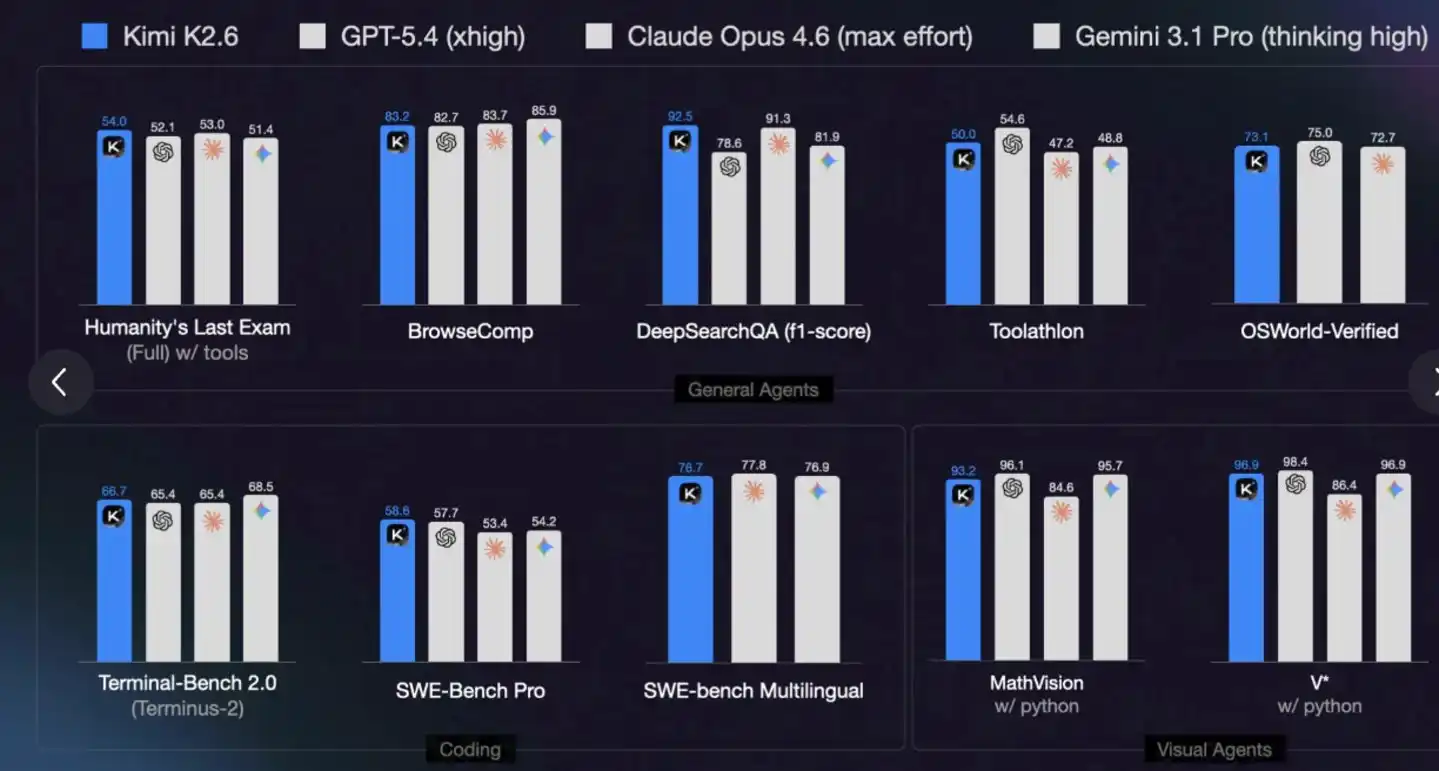
The second thing is benchmark comparisons. K2.6's official chosen references are GPT-5.4, Claude Opus 4.6, Gemini 3.1 Pro. All three are previous-generation flagships.

The same week, Anthropic released Claude Mythos, and Opus 4.7 just launched—both are a generation stronger than Opus 4.6. K2.6 didn't benchmark against them.

This is actually an active choice. Benchmarking against Mythos, K2.6 falls into the "catch-up" position; benchmarking against Opus 4.6, K2.6 falls into the "first tier" position. An $18 billion valuation needs the latter.

Kimi didn't really do this in the past. When K2 Thinking was released, the official ran full benchmarks, good and bad results, all released for developers to judge for themselves. That was the tech community's way—the community understands where you are strong and weak, and is willing to accept a model with obvious shortcomings but a clear roadmap.

Roadshow PPTs are not. Roadshow PPTs need a conclusion a fund manager can understand in 30 seconds: "on par with or superior to top international closed-source models." This sentence is verbatim from the K2.6 official blog.

The third thing is the Agent cluster and open-source dual track. K2.6 upgraded something called Claw Groups—a heterogeneous Agent ecosystem where Agents with different devices, different models, and different toolchains run in a collaborative space, with K2.6 acting as the scheduler. 300 sub-Agents in parallel, 4000 steps of collaboration, 5 days of autonomous operation.

These numbers are written for enterprise clients. Not for developers. For a developer, "300 Agents in parallel" has no practical meaning—they won't run 300 Agents in a local project. This configuration only makes sense for one type of client: large enterprises that need an Agent matrix to automate entire operational processes.

It's targeting the Salesforce story, not the HuggingFace story.

Meanwhile, K2.6 is fully open-sourced. Yang Zhilin said at the Zhongguancun Forum on March 26th that open source will be an absolute victory.

Open source + enterprise Agent clusters—this is a position between DeepSeek and Anthropic, half and half of both models. It sounds like a good story. But occupying both ends means having to prove both.

The capital market doesn't really care if these questions have answers. It only requires you to have a story for each line.

Price increase, benchmarking, Agent cluster—these three things together have an反常的共同点 (abnormal common point). None are for the tech community.

Kimi's underlying logic for releasing models in the past was—if developers like us, enterprise clients will eventually follow, and the capital market will follow even later. This playbook has a name: technical sincerity.

K2.6 isn't waiting. The price increase is a direct declaration of B-end pricing power; benchmarking against GPT-5.4 is preemptively securing a valuation position; Agent clusters and Claw Groups are the showroom for the enterprise service story.

Each thing corresponds to a question on the roadshow PPT: What is your commercialization capability? What is your benchmark position? What is your B-end moat?

Compressing the time from Preview to GA to 8 days is also this logic. Previous versions of the K2 series all went through 2-3 month preview periods, letting the community test enough, provide feedback, and iterate enough. K2.6 didn't give itself this space. It's not that the technology matured faster; the window won't wait.

An IPO in the second half of 2026 requires 4 to 6 months for filing, inquiry, hearing, roadshow, pricing, and cooling-off period according to HKEX procedures. Starting the roadshow in September means the product must be ready by April.

If GA isn't released in April, there's no window later.

K3 is the Real Grand Finale

But K2.6 is also not the strongest card Moonshot AI can play.

There is a very restrained sentence in the official blog—K2.6 is the "runway prepared for K3".

12-hour long-range coding, 300-Agent cluster, context compressor—these are not the final form of the K2 series; they are the execution layer infrastructure that a larger base model can support. Moonshot AI wouldn't spend effort making this work unless it was certain a larger model would consume these capabilities.

Rumors about K3 leaked on Reddit earlier, targeting a parameter scale of 3-4 trillion. Compared to the trillion-scale of the K2 series, this is a base leap.

If K3 can be released during the roadshow window—that is the real answer sheet. The runway paved by K2.6 allows K3 to take off.

The question is whether it can make it. How long does it take to train a 3-4 trillion parameter model? GPT-5 and Claude Opus 4.6 both had roughly 6-9 month pre-training cycles, plus several months for post-training and safety evaluation. Can Moonshot AI's existing compute—judging from the Alibaba Cloud cooperation and current cash reserves—compress this cycle to 5-6 months?

This bet is placed on K2.6.

Eight days from Preview to GA, Agent cluster expanding from 100 to 300 in one go, long-range execution stretching from hundreds of steps to 4000 steps—every move compresses time, making room for the possibility of K3.

If K3 can be released before August or September—that's the grand finale on the roadshow.

If it doesn't make it—K3 becomes a "model that can only be released after the IPO," and K2.6 has to shoulder the entire valuation narrative alone.

Moonshot AI is betting it can be done.

What Does the $18 Billion Valuation Anchor?

Back to valuation.

Three months ago, Moonshot AI was valued at $4.3 billion; two months ago, $5.5 billion; now, $18 billion.

It's not that Moonshot AI became four times stronger in these three months. It's that Zhipu and MiniMax went public and rose 4x, pushing the ceiling of the entire sector up. Zhipu's HK market cap is HK$305 billion, MiniMax's is HK$309.2 billion—both exceeding SenseTime's historical peak.

The valuation logic for these two is not "what the next-gen technology can do," but "how much AI assets can be priced in the Hong Kong market pool."

Moonshot AI's $18 billion valuation anchors the same thing. It is no longer proving it is the strongest Chinese AI company; it is proving it is a priceable Chinese AI company.

All of K2.6's moves—price increase, benchmarking, Agent cluster, open-source dual track—respond to this proposition.

But there is one thing K2.6 has not yet proven. Will Kimi's C-end users be willing to pay for the more expensive K2.6? Will paying subscribers churn to DeepSeek or MiniMax? How many enterprise clients are actually running Claw Groups, and how many just signed a POC?

These are numbers investors will definitely ask during the roadshow. K2.6 can only put the product out now. Whether it turns into numbers depends on the next three months.

When Zhipu went public, it submitted a prospectus where profits weren't yet positive; MiniMax did too. Investors accepted this story because the grand narrative of "Chinese AI assets" had just opened. Moonshot AI is half a year late. For the same question, Zhipu and MiniMax could say "we are validating," Moonshot AI must say "we are monetizing."

This pressure falls entirely on the three months between K2.6 and K3.

So back to the initial question—Is K2.6 Moonshot AI's final roadshow before the IPO?

No.

If K3 catches the roadshow window, K3 is the real grand finale. K2.6 is just the runway paved for it. If K3 misses the roadshow window, K2.6 has to carry the entire IPO narrative. Then it is Yang Zhilin's被迫提前开讲的第一场 (first, forced-to-start-early one).

Neither outcome was what Yang Zhilin wanted four months ago.

But everything that happened in these four months—Zhipu MiniMax IPO, valuation ceiling pushed up, window period compressed—forced a person who dislikes "rushing" to have to rush.

When K3 is released, it will be the second act.

Trending Cryptos

Related Questions

QWhat is the significance of the K2.6 model release for Moonshot AI's IPO plans?

AThe K2.6 model release is Yang Zhilin's first roadshow for Moonshot AI's planned IPO. It is a strategic move to demonstrate the company metrics crucial for valuation, such as enterprise pricing power, competitive positioning, and B2B capabilities, ahead of a potential listing in the second half of 2026.

QHow did Moonshot AI adjust its API pricing with the K2.6 release, and what was the strategic reason?

AMoonshot AI raised its API input price from $0.60 to $0.95 per million tokens, a 58% increase. This was a structured price hike designed to be friendly to enterprise clients with high cache hit rates (who saw a smaller increase) while passing the full increase to more casual, price-comparing users. The move was necessary to improve gross margin figures for the IPO prospectus and to align pricing with the high token consumption of the new Agent era.

QWhy did the K2.6 benchmark choose to compare itself to older models like GPT-5.4 instead of the latest ones?

AK2.6 was benchmarked against previous-generation flagship models like GPT-5.4 and Claude Opus 4.6 rather than the newer, stronger contemporaries (e.g., Claude Mythos) to position itself in the 'first tier' of models for its roadshow narrative. This creates a more favorable comparison for fund managers, supporting a valuation story of being 'on par with or superior to top international closed-source models'.

QWhat is the 'Claw Groups' feature in K2.6, and which audience is it targeting?

AClaw Groups is a feature for heterogeneous Agent ecosystems, allowing up to 300 different Agents across various devices, models, and toolchains to operate collaboratively with K2.6 as the scheduler. This targets enterprise clients, not developers, as it demonstrates a solution for large corporations seeking to automate full-process operations with an Agent matrix, akin to a Salesforce enterprise story.

QWhat is the relationship between the K2.6 release and the anticipated K3 model?

AK2.6 is described as the 'runway' for the much larger K3 model (rumored to be 3-4 trillion parameters). Features like long-context execution and the Agent cluster infrastructure are built to be consumed by a more powerful base model. The rushed 8-day preview-to-GA cycle for K2.6 is a bet that K3 can be ready in time to be the centerpiece of the IPO roadshow; if not, K2.6 must carry the entire valuation narrative alone.

Related Reads

After Three Consecutive Quarters of Decline, Can the Crypto Market Find a Window for Stabilization in Q3?

The cryptocurrency market has just concluded its worst-performing quarter since 2022, with total capitalization dropping 12.6% to $2.1 trillion. All core metrics indicate capital is leaving the sector, not just rotating within it. Bitcoin fell 14.2% and Ethereum dropped 25.4% in Q2, breaking their previous correlation with US tech stocks. A key driver is the reversal in US spot Bitcoin ETF flows, which saw a net outflow of approximately $4.67 billion in Q2, including a record monthly outflow near $4.5 billion in June. While recent data suggests long-term holders are accumulating again, sustained ETF outflows mean continued selling pressure. Market focus is now singularly on the Federal Reserve. The upcoming July FOMC meeting is seen as the most critical event for Q3. A dovish signal could support Bitcoin reclaiming a $68,000-$84,000 range, while a hawkish stance might establish a new trading band around $50,000-$56,000. Additionally, regulatory uncertainty persists, with the progress of the crucial *CLARITY Act* stalling in the Senate, reducing its perceived 2026 passage probability to 40-45%. Despite the broad downturn, a few sectors showed growth. Prediction markets saw nominal volume surge 48.7% year-over-year to $113.8 billion, and tokenized collectibles transaction volume rose 143% quarterly to $1.4 billion. The Real-World Asset (RWA) tokenization sector also continued steady growth, now representing ~$28.1 billion in on-chain value. The market's foundation for an extreme crash appears limited, with Bitcoin price hovering near its 200-week moving average. However, the trading paradigm has shifted from narrative-driven speculation to decisions based on price action, policy developments, and interest rate expectations, making a broad sentiment-driven rally unlikely in the near term.

marsbit22m ago

After Three Consecutive Quarters of Decline, Can the Crypto Market Find a Window for Stabilization in Q3?

marsbit22m ago

BIT Trading Moment: BTC Still Suppressed by Weekly 200 EMA, Rejection May Restart Decline; Storage and Semiconductors that Surged Last Night Begin Falling in Evening Trading

**Crypto & Stock Market Wrap: Bitcoin Tests Resistance, Stocks Retreat After AI Surge** Bitcoin consolidates around $66,000, facing key resistance near $68,000—an area seen as a major psychological and technical hurdle where previous rallies have failed. Analysts note the cryptocurrency is caught between its 200-week moving average (~$63,333) and 200-week EMA (~$68,328). A clear break above $68k is needed to signal a stronger bullish trend, while a rejection could lead to a retest of $63k support. Market sentiment remains cautious, with low futures open interest pointing to a low-liquidity rebound rather than a full bull market. Bitcoin spot ETFs saw another $203 million inflow. US stock futures pointed lower after a strong Tuesday session led by a massive rebound in semiconductors and memory stocks. The rally was fueled by renewed optimism about AI-driven hardware demand, with Micron, SanDisk, and SK Hynix surging. However, those gains reversed in pre-market trading. Super Micro Computer (SMCI) soared over 20% after hours on strong guidance and a record backlog. Other standouts included Rocket Lab and nuclear energy plays Oklo and X-Energy. Rising oil prices (Brent above $91) and climbing Treasury yields (10-year near 4.64%), however, are reigniting inflation concerns and acting as a headwind for equities. In Asia, markets were mixed. South Korea's KOSPI pared early gains to close slightly higher as semiconductor stocks like SK Hynix gave back initial surges. Japan's Nikkei edged lower as the yen hit a fresh 38-year low against the dollar, raising fears of potential market intervention. Key events to watch include the Samsung Galaxy launch, AMD's AI event, and a slew of major tech earnings from Alphabet, Tesla, and IBM after the close on Wednesday, followed by the ECB meeting and Intel's earnings on Thursday.

marsbit30m ago

BIT Trading Moment: BTC Still Suppressed by Weekly 200 EMA, Rejection May Restart Decline; Storage and Semiconductors that Surged Last Night Begin Falling in Evening Trading

marsbit30m ago

Former CFTC Chairman, Circle President Tarbert: Preaching Long-Termism While Cashing Out $30 Million Himself

Former CFTC Chairman and Circle President Heath Tarbert has consistently advocated for a long-term vision in public, urging patience from investors as Circle’s stock price has fallen significantly from its peak. However, it has been revealed that since Circle’s IPO, Tarbert has continuously sold his CRCL shares through pre-arranged trading plans, cashing out approximately $30 million, without making any public market purchases. This contrast between his public messaging and personal actions has drawn criticism. Tarbert joined Circle in July 2023 as Chief Legal Officer, leveraging his regulatory experience to help guide the company through its IPO and expansion. Despite promoting stablecoins as long-term infrastructure, he established a 10b5-1 trading plan just before Circle went public, leading to substantial stock sales over the following year. In March 2026, he initiated another plan to sell more shares. His career trajectory highlights a pattern of moving between high-level regulatory roles and influential positions in the financial sector. After resigning as CFTC Chairman in early 2021, he joined Citadel Securities as Chief Legal Officer just 27 days later, during a period of intense regulatory scrutiny for the firm. He later joined Circle, aiding its efforts to navigate regulatory challenges for its public listing. While Tarbert's expertise in policy and compliance is valuable to companies like Circle, his actions—advocating long-term confidence while personally divesting—raise questions about the alignment between his public statements and his private financial decisions, leaving investors who followed his advice to bear the market risks.

marsbit53m ago

Former CFTC Chairman, Circle President Tarbert: Preaching Long-Termism While Cashing Out $30 Million Himself

marsbit53m ago

Gate Research Institute: The 'Wall Street-ization' Wave of Crypto Financial Products – Competition or Integration?

The article titled "Gate Research Institute: Are Crypto Financial Products Sparking a 'Wall Street' Wave—Competition or Convergence?" explores the evolving relationship between the crypto ecosystem and traditional finance (TradFi). The piece begins by reflecting on Bitcoin's original 2009 vision of decentralization, disintermediation, and moving away from banks. It then contrasts this with the 2024 landscape, where key crypto assets like Bitcoin are increasingly held through Wall Street products like ETFs issued by giants like BlackRock. The article questions whether this signifies that TradFi is systematically taking over the rights to issue, price, custody, and distribute crypto financial assets. The core argument is that this is not a zero-sum takeover but rather a bidirectional convergence where each side addresses the other's weaknesses. Crypto offers 24/7 global markets, programmable settlement, and open access but lacks compliant channels, institutional-grade custody, deep fiat liquidity, and mainstream distribution. TradFi possesses these but is constrained by legacy systems, limited operating hours, and slow settlement. Two primary convergence paths are highlighted: * **Path A (CEX to TradFi):** Exemplified by Gate, which has progressed from offering tokenized stocks and CFDs to providing direct, real stock trading (US, Hong Kong, South Korea) within its platform, using USDT. * **Path B (TradFi to Crypto):** Exemplified by Robinhood, which has integrated crypto trading, acquired exchanges like Bitstamp, and is moving traditional assets like stocks onto the blockchain via tokenization and its own Layer 2. Both paths are ultimately competing to become the next-generation, unified financial account—a "super account" where users can seamlessly trade cryptocurrencies, stocks, ETFs, RWA (Real World Assets), and tokenized treasury products in one interface. The growth of RWA and tokenized treasuries (e.g., BlackRock's BUIDL) is presented as the asset-layer fusion, providing stable, yield-bearing assets on-chain and acting as a bridge between the two worlds. In conclusion, the "Wall Street-ization" of crypto is framed as a mutual transformation. Decentralized ideals persist in the protocol layer, while at the application layer, a more efficient, global, and accessible unified capital market is emerging from this convergence. The future competition lies not between crypto exchanges and stockbrokers, but between platforms vying to offer the most comprehensive asset coverage, liquidity, and user experience within a single account.

marsbit57m ago

Gate Research Institute: The 'Wall Street-ization' Wave of Crypto Financial Products – Competition or Integration?

marsbit57m ago

Trading

Spot

Hot Articles

What is SONIC

Sonic: Pioneering the Future of Gaming in Web3 Introduction to Sonic In the ever-evolving landscape of Web3, the gaming industry stands out as one of the most dynamic and promising sectors. At the forefront of this revolution is Sonic, a project designed to amplify the gaming ecosystem on the Solana blockchain. Leveraging cutting-edge technology, Sonic aims to deliver an unparalleled gaming experience by efficiently processing millions of requests per second, ensuring that players enjoy seamless gameplay while maintaining low transaction costs. This article delves into the intricate details of Sonic, exploring its creators, funding sources, operational mechanics, and the timeline of significant events that have shaped its journey. What is Sonic? Sonic is an innovative layer-2 network that operates atop the Solana blockchain, specifically tailored to enhance the existing Solana gaming ecosystem. It accomplishes this through a customised, VM-agnostic game engine paired with a HyperGrid interpreter, facilitating sovereign game economies that roll up back to the Solana platform. The primary goals of Sonic include: Enhanced Gaming Experiences: Sonic is committed to offering lightning-fast on-chain gameplay, allowing players and developers to engage with games at previously unattainable speeds. Atomic Interoperability: This feature enables transactions to be executed within Sonic without the need to redeploy Solana programmes and accounts. This makes the process more efficient and directly benefits from Solana Layer1 services and liquidity. Seamless Deployment: Sonic allows developers to write for Ethereum Virtual Machine (EVM) based systems and execute them on Solana’s SVM infrastructure. This interoperability is crucial for attracting a broader range of dApps and decentralised applications to the platform. Support for Developers: By offering native composable gaming primitives and extensible data types - dining within the Entity-Component-System (ECS) framework - game creators can craft intricate business logic with ease. Overall, Sonic's unique approach not only caters to players but also provides an accessible and low-cost environment for developers to innovate and thrive. Creator of Sonic The information regarding the creator of Sonic is somewhat ambiguous. However, it is known that Sonic's SVM is owned by the company Mirror World. The absence of detailed information about the individuals behind Sonic reflects a common trend in several Web3 projects, where collective efforts and partnerships often overshadow individual contributions. Investors of Sonic Sonic has garnered considerable attention and support from various investors within the crypto and gaming sectors. Notably, the project raised an impressive $12 million during its Series A funding round. The round was led by BITKRAFT Ventures, with other notable investors including Galaxy, Okx Ventures, Interactive, Big Brain Holdings, and Mirana. This financial backing signifies the confidence that investment foundations have in Sonic’s potential to revolutionise the Web3 gaming landscape, further validating its innovative approaches and technologies. How Does Sonic Work? Sonic utilises the HyperGrid framework, a sophisticated parallel processing mechanism that enhances its scalability and customisability. Here are the core features that set Sonic apart: Lightning Speed at Low Costs: Sonic offers one of the fastest on-chain gaming experiences compared to other Layer-1 solutions, powered by the scalability of Solana’s virtual machine (SVM). Atomic Interoperability: Sonic enables transaction execution without redeployment of Solana programmes and accounts, effectively streamlining the interaction between users and the blockchain. EVM Compatibility: Developers can effortlessly migrate decentralised applications from EVM chains to the Solana environment using Sonic’s HyperGrid interpreter, increasing the accessibility and integration of various dApps. Ecosystem Support for Developers: By exposing native composable gaming primitives, Sonic facilitates a sandbox-like environment where developers can experiment and implement business logic, greatly enhancing the overall development experience. Monetisation Infrastructure: Sonic natively supports growth and monetisation efforts, providing frameworks for traffic generation, payments, and settlements, thereby ensuring that gaming projects are not only viable but also sustainable financially. Timeline of Sonic The evolution of Sonic has been marked by several key milestones. Below is a brief timeline highlighting critical events in the project's history: 2022: The Sonic cryptocurrency was officially launched, marking the beginning of its journey in the Web3 gaming arena. 2024: June: Sonic SVM successfully raised $12 million in a Series A funding round. This investment allowed Sonic to further develop its platform and expand its offerings. August: The launch of the Sonic Odyssey testnet provided users with the first opportunity to engage with the platform, offering interactive activities such as collecting rings—a nod to gaming nostalgia. October: SonicX, an innovative crypto game integrated with Solana, made its debut on TikTok, capturing the attention of over 120,000 users within a short span. This integration illustrated Sonic’s commitment to reaching a broader, global audience and showcased the potential of blockchain gaming. Key Points Sonic SVM is a revolutionary layer-2 network on Solana explicitly designed to enhance the GameFi landscape, demonstrating great potential for future development. HyperGrid Framework empowers Sonic by introducing horizontal scaling capabilities, ensuring that the network can handle the demands of Web3 gaming. Integration with Social Platforms: The successful launch of SonicX on TikTok displays Sonic’s strategy to leverage social media platforms to engage users, exponentially increasing the exposure and reach of its projects. Investment Confidence: The substantial funding from BITKRAFT Ventures, among others, emphasizes the robust backing Sonic has, paving the way for its ambitious future. In conclusion, Sonic encapsulates the essence of Web3 gaming innovation, striking a balance between cutting-edge technology, developer-centric tools, and community engagement. As the project continues to evolve, it is poised to redefine the gaming landscape, making it a notable entity for gamers and developers alike. As Sonic moves forward, it will undoubtedly attract greater interest and participation, solidifying its place within the broader narrative of blockchain gaming.

1.9k Total ViewsPublished 2024.04.04Updated 2024.12.03

What is SONIC

What is $S$

Understanding SPERO: A Comprehensive Overview Introduction to SPERO As the landscape of innovation continues to evolve, the emergence of web3 technologies and cryptocurrency projects plays a pivotal role in shaping the digital future. One project that has garnered attention in this dynamic field is SPERO, denoted as SPERO,$$s$. This article aims to gather and present detailed information about SPERO, to help enthusiasts and investors understand its foundations, objectives, and innovations within the web3 and crypto domains. What is SPERO,$$s$? SPERO,$$s$ is a unique project within the crypto space that seeks to leverage the principles of decentralisation and blockchain technology to create an ecosystem that promotes engagement, utility, and financial inclusion. The project is tailored to facilitate peer-to-peer interactions in new ways, providing users with innovative financial solutions and services. At its core, SPERO,$$s$ aims to empower individuals by providing tools and platforms that enhance user experience in the cryptocurrency space. This includes enabling more flexible transaction methods, fostering community-driven initiatives, and creating pathways for financial opportunities through decentralised applications (dApps). The underlying vision of SPERO,$$s$ revolves around inclusiveness, aiming to bridge gaps within traditional finance while harnessing the benefits of blockchain technology. Who is the Creator of SPERO,$$s$? The identity of the creator of SPERO,$$s$ remains somewhat obscure, as there are limited publicly available resources providing detailed background information on its founder(s). This lack of transparency can stem from the project's commitment to decentralisation—an ethos that many web3 projects share, prioritising collective contributions over individual recognition. By centring discussions around the community and its collective goals, SPERO,$$s$ embodies the essence of empowerment without singling out specific individuals. As such, understanding the ethos and mission of SPERO remains more important than identifying a singular creator. Who are the Investors of SPERO,$$s$? SPERO,$$s$ is supported by a diverse array of investors ranging from venture capitalists to angel investors dedicated to fostering innovation in the crypto sector. The focus of these investors generally aligns with SPERO's mission—prioritising projects that promise societal technological advancement, financial inclusivity, and decentralised governance. These investor foundations are typically interested in projects that not only offer innovative products but also contribute positively to the blockchain community and its ecosystems. The backing from these investors reinforces SPERO,$$s$ as a noteworthy contender in the rapidly evolving domain of crypto projects. How Does SPERO,$$s$ Work? SPERO,$$s$ employs a multi-faceted framework that distinguishes it from conventional cryptocurrency projects. Here are some of the key features that underline its uniqueness and innovation: Decentralised Governance: SPERO,$$s$ integrates decentralised governance models, empowering users to participate actively in decision-making processes regarding the project’s future. This approach fosters a sense of ownership and accountability among community members. Token Utility: SPERO,$$s$ utilises its own cryptocurrency token, designed to serve various functions within the ecosystem. These tokens enable transactions, rewards, and the facilitation of services offered on the platform, enhancing overall engagement and utility. Layered Architecture: The technical architecture of SPERO,$$s$ supports modularity and scalability, allowing for seamless integration of additional features and applications as the project evolves. This adaptability is paramount for sustaining relevance in the ever-changing crypto landscape. Community Engagement: The project emphasises community-driven initiatives, employing mechanisms that incentivise collaboration and feedback. By nurturing a strong community, SPERO,$$s$ can better address user needs and adapt to market trends. Focus on Inclusion: By offering low transaction fees and user-friendly interfaces, SPERO,$$s$ aims to attract a diverse user base, including individuals who may not previously have engaged in the crypto space. This commitment to inclusion aligns with its overarching mission of empowerment through accessibility. Timeline of SPERO,$$s$ Understanding a project's history provides crucial insights into its development trajectory and milestones. Below is a suggested timeline mapping significant events in the evolution of SPERO,$$s$: Conceptualisation and Ideation Phase: The initial ideas forming the basis of SPERO,$$s$ were conceived, aligning closely with the principles of decentralisation and community focus within the blockchain industry. Launch of Project Whitepaper: Following the conceptual phase, a comprehensive whitepaper detailing the vision, goals, and technological infrastructure of SPERO,$$s$ was released to garner community interest and feedback. Community Building and Early Engagements: Active outreach efforts were made to build a community of early adopters and potential investors, facilitating discussions around the project’s goals and garnering support. Token Generation Event: SPERO,$$s$ conducted a token generation event (TGE) to distribute its native tokens to early supporters and establish initial liquidity within the ecosystem. Launch of Initial dApp: The first decentralised application (dApp) associated with SPERO,$$s$ went live, allowing users to engage with the platform's core functionalities. Ongoing Development and Partnerships: Continuous updates and enhancements to the project's offerings, including strategic partnerships with other players in the blockchain space, have shaped SPERO,$$s$ into a competitive and evolving player in the crypto market. Conclusion SPERO,$$s$ stands as a testament to the potential of web3 and cryptocurrency to revolutionise financial systems and empower individuals. With a commitment to decentralised governance, community engagement, and innovatively designed functionalities, it paves the way toward a more inclusive financial landscape. As with any investment in the rapidly evolving crypto space, potential investors and users are encouraged to research thoroughly and engage thoughtfully with the ongoing developments within SPERO,$$s$. The project showcases the innovative spirit of the crypto industry, inviting further exploration into its myriad possibilities. While the journey of SPERO,$$s$ is still unfolding, its foundational principles may indeed influence the future of how we interact with technology, finance, and each other in interconnected digital ecosystems.

156 Total ViewsPublished 2024.12.17Updated 2024.12.17

What is $S$

What is AGENT S

Agent S: The Future of Autonomous Interaction in Web3 Introduction In the ever-evolving landscape of Web3 and cryptocurrency, innovations are constantly redefining how individuals interact with digital platforms. One such pioneering project, Agent S, promises to revolutionise human-computer interaction through its open agentic framework. By paving the way for autonomous interactions, Agent S aims to simplify complex tasks, offering transformative applications in artificial intelligence (AI). This detailed exploration will delve into the project's intricacies, its unique features, and the implications for the cryptocurrency domain. What is Agent S? Agent S stands as a groundbreaking open agentic framework, specifically designed to tackle three fundamental challenges in the automation of computer tasks: Acquiring Domain-Specific Knowledge: The framework intelligently learns from various external knowledge sources and internal experiences. This dual approach empowers it to build a rich repository of domain-specific knowledge, enhancing its performance in task execution. Planning Over Long Task Horizons: Agent S employs experience-augmented hierarchical planning, a strategic approach that facilitates efficient breakdown and execution of intricate tasks. This feature significantly enhances its ability to manage multiple subtasks efficiently and effectively. Handling Dynamic, Non-Uniform Interfaces: The project introduces the Agent-Computer Interface (ACI), an innovative solution that enhances the interaction between agents and users. Utilizing Multimodal Large Language Models (MLLMs), Agent S can navigate and manipulate diverse graphical user interfaces seamlessly. Through these pioneering features, Agent S provides a robust framework that addresses the complexities involved in automating human interaction with machines, setting the stage for myriad applications in AI and beyond. Who is the Creator of Agent S? While the concept of Agent S is fundamentally innovative, specific information about its creator remains elusive. The creator is currently unknown, which highlights either the nascent stage of the project or the strategic choice to keep founding members under wraps. Regardless of anonymity, the focus remains on the framework's capabilities and potential. Who are the Investors of Agent S? As Agent S is relatively new in the cryptographic ecosystem, detailed information regarding its investors and financial backers is not explicitly documented. The lack of publicly available insights into the investment foundations or organisations supporting the project raises questions about its funding structure and development roadmap. Understanding the backing is crucial for gauging the project's sustainability and potential market impact. How Does Agent S Work? At the core of Agent S lies cutting-edge technology that enables it to function effectively in diverse settings. Its operational model is built around several key features: Human-like Computer Interaction: The framework offers advanced AI planning, striving to make interactions with computers more intuitive. By mimicking human behaviour in tasks execution, it promises to elevate user experiences. Narrative Memory: Employed to leverage high-level experiences, Agent S utilises narrative memory to keep track of task histories, thereby enhancing its decision-making processes. Episodic Memory: This feature provides users with step-by-step guidance, allowing the framework to offer contextual support as tasks unfold. Support for OpenACI: With the ability to run locally, Agent S allows users to maintain control over their interactions and workflows, aligning with the decentralised ethos of Web3. Easy Integration with External APIs: Its versatility and compatibility with various AI platforms ensure that Agent S can fit seamlessly into existing technological ecosystems, making it an appealing choice for developers and organisations. These functionalities collectively contribute to Agent S's unique position within the crypto space, as it automates complex, multi-step tasks with minimal human intervention. As the project evolves, its potential applications in Web3 could redefine how digital interactions unfold. Timeline of Agent S The development and milestones of Agent S can be encapsulated in a timeline that highlights its significant events: September 27, 2024: The concept of Agent S was launched in a comprehensive research paper titled “An Open Agentic Framework that Uses Computers Like a Human,” showcasing the groundwork for the project. October 10, 2024: The research paper was made publicly available on arXiv, offering an in-depth exploration of the framework and its performance evaluation based on the OSWorld benchmark. October 12, 2024: A video presentation was released, providing a visual insight into the capabilities and features of Agent S, further engaging potential users and investors. These markers in the timeline not only illustrate the progress of Agent S but also indicate its commitment to transparency and community engagement. Key Points About Agent S As the Agent S framework continues to evolve, several key attributes stand out, underscoring its innovative nature and potential: Innovative Framework: Designed to provide an intuitive use of computers akin to human interaction, Agent S brings a novel approach to task automation. Autonomous Interaction: The ability to interact autonomously with computers through GUI signifies a leap towards more intelligent and efficient computing solutions. Complex Task Automation: With its robust methodology, it can automate complex, multi-step tasks, making processes faster and less error-prone. Continuous Improvement: The learning mechanisms enable Agent S to improve from past experiences, continually enhancing its performance and efficacy. Versatility: Its adaptability across different operating environments like OSWorld and WindowsAgentArena ensures that it can serve a broad range of applications. As Agent S positions itself in the Web3 and crypto landscape, its potential to enhance interaction capabilities and automate processes signifies a significant advancement in AI technologies. Through its innovative framework, Agent S exemplifies the future of digital interactions, promising a more seamless and efficient experience for users across various industries. Conclusion Agent S represents a bold leap forward in the marriage of AI and Web3, with the capacity to redefine how we interact with technology. While still in its early stages, the possibilities for its application are vast and compelling. Through its comprehensive framework addressing critical challenges, Agent S aims to bring autonomous interactions to the forefront of the digital experience. As we move deeper into the realms of cryptocurrency and decentralisation, projects like Agent S will undoubtedly play a crucial role in shaping the future of technology and human-computer collaboration.

824 Total ViewsPublished 2025.01.14Updated 2025.01.14

What is AGENT S

Discussions

Welcome to the HTX Community. Here, you can stay informed about the latest platform developments and gain access to professional market insights. Users' opinions on the price of S (S) are presented below.

活动图片













