‘Just the beginning’: Paul Atkins signals SEC’s new crypto rule changes

ambcryptoPublished on 2026-03-20Last updated on 2026-03-20

Abstract

SEC Chair Paul Atkins announced the agency will soon issue formal proposed rules to codify its recent interpretive guidance, which classifies most crypto assets as non-securities and categorizes them into five groups: digital commodities, collectibles, tools, stablecoins, and securities. The SEC also plans to create a regulatory sandbox for experimentation. Atkins noted that while this is a significant step, courts could still deviate from the SEC’s interpretation. He described the move as a "bridge" as Congress progresses on the CLARITY Act. Senator Cynthia Lummis reported that stablecoin yield issues are "99% resolved" in the bill negotiations. Market optimism for the bill has improved slightly despite earlier setbacks.

Paul Atkins, the chairman of the U.S. Securities and Exchange Commission (SEC), has said the agency will soon issue formally proposed rules for the recent crypto asset classification guidance.

In the latest interpretive guidance, the SEC designated most crypto assets as non-securities. Additionally, the framework classified digital assets into five categories, including digital commodities, collectibles, tools, stablecoins, and securities. It also explained how they fit into the current U.S. law.

To codify the framework, Atkins said the agency will formalize it alongside creating a sandbox for experimenting with different crypto products. But he warned the court could still ‘deviate’ from its interpretation.

This is just an interpretation, and the courts can deviate from that if they don’t like our rationale.

He added,

We’ll shortly follow up with a proposed rule to put much more of this framework into effect. And construct a series of exemptions, equivalent of sandbox for people to experiment and develop proof-of-concept for their products.

SEC’s plans and CLARITY Act progress

For Atkins, SEC’s interpretation of crypto laws is ‘just a beginning,’ and the move would be a ‘bridge’ as the Congress works its way through the CLARITY Act. In fact, most of the guidance issued in the past few days and months covers key topics being discussed in the CLARITY Act. For others, the SEC’s proposed rulemaking on key issues would be sufficient for the market, even if the CLARITY Act’s momentum stalls.

That said, the stablecoin yield issue has been the key deal breaker dragging the crypto bill.

Even so, after the recent Senate Republican meeting on the bill, Senator Cynthia Lummis was ‘positive,’ terming it ‘productive,’ and added,

We’re 99% of the way there on stablecoin yield, and negotiations on the digital asset portions of the bill are in a good place.
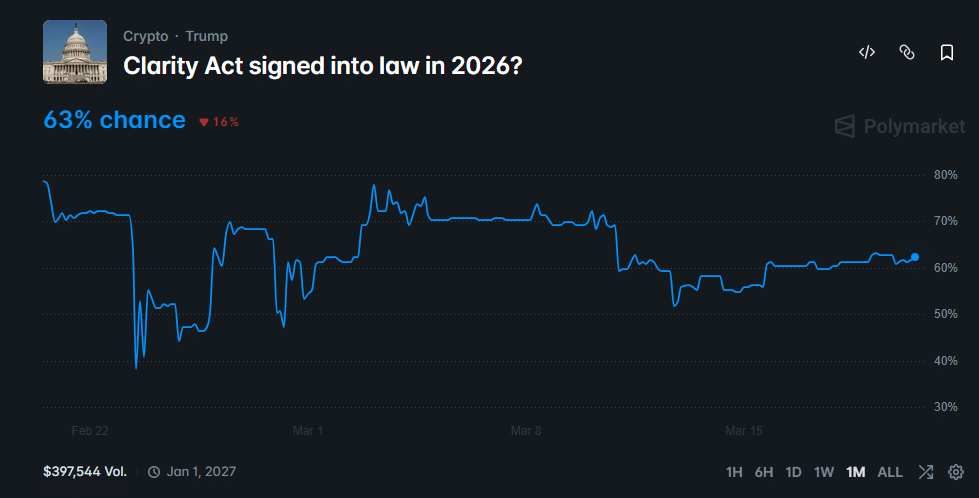
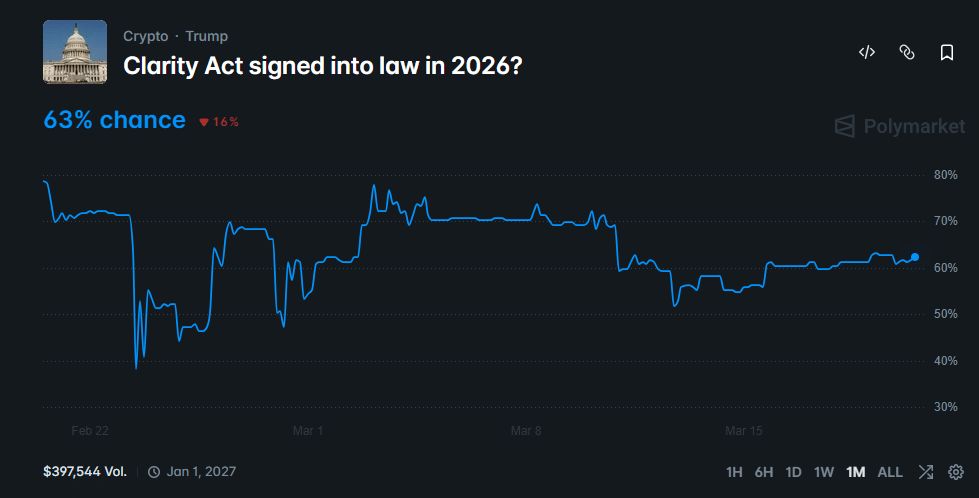
Source: Polymarket

As expected, market optimism on the bill’s passage improved slightly following the recent meetings and updates.

In early March, the chance of the CLARITY Act becoming law dropped to nearly 50% as the White House and the banking industry hit a snag over stablecoin yields.

Whatever the outcome, however, the crypto industry may still be in a better position for clear rules for the road if the SEC continues to issue and codify them.


Final Summary

  • SEC Chair reiterated plans to formalize rulemaking for its recent interpretive guidance on crypto asset classification and how current U.S. law applies to them.
  • According to Senator Lummis, the stablecoin yield issue was ‘99% resolved’ in CLARITY Act talks.

Related Questions

QWhat did SEC Chairman Paul Atkins announce regarding crypto asset classification?

APaul Atkins announced that the SEC will soon issue formally proposed rules to codify its recent interpretive guidance on crypto asset classification, which designates most crypto assets as non-securities and categorizes them into five groups.

QHow did the SEC classify digital assets in its latest guidance?

AThe SEC classified digital assets into five categories: digital commodities, collectibles, tools, stablecoins, and securities, explaining how they fit under current U.S. law.

QWhat did Paul Atkins say about the role of courts in relation to the SEC's interpretation?

AAtkins warned that courts could deviate from the SEC's interpretation if they disagree with the rationale, emphasizing that the guidance is just an interpretation.

QWhat is the CLARITY Act, and how does it relate to the SEC's actions?

AThe CLARITY Act is a congressional bill addressing crypto regulation. The SEC's interpretive guidance covers key topics in the bill and is seen as a 'bridge' while Congress works on the legislation.

QAccording to Senator Cynthia Lummis, what progress has been made on the stablecoin yield issue in the CLARITY Act negotiations?

ASenator Lummis stated that the stablecoin yield issue is '99% resolved' and that negotiations on the digital asset portions of the bill are in a good place.

Related Reads

Banks Battle Stablecoins: Where Will Deposits Ultimately Flow?

"Banks vs. Stablecoins: Where Will Deposits Flow?" By: Prathik Desai The traditional banking model, where banks profit from lending out low-interest deposits, faces a fundamental challenge from blockchain-based stablecoins. While U.S. savings accounts offer ~0.6% interest, stablecoins provide near-instant, low-cost global transfers and, via DeFi protocols, access to 5-8% yields. This threatens bank deposit bases and their net interest margins. History offers a parallel: In the 1970s, Merrill Lynch's Cash Management Account (CMA) circumvented Regulation Q's interest caps by sweeping funds into money market funds, causing massive deposit outflows until banks responded with their own high-yield accounts. Today, two competing "digital dollar" models are emerging: 1. **Stablecoins (e.g., USDC):** Funds leave the banking system to back the tokens. While laws like the GENIUS Act forbid issuers from paying interest, users can earn yield via DeFi. This poses an existential threat, especially to regional banks. Predictions suggest significant deposit migration to stablecoins. 2. **Tokenized Deposits:** Banks convert deposits into on-chain tokens for fast, cheap transfers, while the original funds remain on their balance sheets, protected by FDIC insurance and available for lending. Two major bank consortia are developing platforms: one for institutions (led by JPMorgan, Citi, etc.) and Cari Network (regional banks) for retail users. The competition centers on control. Stablecoins offer openness and programmability but lack insurance. Tokenized deposits offer safety and yield but within the traditional, regulated system. A third path, exemplified by SoFi Bank's launch of SoFiUSD, aims to bridge this divide. SoFi integrates a stablecoin, a tokenized deposit (with yield and FDIC insurance), and a bank account in one app, allowing seamless switching based on the user's need for yield, safety, or liquidity. The core insight is that the future belongs not to a single product form, but to the *ability to frictionlessly switch* between forms—optimizing for security, yield, or liquidity as needed. Blockchain technology is becoming financial infrastructure, not to replace banks, but to force them to deconstruct and rebuild their services. The ultimate winners will be institutions that enable this seamless conversion, forcing an evolution similar to the post-Regulation Q era, where traditional finance absorbed innovations to survive.

Foresight News9m ago

Banks Battle Stablecoins: Where Will Deposits Ultimately Flow?

Foresight News9m ago

Exclusive | ByteDance's AI Drug Discovery Unit Initiates Spinoff and Funding, AI4S Enters Industrialization Phase

Exclusive | ByteDance’s AI Drug Discovery Unit Initiates Spin-off for Financing, Signaling Industrialization Phase for AI4S. ByteDance’s AI drug discovery business line has begun the process of spinning off as an independent entity to raise outside funding, marking a key step toward industrializing its AI for Science (AI4S) efforts. Post-spin-off, ByteDance will remain the controlling shareholder. The new company will inherit the core team, algorithms, technology platform, and existing pipeline assets. It will also continue to receive computing power support from ByteDance's Volcano Engine. The AI drug discovery team, established in 2021 and led by Liu Kai with a core team of about 50 AI and pharmaceutical experts, has been responsible for foundational model research and industrialization. It has consolidated ByteDance's protein structure prediction model team and launched several key technologies. These include the molecular structure prediction models Protenix and Seedfold, the protein design tool PXDesign, and the AI drug discovery platform "Anew Labs." Anew Labs has produced research covering protein-ligand dynamics, molecular generation, and free energy calculation, and has developed early-stage drug pipelines like IL-17 and IL4R inhibitors. Notably, its IL-17 small molecule program, presented in April 2026, demonstrated the first small-molecule blockade of three IL-17 dimers, a significant step in autoimmune disease research. This progress demonstrates ByteDance’s AI capabilities have advanced from model development to validating specific drug targets and molecules. The company believes the opportunity to transition from research to industry is now ripe. The spin-off aims to establish an organizational structure better suited to the business's unique needs—long R&D cycles and complex validation processes involving wet labs and clinical trials—to attract top talent and drive deeper integration of AI with the pharmaceutical industry. The move responds to the pharmaceutical industry's pressing need to improve efficiency amid high R&D costs, long timelines, and high failure rates. The field of AI4S is rapidly advancing, as seen with tools like AlphaFold evolving from protein prediction to modeling complex biological interactions and the emergence of multimodal molecular generation models for drug design. ByteDance has been building its AI4S capabilities for years, exploring areas like computational biology, molecular simulation, and materials science. This spin-off represents its first major attempt to industrialize AI4S. An insider stated the company attaches great importance to this move, hoping that an independent entity with greater decision-making flexibility can pioneer a viable industrial path for AI4S in China.

marsbit47m ago

Exclusive | ByteDance's AI Drug Discovery Unit Initiates Spinoff and Funding, AI4S Enters Industrialization Phase

marsbit47m ago

Galaxy Deep Dive: How Does Hyperliquid's HIP-4 Upgrade Change the Predictive Markets Landscape?

Galaxy Research Report: How Hyperliquid's HIP-4 Upgrade Changes the Prediction Market Landscape. Hyperliquid's HIP-4 protocol upgrade, activated on May 2, introduces a third model for prediction markets. While incumbents like Polymarket focus on consumer discovery and Kalshi on regulated US access, HIP-4 integrates outcome markets directly into Hyperliquid's "house of all finance." This embeds binary event contracts within HyperCore, its native on-chain order book, sharing a single margin account with perpetual and spot trading. HIP-4 offers distinct advantages: superior infrastructure with sub-second finality, ~200k orders/sec throughput, and unified cross-margin, enabling novel hedges for perpetual traders. It also features a unique validator-curated oracle model for off-chain events (e.g., Fed decisions, CPI, sports) and zero fees on opening positions. Early traction shows HIP-4 capturing ~20% of combined BTC prediction market volume within 25 days. The report highlights a broader industry trend of convergence: all major platforms are moving towards a "trade everything from one account" model. HIP-4's challenge lies in expanding market breadth and consumer discovery, currently lagging behind Polymarket's flexible UMA oracle/Kalshi's sports depth. Key risks include validator centralization, US regulatory exposure (mitigated by potential pathways like the CLARITY Act), and competitive pressure from Kalshi's newly CFTC-approved Bitcoin perpetual contract. Ultimately, HIP-4's strongest case is its technically superior, unified execution stack—a harder advantage for competitors to replicate than building consumer layers atop it. The upgrade positions Hyperliquid to contest the lucrative institutional hedging flow in the evolving prediction market arena.

marsbit2h ago

Galaxy Deep Dive: How Does Hyperliquid's HIP-4 Upgrade Change the Predictive Markets Landscape?

marsbit2h ago

Trading

Spot
Futures
活动图片





