Jimmy Carr Tells UK To Mine Bitcoin With Wasted Night-Time Power

bitcoinistPublished on 2025-12-18Last updated on 2025-12-18

Abstract

UK comedian Jimmy Carr proposed that the UK government should mine Bitcoin using excess electricity generated at night by power stations. He suggested this as a way to generate non-tax revenue and utilize underutilized national infrastructure, framing it as part of a broader push for more radical thinking in public finance. Carr argued that certain national assets, like energy resources, should benefit the public directly. While not a detailed policy proposal, his comments position Bitcoin as a state-producible asset that can be held as reserve value. The idea mirrors real-world examples like Bhutan and El Salvador, which use surplus renewable energy for mining.

UK comedian and TV host Jimmy Carr suggested the British state should consider mining bitcoin using electricity that would otherwise go unused overnight, framing the idea as part of a broader push for more “radical” thinking about public finances.

Will The UK Mine Bitcoin With Excess Energy?

Carr made the comments in a Dec. 11 TRIGGERnometry interview recorded on “the day of the budget,” where he questioned why the UK has never created a sovereign wealth fund and argued that some revenue-generating assets should be treated as collectively owned.“

There are certain things that should belong to everyone,” he said, pointing to “the oil and gas that sit under the UK” and “the wind farms around the coast.” Carr claimed that “all of that money goes to the Crown,” and asked why it shouldn’t accrue more directly to the public.

He extended the argument to infrastructure such as “mobile phone masts,” while stressing he wasn’t making a socialist case. “I’m not a socialist. I’m not even for state capitalism,” Carr said, before arguing that some assets “should belong to everyone.”

From there, Carr offered bitcoin mining as a concrete example of a non-tax revenue lever the government could explore. “I would not mind it if our government said, yeah, we’re going to mine for Bitcoins,” he said. “Our power stations, they don’t do anything at night, so we’re going to mine for Bitcoins.” He added: “Great. New gold standard. Fine.”

Carr did not propose a formal policy design, cite figures on spare capacity, or address governance questions around state-run mining. The point, as he presented it, was directional: use underutilized national infrastructure more aggressively and stop treating taxation as the default answer to funding pressures. “Do something radical, something interesting with the finances of the country,” Carr said. “Why does it all have to come from taxation?”

While the remarks come from an entertainer rather than a policymaker, the framing is notable for how it positions bitcoin in a nation-state register: not only as a tradable asset, but as something a government could plausibly produce using excess energy capacity, then hold as an alternative form of reserve value.

Carr’s “mine with spare power” idea has real-world analogs: Bhutan has quietly built a state-linked bitcoin mining operation powered largely by hydropower, a model often described as a way to monetize seasonal surplus generation.

El Salvador has also leaned into the “excess energy” narrative. The country mined nearly 474 BTC over roughly three years using 1.5 MW of geothermal energy from a state-owned plant tied to the Tecapa volcano. And in places like Iceland, miners have long been drawn by plentiful renewable supply (and the economics of cheap, clean power), making it one of the most mining-dense jurisdictions globally.

At press time, BTC traded at $87,113.
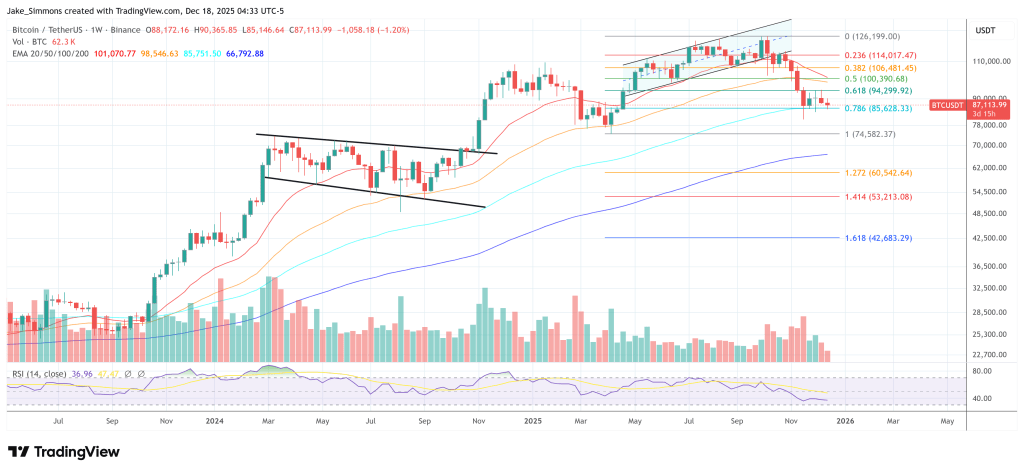
Bitcoin remains between the 0.618 and 0.786 Fib, 1-week chart | Source: BTCUSDT on TradingView.com

Trending Cryptos

Related Questions

QWhat did Jimmy Carr suggest the UK government should do with wasted night-time power?

AJimmy Carr suggested that the UK government should use wasted night-time electricity to mine Bitcoin.

QAccording to Carr, what are some examples of assets that should 'belong to everyone' in the UK?

ACarr pointed to the oil and gas under the UK and the wind farms around the coast as examples of assets that should belong to everyone.

QWhich real-world example of state-linked Bitcoin mining is mentioned in the article?

AThe article mentions that Bhutan has built a state-linked bitcoin mining operation powered largely by hydropower.

QWhat was the primary point Jimmy Carr was making about government finances?

ACarr's primary point was that the government should use underutilized national infrastructure more aggressively to generate revenue instead of treating taxation as the default solution.

QHow much Bitcoin did El Salvador mine using geothermal energy, and from what source?

AEl Salvador mined nearly 474 BTC over roughly three years using 1.5 MW of geothermal energy from a state-owned plant tied to the Tecapa volcano.

Related Reads

Unitree's IPO Frenzy: The Real Mystery is How It Will Spend the 42 Billion Raised

Unitree, a Chinese robotics company, is set for a public listing after its IPO registration was approved by regulators. The company, which started with quadruped robots and has expanded into humanoids, plans to raise approximately 4.2 billion yuan through its offering. The article traces Unitree's rapid growth from its founding in 2016 to its current status. It highlights key milestones like the 2021 CCTV Spring Festival Gala performance, the 2023 launch of its affordable Go2 robot dog and the H1 humanoid robot, and a series of subsequent product launches. By 2025, the company reported revenue of 1.71 billion yuan, profitability, and sales exceeding 5,500 humanoid robots. As the first publicly-listed humanoid robot company on China's STAR Market, Unitree's main challenges are sustaining growth and deploying its newly raised capital effectively. The humanoid robot sector in China is crowded, with over 140 companies. Competitors include UBTech (focusing on industrial and consumer markets), Fourier, and international players like Tesla Optimus and 1X NEO. The article outlines three critical challenges for Unitree: establishing a strong second product line beyond its quadruped robots, maintaining its price advantage while ensuring quality, and successfully advancing its embodied AI capabilities through partnerships like the one with NVIDIA for the H2 Plus platform. Unitree's likely strategy involves a "developer tools + industry benchmarks" approach: using low-cost models like the R1 and G1 to build developer adoption and volume, leveraging high-end platforms for AI training, and securing pilot projects in sectors like logistics and manufacturing to build case studies. The company's future success hinges on converting its current momentum in shipments and pilot programs into sustainable, large-scale commercial contracts as the broader market evolves.

marsbit1h ago

Unitree's IPO Frenzy: The Real Mystery is How It Will Spend the 42 Billion Raised

marsbit1h ago

Examining the Open USD Partner Lineup: Follow Who's Joining to See Where the Money Flows

**Title: Deciphering the Open USD Partner Roster: Following the Money** The launch of Open USD is notable less for the stablecoin itself and more for its expansive list of over 140 founding partners, which reads like a "who's who" of global finance and tech. This coalition, including asset managers like BlackRock, card networks Visa and Mastercard, banks (BNY Mellon, Standard Chartered, etc.), tech giants (Google, IBM), merchants (Shopify), and crypto firms (Coinbase, Ripple, Aave, MetaMask), signals a strategic shift. The diverse membership reveals that stablecoins are increasingly viewed not as products to compete over, but as shared infrastructure too critical to be left to any single entity. Each partner category has distinct motives. Asset managers like BlackRock seek to manage the large, sticky cash reserves, a lucrative fee-generating opportunity. Merchants like Shopify aim for lower-cost settlement and potential yield on balances. Banks join defensively to retain custody and settlement roles, fearing deposit outflows to stablecoins. Tech companies bet on programmable money for future machine-to-machine commerce. Crypto firms gain mainstream legitimacy and distribution channels. Remarkably, the consortium includes direct competitors (Visa vs. Mastercard, Coinbase vs. Ripple), indicating that the fear of exclusion from this emerging financial layer outweighs competitive rivalries. However, this shared governance could also lead to slow decision-making. The roster's composition is the real message: it represents a collective bet that a widely accepted, consortium-owned stablecoin is preferable to proprietary versions or having none at all. For incumbents like Circle and Tether, this alliance poses a significant threat, as potential clients have collectively chosen to build their own alternative. The absence of major U.S. retail banks (busy with their own tokenized deposit networks) is equally telling. In essence, the partner list maps where the industry believes value and risk will flow in a tokenized dollar future, marking stablecoin's evolution from a product to a utility.

Foresight News1h ago

Examining the Open USD Partner Lineup: Follow Who's Joining to See Where the Money Flows

Foresight News1h ago

Trading

Spot

Hot Articles

What is $BITCOIN

DIGITAL GOLD ($BITCOIN): A Comprehensive Analysis Introduction to DIGITAL GOLD ($BITCOIN) DIGITAL GOLD ($BITCOIN) is a blockchain-based project operating on the Solana network, which aims to combine the characteristics of traditional precious metals with the innovation of decentralized technologies. While it shares a name with Bitcoin, often referred to as “digital gold” due to its perception as a store of value, DIGITAL GOLD is a separate token designed to create a unique ecosystem within the Web3 landscape. Its goal is to position itself as a viable alternative digital asset, although specifics regarding its applications and functionalities are still developing. What is DIGITAL GOLD ($BITCOIN)? DIGITAL GOLD ($BITCOIN) is a cryptocurrency token explicitly designed for use on the Solana blockchain. In contrast to Bitcoin, which provides a widely recognized value storage role, this token appears to focus on broader applications and characteristics. Notable aspects include: Blockchain Infrastructure: The token is built on the Solana blockchain, known for its capacity to handle high-speed and low-cost transactions. Supply Dynamics: DIGITAL GOLD has a maximum supply capped at 100 quadrillion tokens (100P $BITCOIN), although details regarding its circulating supply are currently undisclosed. Utility: While precise functionalities are not explicitly outlined, there are indications that the token could be utilized for various applications, potentially involving decentralized applications (dApps) or asset tokenization strategies. Who is the Creator of DIGITAL GOLD ($BITCOIN)? At present, the identity of the creators and development team behind DIGITAL GOLD ($BITCOIN) remains unknown. This situation is typical among many innovative projects within the blockchain space, particularly those aligning with decentralized finance and meme coin phenomena. While such anonymity may foster a community-driven culture, it intensifies concerns about governance and accountability. Who are the Investors of DIGITAL GOLD ($BITCOIN)? The available information indicates that DIGITAL GOLD ($BITCOIN) does not have any known institutional backers or prominent venture capital investments. The project seems to operate on a peer-to-peer model focused on community support and adoption rather than traditional funding routes. Its activity and liquidity are primarily situated on decentralized exchanges (DEXs), such as PumpSwap, rather than established centralized trading platforms, further highlighting its grassroots approach. How DIGITAL GOLD ($BITCOIN) Works The operational mechanics of DIGITAL GOLD ($BITCOIN) can be elaborated on based on its blockchain design and network attributes: Consensus Mechanism: By leveraging Solana’s unique proof-of-history (PoH) combined with a proof-of-stake (PoS) model, the project ensures efficient transaction validation contributing to the network's high performance. Tokenomics: While specific deflationary mechanisms have not been extensively detailed, the vast maximum token supply implies that it may cater to microtransactions or niche use cases that are still to be defined. Interoperability: There exists the potential for integration with Solana’s broader ecosystem, including various decentralized finance (DeFi) platforms. However, the details regarding specific integrations remain unspecified. Timeline of Key Events Here is a timeline that highlights significant milestones concerning DIGITAL GOLD ($BITCOIN): 2023: The initial deployment of the token occurs on the Solana blockchain, marked by its contract address. 2024: DIGITAL GOLD gains visibility as it becomes available for trading on decentralized exchanges like PumpSwap, allowing users to trade it against SOL. 2025: The project witnesses sporadic trading activity and potential interest in community-led engagements, although no noteworthy partnerships or technical advancements have been documented as of yet. Critical Analysis Strengths Scalability: The underlying Solana infrastructure supports high transaction volumes, which could enhance the utility of $BITCOIN in various transaction scenarios. Accessibility: The potential low trading price per token could attract retail investors, facilitating wider participation due to fractional ownership opportunities. Risks Lack of Transparency: The absence of publicly known backers, developers, or an audit process may yield skepticism regarding the project's sustainability and trustworthiness. Market Volatility: The trading activity is heavily reliant on speculative behavior, which can result in significant price volatility and uncertainty for investors. Conclusion DIGITAL GOLD ($BITCOIN) emerges as an intriguing yet ambiguous project within the rapidly evolving Solana ecosystem. While it attempts to leverage the “digital gold” narrative, its departure from Bitcoin's established role as a store of value underscores the need for a clearer differentiation of its intended utility and governance structure. Future acceptance and adoption will likely depend on addressing the current opacity and defining its operational and economic strategies more explicitly. Note: This report encompasses synthesised information available as of October 2023, and developments may have transpired beyond the research period.

656 Total ViewsPublished 2025.05.13Updated 2025.05.13

What is $BITCOIN

Discussions

Welcome to the HTX Community. Here, you can stay informed about the latest platform developments and gain access to professional market insights. Users' opinions on the price of BTC (BTC) are presented below.

活动图片