Japan’s SBI Bank Expands Crypto Push With BTC, ETH, XRP Rewards Program For Depositors

bitcoinistPublished on 2026-06-10Last updated on 2026-06-10

Abstract

SBI Shinsei Bank, part of Japan's SBI Group, is launching a crypto rewards program this fall to expand its digital assets business. The program will reward depositors with vouchers worth 20% of their interest payments, redeemable for Bitcoin (BTC), Ethereum (ETH), or XRP. A three-month trial starts in June for deposits ranging from 300,000 to over 30 million yen. Customers must open an account with SBI's crypto exchange, VC Trade, to convert the vouchers. This initiative is part of SBI Group's broader crypto push, which includes launching a crypto-linked Visa card, developing crypto investment trusts, filing for crypto ETFs, and seeking to acquire a stake in the Bitbank exchange.

The banking arm of Japanese financial giant SBI Holdings is reportedly launching a crypto rewards program for depositors as part of a broader push to expand its digital assets business.

SBI Shinsei Launches BTC, ETH, XRP Rewards

SBI Shinsei Bank, the banking arm of Japan’s SBI Group, will reportedly launch a program this fall that rewards depositors with cryptocurrency vouchers, based on their account balances, Nikkei first reported on Monday.

According to local news outlets, depositors will receive exchange vouchers equal to 20% of their deposit interest payments, redeemable for Bitcoin (BTC), Ethereum (ETH), or XRP “within a certain period,” with conversion based on market rates at the time of execution.

The bank will hold a three-month trial campaign starting June 10. The campaign will reportedly apply to fixed-term deposits and savings accounts with maturities ranging from three months to five years.

Deposits of 300,000 yen will receive a voucher worth about 500 yen, while deposits of 30 million yen or more will earn roughly 20,000 yen in vouchers. SBI Shinsei is set to take customer feedback to shape the final structure of the service, evaluating account openings and usage before deciding on a permanent rollout this fall.

While offering digital assets as a permanent deposit product is highly unusual, the program aims to attract new customers to the group’s crypto business, SBI VC Trade, using bank deposits as the entry point.

Notably, the number of individual deposit accounts currently stands at approximately 4.33 million, the reports added, and customers will reportedly be required to open an SBI VC Trade account to exchange their vouchers.

In February, SBI Shinsei Bank and SBI VC Trade ran a campaign offering up to 20,000 yen in XRP exchange vouchers, based on the total amount deposited in Power Direct yen time deposits.

SBI Group Expands Crypto Push

SBI Group has been accelerating its crypto expansion, rolling out new products while deepening its footprint in both trading and investment services. In March, SBI VC Trade introduced a retail USDC lending service, allowing users to lend stablecoins under fixed-term agreements in exchange for returns.

In May, SBI VC Trade, APLUS, and Visa Worldwide Japan introduced the SBI Visa Crypto Card, which converts spending rewards into BTC, ETH, or XRP. The card integrates with SBI Securities’ investment services, enabling automated crypto accumulation tied to monthly investment activity.

SBI Securities, alongside Rakuten Securities, is developing crypto investment trusts for direct sale to individual investors. Meanwhile, SBI has partnered with Startale Group to build a blockchain for tokenized stocks and launched JPYSC, a yen-backed stablecoin.

The group has also moved to consolidate its position in Japan’s crypto exchange market, formally submitting a letter of intent to acquire a stake in Bitbank, one of Japan’s top regulated exchanges, to make it a consolidated subsidiary, following the integration of Bitpoint Japan into SBI VC Trade.

In addition, SBI has outlined plans to launch crypto-based exchange-traded funds (ETFs), filing for a combined Bitcoin and XRP ETF on the Tokyo Stock Exchange, targeting $32 billion in assets within three years, and a “Digital Gold Crypto” ETF that would allocate 51% to gold and 49% to digital assets.
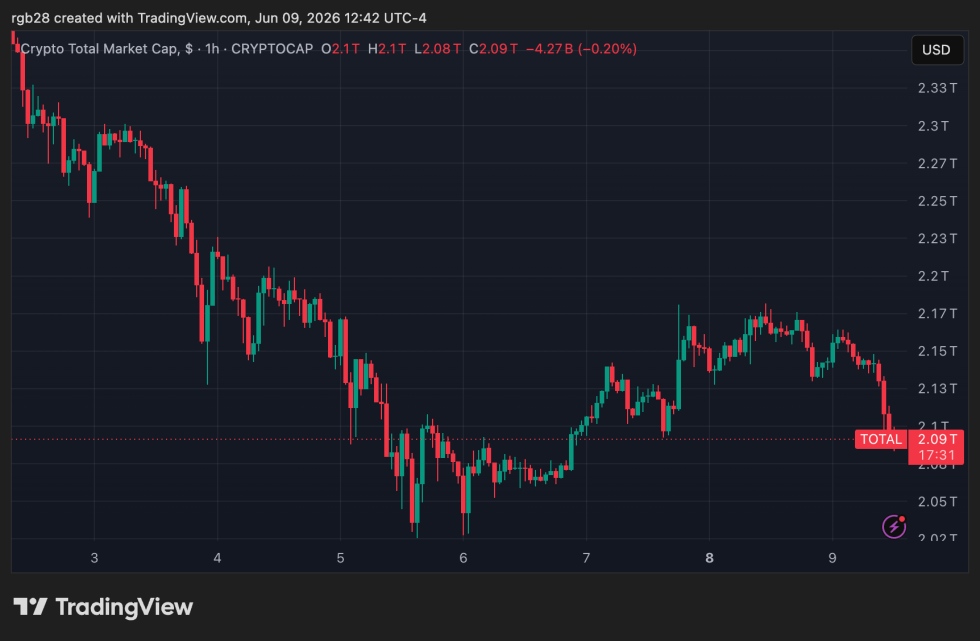
The total crypto market capitalization is at $2.09 trillion in the one-week chart. Source: TOTAL on TradingView


Related Questions

QWhat is the main objective of SBI Shinsei Bank's new cryptocurrency rewards program for depositors?

AThe main objective is to attract new customers to the group's crypto business, SBI VC Trade, by using bank deposits as an entry point and offering cryptocurrency vouchers as a reward.

QHow will the crypto voucher rewards for depositors be calculated in the new program?

ADepositors will receive exchange vouchers equal to 20% of their deposit interest payments, which are redeemable for Bitcoin (BTC), Ethereum (ETH), or XRP based on market rates at the time of redemption.

QWhat is one of the other recent crypto-related products launched by an SBI Group company, as mentioned in the article?

AOne recent product is the SBI Visa Crypto Card, introduced by SBI VC Trade, APLUS, and Visa, which converts spending rewards into BTC, ETH, or XRP and integrates with SBI Securities' investment services.

QWhat strategic move is SBI Group making to strengthen its position in Japan's crypto exchange market?

ASBI Group is moving to acquire a stake in Bitbank, one of Japan's top regulated exchanges, to make it a consolidated subsidiary, following the previous integration of Bitpoint Japan.

QAccording to the article, what type of crypto-related financial product has SBI filed to launch on the Tokyo Stock Exchange?

ASBI has filed to launch crypto-based exchange-traded funds (ETFs), including a combined Bitcoin and XRP ETF and a 'Digital Gold Crypto' ETF that allocates 51% to gold and 49% to digital assets.

Related Reads

Partner at Pantera Capital: How Tokenization Can Restructure the Private Equity and Early-Stage Investment Ecosystem?

"Tokenized Startups: Rebalancing Access to High-Growth Companies" by Jay Yu, compiled by Jiahuan, ChainCatcher The article explores how tokenization could democratize access to high-growth private companies, addressing a market gap created as firms like Stripe and SpaceX stay private for over a decade, depriving public investors of early growth returns. It identifies three converging trends enabling this shift: the explosive growth of Special Purpose Vehicles (SPVs) as makeshift liquidity tools, the rise of tokenized real-world assets (RWA), and the breakdown of the "token vs. equity" consensus where project tokens often fail to capture value. The landscape of tokenized startup platforms is analyzed across two dimensions: investment mechanisms (from equity-holding SPVs like PreStocks to perpetual futures like TradeXYZ) and company stage (early-stage to pre-IPO giants). A key finding is a strong power-law concentration, with most platform volume driven by a few high-profile pre-IPO names like SpaceX and Anthropic. Platforms providing direct equity exposure (e.g., Robinhood Ventures) currently see higher volumes than pure synthetic/perpetual platforms. The discussion highlights major challenges and opportunities: 1. **Founder/Team Alignment:** Gaining company consent for tokenization is critical, as seen when Anthropic and OpenAI objected. Proposed solutions include tokenized startup baskets, accelerator models (e.g., Street, MetaDAO helping startups grow), and community token distributions to align incentives. 2. **Non-U.S. Jurisdictions:** Tokenization offers significant potential in regions with less efficient capital markets (e.g., South Korea), providing global liquidity and better valuations for local champions. 3. **Price Discovery for Perpetuals:** Synthetic/perpetual platforms avoid consent issues but face price discovery challenges for illiquid private assets. TradeXYZ's success with Cerebras Systems' pre-IPO perpetual, which accurately predicted the IPO price, showcases potential but scalability remains unproven. 4. **Legal & Regulatory Structure:** Regulatory treatment varies. Issuer-sponsored tokens are treated as traditional securities. Third-party tokens face complex classifications—custodial tokens represent claims on held shares, while synthetic tokens (perpetuals, linked notes) are separate securities subject to strict rules, often restricting U.S. retail access. In conclusion, tokenized startup mechanisms represent an attempt to restore the public market's historical function of providing early, liquid exposure to high-growth companies. For crypto tokens, successfully capturing real economic upside in startups could resolve their current identity crisis and fulfill their original promise.

marsbit26m ago

Partner at Pantera Capital: How Tokenization Can Restructure the Private Equity and Early-Stage Investment Ecosystem?

marsbit26m ago

Partner at Pantera Capital: How Tokenization Could Reshape the Private Equity and Early-Stage Investment Ecosystem?

The article discusses how tokenization could reshape private equity and early-stage investment. Historically, public markets allowed early access to high-growth companies, but today's leading tech firms (e.g., Stripe, SpaceX) remain private for over a decade, with private capital capturing their growth phase. Temporary fixes like SPVs and secondary markets have emerged but are not fundamental solutions. Tokenized venture assets present a potential solution, converging three trends: the explosive growth of SPVs, the rapid expansion of tokenized real-world assets (RWA), and the breakdown of the "token vs. equity" consensus, where project tokens have become subordinate to equity in value capture. This creates an opportunity for tokenized startups to offer public, liquid exposure to venture-scale returns. The landscape includes various models: equity-backed tokens via SPVs or funds (e.g., PreStocks, Robinhood Ventures) and synthetic perpetual futures offering only price exposure (e.g., TradeXYZ, Ventuals). Trading volume is heavily concentrated in late-stage, pre-IPO companies like SpaceX and Anthropic and shows a power-law distribution across platforms. Key challenges and opportunities include aligning with founder/team interests, which can be addressed through models like tokenized startup baskets, accelerator models, or community token distributions. Expanding into non-U.S. jurisdictions with less efficient capital markets offers another path. For perpetual futures models, the central challenge is accurate price discovery for private assets without reliable oracles; TradeXYZ's success with Cerebras Systems pre-IPO pricing demonstrates potential. Regulatory and legal structures for these tokenized instruments remain nascent and untested. In conclusion, tokenization represents an effort to restore the early, liquid access to high-growth companies that public markets once provided. It could also resolve the identity crisis of project tokens by granting them genuine claims on venture-scale upside, potentially fulfilling crypto's original promise with more mature infrastructure.

链捕手46m ago

Partner at Pantera Capital: How Tokenization Could Reshape the Private Equity and Early-Stage Investment Ecosystem?

链捕手46m ago

SpaceX's Core Window for Listed Trading: July 7th Nasdaq Inclusion Date and Post-Q2 Earnings Lockup Expiration

SpaceX is set for its historic IPO on June 12 at $135 per share, with a paper valuation of $1.75 trillion. A key insight from analyst Alexandra Mertz highlights the IPO's unique structure, where an extremely low initial public float of only 4.3% is expected to create a significant supply vacuum. This scarcity is set to collide with massive forced buying from index funds like Vanguard, CRSP, and FTSE Russell, which are scheduled to start adding SpaceX to their indices as early as June 18/22 and July 7 (NASDAQ 100 inclusion). This could propel the stock price sharply higher, with AI models like Grok predicting a potential doubling from the IPO price around July 7. Another critical date is the post-Q2 earnings call (estimated late July), when early insider shareholders (excluding Elon Musk, who has a 366-day lock-up) become eligible to sell. However, actual selling pressure may be only 10-15% of shares, as major holders like Ron Baron and BlackRock have expressed intentions to hold or buy more. The discussion introduces a compelling "Goldilocks scenario": a potential stock-for-stock merger announcement between SpaceX and Tesla in the window between the July 7 price peak and the late-July unlock period. This timing could help Elon Musk manage a personal $7 billion tax liability related to exercising Tesla stock options by August 15, while leveraging high valuations for both companies. Furthermore, the inclusion of former Tesla adversaries like Charles Schwab, Morgan Stanley, and J.P. Morgan as SpaceX IPO underwriters is seen as a strategic move to secure their "yes" votes for a potential Tesla merger approval in a November shareholder vote. The rationale for SpaceX acquiring Tesla, rather than the reverse, centers on SpaceX's superior governance structure, which offers Musk stronger control through super-voting shares and mandatory arbitration clauses, protecting the combined entity from activist investors and legal challenges.

marsbit1h ago

SpaceX's Core Window for Listed Trading: July 7th Nasdaq Inclusion Date and Post-Q2 Earnings Lockup Expiration

marsbit1h ago

Trading

Spot
Futures

Hot Articles

How to Buy PUSH

Welcome to HTX.com! We've made purchasing Push Protocol (PUSH) simple and convenient. Follow our step-by-step guide to embark on your crypto journey.Step 1: Create Your HTX AccountUse your email or phone number to sign up for a free account on HTX. Experience a hassle-free registration journey and unlock all features.Get My AccountStep 2: Go to Buy Crypto and Choose Your Payment MethodCredit/Debit Card: Use your Visa or Mastercard to buy Push Protocol (PUSH) instantly.Balance: Use funds from your HTX account balance to trade seamlessly.Third Parties: We've added popular payment methods such as Google Pay and Apple Pay to enhance convenience.P2P: Trade directly with other users on HTX.Over-the-Counter (OTC): We offer tailor-made services and competitive exchange rates for traders.Step 3: Store Your Push Protocol (PUSH)After purchasing your Push Protocol (PUSH), store it in your HTX account. Alternatively, you can send it elsewhere via blockchain transfer or use it to trade other cryptocurrencies.Step 4: Trade Push Protocol (PUSH)Easily trade Push Protocol (PUSH) on HTX's spot market. Simply access your account, select your trading pair, execute your trades, and monitor in real-time. We offer a user-friendly experience for both beginners and seasoned traders.

3.7k Total ViewsPublished 2024.03.29Updated 2026.06.02

How to Buy PUSH

Discussions

Welcome to the HTX Community. Here, you can stay informed about the latest platform developments and gain access to professional market insights. Users' opinions on the price of PUSH (PUSH) are presented below.

活动图片