January Crypto Market Analysis: Prices Decline, But Institutional Infrastructure Accelerates

marsbitPublished on 2026-02-10Last updated on 2026-02-10

Abstract

January 2026 presented a paradox in the crypto market: prices fell by 25%, yet infrastructure supporting institutional adoption accelerated. While Bitcoin dropped to a 10-month low near $73,000 and leveraged traders liquidated $2.2 billion in positions, institutional developments advanced rapidly. BlackRock identified digital assets as a key 2026 investment theme, DTCC launched production-level tokenization for U.S. Treasuries and equities, and Y Combinator announced it would fund startups in USDC. The sell-off was driven by macro shocks—not crypto-specific weakness—including stress in Japanese government bonds and the nomination of a hawkish Fed chair, triggering global deleveraging. Bitcoin correlated with risk assets rather than acting as a hedge, raising questions about its institutional role. Despite price volatility, regulatory clarity improved, and jurisdictions like Hong Kong and Dubai competed to attract crypto capital. Protocol development continued unabated, with Ethereum and Solana pushing scalability upgrades. However, security losses exceeded $370 million, highlighting operational risks. The divergence between price action and structural progress defines this cycle, indicating that institutional maturity is advancing independently of short-term valuations.

Author: Dhruvang Choudhari (AMINA Bank)

Compiled by: Deep Tide TechFlow

Deep Tide Introduction: January 2026 presented a paradox: crypto prices fell by 25%, but the infrastructure supporting institutional adoption was accelerating. While Bitcoin dropped to a ten-month low of $73,000, BlackRock listed digital assets as a decisive investment theme for 2026.

While leveraged traders liquidated $2.2 billion in positions, the Depository Trust and Clearing Corporation (DTCC) launched production-level tokenization for U.S. Treasuries and stocks. While sentiment indices reached extreme pessimism, Y Combinator announced it would begin funding startups in USDC.

AMINA Bank's analysis points out that this is not a rejection of digital assets, but a repricing within an evolving global monetary system. The divergence between price action and structural progress defines the current phase of the cycle.

Full Text Below:

Introduction

January 2026 presented a paradox: crypto prices fell by 25%, but the infrastructure supporting institutional adoption was accelerating.

While Bitcoin dropped to a ten-month low near $73,000, BlackRock listed digital assets as a decisive investment theme for 2026. While leveraged traders liquidated $2.2 billion in positions, the Depository Trust and Clearing Corporation (DTCC) launched production-level tokenization for U.S. Treasuries and stocks. While sentiment indices reached extreme pessimism, Y Combinator announced it would begin funding startups in USDC.

The first two months of 2026 marked a decisive shift in the digital asset market. What initially seemed like chaotic selling was actually a broad macro repricing driven by sovereign risk, changes in the monetary system, and forced unwinding of global leverage. Unlike previous crypto downturns, this event did not originate from within the digital asset ecosystem itself. It emerged from the outside.

January and February revealed a paradox that is now central to the institutional crypto era. Market prices deteriorated sharply, yet regulatory clarity, infrastructure deployment, and institutional commitment advanced at an unprecedented pace. This divergence between price action and structural progress defines the current phase of the cycle.

This update analyzes how the macroeconomic shock disrupted crypto market structure, why Bitcoin faces an identity challenge as a macro asset, and how institutional capital continues to build amidst volatility rather than retreat from it.

Institutional Expansion Amid Market Weakness

Despite deteriorating spot prices, institutional participation accelerated rather than slowed. This acceleration reveals a fundamental shift in how mature allocators approach digital assets: infrastructure maturity now matters more than price momentum.

Tokenization as a Core Strategy

BlackRock formally listed digital assets and tokenization as decisive investment themes for 2026, alongside AI, as structural drivers for capital markets.

At Franklin Templeton, innovation leadership described 2026 as the beginning of a wallet-native financial system, where stocks, bonds, and funds are held directly in digital wallets, rather than through traditional custody frameworks.

Y Combinator sent a key signal, announcing that starting with the Spring 2026 batch, startups may receive funding in USDC on Ethereum, Base, and Solana. Stablecoin settlements now typically clear in less than a second at a cost below $0.01, offering a clear advantage over cross-border fiat rails.

Reduced Regulatory Friction

Regulatory developments quietly removed long-standing structural barriers. The SEC rescinded previous accounting guidance that hindered banks from offering digital asset custody services. Simultaneously, the Depository Trust and Clearing Corporation (DTCC) launched a production-level tokenization program for U.S. Treasuries, large-cap stocks, and ETFs, confirming the legal equivalence between tokenized securities and traditional securities.

This marks a shift from experimental adoption to an upgrade of internal financial infrastructure.

Regional Competition for Crypto Capital

Jurisdictions are increasingly deploying policy as a competitive lever.

Hong Kong announced zero-tax incentives on qualified digital asset income for funds and family offices, positioning itself as a major institutional crypto hub in Asia. As of January 2026, 11 licensed virtual asset trading platforms are operating.

Meanwhile, Dubai continues to execute its blockchain-first government strategy, aiming for on-chain processing of 50% of public sector transactions by the end of 2026. Crypto penetration in the UAE has reached approximately 39%, representing over 3.7 million users.

Macroeconomic Shock Shattering the Calm

Understanding why institutions continue to build requires understanding what drove the sell-off. The relative stability of 2025 fostered expectations that crypto had entered a low-volatility, institutionally-anchored phase. These assumptions were shattered in January.

Japan and the Unwinding of Global Leverage

On January 20, 2026, the Japanese Government Bond (JGB) market entered a period of acute stress. The 30-year JGB yield surged over 30 basis points to 3.91%, its highest level in 27 years, following fiscal rhetoric from Prime Minister Sanae Takaichi that heightened concerns about debt sustainability. Japan's debt-to-GDP ratio has exceeded 250%, making it a focal point for global bond markets.

Figure 1: Japan 30-Year Government Bond Yield (Historical)
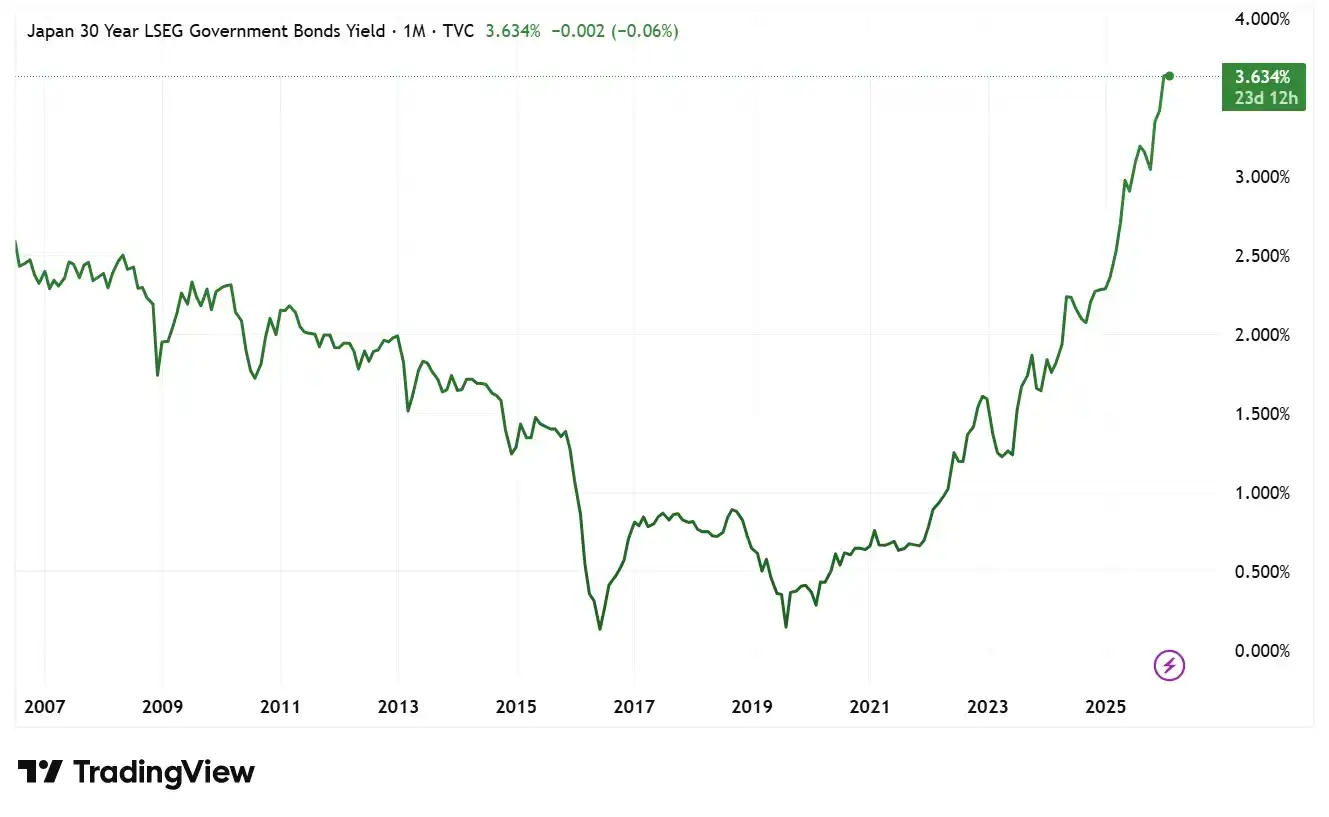
Source: TradingView

The immediate consequence was the rapid unwinding of the yen carry trade, one of the largest sources of cheap global leverage. As yen funding costs rose, investors were forced to liquidate risk assets to meet margin requirements. Bitcoin fell below $91,000 not due to crypto-specific weakness, but because it served as a liquidity proxy for balance sheet repair.

Warsh Nomination and Monetary Repricing

This pressure escalated on January 30th with the nomination of Kevin Warsh as the next Federal Reserve Chair. Warsh's long-standing preference for higher real interest rates and a significant reduction of the Fed's balance sheet was interpreted as a clear shift away from accommodative monetary policy.

Within 24 hours, the total cryptocurrency market capitalization fell by about $430 billion. Bitcoin fell approximately 7% in a single trading session, while Ethereum and high-beta altcoins experienced double-digit percentage pullbacks. This move reflected a repricing of global dollar liquidity expectations, not speculative panic.

Price Action and Bitcoin's Identity Crisis

The macro shock revealed an uncomfortable truth about Bitcoin's evolution as an institutional asset. The last week of January produced one of the most severe single-day dislocations of the institutional era.

On January 29th, Bitcoin fell from $96,000 to $80,000, a drop of approximately 15% in a single day. The crypto derivatives market liquidated over $2.2 billion in leveraged positions. The significance of this move lies not in its magnitude, but in its correlation characteristics.

Bitcoin failed to decouple from stocks, instead trading in sync with high-beta tech stocks. During a global deleveraging event, it behaved not as a defensive asset, but as a liquidity-sensitive risk instrument.

By early February, sentiment indicators reflected extreme pessimism. The Crypto Fear & Greed Index dropped to 19, and key technical levels, including the 0.786 Fibonacci retracement at $85,400, were decisively broken. The high $70,000s range became the market's primary structural support zone.

Figure 2: Bitcoin Price Decline Driven by Global Macro Events (Jan-Feb 2026)

Source: AMINA Bank

The correlation characteristics raise fundamental questions about Bitcoin's role in institutional portfolios. If it behaves as a high-beta tech proxy rather than a defensive hedge during stress, the allocation thesis must adjust accordingly. Yet, institutional commitment continues regardless, suggesting mature allocators are pricing Bitcoin's long-term structural role, not its short-term correlation behavior.

Protocol Evolution and Competitive Differentiation

While prices fell and macro conditions worsened, foundational layer development continued unabated. This demonstrates a key feature of the current cycle: infrastructure development has decoupled from price momentum.

Ethereum remains focused on scaling through execution efficiency, censorship resistance, and MEV mitigation. The upcoming Glamsterdam upgrade aims to increase the gas limit to 200 million, approaching a throughput of nearly 10,000 TPS theoretically.

Solana is pursuing aggressive performance enhancements. Its Alpenglow upgrade aims to reduce transaction finality from 12.8 seconds to approximately 100-150 milliseconds, positioning it as one of the fastest settlement layers in production.

These technical advancements continue regardless of market sentiment, reflecting long-term capital commitment and engineering development independent of price action.

Security Losses Highlight Operational Risks

Even as institutional infrastructure matures, security incidents highlight ongoing operational vulnerabilities. January 2026 recorded over $370 million in stolen funds, the highest monthly total in nearly a year. Over $311 million in losses stemmed from phishing and social engineering attacks, not smart contract failures.

The single largest event, exceeding $280 million, involved AI-generated voice impersonation targeting hardware wallet users. These incidents emphasize a structural shift in risk. Human and operational vulnerabilities now represent the primary attack surface for institutional crypto participants.

This pattern reinforces why custody frameworks operating under regulatory oversight offer competitive advantages beyond compliance. Operational security protocols, institutional-grade key management, and insurance frameworks have become mandatory requirements.

Conclusion

The retracement of January-February 2026 is not a rejection of digital assets, but a repricing within a changing global monetary system. Crypto now reacts directly to sovereign bond markets, central bank leadership, and geopolitical escalation. This sensitivity introduces volatility, but it also confirms integration.

Simultaneously, institutional adoption, regulatory clarity, and protocol development advanced during the sell-off. Tokenization shifted from narrative to deployed infrastructure, wallet-native finance from theory to implementation.

Early 2026 did not mark a collapse of the crypto market. It marked its first real stress test of institutional maturity. While prices failed the test, the underlying infrastructure passed with flying colors.

The divergence between price action and structural progress will not persist indefinitely, as institutional deployment, regulatory clarification, and infrastructure maturity will ultimately be reflected in market valuations.


Related Questions

QWhat was the key paradox observed in the crypto market in January 2026 according to the article?

AThe key paradox was that while crypto prices fell by 25%, the infrastructure supporting institutional adoption was accelerating.

QWhich major financial institution listed digital assets as a definitive investment theme for 2026, alongside AI?

ABlackRock listed digital assets and tokenization as a definitive investment theme for 2026, alongside AI.

QWhat major macroeconomic event in Japan triggered a global deleveraging event that impacted crypto prices?

AAcute stress in the Japanese Government Bond (JGB) market, where 30-year JGB yields surged over 30 basis points to 3.91%, triggered a rapid unwinding of yen carry trades and forced liquidations of risk assets like crypto.

QWhat significant policy change did the SEC make regarding digital asset custody services?

AThe SEC rescinded previous accounting guidance that had prevented banks from offering digital asset custody services.

QHow did Bitcoin's price behavior during the January 2026 sell-off challenge its perceived role as an institutional asset?

ABitcoin failed to act as a defensive asset or decouple from equities. Instead, it traded in sync with high-beta tech stocks, behaving like a liquidity-sensitive risk tool during a global deleveraging event, which raised questions about its role in institutional portfolios.

Related Reads

Unveiling the 'White-haired Stock God' Serenity: A Spiritual Remedy for Anxious Retail Investors

The article details the rise of Serenity, dubbed the "White-Haired Stock God," whose social media posts have recently caused significant volatility in China's A-share market. Previously gaining fame in international retail investor communities, Serenity is known for his "Chokepoint Investment" strategy targeting small monopolies in the AI supply chain, reportedly achieving returns over 3612% this year. His influence stems from his background as a former AI research scientist, detailed analysis, and a massive following on X, where his subscriber count has surpassed Elon Musk's. In early June, Serenity's Chinese-language posts mentioning A-shares like LeaderDrive (Lide Xiebo), Easun, and Innolight triggered immediate 20% surges in their stock prices. He later clarified that some recommendations were crowdsourced from followers and claimed he did not hold positions in these stocks, stating his actions were "just for fun" to offer a foreign perspective on Chinese markets. This activity drew scrutiny from Chinese financial media, which warned of potential "pump-and-dump" schemes and legal risks. While anonymous, clues suggest Serenity is likely a Chinese-speaking individual living in Japan. He maintains his anonymity due to past harassment but enjoys substantial monthly income from his paid subscriptions. The article posits that Serenity embodies the market's current appetite for a charismatic, successful figure during the AI bull run, serving as an "outward projection" of bullish sentiment. It concludes by noting the cyclical nature of such market icons, warning that the same crowds that elevate them often seek scapegoats when trends reverse.

Odaily星球日报1m ago

Unveiling the 'White-haired Stock God' Serenity: A Spiritual Remedy for Anxious Retail Investors

Odaily星球日报1m ago

Unveiling the 'White-Haired Stock God' Serenity: The Mental Elixir for Anxious Retail Investors

The anonymous stock influencer known as "White-Haired Stock God" Serenity has ignited a frenzy in the A-share market. From June 5-9, Serenity's posts on platform X mentioning A-shares like LeaderDrive, Easun, and Innolight triggered sharp price surges, with some stocks hitting 20% daily limits. Serenity, who claims a 3612% personal return this year, gained fame internationally using a "chokepoint investment" strategy focused on small, monopolistic AI supply chain companies. With over 810k X followers, his influence rivals top analysts. His recent foray into Chinese stocks, which he claims is "for fun" to offer a "foreign perspective," has drawn scrutiny. While Serenity denies holding positions in these A-shares and states his posts are not recommendations, his actions have caused significant market volatility. He monetizes through a $1/month subscription, earning an estimated $54k monthly. Facing accusations of market manipulation, he maintains he promotes "information democracy." Community analysis suggests Serenity is likely an English-speaking Chinese national living in Japan, based on his posting patterns and shared personal details. He maintains anonymity due to past harassment. Ultimately, Serenity is seen by many as a manifestation of the current AI bull market's euphoria—a mysterious, seemingly successful figure who fulfills the market's desire for a "stock god," though such personas often face intense scrutiny when market sentiment shifts.

marsbit2m ago

Unveiling the 'White-Haired Stock God' Serenity: The Mental Elixir for Anxious Retail Investors

marsbit2m ago

Korean Youth, Making a 'Last Stand' in an Epic Bull Market

South Korea is experiencing an unprecedented stock market boom in the first half of 2026, with the KOSPI index doubling in six months, driven primarily by tech giants Samsung Electronics and SK Hynix. This "epic bull run," tied to the semiconductor cycle, has sparked a nationwide frenzy for stock trading. The country, with a population of just over 50 million, now has over 105 million securities accounts. The article, from the perspective of a Chinese national living in Seoul, explores how this speculative fever reflects deeper societal anxieties among Korean youth. Facing stagnant wages, high costs of living, housing pressures, and rigid social stratification, many young people see the volatile market as a "last chance" to alter their predetermined life trajectories and escape financial precarity. Stories include a young office worker investing her meager savings, a couple delaying marriage due to financial pressures, and a seasoned trader navigating exclusive social circles where market information is currency. However, the boom also exposes and exacerbates existing inequalities. While some achieve windfalls, others face devastating losses, with borrowing to invest reaching record highs. The narrative contrasts the illusion of equal opportunity with the harsh reality that the ability to absorb risk is unevenly distributed. Ultimately, the market frenzy is portrayed not as a solution, but as a symptom of a generation's struggle against a system offering limited upward mobility, where daily life is a precarious balance of bills, debts, and societal expectations.

marsbit29m ago

Korean Youth, Making a 'Last Stand' in an Epic Bull Market

marsbit29m ago

Young South Koreans, Making a 'Last-Ditch Effort' in an Epic Bull Market

This article explores how an unprecedented stock market boom in South Korea during the first half of 2026, driven by the semiconductor industry, is transforming the lives of ordinary people, particularly the youth. The KOSPI index doubled in six months, fueled by giants Samsung and SK Hynix, leading to a frenzy of retail investing. With over 105 million stock accounts in a population of just over 50 million, a sense of "FOMO" (fear of missing out) is pervasive. Through the perspective of Li Yuning, a Chinese woman living in Seoul, the piece follows several young Koreans who see the market as a last chance to escape stifling economic pressures, high housing costs, and narrow social mobility. Individuals like Minji, a low-paid office worker, and Junho, saving for marriage, invest their limited savings, while experienced traders like Suhu navigate exclusive social circles. The narrative reveals that this speculative fever stems less from greed and more from deep-seated anxiety about being left behind in a society with growing wealth inequality and rigid class structures. However, the boom also exposes stark social divides. It exacerbates wealth gaps, as those with family support or existing capital fare better. The pressure to succeed is immense, with stories of devastating losses leading to personal tragedy. Ultimately, the article suggests the牛市 acts as a pressure valve and a temporary illusion of opportunity in a system where traditional paths to advancement seem increasingly closed, leaving young people to gamble on the market as a final, desperate bid for a better future.

链捕手35m ago

Young South Koreans, Making a 'Last-Ditch Effort' in an Epic Bull Market

链捕手35m ago

Trading

Spot
Futures

Hot Articles

What is $BANK

Bank AI: A Revolutionary Step in the Future of Banking Introduction In an era marked by rapid advancements in technology, Bank AI stands at the intersection of artificial intelligence (AI) and banking services. This innovative project seeks to redefine the financial landscape, enhancing operational efficiency, security measures, and customer experiences through the power of AI. As we embark on this exploration of Bank AI, we will delve into what the project entails, its operational dynamics, its historical context, and significant milestones. What is Bank AI? At its core, Bank AI represents a transformative initiative aimed at integrating artificial intelligence into various banking operations. This project harnesses the capabilities of AI to automate processes, improve risk management protocols, and enhance customer interaction through personalised services. The primary objectives of Bank AI include: Automation of Banking Functions: By leveraging AI technologies, Bank AI aims to automate routine tasks, reducing the burden on human resources and enhancing efficiency. Enhanced Risk Management: The project utilises AI algorithms to predict and identify risks, thereby fortifying security measures against fraud and other threats. Personalisation of Banking Services: Bank AI focuses on offering tailored financial products and services by analysing customer data and behaviours. Improving Customer Experience: The implementation of AI-driven solutions, such as chatbots and virtual assistants, aims to provide users with more human-like interactions, revolutionising the way customers engage with banks. With these goals, Bank AI positions itself as a crucial player in rendering banking more efficient, secure, and user-centric. Who is the Creator of Bank AI? Details regarding the creator of Bank AI remain unknown. As such, no specific individual or organisation has been identified in the available information. The anonymity surrounding the project's inception raises questions but does not detract from its ambitious vision and objectives. Who are the Investors of Bank AI? Similar to the project's creator, specific information regarding the investors or supporting organisations of Bank AI has not been disclosed. Without this information, it is challenging to outline the financial backing and institutional support that might be propelling the project forward. Nevertheless, the importance of having a robust investment foundation is pivotal for sustaining development in such an innovative field. How Does Bank AI Work? Bank AI operates on several innovative fronts, focusing on unique factors that differentiate it from traditional banking frameworks. Below are key operational features: Automation: By applying machine learning algorithms, Bank AI automates various manual processes within banks. This results in reduced operational costs and allows human workers to redirect their efforts towards more strategic activities. Advanced Risk Management: The integration of AI into risk management practices equips banks with tools to accurately predict potential threats such as fraud, ensuring that customer information and assets remain secure. Tailored Financial Recommendations: Through continuous learning from customer interactions, the AI systems develop a nuanced understanding of user needs, enabling them to offer tailored advice on financial decisions. Enhanced Customer Interactions: Utilizing chatbots and virtual assistants powered by AI, Bank AI enables a more engaging customer experience, allowing users to have their queries resolved quickly, thus reducing wait times and improving satisfaction levels. Together, these operational features position Bank AI as a pioneer in the banking sector, establishing new benchmarks for service delivery and operational excellence. Timeline of Bank AI Understanding the trajectory of Bank AI requires a look at its historical context. Below is a timeline highlighting important milestones and developments: Early 2010s: The conceptualisation of AI integration into banking services began to gain attention as banking institutions recognised the potential benefits. 2018: A marked increase in the implementation of AI technologies occurred when banks started using AI tools like chatbots for basic customer service and risk management systems for improved security handling. 2023: The sophistication of AI continued to advance, with generative AI being introduced for more complex tasks such as document processing and real-time investment analysis. This year marked a significant leap in the capabilities afforded to banks by AI technology. 2024-Current Status: As of this year, Bank AI is on an upward trajectory, with ongoing research and developments poised to further enhance capabilities in banking operations. Continued exploration of AI applications hints at exciting developments yet to come. Key Points About Bank AI Integration of AI in Banking: Bank AI focuses on adopting artificial intelligence to streamline banking processes and improve user experiences. Automation and Risk Management Focus: The project strongly emphasises these areas, aiming to shift the burden of routine tasks while enhancing security frameworks through predictive analytics. Personalised Banking Solutions: By harnessing customer data, Bank AI enables tailored banking services that cater to individual user needs. Commitment to Development: Bank AI remains committed to ongoing research and development efforts, ensuring its adaptability and ongoing relevance as technology continues to evolve. Conclusion In summary, Bank AI exemplifies a crucial step forward in the banking industry, leveraging artificial intelligence to reshape operational paradigms, enhance security, and promote customer satisfaction. Despite gaps in information surrounding the creator and investors, the clear objectives and functional mechanisms of Bank AI provide a strong foundation for its ongoing evolution. As AI technology continues to advance and merge with the banking sector, Bank AI is well-positioned to significantly impact the future of financial services, enhancing the way we understand and interact with banking.

152 Total ViewsPublished 2024.04.06Updated 2024.12.03

What is $BANK

Discussions

Welcome to the HTX Community. Here, you can stay informed about the latest platform developments and gain access to professional market insights. Users' opinions on the price of BANK (BANK) are presented below.

活动图片












