Itaú Joins Brazilian Tokenization Pilot Project Together with OpenAssets

cryptonews.ruPublished on 2026-08-12Last updated on 2026-08-12

Abstract

Itaú, Latin America's largest private bank, has partnered with digital asset infrastructure provider OpenAssets to join an industry-led pilot project in Brazil testing the tokenization of fixed-income instruments and investment funds. The initiative is spearheaded by the Brazilian Financial and Capital Markets Association (ANBIMA) and explores the issuance, trading, and settlement of capital market instruments using distributed ledger technology (DLT). The project involves developing technical proof-of-concept solutions and assessing operational, regulatory, and technological requirements for tokenized assets, with debt securities and investment funds among the use cases. OpenAssets will provide the tokenization infrastructure, while Itaú will contribute its capital markets expertise. The pilot, conducted in a private DLT network with simulated transactions, was selected from numerous proposals. Meanwhile, the total value of real-world tokenized assets on public blockchains has more than doubled over the past year, exceeding $38 billion, with U.S. Treasury debt being the largest category.

Itaú, the largest private bank in Latin America, has partnered with digital asset infrastructure provider OpenAssets to participate in an industry pilot project testing the tokenization of fixed-income instruments and investment funds in Brazil.

The initiative is led by the Brazilian Association of Financial and Capital Market Entities (ANBIMA). It is testing the issuance, trading, and settlement of capital market instruments using distributed ledger technology (DLT).

According to an announcement published on Tuesday, the companies will develop technical solutions to prove the concept and evaluate the operational, regulatory, and technological requirements for tokenized assets. Use cases under consideration include debt securities and investment funds.

OpenAssets will provide the tokenization infrastructure, while Itaú will share its expertise in capital markets. The companies will examine how tokenized assets could function within an institutional framework.

In April, ANBIMA selected 20 use cases for the pilot project from 39 proposals submitted by more than 50 banks, asset managers, and technology companies. The tests are being conducted on a private, permissioned DLT network in a simulated environment without real financial transactions.

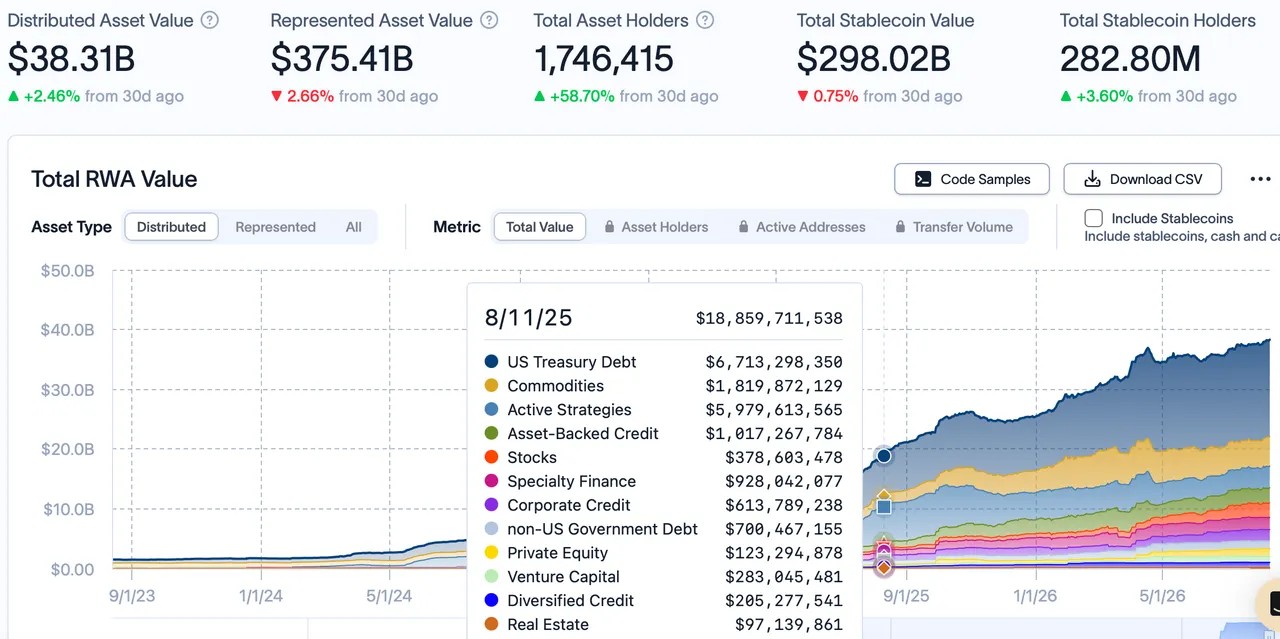
According to RWA.xyz's estimates, the value of real-world tokenized assets distributed across public blockchains has more than doubled over the past year, rising from approximately $18.9 billion in August 2025 to $38.3 billion at the time of publication. The largest category is U.S. Treasury debt obligations, accounting for over $16 billion.

Real-world tokenized assets. Source: RWA.xyz

Magazine: BIP-110 Concludes Inconclusively, CLARITY Vote Delayed: Hodler’s Digest, August 9

end-content

Trending Cryptos

Related Questions

QWhat is the main purpose of the pilot project in Brazil that Itaú is participating in with OpenAssets?

AThe main purpose of the pilot project is to test the tokenization of fixed-income instruments and investment funds using Distributed Ledger Technology (DLT).

QWhich organization is leading the tokenization pilot initiative involving Itaú and OpenAssets?

AThe initiative is being led by the Brazilian Association of Financial and Capital Markets (ANBIMA).

QWhat specific roles do Itaú and OpenAssets play in the pilot project?

AOpenAssets provides the tokenization infrastructure, while Itaú contributes its expertise in capital markets.

QAccording to the article, how many use cases were selected for the pilot project from the initial proposals?

AANBIMA selected 20 use cases for the pilot project from 39 proposals submitted by over 50 banks, asset managers, and tech companies.

QWhat was the estimated value of real-world tokenized assets on public blockchains as of the article's publication, and what is the largest single category?

AAs of the article's publication, the estimated value was $38.3 billion, more than doubling from the previous year. The largest category is U.S. Treasury obligations, accounting for over $16 billion.

Related Reads

Wall Street Begins to Question Tech Giants' AI Narrative

Wall Street Questions the AI Narrative of Tech Giants Wall Street is shifting its focus from the hype surrounding artificial intelligence (AI) to a rigorous financial reality check. Following strong earnings reports from companies like Google and a massive $500 billion financing initiative from Nvidia for AI infrastructure, the market reaction has been mixed and skeptical. The core concern revolves around the massive capital expenditure (CapEx) required for AI development—building data centers and acquiring chips—and whether future cash flows can justify these upfront costs. Investors are now scrutinizing free cash flow (FCF), which measures the cash left after operational expenses and capital investments. A negative FCF, as seen recently with Alphabet (Google's parent company), signals heavy immediate spending, even if profits are growing. The divergent stock reactions highlight this new scrutiny. Microsoft's stock surged after its earnings, supported by strong operating cash flow, growing cloud revenue (Azure), and a large backlog of committed business. In contrast, Alphabet's stock fell despite profit growth because its capital spending caused FCF to turn negative for the first time. Similarly, Nvidia's announcement of a $500 billion financing platform, while potentially expanding its market, raised questions about whether AI build-out has become too expensive for tech companies to fund internally. Analysts are moving beyond simply asking if there is AI demand—which cloud revenue growth confirms—to deeper questions: the speed at which AI investments translate into revenue, profit, and ultimately, cash returns. The market is evaluating the "return on invested capital" (ROIC) over the long term, considering factors like rapid chip obsolescence, energy costs, and future competition. In summary, Wall Street's AI narrative is evolving from grand vision to a detailed financial and operational examination. The key question is no longer if AI is transformative, but whether companies can generate cash returns fast enough to outpace the immense costs of building it. Free cash flow has become a critical first filter in this reassessment.

marsbit54m ago

Wall Street Begins to Question Tech Giants' AI Narrative

marsbit54m ago

An Unexpected Player Enters the Lithography Machine Arena

In the spring of 2026, Elon Musk unveiled the TeraFab chip manufacturing plan, aiming to meet the immense computing power needs of SpaceX and Tesla. He subsequently signaled a move into the photolithography machine market, with speculation centering on a Free Electron Laser (FEL) approach to challenge the dominance of traditional EUV technology. Currently, ASML, utilizing Laser-Produced Plasma (LPP) EUV光源, holds a near-monopoly. However, LPP faces bottlenecks in energy conversion efficiency, tin debris contamination, and a power ceiling. In contrast, FEL technology, pursued by companies like xLight (where former Intel CEO Pat Gelsinger serves as executive chairman), offers a different path. It generates EUV light by accelerating electrons, potentially providing higher power without plasma conversion and its associated contamination, targeting the sub-13.5nm "beyond-EUV" wavelength range. The photolithography landscape shows three main trajectories: ASML's incremental evolution (like High-NA EUV),光源革新 like FEL targeting ASML's core component, and non-EUV alternatives like Nanoimprint Lithography (NIL) or Electron Beam Lithography (EBL). While ASML remains the dominant player with strong financials and产能 expansion plans, new entrants are challenging the status quo. xLight claims its FEL could boost productivity by 50-100%. Other paths include Substrate's particle-accelerator-based X-ray lithography and Chinese research into LPP alternatives. Musk's TeraFab is a high-stakes bet that FEL can move from lab to fab, that "plug-and-play"光源 replacement can circumvent ASML's ecosystem, and that massive future compute demand justifies a new supply chain. His public endorsement of FEL signifies that the photolithography business is no longer ASML's game alone.

marsbit54m ago

An Unexpected Player Enters the Lithography Machine Arena

marsbit54m ago

Trading

Spot

Hot Articles

What is $BANK

Bank AI: A Revolutionary Step in the Future of Banking Introduction In an era marked by rapid advancements in technology, Bank AI stands at the intersection of artificial intelligence (AI) and banking services. This innovative project seeks to redefine the financial landscape, enhancing operational efficiency, security measures, and customer experiences through the power of AI. As we embark on this exploration of Bank AI, we will delve into what the project entails, its operational dynamics, its historical context, and significant milestones. What is Bank AI? At its core, Bank AI represents a transformative initiative aimed at integrating artificial intelligence into various banking operations. This project harnesses the capabilities of AI to automate processes, improve risk management protocols, and enhance customer interaction through personalised services. The primary objectives of Bank AI include: Automation of Banking Functions: By leveraging AI technologies, Bank AI aims to automate routine tasks, reducing the burden on human resources and enhancing efficiency. Enhanced Risk Management: The project utilises AI algorithms to predict and identify risks, thereby fortifying security measures against fraud and other threats. Personalisation of Banking Services: Bank AI focuses on offering tailored financial products and services by analysing customer data and behaviours. Improving Customer Experience: The implementation of AI-driven solutions, such as chatbots and virtual assistants, aims to provide users with more human-like interactions, revolutionising the way customers engage with banks. With these goals, Bank AI positions itself as a crucial player in rendering banking more efficient, secure, and user-centric. Who is the Creator of Bank AI? Details regarding the creator of Bank AI remain unknown. As such, no specific individual or organisation has been identified in the available information. The anonymity surrounding the project's inception raises questions but does not detract from its ambitious vision and objectives. Who are the Investors of Bank AI? Similar to the project's creator, specific information regarding the investors or supporting organisations of Bank AI has not been disclosed. Without this information, it is challenging to outline the financial backing and institutional support that might be propelling the project forward. Nevertheless, the importance of having a robust investment foundation is pivotal for sustaining development in such an innovative field. How Does Bank AI Work? Bank AI operates on several innovative fronts, focusing on unique factors that differentiate it from traditional banking frameworks. Below are key operational features: Automation: By applying machine learning algorithms, Bank AI automates various manual processes within banks. This results in reduced operational costs and allows human workers to redirect their efforts towards more strategic activities. Advanced Risk Management: The integration of AI into risk management practices equips banks with tools to accurately predict potential threats such as fraud, ensuring that customer information and assets remain secure. Tailored Financial Recommendations: Through continuous learning from customer interactions, the AI systems develop a nuanced understanding of user needs, enabling them to offer tailored advice on financial decisions. Enhanced Customer Interactions: Utilizing chatbots and virtual assistants powered by AI, Bank AI enables a more engaging customer experience, allowing users to have their queries resolved quickly, thus reducing wait times and improving satisfaction levels. Together, these operational features position Bank AI as a pioneer in the banking sector, establishing new benchmarks for service delivery and operational excellence. Timeline of Bank AI Understanding the trajectory of Bank AI requires a look at its historical context. Below is a timeline highlighting important milestones and developments: Early 2010s: The conceptualisation of AI integration into banking services began to gain attention as banking institutions recognised the potential benefits. 2018: A marked increase in the implementation of AI technologies occurred when banks started using AI tools like chatbots for basic customer service and risk management systems for improved security handling. 2023: The sophistication of AI continued to advance, with generative AI being introduced for more complex tasks such as document processing and real-time investment analysis. This year marked a significant leap in the capabilities afforded to banks by AI technology. 2024-Current Status: As of this year, Bank AI is on an upward trajectory, with ongoing research and developments poised to further enhance capabilities in banking operations. Continued exploration of AI applications hints at exciting developments yet to come. Key Points About Bank AI Integration of AI in Banking: Bank AI focuses on adopting artificial intelligence to streamline banking processes and improve user experiences. Automation and Risk Management Focus: The project strongly emphasises these areas, aiming to shift the burden of routine tasks while enhancing security frameworks through predictive analytics. Personalised Banking Solutions: By harnessing customer data, Bank AI enables tailored banking services that cater to individual user needs. Commitment to Development: Bank AI remains committed to ongoing research and development efforts, ensuring its adaptability and ongoing relevance as technology continues to evolve. Conclusion In summary, Bank AI exemplifies a crucial step forward in the banking industry, leveraging artificial intelligence to reshape operational paradigms, enhance security, and promote customer satisfaction. Despite gaps in information surrounding the creator and investors, the clear objectives and functional mechanisms of Bank AI provide a strong foundation for its ongoing evolution. As AI technology continues to advance and merge with the banking sector, Bank AI is well-positioned to significantly impact the future of financial services, enhancing the way we understand and interact with banking.

349 Total ViewsPublished 2024.04.06Updated 2024.12.03
What is $BANK

Discussions

Welcome to the HTX Community. Here, you can stay informed about the latest platform developments and gain access to professional market insights. Users' opinions on the price of BANK (BANK) are presented below.

活动图片