Is the MicroStrategy Model Failing? Imitator Holding 30,000 Bitcoins Sees Pre-IPO Investors Backing Out

marsbitPublished on 2026-07-13Last updated on 2026-07-13

Abstract

"The 'Bitcoin Treasury' model is facing a critical test. BSTR Holdings, a company founded by Adam Back and holding 30,021 Bitcoin, has called off its planned merger with SPAC Cantor Equity Partners I. The deal, which would have taken it public, fell apart as the attached private investment (PIPE) financing collapsed. This failure highlights a core vulnerability of the 'Bitcoin accumulation company' strategy popularized by MicroStrategy. The model relies on a key metric: mNAV, or the premium of a company's stock market value over the value of its Bitcoin holdings. This premium fuels a cycle where companies issue shares at a premium, use the cash to buy more Bitcoin, and theoretically increase the Bitcoin per share for investors. However, with Bitcoin's price down roughly 49% from its late-2024 peak, this premium has evaporated across the sector. Companies like American Bitcoin and Metaplanet are also under severe pressure. For BSTR, the lack of premium meant investors were unwilling to fund the original deal structure at the proposed terms. The companies are now renegotiating. The next SEC filing detailing any new agreement will be a crucial indicator. It will show if the model can be repriced for a low-premium environment by preserving Bitcoin holdings and investor commitments, or if it requires significantly diluting shareholders and scaling back ambitions. The outcome is a public stress test for the entire 'Bitcoin treasury' investment thesis."

Author: Claude, Deep Tide TechFlow

Deep Tide Introduction: On July 8, BSTR, the bitcoin treasury company of Blockstream co-founder Adam Back, and SPAC company Cantor Equity Partners I (Nasdaq: CEPO) jointly announced they would not complete the merger as per the original agreement dated July 2025, and the private placement (PIPE) tied to the transaction is no longer required to be completed. The special shareholder meeting originally scheduled for July 10 is postponed indefinitely. This deal was supposed to bring 30,021 bitcoins and up to $1.5 billion in cash PIPE funding to the public market. Bitcoin is currently around $64,000, nearly halved from its all-time high of $126,000 in October last year. With the stock price premium that fueled the 'bitcoin-holding company' model gone, whether this financing machine can restart depends on the next SEC filing.

Adam Back, inventor of Hashcash, holds 30,000 bitcoins but cannot raise money in the capital markets.

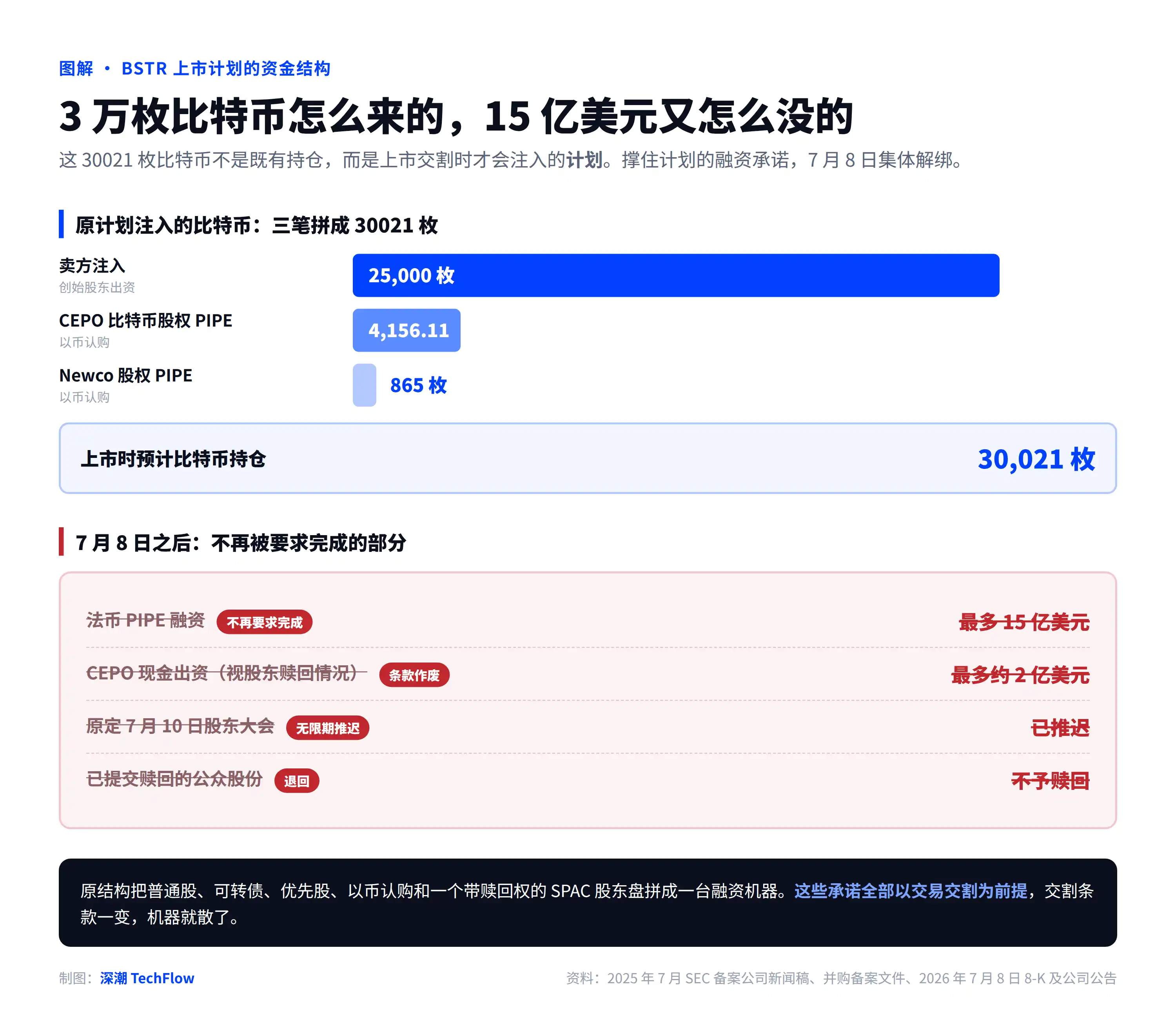
On July 8, Cantor Equity Partners I filed an 8-K form with the SEC, disclosing it and BSTR Holdings were discussing a revised transaction structure and terms to 'better reflect current market conditions.' The most critical sentence in the filing is: both parties will not complete the transaction under the original merger agreement dated July 16, 2025, and the private placement tied to this transaction is no longer required to be completed.

A company announcement issued the same day added two points: the special shareholder meeting originally scheduled for July 10 is postponed indefinitely; public shares for which redemption requests have been submitted will be returned and not redeemed.

Bitcoin hasn't crashed; what has crashed is the financing structure built to buy it.

The Original Scale: 30,000 Bitcoins

BSTR's selling point from the start was scale.

According to a company press release submitted to the SEC in July 2025, BSTR expected its balance sheet upon listing to include 30,021 bitcoins, plus up to $1.5 billion in cash PIPE financing, 5,021 bitcoins for an in-kind PIPE, 25,000 bitcoins from founding shareholders, and up to approximately $200 million in cash from Cantor Equity Partners I (depending on shareholder redemptions).

The number 30,021 is not a single block; detailed merger documents break it into three parts: 25,000 from sellers, 4,156.11 from the CEPO bitcoin equity PIPE, and 865 from the Newco equity PIPE. Additionally, there were cash equity, convertible notes, preferred stock, and bitcoin-denominated subscription commitments, all contingent on the successful closing of the transaction.

These commitments were the true load-bearing walls. They turned a pile of bitcoin into a financing machine for the public markets: common stock, convertible notes, preferred stock, bitcoin subscriptions, plus a SPAC shareholder base with redemption rights—five funding sources pieced together.

Adam Back himself served as CEO of BSTR, and the transaction narrative revolved around 'Bitcoin per share' rather than simply passive holding.

After the July 8 announcement said the private placement didn't have to be completed, the question became whether new terms could bring these funds back.
The Engine is Stock Premium, Not Bitcoin

The operating logic of the 'bitcoin-holding company' model is actually separate from whether bitcoin rises.

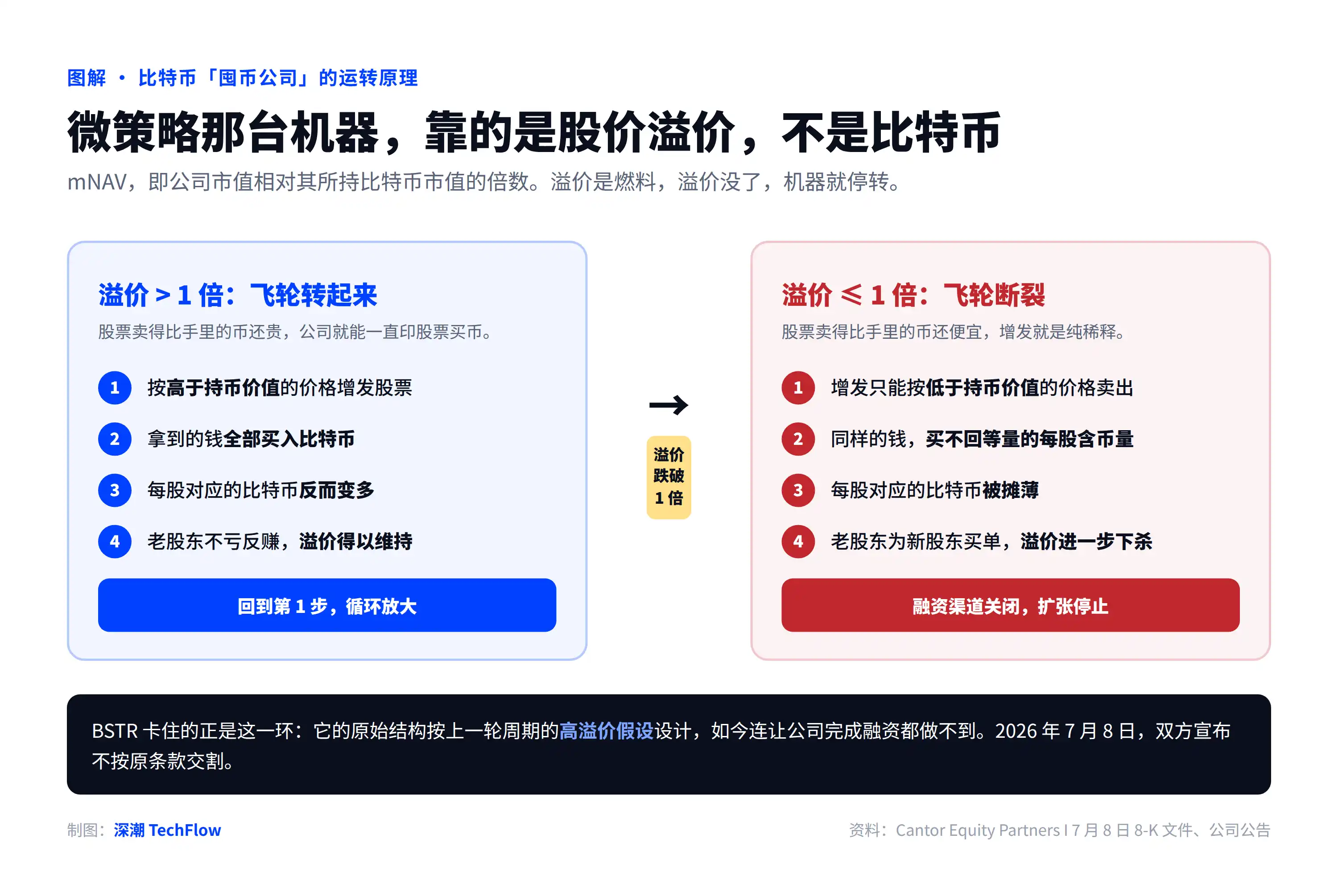
The key metric is mNAV, meaning the company's stock market capitalization relative to the market value of the bitcoin it holds. A company with a market cap double its bitcoin holdings has an mNAV of 2. This premium is the fuel for the entire machine: the company issues shares at a price above net asset value, uses the money to buy more bitcoin, the bitcoin per share actually increases, shareholders profit rather than lose, and the cycle repeats. MicroStrategy (now Strategy) was built by rolling this cycle.

Once the premium converges to 1x or even falls below 1x, this cycle breaks. Issuing shares to buy bitcoin no longer increases bitcoin per share but dilutes existing shareholders. The machine stops.

This is precisely BSTR's problem. The original structure was designed based on premium assumptions from the last cycle, and those assumptions are no longer something anyone is willing to pay for. So this isn't about 'whether the stock can maintain its premium after listing,' but rather that the premium assumption cannot even get the company to complete its financing.
The Entire Sector is Under Pressure

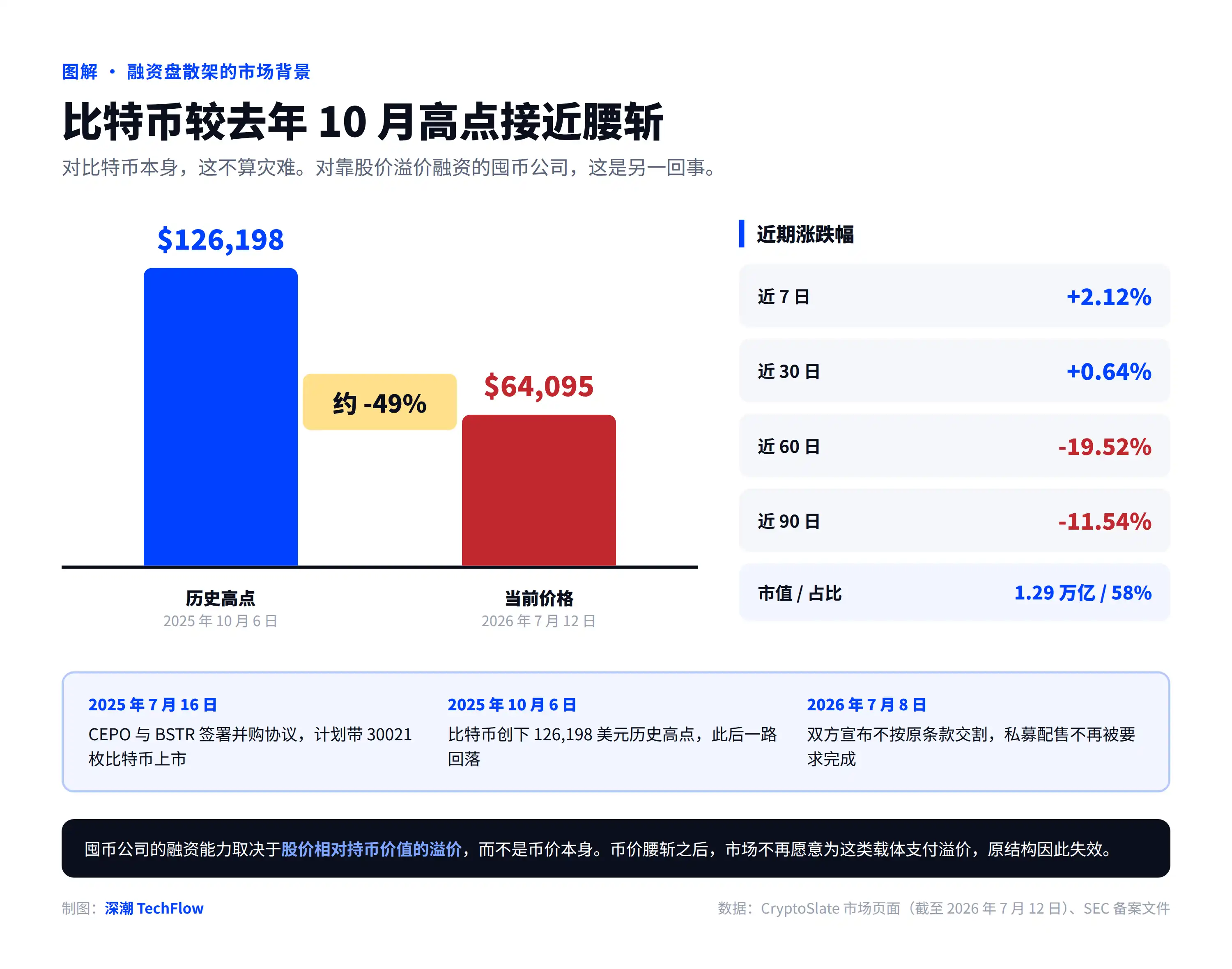
Bitcoin was quoted around $64,000 on July 12, with a market cap of about $1.27 trillion, accounting for roughly 58% of the crypto market. This price has fallen about 49% from the all-time high of $126,200 set on October 6 last year, down about 19.5% over the past 60 days.

For bitcoin itself, this is not a disaster. For bitcoin-holding companies relying on premium financing, it's another story.

Other news from the same week serves as a reference. American Bitcoin, involving Eric Trump, was forced to implement a 1-for-15 reverse stock split to maintain Nasdaq's minimum bid price requirement; it holds about 8,000 bitcoins. Strategy's preferred stock fell below par value in June. Metaplanet's stock price is already below the value of its bitcoin holdings. In early July, another US bitcoin-holding company liquidated its entire bitcoin holdings under debt and Nasdaq compliance pressures.

Meanwhile, money is flowing elsewhere. AI computing company CoreWeave just completed a $20 billion financing round.
The Next SEC Filing is the Real Verdict

Cantor and BSTR are still negotiating; the original terms are void.

If the two parties reach a new agreement, a new SEC filing will amend or supplement the registration statement and proxy materials. That filing will answer three questions: how much of the 30,021 bitcoin scale remains, how much of the original PIPE commitments remain, and at what price investors are now willing to put in money.

According to market data cited by TFTC, CEPO's stock price is currently around $10.50, close to its trust value. This position itself is a signal: the market is not assigning any premium to this transaction.

The risk factors listed in the July 8 filing are almost a negotiation checklist: public shareholder redemptions, public float percentage, liquidity, exchange listing, bitcoin price volatility, competition, regulatory uncertainty, and difficulty in expanding bitcoin accumulation and treasury operations.

For readers holding bitcoin-holding stocks, the implications are twofold:

If the new agreement preserves the 30,000 bitcoin scale, retains substantial investor commitments, and does not heavily transfer costs to new shareholders, it means this model can be repriced in a low-premium environment without dying.

If the new terms reduce the bitcoin holding scale, increase funding costs, weaken investor protections, or rely more on dilution to raise money, it means the next batch of bitcoin-holding companies can no longer feast on the premium红利 left by the last cycle. Those buying such stocks are essentially paying for someone else's restructuring.

BSTR is now a public stress test for the entire sector. The test results will be written in the next SEC filing.


Trending Cryptos

Related Questions

QWhat was the core reason behind the failure of the original merger and PIPE financing deal for BSTR Holdings?

AThe original financing structure, based on assumptions of a significant premium to the company's net asset value (the 'mNAV' multiple), failed to attract investors in the current market. The 'premium' that fuels the 'Bitcoin hoarding company' model had vanished, making the deal unattractive. Investors were no longer willing to pay the expected price.

QWhat is the 'mNAV' multiple and why is it crucial for companies like BSTR and MicroStrategy?

AThe 'mNAV' (Market-to-Net Asset Value) multiple is the ratio of a company's market capitalization to the market value of the Bitcoin it holds. A premium (mNAV > 1) is crucial as it allows these companies to issue new shares at a price above their underlying Bitcoin value. The proceeds are used to buy more Bitcoin, increasing the Bitcoin-per-share metric for all shareholders. This self-reinforcing cycle is the core engine of their business model.

QWhat are the two possible interpretations for investors depending on the new terms BSTR negotiates?

A1. If the new terms preserve the 30,000 Bitcoin scale, retain substantial investor commitments, and don't heavily transfer costs to new shareholders, it signals the model can be re-priced and survive in a low-premium environment. 2. If the terms reduce the Bitcoin holdings, increase financing costs, weaken investor protections, or rely heavily on shareholder dilution, it signifies that future 'hoarding companies' can no longer benefit from past-cycle premiums. Buying such stock would mean investors are essentially paying for the company's restructuring.

QAccording to the article, what broader market trends are putting pressure on the 'Bitcoin hoarding company' sector?

AThe entire sector is under pressure as the premium (mNAV multiple) has collapsed across the board. Examples include American Bitcoin resorting to a reverse stock split, MicroStrategy's (Strategy) preferred shares trading below par, Metaplanet's stock trading below its Bitcoin holdings value, and another unnamed U.S. company liquidating its Bitcoin treasury due to debt and compliance pressures. Meanwhile, capital is flowing to other sectors like AI (e.g., CoreWeave's $20B funding round).

QWhat key information will be revealed in BSTR's next major SEC filing?

AThe next significant SEC filing, which would contain a revised or amended registration statement, will reveal: 1) How much of the originally planned 30,021 Bitcoin scale remains, 2) How many of the original PIPE financing commitments are still in place, and 3) What price or terms investors are now demanding to provide capital. This document will serve as the verdict on whether the model can be restructured successfully.

Related Reads

The Success of Robinhood Chain Proves Ethereum Is Not Dead

The article argues that Robinhood's decision to build its own dedicated blockchain, Robinhood Chain, as an Ethereum Layer 2 (L2) using Arbitrum technology is a powerful endorsement of Ethereum's L1+L2 model, not a rejection of it. This move reflects a broader shift in the crypto industry from projects focused on token monetization to real-world businesses building cash-generating operations. Historically, many crypto projects chose infrastructure to support token sales and speculative value. In contrast, businesses like Robinhood and Coinbase (with Base) choose infrastructure based on commercial needs: security, liquidity, customer reach, and control. Ethereum's model provides a trusted, neutral, and liquid global settlement layer (L1) coupled with customizable, high-performance execution environments (L2s). This allows companies to maintain control and specialization without the cost and risk of building an independent L1 from scratch. The author contends that as more traditional enterprises enter the space to build sustainable businesses, they will rationally select Ethereum's L1 for maximum security and liquidity and its L2s for scalability and customization. This trend strengthens Ethereum's network effects and the utility of ETH as the native gas and asset within this expanding ecosystem. Robinhood's choice is thus seen as a landmark example of pragmatic business strategy aligning with Ethereum's architectural strengths.

marsbit39m ago

The Success of Robinhood Chain Proves Ethereum Is Not Dead

marsbit39m ago

South Korean Broker's 'Below-Expectations' Forecast Triggers 12% Plunge in SK Hynix, Putting Pressure on Entire Storage Sector

South Korean brokerage KIS released a forecast for SK Hynix's Q2 2026 earnings, predicting operating profit of 60.4 trillion won, up 556% year-over-year. However, this figure was about 8% below the market consensus of 65 trillion won. The shortfall was attributed to SK Hynix's high proportion of HBM (High Bandwidth Memory) revenue. HBM is typically sold under long-term agreements (LTAs) with fixed prices, which limited the company's average selling price (ASP) growth compared to the soaring spot market prices for standard DRAM and NAND. KIS emphasized this was a methodological adjustment to include LTA pricing, not a fundamental deterioration, and maintained its buy rating and 3.8 million won target price. Nevertheless, the report triggered a sharp market sell-off. SK Hynix's stock plunged over 12%, falling below 2 million won and extending its pullback from recent highs. The sell-off spread to related assets: leveraged ETFs tracking SK Hynix and Samsung Electronics fell sharply in Hong Kong, and A-share memory stocks also declined. Analysts note the incident highlights market sensitivity to earnings misses versus high expectations. However, KIS argues the long-term investment thesis remains intact, with the industry shift toward LTAs potentially leading to more stable, sustained profitability rather than volatile quarter-to-quarter ASP gains.

链捕手46m ago

South Korean Broker's 'Below-Expectations' Forecast Triggers 12% Plunge in SK Hynix, Putting Pressure on Entire Storage Sector

链捕手46m ago

Want Another Bull Market? Bitcoin Needs Trillions in Fresh Capital Inflow

Title: Want Another Bull Run? Bitcoin Needs Trillions in New Capital Bitcoin has fallen 50% from its October 2025 high of $126k, now trading near $63,000. Recent on-chain reports reveal structural differences in this downturn compared to past cycles, extending beyond simple price charts. A key issue is declining capital efficiency. CryptoQuant analysis shows the capital required for price appreciation has surged dramatically. In 2011, $27 billion in net inflows drove a 55,436% gain. From 2018-2021, $36.5 billion fueled a ~2000% rise. This cycle, $69.7 billion in realized cap growth has yielded only a 689% increase. Today, an estimated $101 billion is needed to double the price, versus just $5 million in 2011. The report concludes that triggering a major bull run now likely requires over $1 trillion in new institutional capital, positioning Bitcoin as a core global asset class rather than relying on retail ETF flows. Meanwhile, supply is tightening. K33 Research notes long-term holder supply has hit a record 79% of circulating coins. Dormant bitcoin moving after 2+ years is at its lowest since 2012. Alphractal data confirms this trend, with ~830k BTC recently moving to long-term storage. This scarcity of tradable supply can amplify price moves from any new buying pressure but doesn't guarantee capital inflow. Profitability metrics signal a potential bottom. CryptoQuant's Net Realized Profit/Loss ratio has dropped to -0.35, a 43-month low matching levels seen during the 2022 FTX crash. Historically, such extremes preceded major bull markets in 2015 and 2019. The current price is only 16% above the network's realized price; historically, this has led to average gains of 41% in six months and 81% in one year. Bitcoin is testing key support near $60,000, with analysts noting a potential W-bottom pattern forming. Macro headwinds persist. U.S. spot Bitcoin ETFs saw record monthly outflows of over $4.5 billion in June. Uncertainty around Federal Reserve policy under a potential new chair and mixed economic data add pressure. While European institutional infrastructure is slowly developing (e.g., German banks offering BTC services), this is a demand factor, not an immediate liquidity catalyst. In summary, the market shows signs of bottoming: sell-side pressure is largely exhausted, supply is scarce, and metrics are at historical extremes. However, for a significant bull run akin to past cycles, unprecedented institutional capital—likely exceeding $1 trillion—is required to overcome the new reality of drastically lower capital efficiency. The decisive variable of massive new institutional inflows remains absent.

Foresight News1h ago

Want Another Bull Market? Bitcoin Needs Trillions in Fresh Capital Inflow

Foresight News1h ago

Trading

Spot

Hot Articles

What is $BITCOIN

DIGITAL GOLD ($BITCOIN): A Comprehensive Analysis Introduction to DIGITAL GOLD ($BITCOIN) DIGITAL GOLD ($BITCOIN) is a blockchain-based project operating on the Solana network, which aims to combine the characteristics of traditional precious metals with the innovation of decentralized technologies. While it shares a name with Bitcoin, often referred to as “digital gold” due to its perception as a store of value, DIGITAL GOLD is a separate token designed to create a unique ecosystem within the Web3 landscape. Its goal is to position itself as a viable alternative digital asset, although specifics regarding its applications and functionalities are still developing. What is DIGITAL GOLD ($BITCOIN)? DIGITAL GOLD ($BITCOIN) is a cryptocurrency token explicitly designed for use on the Solana blockchain. In contrast to Bitcoin, which provides a widely recognized value storage role, this token appears to focus on broader applications and characteristics. Notable aspects include: Blockchain Infrastructure: The token is built on the Solana blockchain, known for its capacity to handle high-speed and low-cost transactions. Supply Dynamics: DIGITAL GOLD has a maximum supply capped at 100 quadrillion tokens (100P $BITCOIN), although details regarding its circulating supply are currently undisclosed. Utility: While precise functionalities are not explicitly outlined, there are indications that the token could be utilized for various applications, potentially involving decentralized applications (dApps) or asset tokenization strategies. Who is the Creator of DIGITAL GOLD ($BITCOIN)? At present, the identity of the creators and development team behind DIGITAL GOLD ($BITCOIN) remains unknown. This situation is typical among many innovative projects within the blockchain space, particularly those aligning with decentralized finance and meme coin phenomena. While such anonymity may foster a community-driven culture, it intensifies concerns about governance and accountability. Who are the Investors of DIGITAL GOLD ($BITCOIN)? The available information indicates that DIGITAL GOLD ($BITCOIN) does not have any known institutional backers or prominent venture capital investments. The project seems to operate on a peer-to-peer model focused on community support and adoption rather than traditional funding routes. Its activity and liquidity are primarily situated on decentralized exchanges (DEXs), such as PumpSwap, rather than established centralized trading platforms, further highlighting its grassroots approach. How DIGITAL GOLD ($BITCOIN) Works The operational mechanics of DIGITAL GOLD ($BITCOIN) can be elaborated on based on its blockchain design and network attributes: Consensus Mechanism: By leveraging Solana’s unique proof-of-history (PoH) combined with a proof-of-stake (PoS) model, the project ensures efficient transaction validation contributing to the network's high performance. Tokenomics: While specific deflationary mechanisms have not been extensively detailed, the vast maximum token supply implies that it may cater to microtransactions or niche use cases that are still to be defined. Interoperability: There exists the potential for integration with Solana’s broader ecosystem, including various decentralized finance (DeFi) platforms. However, the details regarding specific integrations remain unspecified. Timeline of Key Events Here is a timeline that highlights significant milestones concerning DIGITAL GOLD ($BITCOIN): 2023: The initial deployment of the token occurs on the Solana blockchain, marked by its contract address. 2024: DIGITAL GOLD gains visibility as it becomes available for trading on decentralized exchanges like PumpSwap, allowing users to trade it against SOL. 2025: The project witnesses sporadic trading activity and potential interest in community-led engagements, although no noteworthy partnerships or technical advancements have been documented as of yet. Critical Analysis Strengths Scalability: The underlying Solana infrastructure supports high transaction volumes, which could enhance the utility of $BITCOIN in various transaction scenarios. Accessibility: The potential low trading price per token could attract retail investors, facilitating wider participation due to fractional ownership opportunities. Risks Lack of Transparency: The absence of publicly known backers, developers, or an audit process may yield skepticism regarding the project's sustainability and trustworthiness. Market Volatility: The trading activity is heavily reliant on speculative behavior, which can result in significant price volatility and uncertainty for investors. Conclusion DIGITAL GOLD ($BITCOIN) emerges as an intriguing yet ambiguous project within the rapidly evolving Solana ecosystem. While it attempts to leverage the “digital gold” narrative, its departure from Bitcoin's established role as a store of value underscores the need for a clearer differentiation of its intended utility and governance structure. Future acceptance and adoption will likely depend on addressing the current opacity and defining its operational and economic strategies more explicitly. Note: This report encompasses synthesised information available as of October 2023, and developments may have transpired beyond the research period.

762 Total ViewsPublished 2025.05.13Updated 2025.05.13

What is $BITCOIN

Discussions

Welcome to the HTX Community. Here, you can stay informed about the latest platform developments and gain access to professional market insights. Users' opinions on the price of BTC (BTC) are presented below.

活动图片