Is Tether's Gold Token XAUT Worth Buying?

marsbitPublished on 2026-01-10Last updated on 2026-01-10

Abstract

"Tether's Gold Token (XAUT): A Viable Investment in 2026?" Amidst a challenging 2026 market, gold emerges as a key asset for hedging against inflation and currency devaluation. Tether's XAUT, a gold-backed token, is positioned as an optimal solution for crypto-savvy investors seeking exposure to gold. Gold's impressive performance in 2025, with a ~65% annual increase and over 50 record highs, sets a strong precedent. Its price surge to nearly $4,550/oz is supported by factors including potential U.S. policy shifts, massive inflows into Gold ETFs, and ongoing geopolitical tensions. Institutions like UBS are bullish, forecasting a rise to $5,000/oz by mid-2026. XAUT offers four main advantages: 1. **Strong Backing & Liquidity:** Tether holds 116 tons of physical gold, making it a top 30 global holder. XAUT's market cap stands at ~$2.3 billion, ensuring robust liquidity. 2. **Low Entry Barrier:** The recent introduction of "Scudo," a new unit equal to 1/1000th of an XAUT token (~$4.40), drastically lowers the investment threshold. 3. **High Accessibility:** XAUT is listed on major CEXs (Bybit, OKX) and DEXs (Uniswap), supporting both spot and leveraged trading. 4. **Tether's Dominance:** Backed by Tether's profitable stablecoin empire and significant Bitcoin reserves, XAUT benefits from immense institutional strength. With the de-dollarization trend and a weak USD/CNY exchange rate, XAUT presents a compelling, lower-risk option for ordinary investors to diversify into g...

Original | Odaily Planet Daily (@OdailyChina)

Author | Wenser (@wenser 2010)

2026, survival is paramount.

In the previous article "2026, Survive: A Bear Market Survival and Counterattack Manual for Crypto Enthusiasts", we systematically outlined this year's "survival strategy", emphasizing the allocation of assets such as gold and other precious metals as a key component. For those aiming to combat inflation, mitigate fiat currency devaluation, the decline of the US dollar exchange rate, and other issues through gold, how to allocate gold-related assets has become the next challenge.

In this regard, based on the author's personal understanding, XAUT, issued by Tether, is relatively perhaps the best way for crypto users to allocate gold assets. Combined with the recent introduction of a new unit of account "Scudo" for Tether Gold (XAU₮), the entry barrier for gold token allocation has also sharply dropped to as low as a few dollars.

Odaily Planet Daily will systematically analyze in this article whether XAUT is worth allocating in one's portfolio.

Potential Supports for Gold's Rise: US Policy, ETF Inflows, Bank Ratings

Last September, when the spot gold price was still around $3400-$3500, we introduced five major gold tokens in the article "Gold Price Expected to Continue Surging to $3900/oz, Here's a List of 5 Gold Tokens", with XAUT being one of them. Looking back 3 months later, the spot gold price per ounce once surged to around $4550. It must be said, impressively so.
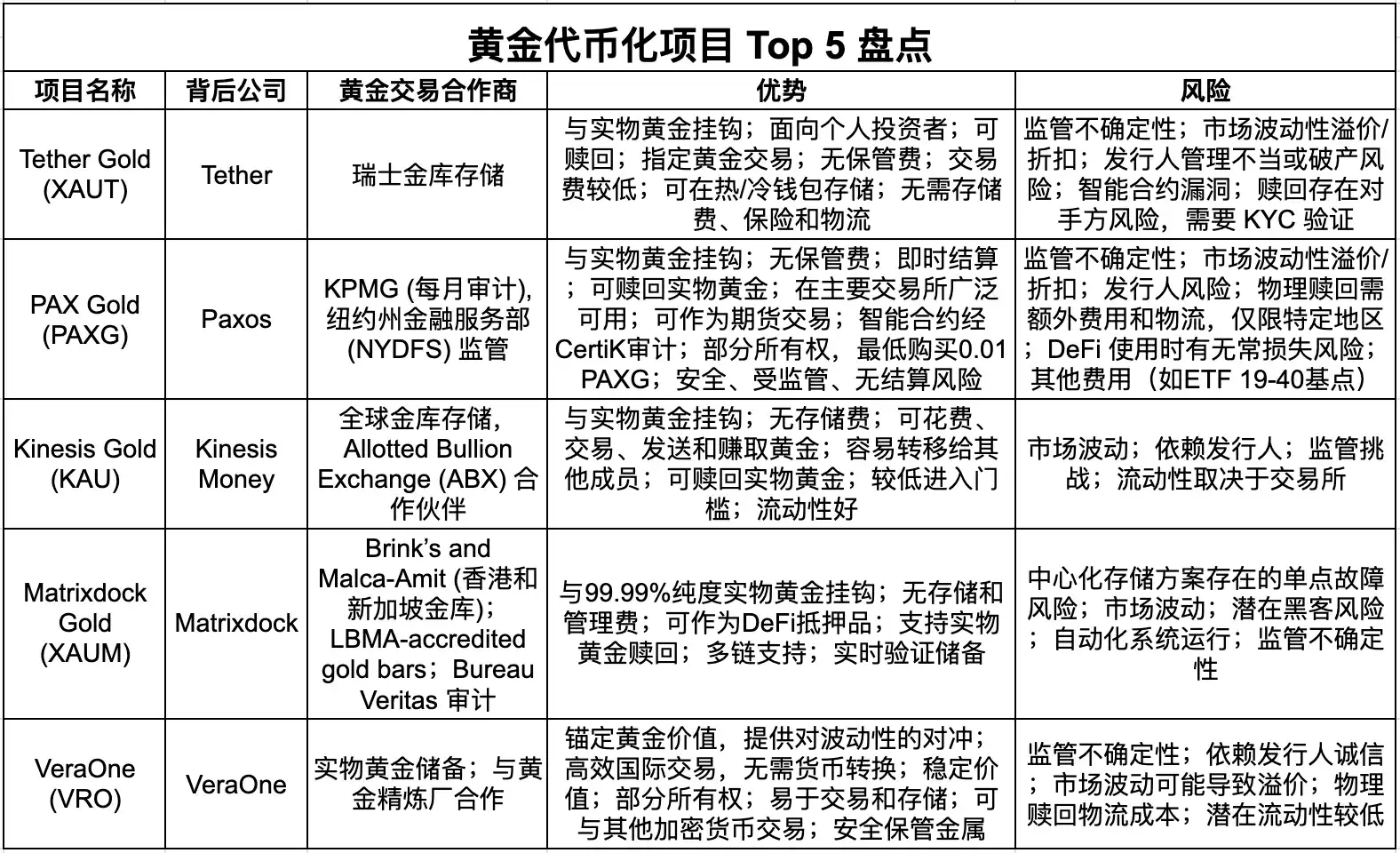
Not only that, although there has been a阶段性回调 in price recently, the upward trend of spot gold has not been significantly interrupted. Specifically, the support for the gold price stems from the following aspects:

World Gold Council: US Supreme Court Tariff Decision and Two Other Factors Only Constitute Short-Term Fluctuation Impact on Gold's Future Trend

The World Gold Council reported that the surge in precious metals (including silver and platinum) in December and the rebalancing of commodity indices may trigger market volatility in the short term. However, apart from short-term fluctuation impacts, gold is expected to continue its own operating logic. The upcoming ruling by the US Supreme Court on tariff policy may have a significant impact on US trade policy. The impact on gold may be more complex but could constitute potential support. Finally, ongoing geopolitical conflicts (with recent US moves in Venezuela being the latest example) also provide support for the gold price.

Gold Price Set 53 Historical Records in 2025, ETFs Saw Unprecedented Inflows

The World Gold Council stated that as the gold price set 53 historical records in 2025, global investors poured unprecedented funds into gold ETFs. North American funds contributed the main part of the global inflows in 2025. Meanwhile, gold holdings in the Asian region nearly doubled, and Europe also showed significant demand.

Gold Rose About 65% in 2025 and Set Over 50 New Highs, Silver Rose About 150%

The 2025 precious metals行情 showed that spot gold closed down 0.46% on December 31st at $4318.65/oz. Against the backdrop of global "de-dollarization", the Federal Reserve restarting its interest rate cut cycle, and continued gold purchases by central banks, gold became the most dazzling "star asset" of 2025, with a rising trend throughout the year, rising about 65% for the year, once refreshing a historical high to $4549.96/oz, and setting over 50 new highs during the year.

UBS Group: Raises Gold Price Targets for March, June, and September 2026 to $5000 Per Ounce

UBS Group stated that it remains bullish and has raised its gold price targets for March, June, and September 2026 to $5000 per ounce (previously $4500 per ounce). It is expected that by the end of 2026, the gold price will slightly fall to $4800 per ounce.

Based on the above information, the gold行情 is continuously看好 for the next year. Let's talk about why Tether's gold token XAUT is worth allocating.

4 Major Advantages of XAUT Allocation: High Market Cap, Low Threshold, Good Liquidity, Leverage Available

First, Tether's strong financial support and the gold reserves and sufficient liquidity behind XAUT.

At the beginning of the month, Tether CEO Paolo Ardoino stated that Tether purchased 8888 Bitcoins on New Year's Eve 2025, worth approximately $780 million. This transaction increased the public Bitcoin holdings of the stablecoin issuer to over 96,000. Tether currently allocates 15% of its quarterly profits to Bitcoin regularly. Furthermore, Tether purchased 26 tons of gold in the third quarter of 2025, bringing its total gold holdings to 116 tons, ranking among the top 30 gold holders globally. A market cap of around $2.3 billion is also proof of XAUT's sufficient liquidity.

Second, Tether recently introduced a new unit of account "Scudo" for XAUT.

According to official news, Tether officially launched the new计价 unit Scudo for Tether Gold (XAUT). This unit aims to reintroduce gold as a means of payment. 1 Scudo is defined as one-thousandth of a troy ounce of gold or one-thousandth of an XAUT (approximately $4.40). This move addresses the issue of users having to handle long decimals when trading or pricing by introducing a simpler计价 method, making gold more practical in daily economic activities. Tether Gold is currently fully backed by physical gold in secure vaults; the introduction of Scudo does not change the structure or backing of XAUT.

Third, XAUT is listed on major mainstream CEX and DEX platforms and supports spot buying or contract leverage operations.

According to Coingecko information, XAUT supports buying and selling on CEXs such as Bybit, OKX, Bitget, and DEXs such as Uniswap, Fluid, Curve.
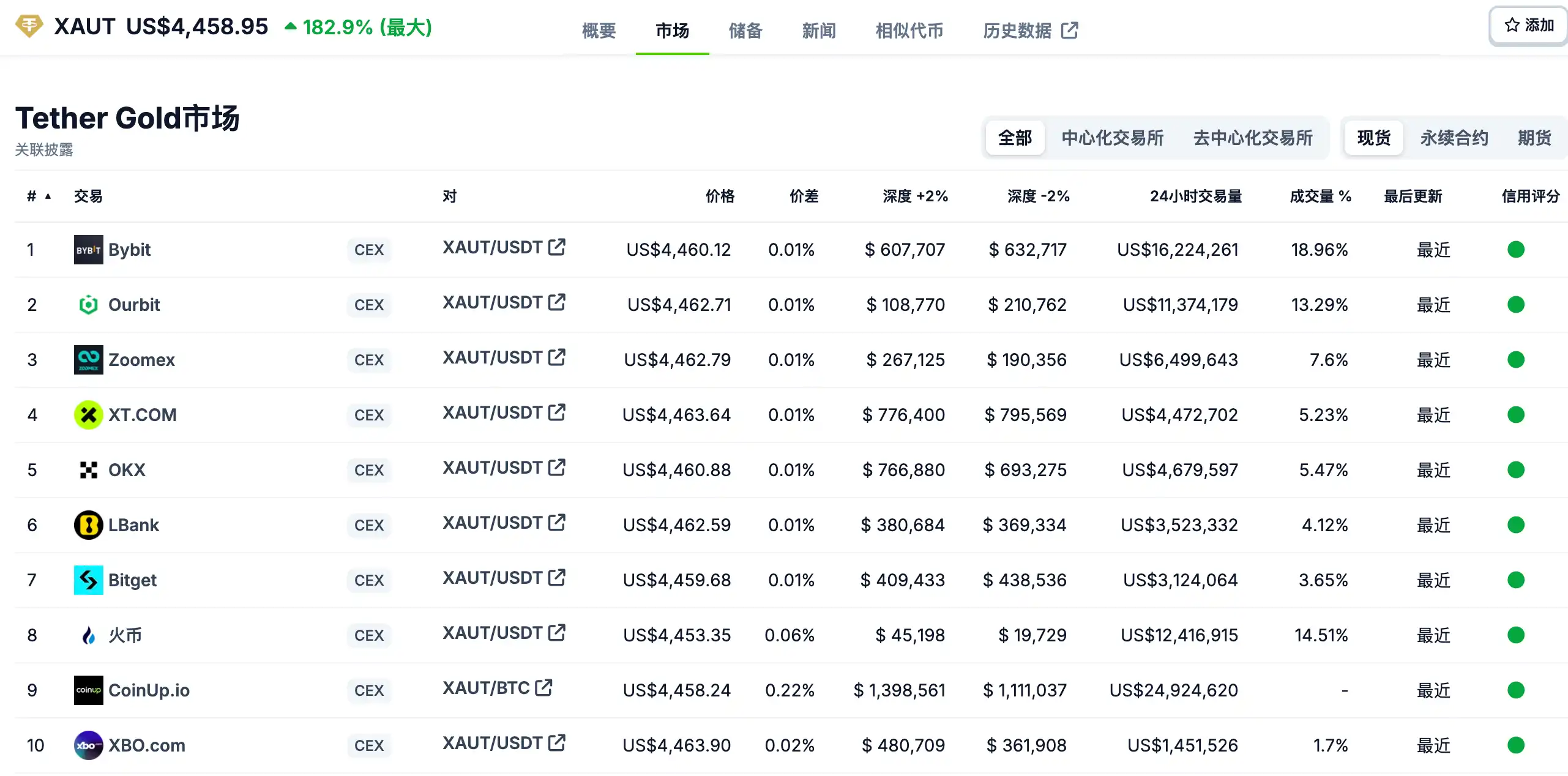
Finally, Tether's dominant position in the stablecoin track and the超高利润 of its business revenue also provide strong support for the growth and development of XAUT. Its industry application popularity is expected to further increase in 2026.

According to a Bloomberg report citing Artemis Analytics data, global stablecoin transaction volume surged 72% year-on-year in 2025, reaching a record $33 trillion. Among them, USDC issued by Circle had a transaction volume of $18.3 trillion, ranking first; Tether's USDT transaction volume was $13.3 trillion, also maintaining a high level. The two together account for the vast majority of stablecoin trading activity.

Considering the continuous decline in the US dollar to RMB exchange rate, for most ordinary people with relatively limited liquid funds and lower investment risk appetite, converting some fiat currency into the gold token XAUT might be a relatively better solution.


Related Questions

QWhat are the main factors supporting the potential rise in gold prices as mentioned in the article?

AThe main factors include U.S. policy impacts (such as Supreme Court tariff decisions), unprecedented inflows into gold ETFs, and ongoing geopolitical conflicts. Additionally, banking ratings and the global trend of de-dollarization contribute to the support.

QWhat is XAUT and which company issues it?

AXAUT is a gold-backed token issued by Tether. It represents ownership of physical gold stored in secure vaults, with each token corresponding to one troy ounce of gold.

QWhat advantages does XAUT offer for investors according to the article?

AXAUT offers four main advantages: high market capitalization and liquidity due to Tether's substantial gold reserves, low entry threshold with the introduction of the 'Scudo' unit (1/1000 of an ounce), availability on major CEX and DEX platforms, and the ability to use leverage through contract trading.

QWhat is the new accounting unit 'Scudo' for XAUT and what problem does it solve?

A'Scudo' is a new accounting unit for Tether Gold (XAUT), defined as one-thousandth of a troy ounce of gold (approximately $4.4). It simplifies transactions and pricing by avoiding long decimal numbers, making gold more practical for everyday economic activities.

QHow does Tether's financial strength support XAUT?

ATether's financial strength is demonstrated by its significant Bitcoin and gold reserves, including 116 tons of gold holdings (ranking among the top 30 globally) and over 96,000 Bitcoin. Its dominant position in the stablecoin market and high profitability provide robust backing for XAUT's growth and liquidity.

Related Reads

Bitcoin's 'Rally Ends,' Officially Entering the Later Stage of a Bear Market?

Bitcoin prices declined 13% this week, reversing the recent rebound and signaling a likely transition into the later stages of a bear market. Key on-chain metrics deteriorated, with the short-term holder cost basis falling below the Realized Price—a pattern last seen in early 2022, characteristic of bear market maturity. The rally to ~$82k proved to be a bear market bounce, as evidenced by the 90-day realized profit/loss ratio failing to sustain above the bullish threshold of 2. Daily realized losses surged to $1.35B, including significant selling from long-term holders who accumulated near cycle tops, indicating ongoing supply redistribution. Price was rejected almost precisely at the aggregate US spot ETF cost basis of ~$83k, turning that level into resistance and leaving the average ETF investor underwater again. Spot market selling pressure intensified, with the 7-day volume delta turning significantly negative to its weakest level since February. While a major long liquidation event cleared over $400M in leverage, spot demand has not yet stepped in to absorb the resulting supply. Options markets continue pricing in higher future volatility (elevated volatility risk premium) and maintain a skew toward put options, reflecting persistent demand for downside protection, though not yet panic. Overall, market structure remains fragile. Sustained recovery likely requires a reclaim of the ETF cost basis, a shift back to positive spot demand, and a slowdown in realized loss-taking. Until then, the market risks further downside or extended consolidation within the broader bear trend.

Foresight News13m ago

Bitcoin's 'Rally Ends,' Officially Entering the Later Stage of a Bear Market?

Foresight News13m ago

How Risky is the "Death Spiral" of MSTR and STRC?

Summary: This article explores the perceived "death spiral" risk between MicroStrategy (MSTR), its Bitcoin holdings, and its perpetual preferred stock (STRC), drawing comparisons to the LUNA-UST collapse. While both systems feature price anchors, high yields for holders, and potential feedback loops, their core mechanisms differ fundamentally. The MSTR-STRC structure relies on continuous financing to sustain its high dividend payouts, primarily through stock ATM offerings. A negative feedback cycle could occur: falling MSTR stock price makes raising equity capital harder, increasing pressure to sell Bitcoin, which undermines STRC confidence and further depresses MSTR. However, unlike LUNA-UST's automated, direct linkage, the MSTR-STRC loop is weaker and has brakes: STRC dividends can be deferred or rates lowered, and STRC holders have a $100/share liquidation preference in bankruptcy, providing a price floor. The company's sustainability hinges on its ability to continue financing. Its current ~$900 million USD reserves cover only about 6.3 months of its ~$1.71 billion annual interest/dividend burden. The next six months are critical, aligning with both the potential bottom in Bitcoin's four-year cycle and the depletion timeline of its reserves. While a LUNA-style catastrophic collapse is deemed highly unlikely due to structural differences, the key question is whether MicroStrategy can navigate this period through healthy deleveraging to restart its capital engine.

Foresight News31m ago

How Risky is the "Death Spiral" of MSTR and STRC?

Foresight News31m ago

How Much Debt Does Strategy Really Have? Is There a Risk of Implosion?

MicroStrategy's Debt Risk: A Turning Point in the "Never Sell" Strategy As of June 3, 2026, MicroStrategy holds 843,706 bitcoins (valued at ~$53.1B) but faces significant financial obligations. Its capital structure includes $6.75B in convertible notes and $15.48B in perpetual preferred stock (led by the $8.5B STRC series), creating an annual payout burden of ~$1.71B. With software revenue at only ~$500M, interest and dividend obligations far exceed operating income. A critical shift occurred in late May 2026 when the company sold 32 bitcoins for ~$2.5M to cover dividends, breaking CEO Michael Saylor's long-standing "never sell" pledge. This symbolic move triggered a sharp decline in both Bitcoin's price and MSTR stock, reflecting market fears about cash flow sustainability. The core of the strain is the STRC perpetual preferred stock, designed as a "permanent loan" with no maturity date but requiring high monthly dividends (currently 11.5%). Its business model relies on a three-part cycle: issuing new STRC shares, using proceeds to buy more Bitcoin and fund a USD reserve, and using that reserve to pay dividends. This cycle depends on continuous investor demand for STRC and Bitcoin's price appreciation. Analysis shows Bitcoin needs to appreciate at least 2.3% annually to cover the $1.71B in yearly obligations at current holdings. With Bitcoin price down ~22% from March 2026 highs, this pressure has intensified. The company's $900M USD reserve can only cover about 7 months of payments if STRC issuance stalls. Key risks are not immediate bankruptcy or forced Bitcoin liquidation (as BTC is not collateral), but rather: 1) The erosion of MSTR's premium to its Bitcoin holdings (mNAV), which would cripple its ability to raise cheap capital; 2) A vicious cycle where stagnant Bitcoin prices reduce STRC demand, draining the USD reserve and forcing BTC sales, further depressing prices. The period from February 2027 to September 2028 is a crucial test, with over $5.9B in convertible notes facing put options or maturity. In essence, MicroStrategy has evolved from a simple Bitcoin holder into a complex financial entity acting like a "private Bitcoin bank," leveraging its BTC holdings to create layered financial products. Its survival depends on maintaining Bitcoin's price trend, its stock premium, and market appetite for its preferred shares. The recent token sale marks not a betrayal of its Bitcoin thesis, but an admission that the leveraged strategy must eventually be paid for.

marsbit42m ago

How Much Debt Does Strategy Really Have? Is There a Risk of Implosion?

marsbit42m ago

Anthropic Cries Wolf: Is the AGI Threat Real, or Just an IPO Story?

Anthropic has published an article titled "When AI builds itself," discussing the emerging concept of "recursive self-improvement," where AI begins to actively participate in designing, training, testing, and optimizing its own subsequent versions. The company presents internal data showing that by May 2026, over 80% of code merged into its codebase was written by Claude, its AI model. Claude's capabilities have expanded to handling complex, open-ended engineering tasks, achieving a 76% success rate in such areas, and even contributing to research processes, such as optimizing code performance and conducting AI safety experiments. Anthropic outlines an evolution from human-driven development to AI-assisted workflows, culminating in the current stage where AI agents can autonomously write, run, and delegate code. The company cautions that the path toward a "closed loop," where AI continuously improves itself, is becoming visible. It calls for coordinated global mechanisms to potentially slow or pause frontier AI development to allow safety research and societal structures to catch up. However, the timing of this warning coincides with Anthropic's preparations for an IPO, framing the narrative not just as a safety concern but also as a demonstration of Claude's advanced capabilities and its integral role in accelerating Anthropic's own R&D—creating a potential "flywheel" effect for competitive advantage. This contrasts with OpenAI's recent, more policy-oriented discussion of the same risks, highlighting the competitive dynamics in the AI industry as companies position themselves in both the technological and regulatory landscape.

marsbit1h ago

Anthropic Cries Wolf: Is the AGI Threat Real, or Just an IPO Story?

marsbit1h ago

Trading

Spot
Futures

Hot Articles

Discussions

Welcome to the HTX Community. Here, you can stay informed about the latest platform developments and gain access to professional market insights. Users' opinions on the price of XAUT (XAUT) are presented below.

活动图片