Is Bitcoin's Recent Surge a Bubble or a Healthy Bubble?

cryptonews.ruPublished on 2026-08-30Last updated on 2026-08-30

Abstract

The recent surge in Bitcoin's price from around $63,500 to over $80,000 appears to be driven by strong spot market demand rather than leveraged trading, according to an analysis from QCP Capital. The firm notes that approximately $2.8 billion in net inflows entered spot Bitcoin ETFs during this rally. Conversely, open interest for Bitcoin futures declined, and relatively low funding rates suggest the price increase was not fueled by aggressive leverage for long positions. This indicates spot buying and short covering were prominent, potentially pointing to a healthier market structure with limited excessive leverage buildup. On the macroeconomic front, uncertainty remains. While markets price in a 35% chance of a Fed rate hike in September, an expansion of the US Treasury's bond buyback program has supported risk assets like Bitcoin and gold by improving long-term bond liquidity and weakening the dollar. However, QCP clarifies this program is not quantitative easing (QE). The firm also cites Nvidia's strong financial performance as boosting global risk appetite. The key short-term question for Bitcoin is whether the high spot demand will be sustained.

In cryptocurrency markets, Bitcoin's ($BTC) recent surge from around $63,500 to over $80,000 is claimed to have been supported by strong spot demand, rather than leveraged trading.

According to an assessment published by QCP Capital, the current structure of the Bitcoin market appears healthier than previous speculative rallies. The firm states that during the rise from $63,500, spot Bitcoin ETFs saw approximately $2.8 billion in net inflows.

In contrast, open interest in Bitcoin futures decreased from about 646,000 $BTC in mid-August to 588,000 $BTC. The fact that funding rates remain at relatively low levels also suggests the price increase is not driven by aggressively used leverage to open long positions.

QCP stated that these data indicate the rally was particularly characterized by spot buying and short-covering. This may point to a more sustainable Bitcoin market structure due to limited accumulation of excessive leverage.

In the macroeconomic sphere, close attention is being paid to the Federal Reserve and the U.S. Treasury Department.

Despite Bitcoin's positive market technical structure, macroeconomic prospects remain uncertain. Although core PCE inflation in July remained at 3.3% year-on-year, markets are pricing in a 35% probability of the Federal Reserve raising interest rates by 25 basis points at its September meeting.

On the other hand, the expansion of the U.S. Treasury's bond buyback program, aimed at maintaining the liquidity of long-term bonds, is one factor supporting risk assets.

The Treasury Department announced that starting September 9, it will increase the upper limit for buyback operations of bonds with maturities from 10 to 30 years from $2 billion to at least $4 billion. Following this announcement, long-term bond yields fell, the dollar index weakened, while gold and Bitcoin prices rose.

QCP also noted that Nvidia's solid financial performance has contributed to increased risk appetite in global markets.

However, it should be noted that the U.S. Treasury's bond buyback program is not quantitative easing (QE). The program's goal is to improve liquidity conditions in the long-term bond market, not to directly dictate bond yields, and it does not lead to an expansion of central bank reserves similar to QE.

According to QCP's assessment, the key short-term question for Bitcoin will be whether the high spot demand persists.

*This is not investment advice.

end-content

Trending Cryptos

Related Questions

QWhat does QCP Capital claim is the primary driver behind Bitcoin's recent price surge from around $63,500 to over $80,000?

AQCP Capital claims the surge was driven by strong spot demand, not leveraged trading.

QAccording to the article, what evidence suggests Bitcoin's current market structure is healthier than previous speculative rallies?

AThe evidence includes net inflows of approximately $2.8 billion into spot Bitcoin ETFs and a reduction in Bitcoin futures open interest from ~646,000 BTC to 588,000 BTC, with relatively low funding rates indicating less leverage-driven speculation.

QWhat did the U.S. Treasury announce regarding its bond buyback program that impacted asset prices?

AThe U.S. Treasury announced it will increase the upper limit for bond buyback operations for maturities from 10 to 30 years from $2 billion to at least $4 billion starting September 9th, which led to lower long-term bond yields and supported prices for gold and Bitcoin.

QHow does the article differentiate the U.S. Treasury's bond buyback program from quantitative easing (QE)?

AThe article states the program aims to improve liquidity conditions in the long-term bond market, not directly target bond yields, and does not lead to an expansion of central bank reserves like QE does.

QWhat does QCP identify as a key short-term question for Bitcoin's price trajectory?

AQCP identifies whether the high level of spot demand will be sustained as a key short-term question for Bitcoin's price trajectory.

Related Reads

Strive Executive: Rethinking the Bitcoin Price Flywheel

In this article, the author discusses the future trajectory of Bitcoin's price, moving beyond the traditional "power law" model that has described its long-term price appreciation with diminishing returns. The core argument is that Bitcoin is maturing, evidenced by declining volatility and shallower market drawdowns. This maturation, often seen as leading to permanently lower returns, is framed as a precursor to a new, potentially explosive phase. The author draws an analogy to metal fatigue, where cracks propagate in three stages: initial irregular formation, a predictable middle phase describable by a power law (Paris' law), and a final rapid acceleration leading to fracture. Similarly, Bitcoin's monetization is seen in three phases: 1) Discovery (high volatility/returns), 2) Maturation (declining volatility/returns, improving risk-adjusted metrics), and 3) System-driven monetization. The key insight is that Phase 2 sets the stage for Phase 3. Lower volatility makes Bitcoin a more attractive asset for large-scale capital allocation (due to improved Sharpe ratios) and, crucially, a higher-quality collateral for loans. As perceived credit risk falls, the financial system can safely extend more dollar-denominated credit against Bitcoin holdings. This creates a self-reinforcing "flywheel": lower volatility → more capital allocation & cheaper credit → increased demand for fixed-supply Bitcoin → price rise → higher collateral value enabling more credit → continued price pressure. The conclusion posits that even if Bitcoin adoption eventually plateaus (reaching an S-curve saturation), the expansion of capital and credit chasing a fixed supply could cause its USD price to re-accelerate, breaking above the long-term power-law trajectory and entering the "third region" of rapid, system-driven monetization.

marsbit5h ago

Strive Executive: Rethinking the Bitcoin Price Flywheel

marsbit5h ago

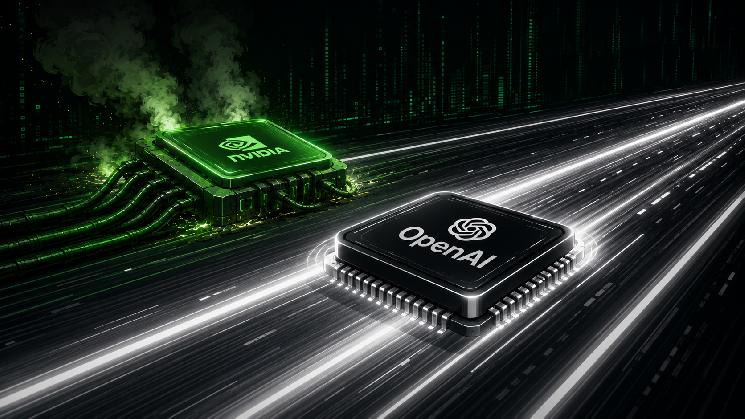
OpenAI Reveals Its Own Jalapeño Chip: Accelerator 1.5–2 Times More Efficient Than Nvidia

On August 25, 2026, OpenAI unveiled initial test results for its proprietary inference accelerator, the Jalapeño. Benchmarks on SemiAnalysis's InferenceX platform showed that systems using Jalapeño delivered 1.5–1.9 times more computations per watt at peak throughput and reduced latency by 1.7–3.6 times compared to systems based on Nvidia's GB200 and GB300, tested on models like GPT-OSS-120B. Designed specifically for OpenAI's own workloads, the 700W-rated chip was developed in nine months with partners Broadcom (silicon/network) and Celestica (boards/racks). It's the first in a planned multi-year platform. Deployment is slated for late 2026, backed by an OpenAI-Broadcom agreement to deploy 10 GW of custom accelerators through 2029. This move shifts a major portion of OpenAI's daily inference, crucial for services like ChatGPT and its API, away from Nvidia's universal GPUs. By controlling this hardware architecture, OpenAI aims to directly reduce the per-query cost of its massive service traffic, converting what was previously supplier profit (noting Nvidia's high margins) into internal savings and computational capacity. While OpenAI will still rely on external suppliers for training cutting-edge models and for parts of inference, Jalapeño represents a strategic industry trend where hyperscalers design custom chips once inference volume becomes predictable. However, this specialization risks future inflexibility if AI architectures shift and creates dependency on its manufacturing partners.

cryptonews.ru6h ago

OpenAI Reveals Its Own Jalapeño Chip: Accelerator 1.5–2 Times More Efficient Than Nvidia

cryptonews.ru6h ago

Trading

Spot

Hot Articles

What is $BITCOIN

DIGITAL GOLD ($BITCOIN): A Comprehensive Analysis Introduction to DIGITAL GOLD ($BITCOIN) DIGITAL GOLD ($BITCOIN) is a blockchain-based project operating on the Solana network, which aims to combine the characteristics of traditional precious metals with the innovation of decentralized technologies. While it shares a name with Bitcoin, often referred to as “digital gold” due to its perception as a store of value, DIGITAL GOLD is a separate token designed to create a unique ecosystem within the Web3 landscape. Its goal is to position itself as a viable alternative digital asset, although specifics regarding its applications and functionalities are still developing. What is DIGITAL GOLD ($BITCOIN)? DIGITAL GOLD ($BITCOIN) is a cryptocurrency token explicitly designed for use on the Solana blockchain. In contrast to Bitcoin, which provides a widely recognized value storage role, this token appears to focus on broader applications and characteristics. Notable aspects include: Blockchain Infrastructure: The token is built on the Solana blockchain, known for its capacity to handle high-speed and low-cost transactions. Supply Dynamics: DIGITAL GOLD has a maximum supply capped at 100 quadrillion tokens (100P $BITCOIN), although details regarding its circulating supply are currently undisclosed. Utility: While precise functionalities are not explicitly outlined, there are indications that the token could be utilized for various applications, potentially involving decentralized applications (dApps) or asset tokenization strategies. Who is the Creator of DIGITAL GOLD ($BITCOIN)? At present, the identity of the creators and development team behind DIGITAL GOLD ($BITCOIN) remains unknown. This situation is typical among many innovative projects within the blockchain space, particularly those aligning with decentralized finance and meme coin phenomena. While such anonymity may foster a community-driven culture, it intensifies concerns about governance and accountability. Who are the Investors of DIGITAL GOLD ($BITCOIN)? The available information indicates that DIGITAL GOLD ($BITCOIN) does not have any known institutional backers or prominent venture capital investments. The project seems to operate on a peer-to-peer model focused on community support and adoption rather than traditional funding routes. Its activity and liquidity are primarily situated on decentralized exchanges (DEXs), such as PumpSwap, rather than established centralized trading platforms, further highlighting its grassroots approach. How DIGITAL GOLD ($BITCOIN) Works The operational mechanics of DIGITAL GOLD ($BITCOIN) can be elaborated on based on its blockchain design and network attributes: Consensus Mechanism: By leveraging Solana’s unique proof-of-history (PoH) combined with a proof-of-stake (PoS) model, the project ensures efficient transaction validation contributing to the network's high performance. Tokenomics: While specific deflationary mechanisms have not been extensively detailed, the vast maximum token supply implies that it may cater to microtransactions or niche use cases that are still to be defined. Interoperability: There exists the potential for integration with Solana’s broader ecosystem, including various decentralized finance (DeFi) platforms. However, the details regarding specific integrations remain unspecified. Timeline of Key Events Here is a timeline that highlights significant milestones concerning DIGITAL GOLD ($BITCOIN): 2023: The initial deployment of the token occurs on the Solana blockchain, marked by its contract address. 2024: DIGITAL GOLD gains visibility as it becomes available for trading on decentralized exchanges like PumpSwap, allowing users to trade it against SOL. 2025: The project witnesses sporadic trading activity and potential interest in community-led engagements, although no noteworthy partnerships or technical advancements have been documented as of yet. Critical Analysis Strengths Scalability: The underlying Solana infrastructure supports high transaction volumes, which could enhance the utility of $BITCOIN in various transaction scenarios. Accessibility: The potential low trading price per token could attract retail investors, facilitating wider participation due to fractional ownership opportunities. Risks Lack of Transparency: The absence of publicly known backers, developers, or an audit process may yield skepticism regarding the project's sustainability and trustworthiness. Market Volatility: The trading activity is heavily reliant on speculative behavior, which can result in significant price volatility and uncertainty for investors. Conclusion DIGITAL GOLD ($BITCOIN) emerges as an intriguing yet ambiguous project within the rapidly evolving Solana ecosystem. While it attempts to leverage the “digital gold” narrative, its departure from Bitcoin's established role as a store of value underscores the need for a clearer differentiation of its intended utility and governance structure. Future acceptance and adoption will likely depend on addressing the current opacity and defining its operational and economic strategies more explicitly. Note: This report encompasses synthesised information available as of October 2023, and developments may have transpired beyond the research period.

2.4k Total ViewsPublished 2025.05.13Updated 2025.05.13

What is $BITCOIN

Discussions

Welcome to the HTX Community. Here, you can stay informed about the latest platform developments and gain access to professional market insights. Users' opinions on the price of BTC (BTC) are presented below.

活动图片