Iran Launches Bitcoin-Based Maritime Insurance Platform 'HormuzSafe', Claims Annual Revenue Could Exceed $100 Billion

marsbitPublished on 2026-05-20Last updated on 2026-05-20

Abstract

Iran has launched "HormuzSafe," a Bitcoin-based maritime insurance platform for shipping through the Strait of Hormuz, aiming for potential annual revenue exceeding $10 billion. The platform, announced by Iranian semi-official media, offers "cryptographically verifiable insurance policies" settled in Bitcoin for Iranian shippers and cargo owners. However, its operational status is unconfirmed, and analysts highlight significant challenges including Bitcoin's price volatility, risks of violating U.S. sanctions, and the controversial background of some involved figures. This initiative is part of Iran's broader strategy to institutionalize control over the critical waterway—which handles roughly 20% of global seaborne oil trade—following its closure after U.S.-Israel airstrikes in late February. Iran has also established the Persian Gulf Strait Authority (PGSA) to manage traffic and fees. While positioning Bitcoin as a sanctions-resistant settlement layer, the platform faces skepticism regarding its technical feasibility, user adoption, and the potential for it to be confused with existing crypto-related shipping scams.

Shenchao Digest: Iran's Ministry of Economy has launched a Bitcoin-settled maritime insurance platform called 'Hormuz Safe', targeting Iranian shipowners and cargo owners transiting the Strait of Hormuz with 'cryptographically verifiable insurance policies'. Iranian state media claims the platform could generate over $100 billion in annual revenue.

However, independent verification of whether the platform is actually operational has not been obtained. Its feasibility faces severe challenges due to Bitcoin's high volatility, compliance risks from US sanctions, and the controversial background of its alleged backer, Babak Zanjani. This represents Iran's most prominent attempt to convert its military control over the Strait of Hormuz into a crypto-financial product.

Iran is attempting to turn one of the world's most critical maritime chokepoints into a Bitcoin-settled insurance market.

According to a Bloomberg report on May 18, Iran's semi-official Fars news agency, citing documents from the country's Ministry of Economic Affairs and Finance, reported that Iran has launched a Bitcoin-backed maritime insurance service named 'Hormuz Safe' for Iranian shipping companies and cargo owners wishing to pass through the Strait of Hormuz.

Fars stated that the plan could generate over $100 billion in revenue for Iran but did not provide a timeframe or operational details.

Since the US and Israeli airstrikes on Iran on February 28, Iran has effectively closed the Strait of Hormuz. In peacetime, the strait handles about 20% of global seaborne oil trade and 20% of liquefied natural gas exports.

The Iranian government and the Islamic Revolutionary Guard Corps (IRGC) have since sought to formalize control over the waterway, including charging tolls and other fees. The insurance service is the latest link in its chain of revenue-generating tools.

Crypto-Verified Policies, Bitcoin Instant Settlement

According to a screenshot of the 'Hormuz Safe' website shared by Fars, the platform claims to provide Iranian shipping companies and cargo owners with 'fast, verifiable digital insurance'. As reported by Bitcoin Magazine, coverage includes risks such as vessel inspection, seizure, and confiscation, but war damage claims are excluded.

Fars quoted the description from the website hormuzsafe.ir, stating that the platform will provide 'cryptographically verifiable insurance policies' for cargo transiting the Persian Gulf, the Strait of Hormuz, and surrounding waters, with payments settled in Bitcoin. Coverage begins the moment the cargo is confirmed on the blockchain, and the cargo owner will receive a signed receipt. The website currently appears inaccessible outside Iran.
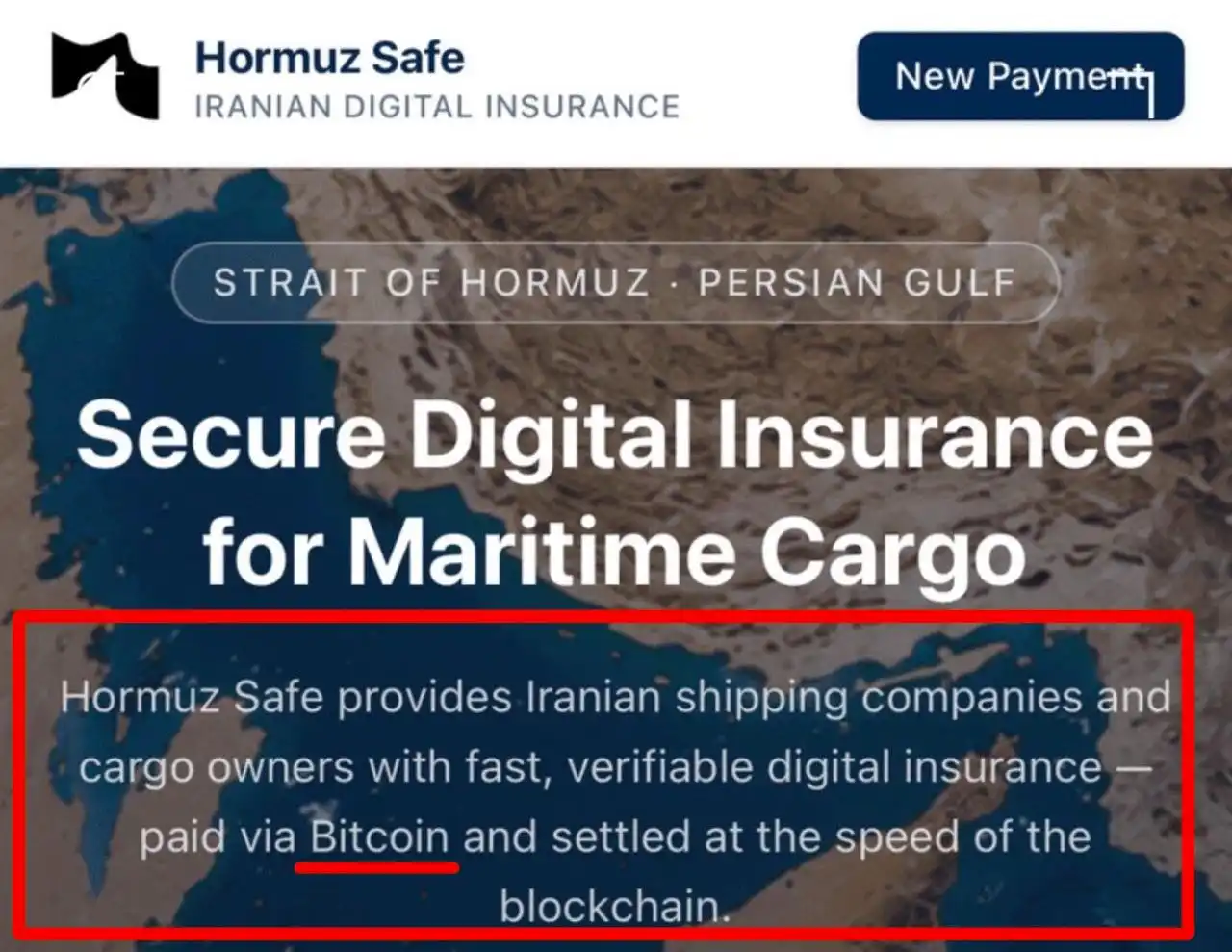
According to Bitcoin Magazine, Iran's Ministry of Economy began advancing this insurance plan from late April (early Ordibehesht in the Persian calendar). In April, Hamid Hosseini, spokesman for the Iranian Oil, Gas, and Petrochemical Products Exporters Union, told the Financial Times that shipping companies could settle Strait of Hormuz passage fees using non-dollar currencies like Bitcoin or Chinese Yuan.

Accelerating Institutionalization: From Tolls to Insurance Platform

Hormuz Safe is not an isolated move but the latest component of an entire institutional framework Iran is building around the Strait of Hormuz.

According to Bitcoin Magazine, in March 2026, the Iranian parliament passed the 'Strait of Hormuz Management Plan', formalizing into law the toll system operated by the IRGC since mid-March. Under this framework, the IRGC charges fees to ships passing through the strait; operators must submit information on vessel ownership, cargo type, destination, and crew to obtain a passage permit code.

Fees start at about $1 per barrel of oil, with fully loaded oil tankers facing charges up to $2 million, payable in Chinese Yuan.

On May 18, Iran's Supreme National Security Council announced the formal establishment of the 'Persian Gulf Strait Authority' (PGSA) and opened an official account on X.
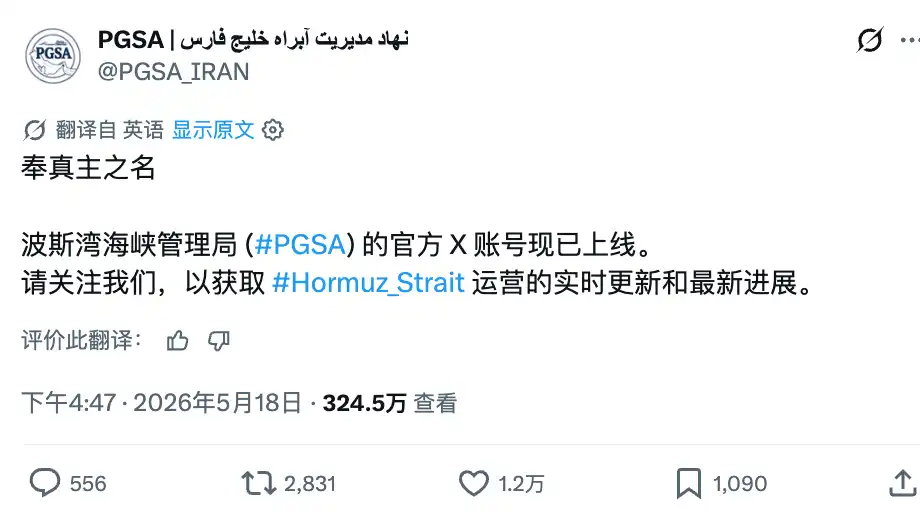
According to Euronews, the agency is positioned as an administrative entity to manage Strait of Hormuz traffic and collect tolls, operating in coordination with the IRGC Navy.

Ships must submit complete information, including ownership, insurance, crew lists, cargo declarations, and planned routes, via the PGSA's official email for approval and payment before receiving passage permits.

Ebrahim Azizi, chairman of the National Security and Foreign Policy Committee of the Iranian parliament, stated on X that only commercial vessels cooperating with Iran will benefit from this mechanism, and parties involved in US-Israeli military operations will be banned from using the route.

According to Windward intelligence analysis, as of May 18, strait traffic remains only about 38% of pre-conflict levels, with central Qeshm-Larak anchorage showing fixed dark vessel positioning for six consecutive days. Approximately 369 IRGC fast boats are concentrated in a single area about 30 nautical miles northeast of Khasab, shifting from coastal patrols to a presence in the main body of the strait.

Volatility, Sanctions Risks, and Shadow of Fraud

Several analysts have expressed skepticism about the practical feasibility of Hormuz Safe.

Bloomberg points out that, unlike stablecoins pegged to the US dollar, Bitcoin's price is highly volatile, limiting its adoption as a payment method. Foreign shipowners may be reluctant to use the mechanism for fear of violating US sanctions against Iran.

Ryan Yoon, senior analyst at Tiger Research, told Decrypt that the platform's technical and legal feasibility is 'highly questionable'; despite the announcement of its launch, no actual users have been confirmed. Shipping companies using Hormuz Safe would face the risk of 'immediate expulsion from the global financial system'.

Cake Wallet CEO Vikrant Sharma told BeInCrypto that Bitcoin can reduce some payment friction but is not a clean path to bypass the sanctions system. Liquidity at the scale of maritime insurance is a limiting factor. Activity on public blockchains can be monitored, and any exchange, broker, custodian, or counterparty tied to the US dollar brings compliance risks.

Sam Lyman, Research Director at the Bitcoin Policy Institute, explained Iran's logic from another angle: Bitcoin's core appeal lies in the fact that 'no one can freeze it'.

According to Decrypt, since the war began, crypto 'safe passage fee' scams have proliferated. Scammers impersonate Iranian authorities, demanding Bitcoin or USDT from ship operators. Hormuz Safe appears to be an independent national-level plan, but the line between genuine and fake is extremely blurred in the current environment.

The Bigger Picture: Iran Building a De-dollarized Maritime Financial System

According to Bitcoin Magazine data, Iran's crypto ecosystem was estimated at $7.8 billion in 2025, with IRGC-linked transactions accounting for about 50% of the country's total crypto volume (as of Q4 2025). The Iranian government has reportedly used mined Bitcoin to fund imports and hedge against oil revenue losses, with a stated national mining cost of about $1,300 per coin.

CoinDesk's analysis was quite precise: an insurance structure is more sophisticated than directly charging tolls. On paper, cargo owners are not paying for passage but purchasing insurance and financial responsibility certificates for sailing in waters that Tehran claims it can secure. This allows Iran to monetize its geographical advantage in a more palatable way.

A comment by Hacker News user everdrive received high votes in the tech community: The post-WWII US-led world order was partly built on the premise that the US military kept international waters open. Iran challenging the US at this level is astonishing. Everyone knew Iran had the capacity to close the strait if backed into a corner, but the arrival of this outcome still exposes serious policy-level miscalculations.

Regardless of whether Hormuz Safe ultimately operates at scale, the signal it sends is clear: Iran is building a complete set of administrative governance and financial infrastructure around the Strait of Hormuz, converting military blockade into a sustainable sovereign revenue mechanism, with Bitcoin serving as the settlement layer for this system.


Related Questions

QWhat is 'Hormuz Safe' and what is its primary purpose?

A'Hormuz Safe' is a Bitcoin-based maritime insurance platform launched by Iran's Ministry of Economy. Its primary purpose is to offer 'cryptographically verifiable insurance policies' to Iranian shipping companies and cargo owners for voyages passing through the Strait of Hormuz, with settlements to be made in Bitcoin.

QWhat are the main challenges and risks associated with the 'Hormuz Safe' platform, according to the article?

AThe main challenges and risks include: Bitcoin's high price volatility making it an unstable payment method; the risk of users violating US sanctions against Iran, potentially leading to exclusion from the global financial system; unconfirmed operational status and user adoption; and concerns about the feasibility of its legal and technical framework.

QWhat institutional frameworks is Iran building around the Strait of Hormuz alongside the 'Hormuz Safe' platform?

AIran is building a broader institutional framework for the Strait of Hormuz, including the passage of the 'Strait of Hormuz Management Plan' in March 2026 to formalize transit fees, and the establishment of the 'Persian Gulf Strait Authority' (PGSA) in May 2026 to manage traffic and collect fees, operating alongside the Islamic Revolutionary Guard Corps (IRGC) Navy.

QHow is Iran reportedly using Bitcoin within its national economy according to the article?

AThe article states that Iran's crypto ecosystem was estimated at $7.8 billion in 2025, with IRGC-linked transactions accounting for about 50% of the country's total crypto volume. The government reportedly uses Bitcoin mined domestically (at a cost of around $1,300 per coin) to fund imports and hedge against losses in oil revenues.

QBeyond simple transit fees, what strategic advantage does the 'Hormuz Safe' insurance model offer Iran, according to analysts?

AAnalysts, such as from CoinDesk, note that the insurance model is more sophisticated than direct transit fees. It allows Iran to monetize its geographic control by having cargo owners pay for insurance and financial responsibility certificates for sailing in waters Tehran claims to secure, rather than directly paying a toll. This makes the revenue stream more palatable and packageable internationally.

Related Reads

Five Core Forms of AI Agent in YC's Eyes

The article outlines five core architectural patterns for effective AI Agents, emerging from tools like Codex and Claude, that move beyond simple prompts towards reusable, process-based capabilities. 1. **Skills**: Reusable, parameterized workflows that function like method calls, allowing a single process (e.g., "/investigate") to handle various tasks based on input parameters. 2. **Thin Harness**: A lightweight execution framework (~200 lines) that manages the AI model's "hands and feet"—handling loops, file I/O, and context—without becoming bloated. 3. **Resolvers**: Routing tables that map tasks to specific Skills, preventing "context corruption" when managing dozens of Skills and ensuring outputs go to the correct locations. 4. **Latent vs. Deterministic Layer**: A critical separation where LLMs handle judgment, synthesis, and pattern recognition, while deterministic code handles tasks requiring precision, consistency, and low cost (like calculations). 5. **Memory**: A persistent, accumulating knowledge base (e.g., a markdown folder) with a "current trusted conclusion" section and an append-only timeline, enabling the system to learn and retain context over time. Together, these patterns create a "process power"—a durable competitive advantage. Unlike one-off prompt-based applications whose value quickly commoditizes, a well-designed AI Agent system encodes experience into reusable, parameterized workflows, offloads stable rules to code, and continuously learns through memory. This creates a structured, hard-to-replicate capability that can provide sustained value for individuals or businesses, such as an accountant automating client reviews while preserving privacy and accumulating expertise.

marsbit53m ago

Five Core Forms of AI Agent in YC's Eyes

marsbit53m ago

Tiger Research: On-Chain Risk Operators, The Market Cap Gap Between 147 Trillion and 70 Billion

This report by Tiger Research examines the evolution of risk management in decentralized finance (DeFi) lending. It highlights a power shift from protocol developers to specialized professional risk operators who manage on-chain capital. The era of protocols and community governance solely dictating DeFi lending is ending. A new professional asset management layer has emerged. While the sector is nascent, capital and distribution channels are rapidly consolidating around top risk operator teams, whose past performance is now a key criterion for institutional entry. The industry's development, accelerated by modular infrastructures like Morpho, has led to a clear division of labor mirroring traditional finance: distribution channels (e.g., exchanges), strategy/risk management (the risk operators), and product infrastructure/asset custody (smart contract protocols). This structure lowers the entry barrier for traditional institutions. Currently, the total value managed by risk operators is approximately $70 billion, dominated by a few leading teams like Steakhouse (RWA focus), Sentora (AI models), and Gauntlet (crisis management). Competition now centers on collateral standards, distribution access, and crisis response capabilities. The report outlines three primary entry paths for institutions: 1) **Distribution Model**: Leveraging external risk operators as backend service providers (common for exchanges). 2) **Asset Supply Model**: Onboarding real-world assets to DeFi as collateral. 3) **Independent Operator Model**: Building an in-house team to become a risk operator (e.g., Bitwise). The core opportunity lies in the strategy/risk management layer, where traditional financial institutions can leverage their existing expertise in due diligence and risk assessment without deep technical development. A vast opportunity gap exists: the global traditional asset management industry manages ~$147 trillion, while the entire DeFi sector is only ~$800 billion, with the risk operator niche at ~$70 billion. This disparity signifies immense growth potential. Once robust risk frameworks and clearer regulations are established, even a minor allocation from traditional markets could trigger exponential DeFi growth. Early movers who help build these foundational systems will gain significant rule-setting influence and first-mover advantages.

marsbit1h ago

Tiger Research: On-Chain Risk Operators, The Market Cap Gap Between 147 Trillion and 70 Billion

marsbit1h ago

Interview with Circle's Chief Economist: USDC's Entry into Hyperliquid Benefits Circle and HYPE, Stablecoins Are Becoming Marginal Buyers of U.S. Treasuries

In an interview with Circle's Chief Economist Gordon Liao, the conversation covers the strategic significance of USDC replacing USDH as the reference asset on the decentralized perpetual exchange Hyperliquid. This shift, facilitated by Coinbase as the reserve manager and Circle providing technical infrastructure, aims to capture net interest income for the platform, with 90% of reserve earnings directed back to Hyperliquid for HYPE token buybacks. Liao discusses how stablecoins like USDC, with their substantial on-chain settlement volumes (e.g., $21 trillion in Q1 2026), are emerging as marginal buyers of U.S. Treasuries, concentrating on short-term debt and effectively reducing the weighted duration of the market, which may provide underlying support for long-term rates. The dialogue also explores the evolving nature of stablecoins as both a medium of exchange and a vehicle for capital and collateral liquidity. Additionally, the panel touches on the CLARITY Act's legislative progress, noting compromises around "activity-based rewards" and remaining hurdles like ethics concerns. On AI, there's debate over value capture, with predictions that distribution and application layers, rather than foundational model companies like OpenAI, will accrue most value. Regarding the bond market, Liao attributes the rise in 30-year yields primarily to an increased term premium (around 80 bps) driven by supply-demand dynamics, including fiscal expansion and changing investor demand, rather than expectations of Fed rate hikes.

marsbit1h ago

Interview with Circle's Chief Economist: USDC's Entry into Hyperliquid Benefits Circle and HYPE, Stablecoins Are Becoming Marginal Buyers of U.S. Treasuries

marsbit1h ago

Trading

Spot
Futures

Hot Articles

What is $BITCOIN

DIGITAL GOLD ($BITCOIN): A Comprehensive Analysis Introduction to DIGITAL GOLD ($BITCOIN) DIGITAL GOLD ($BITCOIN) is a blockchain-based project operating on the Solana network, which aims to combine the characteristics of traditional precious metals with the innovation of decentralized technologies. While it shares a name with Bitcoin, often referred to as “digital gold” due to its perception as a store of value, DIGITAL GOLD is a separate token designed to create a unique ecosystem within the Web3 landscape. Its goal is to position itself as a viable alternative digital asset, although specifics regarding its applications and functionalities are still developing. What is DIGITAL GOLD ($BITCOIN)? DIGITAL GOLD ($BITCOIN) is a cryptocurrency token explicitly designed for use on the Solana blockchain. In contrast to Bitcoin, which provides a widely recognized value storage role, this token appears to focus on broader applications and characteristics. Notable aspects include: Blockchain Infrastructure: The token is built on the Solana blockchain, known for its capacity to handle high-speed and low-cost transactions. Supply Dynamics: DIGITAL GOLD has a maximum supply capped at 100 quadrillion tokens (100P $BITCOIN), although details regarding its circulating supply are currently undisclosed. Utility: While precise functionalities are not explicitly outlined, there are indications that the token could be utilized for various applications, potentially involving decentralized applications (dApps) or asset tokenization strategies. Who is the Creator of DIGITAL GOLD ($BITCOIN)? At present, the identity of the creators and development team behind DIGITAL GOLD ($BITCOIN) remains unknown. This situation is typical among many innovative projects within the blockchain space, particularly those aligning with decentralized finance and meme coin phenomena. While such anonymity may foster a community-driven culture, it intensifies concerns about governance and accountability. Who are the Investors of DIGITAL GOLD ($BITCOIN)? The available information indicates that DIGITAL GOLD ($BITCOIN) does not have any known institutional backers or prominent venture capital investments. The project seems to operate on a peer-to-peer model focused on community support and adoption rather than traditional funding routes. Its activity and liquidity are primarily situated on decentralized exchanges (DEXs), such as PumpSwap, rather than established centralized trading platforms, further highlighting its grassroots approach. How DIGITAL GOLD ($BITCOIN) Works The operational mechanics of DIGITAL GOLD ($BITCOIN) can be elaborated on based on its blockchain design and network attributes: Consensus Mechanism: By leveraging Solana’s unique proof-of-history (PoH) combined with a proof-of-stake (PoS) model, the project ensures efficient transaction validation contributing to the network's high performance. Tokenomics: While specific deflationary mechanisms have not been extensively detailed, the vast maximum token supply implies that it may cater to microtransactions or niche use cases that are still to be defined. Interoperability: There exists the potential for integration with Solana’s broader ecosystem, including various decentralized finance (DeFi) platforms. However, the details regarding specific integrations remain unspecified. Timeline of Key Events Here is a timeline that highlights significant milestones concerning DIGITAL GOLD ($BITCOIN): 2023: The initial deployment of the token occurs on the Solana blockchain, marked by its contract address. 2024: DIGITAL GOLD gains visibility as it becomes available for trading on decentralized exchanges like PumpSwap, allowing users to trade it against SOL. 2025: The project witnesses sporadic trading activity and potential interest in community-led engagements, although no noteworthy partnerships or technical advancements have been documented as of yet. Critical Analysis Strengths Scalability: The underlying Solana infrastructure supports high transaction volumes, which could enhance the utility of $BITCOIN in various transaction scenarios. Accessibility: The potential low trading price per token could attract retail investors, facilitating wider participation due to fractional ownership opportunities. Risks Lack of Transparency: The absence of publicly known backers, developers, or an audit process may yield skepticism regarding the project's sustainability and trustworthiness. Market Volatility: The trading activity is heavily reliant on speculative behavior, which can result in significant price volatility and uncertainty for investors. Conclusion DIGITAL GOLD ($BITCOIN) emerges as an intriguing yet ambiguous project within the rapidly evolving Solana ecosystem. While it attempts to leverage the “digital gold” narrative, its departure from Bitcoin's established role as a store of value underscores the need for a clearer differentiation of its intended utility and governance structure. Future acceptance and adoption will likely depend on addressing the current opacity and defining its operational and economic strategies more explicitly. Note: This report encompasses synthesised information available as of October 2023, and developments may have transpired beyond the research period.

363 Total ViewsPublished 2025.05.13Updated 2025.05.13

What is $BITCOIN

Discussions

Welcome to the HTX Community. Here, you can stay informed about the latest platform developments and gain access to professional market insights. Users' opinions on the price of BTC (BTC) are presented below.

活动图片