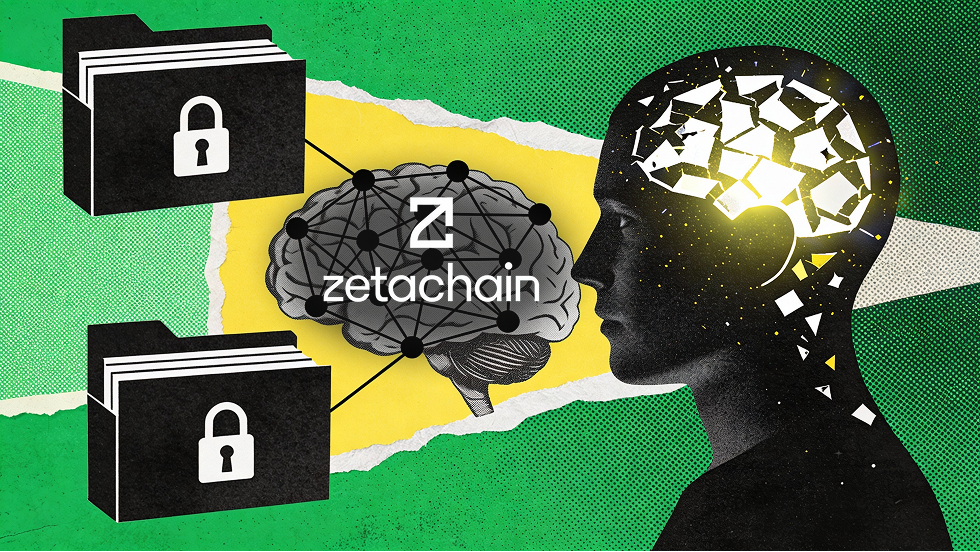
Interview with ZetaChain Lead Jessie Zhang: Reclaiming Humanity's Right to Think Between Decentralization and AI

marsbitPublished on 2026-02-06Last updated on 2026-02-06

Abstract

Interview with Jessie Zhang, Head of Incubation and Investment at ZetaChain, discussing the intersection of decentralization and AI, and the importance of reclaiming human cognitive sovereignty. ZetaChain, initially known for cross-chain interoperability, evolved in 2025 from building foundational infrastructure to focusing on real-world applications, connecting major blockchains like Bitcoin, Ethereum, and Solana. The team began exploring how blockchain could address growing concerns around AI, particularly data privacy and centralized control. Jessie highlights the risks of AI-driven "cognitive centralization," where user data—including intentions, emotions, and preferences—is concentrated in few platforms, threatening individual autonomy. Examples like OpenAI retaining deleted user chats and past incidents of algorithmic manipulation (e.g., Facebook influencing elections) underscore the urgency. ZetaChain’s response is Anuma, a private AI platform built as a "personal memory layer." Anuma acts as a privacy-first AI管家 (butler) that manages user data locally, allowing interaction with models like ChatGPT or Claude without surrendering personal information. It ensures data sovereignty, prevents context fragmentation across AI tools, and safeguards independent thinking. Jessie emphasizes that privacy is an architectural imperative, not just a feature, and that blockchain’s trustless, ownership-based model is critical for AI ethics. Anuma, while built on ZetaChain, ...

——An in-depth interview with Jessie Zhang, Head of Incubation and Investment at ZetaChain

When the blockchain space began pondering "what's next," AI almost inevitably became a topic of discussion. But for Jessie Zhang, this is not merely a technological overlay; it is a long-term struggle concerning privacy, cognitive sovereignty, and humanity's independent thinking ability.

As a core contributor to ZetaChain, Jessie operates at the intersection of infrastructure, product incubation, investment, and long-term strategy. In 2025, after ZetaChain reached a key milestone, the decision was made to subsequently launch what seems like an "atypical blockchain product"—Anuma, a privacy-focused AI platform built around a "private memory layer."

In this interview, we started by reviewing ZetaChain's 2025 and ultimately touched upon a more fundamental question:

In a world reshaped by large models, can humanity still maintain genuine independent thought?

Starting with Cross-Chain: ZetaChain's 2025

PANews: Many people know ZetaChain from the keyword "cross-chain." How would you summarize what ZetaChain does, and what progress did you make in 2025?

Jessie:

2025 was a transition period for ZetaChain, moving from 'laying the foundation' to 'gaining momentum.'

From the beginning, we focused on interoperability. We are not just building bridges but creating a universal blockchain that can natively connect all chains. Our goal is to enable developers to avoid deploying and maintaining logic for each chain individually, instead providing comprehensive coverage for different ecosystems like Bitcoin, Ethereum, and Solana in one go.

By 2025, we had achieved native connections with multiple major public chains, supported cross-chain assets and contract calls, and saw significant growth in user scale and ecosystem projects. More importantly, ZetaChain is no longer just a "technical concept" but has been validated as infrastructure capable of supporting real applications.

But at this stage, we began asking a more complex question:

If "connecting everything" is just the means, then what are we truly aiming to protect and empower?

When AI Becomes Powerful Enough, the Risks Become Real Enough

PANews: Why did you start thinking about the integration of blockchain and AI around the middle of last year? Was there a specific trigger?

Jessie:

The core logic stems from our vigilance regarding AI development trends and our commitment to privacy principles.

First, we observed AI shifting from an "efficiency tool" to a form of "cognitive centralization," moving from "information centralization" to "cognitive centralization." Mid-last year was a tipping point. Approximately 80% of the world's high-value AI interaction data was rapidly concentrating in the hands of a very few leading platforms. In May 2025, a US court ordered OpenAI to preserve all ChatGPT user chat histories, including deleted chats and sensitive conversations recorded via its API services, which made us acutely aware of the harsh reality of this "digital centralization."

The data being captured goes far beyond simple natural language interactions; it encompasses your intentions, emotions, decision-making context, and long-term user preferences.

We have already witnessed the cost of data misuse: Facebook manipulating news feeds through algorithms, influencing presidential elections without users' awareness; travel or food delivery platforms using data for precise profiling, engaging in "price discrimination" or "big data price gouging" against frequent users, erasing fair competition behind algorithms; and even on social media, algorithms creating "information cocoons," completely fracturing the worldviews of different groups.

But large models are more insidious than these social networks or search engines. They don't just mislead you on the consumer end; they deeply介入 (intervene in) your thought process. When you ask AI for assistance in decision-making, you can hardly tell if its response is neutral or subtly manipulated by commercial interests or algorithmic biases. When a system gradually understands you better than you do yourself and begins to shape your judgment in reverse, the boundaries of independent thinking become blurred. This is the systemic risk we are concerned about.

The second reason comes from our own DNA and long-term choices.

Ankur Nandwani, a co-founder of the Brave privacy browser ($BAT), is also a core contributor to ZetaChain. Today, Brave's monthly revenue exceeds $10 million, and another privacy-focused application, the instant messaging app Signal, has reached 70 million monthly active users. These facts continually validate one point: privacy is not a niche demand but a long-underestimated, yet consistently essential,刚性需求 (rigid demand).

We have always believed that privacy in the AI era will not be diminished but will be increasingly amplified. As AI deeply介入 (intervenes in) cognition, decision-making, and behavior, data sovereignty and usage boundaries are no longer just technical issues but fundamental questions concerning individual freedom and social structure.

It is against these two backgrounds that we began systematically considering: could there be an infrastructure for LLMs that reintroduces data sovereignty, verifiability, and decentralization into the AI system without sacrificing AI capabilities? This is the fundamental reason we started thinking about blockchain and AI together.

Why Blockchain is Still the Answer

PANews: Many people might think "AI privacy" is a Web2 problem. Why do you believe blockchain is the key?

Jessie:

Among all technologies, only blockchain inherently addresses the three core challenges: ownership, tamper-proof verification, and trustless system design.

An AI company can promise "we don't do evil," but the philosophy of blockchain is: you don't even need to trust me.

We increasingly believe that privacy is not a feature but an architectural choice. Cognitive sovereignty is not guaranteed by terms but enforced by technology.

The Birth of Anuma, and Why It's Defined as a "Private Memory Layer"

Jessie:

Anuma was born precisely to solve the core paradox we just mentioned: we want AI's "intelligence" but not its "manipulation."

The current AI logic is: if you want it to be smarter and understand you better, you must feed it massive amounts of context and personal information. As interactions deepen, these fragments of information gradually piece together a "memory layer" of your true self. You can try asking an AI: "In your eyes, what kind of person am I?" You'll find its answer is often startlingly accurate. This indicates it has already grasped your mental model.

But the problem is, this "memory layer" is currently hosted on the servers of tech giants.

Anuma's starting point is not "anti-AI" but "anti-monopoly." We believe that since "memory" is an inevitable byproduct of AI evolution, it should not naturally belong to any single platform. This memory should be held and controlled by you, and you should be able to take it with you at any time.

By defining Anuma as a "private memory layer," we aim to defend the last line of cognitive sovereignty for humanity in a highly intelligent future. We want to achieve this: allow data to continuously generate value and make you more powerful, while preventing it from becoming a weapon that alienates and attacks us.

What Functions Does Anuma Have?

PANews: How would you introduce Anuma to the average person? What core functions has it currently implemented?

Jessie:

Simply put, Anuma is an AI private butler who will never tell your secrets. The most remarkable thing about this butler is that he doesn't work alone; he brings a whole team of "AI assistants" to serve you. If ChatGPT, Claude, or Gemini are like top expert assistants from different fields, then Anuma is the overall coordinator, the trusted chief butler who knows all your secrets but remains tight-lipped.

This architecture solves two core pain points in current AI usage:

  • First, it is your "cognitive firewall": All sensitive information and historical memory are locked solely with the butler (Anuma). When he dispatches the little assistants to handle tasks, he ensures your privacy is not "stolen" for model training. This means AI can become smarter, but your raw data never leaves your control.

  • Second, it is your "memory synchronizer": When you instruct the butler to switch to a different "assistant" to handle a problem, the conversation memory is completely continuous. You don't need to jump between different Apps, nor repeat your background information to every new assistant. The butler helps each assistant "sync progress"; no matter who you call upon, they always understand you like an old friend.

In terms of user experience, you see only a minimalist, natural conversation interface; but underlying it, we use technical means to reassemble the digital sovereignty originally scattered in the hands of giants and return it to the user.

Humanity's Independent Thought is Still Worth Defending

PANews: Why does your branding repeatedly emphasize "the autonomy of the human mind"?

Jessie:

We believe this is an underestimated crisis. As AI increasingly resembles a "second brain," people are prone to abandon thinking and outsource judgment.

And if this "second brain" does not truly belong to you, then you are essentially handing over your right to think to a system you cannot audit.

The bottom line Anuma wants to protect is: your memory, your context, your thought history should be your private property. Not the platform's, not the model's, and not the advertising system's.

I believe AI will become one of humanity's most important tools. But the prerequisite is that humans remain the masters of their own thoughts.

From ZetaChain to Anuma: Blockchain's Extension into the Web2 World

PANews: How do you view the relationship between ZetaChain and Anuma?

Jessie:

Anuma is the flagship落地 (landing/implementation) of ZetaChain entering its 2.0 phase and fully embracing the AI narrative. I see the relationship between the two as one where "the infrastructure drives the application, and the application defines the value": Internally, we don't simply define Anuma as a "Web3-specific" product; it is built entirely according to Web2's 2C standards and user experience. But at the same time, it is completely built on top of ZetaChain.

This is the direction we believe Web3 should take: the infrastructure becomes invisible, but its value is irreplaceable. Only when users no longer perceive the existence of the "chain" and only feel a "more usable, more secure" service will Web3 truly move towards mass adoption.

Epilogue

At the end of the interview, Jessie said: "The real danger is not how smart AI becomes, but that humans unknowingly hand over the steering wheel of decision-making without realizing it."

Perhaps, Anuma is more than just an AI product.

It is more like a reminder:

In a highly intelligent world, maintaining independent thinking is itself an ability that needs to be guarded by technology.


Related Questions

QWhat is the core mission of Anuma, the AI platform developed by ZetaChain?

AAnuma's core mission is to serve as a 'private memory layer' that protects user data sovereignty and cognitive independence in the AI era. It ensures users retain ownership and control over their personal data and interaction history with AI models, preventing centralized platforms from exploiting or manipulating this information.

QHow does ZetaChain's infrastructure support Anuma's functionality?

AZetaChain provides the underlying decentralized infrastructure for Anuma, enabling features like data ownership, immutability, and trustless system design. This ensures that user data and memory layers remain private, secure, and under user control, without relying on centralized intermediaries.

QWhat risks does Jessie Zhang associate with the current AI landscape?

AJessie Zhang highlights risks such as cognitive centralization, where a few major platforms control vast amounts of user data, leading to potential manipulation, algorithmic bias, and loss of individual decision-making autonomy. She emphasizes that AI systems can subtly influence human judgment, undermining independent thinking.

QHow does Anuma address the trade-off between AI intelligence and user privacy?

AAnuma decouples AI intelligence from data exploitation by acting as a privacy-first intermediary. It allows users to leverage multiple AI models (e.g., ChatGPT, Claude) while keeping their sensitive data and memory layer encrypted and locally controlled. This ensures AI benefits are retained without compromising privacy.

QWhy does Jessie Zhang believe blockchain is essential for solving AI privacy issues?

AShe argues that blockchain is uniquely suited to address AI privacy challenges due to its inherent properties: decentralized ownership, tamper-proof verification, and trustless architecture. Unlike centralized promises of 'do no harm,' blockchain enforces privacy and sovereignty through technical design rather than policy.

Related Reads

$30 Billion DeFi Capital Exodus: LayerZero Stumbles, Chainlink Feasts

Following the major DeFi security incident involving Kelp DAO, a significant migration of funds is underway from the cross-chain protocol LayerZero to Chainlink's CCIP (Cross-Chain Interoperability Protocol). Over $30 billion in Total Value Locked (TVL) from protocols like Kelp DAO, Solv Protocol, Re, and Tydro has moved to Chainlink in the past week, driven by security concerns. LayerZero is facing a severe trust crisis after the attack. Initially denying responsibility, LayerZero Labs has now issued a public apology, acknowledging management oversights. These include a vulnerable "1/1" single-node configuration for its Decentralized Verification Network (DVN) and past misuse of a multi-signature wallet by a team member. The protocol's weekly bridge volume has slumped to near-historic lows of around $470 million. In contrast, Chainlink is experiencing a surge in adoption and activity. Its independent active addresses recently hit multi-month highs, and whales have been accumulating LINK tokens. Beyond DeFi, Chainlink is securing partnerships with traditional finance giants like DTCC, European stock exchange operator SIX Group, and asset manager Amundi. While LayerZero has announced security upgrades—such as migrating to stronger multi-signature configurations and developing a second DVN client—and contributed to a rescue fund, the event underscores that security is becoming a decisive competitive factor as DeFi matures.

marsbit4m ago

$30 Billion DeFi Capital Exodus: LayerZero Stumbles, Chainlink Feasts

marsbit4m ago

The $13 Trillion Repo Market Is Quietly Being Rewritten by Blockchain

The $13 trillion repurchase agreement (repo) market, a crucial artery for global short-term funding, is experiencing a significant transformation through blockchain technology. After years of limited impact in finance, blockchain is finding substantial adoption in repo transactions. Major institutions like JPMorgan Chase, HSBC, and Broadridge are deploying tokenized repo platforms, with daily volumes already reaching tens of billions of dollars. Traditional repo markets operate with fixed hours, rely on intermediaries, and involve manual, time-consuming processes. Tokenized repos, by contrast, use blockchain to create digital tokens representing cash and securities collateral. This enables near-instantaneous settlement, 24/7 trading, automated execution, and enhanced auditability. The key drivers for adoption include maturing technology, more receptive regulators, and growing client recognition of tangible benefits like reduced operational friction and capital efficiency. Analyses, such as one from Broadridge, indicate that moving a portion of repo activity onto blockchain can significantly reduce a bank's required liquidity buffers, potentially freeing up billions in capital. The infrastructure is also seen as foundational for a future of round-the-clock trading for traditional assets. Challenges remain, including the existence of fragmented blockchain networks, the need for stress testing under extreme market conditions, and the loss of operational flexibility compared to manual processes. However, the industry consensus is that these are implementation hurdles. Tokenized repo has moved beyond pilot stages to become one of blockchain's most concrete and impactful applications in traditional finance, marking a pivotal shift in how a core market functions.

marsbit5m ago

The $13 Trillion Repo Market Is Quietly Being Rewritten by Blockchain

marsbit5m ago

From Gas Limit to 'Keyed Nonces', How to Understand the Next Step in Ethereum Scalability?

Ethereum’s scalability efforts are shifting toward a user-centric approach—focusing not only on higher TPS, but on translating technical upgrades into lower costs, smoother operations, and better wallet experiences. Two recent developments highlight this direction: - **Raising the Gas Limit to 200 million**: Following the Fusaka upgrade that increased it to 60 million, a consensus has formed around a potential future increase to 200 million. This would boost Ethereum’s execution capacity, but it is planned alongside other upgrades—such as ePBS, Block-Level Access Lists (BAL), and EIP-8037—to manage state growth and keep node operation viable for average participants. - **Keyed Nonces (EIP-8250)**: This proposal aims to improve how transactions are queued. Instead of a single linear nonce per account, it introduces multiple independent nonce domains. This prevents different types of transactions—such as private payments, session keys, or batch operations—from blocking each other. Vitalik Buterin views this as a foundational step toward better privacy support and more flexible state scalability. Together, these upgrades are part of a broader move to push complexity from wallets, DApps, and relays back into the protocol layer. For everyday users, this means future Ethereum interactions could become less congested, more intuitive, and safer—especially as core improvements in account abstraction, cross-L2 interoperability, and node decentralization continue to progress. Ultimately, Ethereum is evolving to handle not just more transactions, but more varied and complex on-chain use cases while preserving its decentralized foundation.

marsbit27m ago

From Gas Limit to 'Keyed Nonces', How to Understand the Next Step in Ethereum Scalability?

marsbit27m ago

Leaving OpenAI, How Much Has Their Net Worth Increased?

Former OpenAI employees have collectively accrued near-trillion dollar valuations through ventures and investments, charting AI's future. The article highlights two main paths: founding high-value companies like Anthropic and Perplexity, or applying insider insights as investors. Leopold Aschenbrenner exemplifies the investor path. After being fired from OpenAI, he leveraged firsthand knowledge of AI's massive energy demands to make hugely successful public market bets on nuclear and fuel cell companies, practicing "cross-industry cognitive arbitrage." Other alumni, like the Zero Shot VC fund founders, use their technical foresight for early-stage investing. Their key advantage lies not just in picking winners, but in knowing which technical approaches are likely dead ends—a "veto list" derived from internal OpenAI experience. Angel investing within the network, as seen with Mira Murati and Sam Altman, operates on deep, pre-existing understanding of a founder's capabilities, reducing due diligence to near zero. This creates an ecosystem bound by a shared belief in AGI's imminent arrival, differing from networks like the "PayPal Mafia" which were built on shared past struggles. The shift of these builders to investors signals a profound conviction: their situational awareness of the AI landscape is now so clear that deploying capital based on that judgment is more efficient than building themselves. They are allocating bets on the future they helped shape from the inside.

marsbit38m ago

Leaving OpenAI, How Much Has Their Net Worth Increased?

marsbit38m ago

Trading

Spot
Futures

Hot Articles

Discussions

Welcome to the HTX Community. Here, you can stay informed about the latest platform developments and gain access to professional market insights. Users' opinions on the price of AI (AI) are presented below.

活动图片