Institutions Are Using XRP As Collateral, Says Ripple Prime CEO

bitcoinistPublished on 2026-03-19Last updated on 2026-03-19

Abstract

Ripple Prime CEO Mike Higgins states that institutions are beginning to use XRP as collateral within their market structures. Ripple's acquisition and rebranding of Hidden Road to Ripple Prime aims to integrate prime brokerage, clearing, custody, and treasury services. The platform enables firms to use XRP as collateral to finance trades without needing to liquidate it first, providing dollar credit for activities like trading CME futures. This approach, similar to traditional commodity finance, allows for balance-sheet efficiency and access to additional return strategies. Higgins highlights the advantages of digital collateral, such as 24/7 movement and liquidation, crucial for risk management. He emphasizes that institutional adoption requires compliance, transparency, and permissioned access, bridging traditional and digital finance. At the time of reporting, XRP was trading at $1.46.

Ripple Prime is pitching XRP not just as a traded asset, but as working collateral inside institutional market structure. In a March 17 interview with Jake Claver, international CEO Mike Higgins said Ripple’s acquisition of Hidden Road, now rebranded as Ripple Prime, is designed to bring prime brokerage, clearing, custody and treasury functions into a single institutional stack.

Higgins framed Ripple Prime as an access layer for firms trading across both traditional and digital markets. The core idea, he said, is that those markets are no longer separate for much longer, and institutions will need balance-sheet access, collateral mobility and cross-margining tools that work across both.

The Role Of XRP Within Ripple Prime

That is where XRP enters the picture. Higgins said Ripple Prime has built “innovative ways around taking XRP as collateral” and using it to finance trades, allowing institutional clients to post digital assets without first liquidating them into dollars. In practice, that means a firm holding XRP can keep the position on its balance sheet while still accessing leverage or liquidity in markets that do not natively accept XRP.

He gave a concrete example using CME futures. “If you wanted to trade futures on the CME, the CME doesn’t take XRP as good collateral,” Higgins said. “Instead of transforming that and selling that into dollars to give to your clearer, what you can do through Ripple Prime is post your XRP as good margin. We give you dollar credit to trade on the CME, and so now you could be long spot, front-month future, capturing the basis trade.”

That comparison was central to his argument. Higgins likened the model to traditional commodity finance, where a bank would lend against oranges, gold or Treasuries rather than require a client to sell the underlying asset first. The difference now is that crypto-native collateral is starting to be recognized inside institutional risk systems. For holders of assets like XRP, he said, that avoids crystallizing profit and loss, preserves treasury positions and opens up additional return strategies.

He also argued that digital collateral has one structural advantage over traditional assets: it can be moved and liquidated around the clock. That matters not only for trading, but for risk management. “When you trade traditional assets, they have an open and a close every day and they have weekends or long periods of holidays,” Higgins said. “What you get the next day are these huge gaps. A smooth 24/7 market where you can move collateral, that velocity of collateral to meet collateral calls shrinks.”

In Higgins’ telling, the institutional case for tokenization is broader than a single asset. He pointed to Treasury operations, tokenized repo, onchain money-market products and, eventually, tokenized equities as part of the same transition. “You already have crypto as an asset class itself. You have stablecoin usage,” he said. “The world is inexorably moving in this direction and the pace of that is increasing now that we’ve already proven out the thesis of using the technologies with crypto.”

Still, he did not suggest a clean handoff from legacy finance to open DeFi. Higgins repeatedly stressed compliance, counterparty transparency and permissioned access as prerequisites for serious institutional adoption.

Public decentralized venues may be winning market share, he said, but large firms still need AML, KYC and balance-sheet visibility before they can deploy capital at scale. That leaves prime brokers in a familiar role: connecting fragmented pools of liquidity while managing credit, margin and settlement across venues.

At press time, XRP traded at $1.46.
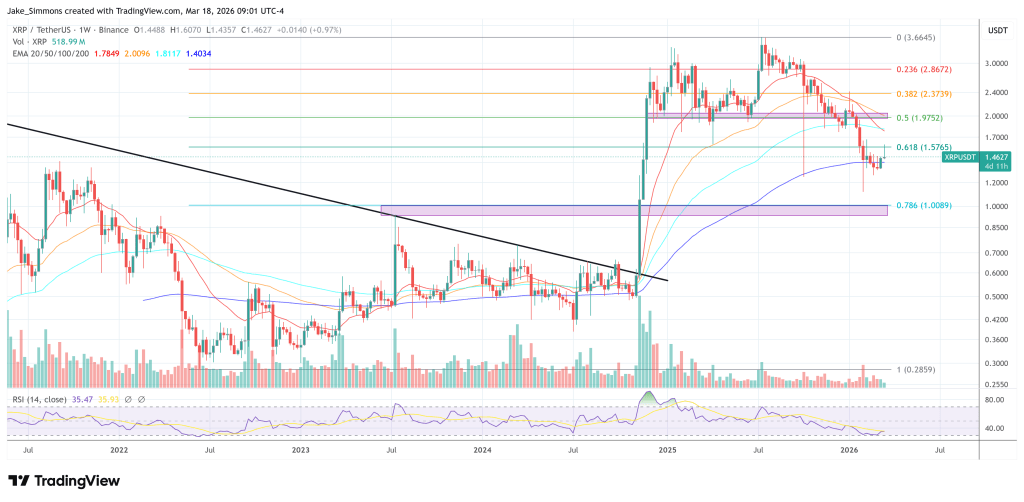
XRP must rise above the 0.618 Fib, 1-week chart | Source: XRPUSDT on TradingView.com

Related Questions

QWhat is the primary function of Ripple Prime according to CEO Mike Higgins?

ARipple Prime serves as an access layer for firms trading across both traditional and digital markets, providing prime brokerage, clearing, custody, and treasury functions in a single institutional stack.

QHow is XRP being used as collateral within the Ripple Prime system?

ARipple Prime has built innovative ways to accept XRP as collateral, allowing institutional clients to post their XRP to obtain dollar credit for trading in markets like the CME without having to first liquidate their digital assets.

QWhat specific example did Higgins give to illustrate the use of XRP as collateral?

AHiggins gave the example of trading CME futures. Instead of selling XRP for dollars to post as margin, a firm can post its XRP directly with Ripple Prime, which then provides them with dollar credit to trade on the CME.

QWhat structural advantage does digital collateral like XRP have over traditional assets, according to the article?

ADigital collateral can be moved and liquidated 24/7, which provides a significant advantage for risk management and meeting collateral calls, unlike traditional assets which have market closures, weekends, and holidays.

QWhat prerequisites for serious institutional adoption did Higgins repeatedly stress?

AHiggins stressed that compliance, counterparty transparency, and permissioned access are essential prerequisites for serious institutional adoption of these new financial technologies.

Related Reads

In-Depth Report on the On-Chain Lending Market: When Off-Chain Credit Meets On-Chain Liquidation

The on-chain lending market has evolved from a peripheral DeFi niche into core financial infrastructure. As of early 2026, total value locked (TVL) in on-chain lending protocols has reached $64.3 billion, accounting for 53.54% of total DeFi TVL, making it the largest and most mature vertical within decentralized finance. Aave dominates the sector with approximately $32.9 billion in TVL, commanding nearly half of the market—a leadership position that is unlikely to be challenged in the foreseeable future. However, the path of on-chain lending forward is not without risk. Liquidation cascades, credit defaults, and cross-chain vulnerabilities remain systemic threats hanging over the industry. At the same time, a deeper structural transformation is underway: on-chain lending is shifting from a “leverage tool for crypto-native users” to a “compliant gateway for institutional capital”. The scale of RWA (Real World Asset) lending has surpassed $18.5 billion, with U.S. Treasuries and government securities increasingly serving as core collateral. Institutional capital inflows are reshaping both the user base and risk appetite of the sector. This report systematically analyzes the evolution of on-chain lending definitions, competitive dynamics, core risks, and future trends, providing a comprehensive industry outlook for investors and trade practitioners. Key findings suggest that the “one dominant player with several strong challengers” structure will persist in the short term, while fixed-rate lending, compliant collateral, and institutional credit underwriting will define the next phase of competition. For investors focused on DeFi infrastructure, three key opportunity tracks stand out, namely, the Aave ecosystem (Morpho, Spark), RWA lending protocols (Ondo, Maple) and fixed-rate innovation (Notional, Pendle).

HTX Learn13m ago

In-Depth Report on the On-Chain Lending Market: When Off-Chain Credit Meets On-Chain Liquidation

HTX Learn13m ago

Fu Peng's First Public Speech in 2026: What Exactly Are Crypto Assets? Why Did I Join the Crypto Asset Industry?

Fu Peng, a renowned macroeconomist and now Chief Economist at New火 Group, delivered his first public speech of 2026 at the Hong Kong Web3 Festival. He explained his perspective on crypto assets and why he joined the industry, framing it within the context of macroeconomic trends and financial evolution. Fu emphasized that crypto assets are transitioning from an early, belief-driven phase to a mature, institutionally integrated asset class. He drew parallels to the 1970s-80s, when technological advances (like computing) revolutionized traditional finance, leading to the rise of FICC (Fixed Income, Currencies, and Commodities). Similarly, current advancements in AI, data, and blockchain are reshaping finance, with crypto assets becoming part of a new "FICC + C" (C for Crypto) framework. He noted that institutional capital, including traditional hedge funds, avoided early crypto due to its speculative nature but are now engaging as regulatory clarity emerges (e.g., stablecoin laws, CFTC classifying crypto as a commodity). Fu predicted that 2025-2026 marks a turning point where crypto becomes a standardized, financially viable asset for diversified portfolios, akin to commodities or derivatives in traditional finance. Fu defined Bitcoin not as "digital gold" in a simplistic sense but as a value-preserving, financially tradable asset. He highlighted that crypto's future lies in regulated, institutional adoption, moving away from retail-dominated trading. His entry into crypto signals this maturation, where traditional finance integrates crypto into mainstream asset management.

marsbit1h ago

Fu Peng's First Public Speech in 2026: What Exactly Are Crypto Assets? Why Did I Join the Crypto Asset Industry?

marsbit1h ago

Justin Sun Sues Trump Family: What $75 Million Bought Was Only a Blacklist

Justin Sun, founder of Tron, has filed a lawsuit in federal court against World Liberty Financial (WLF), alleging he was made the "primary target of a fraudulent scheme" after investing $75 million. Sun claims the investment secured him an advisor title and WLFI tokens, which were later frozen by WLF, causing "hundreds of millions in losses." The dispute began in late 2024 when Sun's investment helped revive WLF's struggling token sale, which ultimately raised $550 million. Shortly after, the SEC dropped its lawsuit against Sun following Donald Trump's inauguration. However, relations soured when Sun refused WLF's demands for additional funding. In August 2025, WLF added a "blacklist" function to its smart contract, allowing it to unilaterally freeze tokens. Sun's holdings, worth approximately $107 million, were frozen, and he was threatened with token destruction. The lawsuit highlights WLF's structure, which directs 75% of token sale profits to the Trump family, who had earned $1 billion by December 2025. WLF's CEO is Zach Witkoff, son of U.S. Middle East envoy Steve Witkoff. The project faces scrutiny for opaque operations, including a controversial loan arrangement on the Dolomite platform, co-founded by a WLF advisor. Despite Sun's history with the SEC, the case underscores centralization risks within DeFi, as WLF controls governance and holds powers to freeze assets arbitrarily. Sun's tokens remain frozen as legal proceedings begin.

marsbit1h ago

Justin Sun Sues Trump Family: What $75 Million Bought Was Only a Blacklist

marsbit1h ago

Trading

Spot
Futures

Hot Articles

What is XRP 2.0

XRP 2.0: A New Frontier in the Cryptocurrency Landscape Introduction to XRP 2.0 In the ever-evolving realm of cryptocurrency, new projects continuously emerge, vying for attention and adoption. One such promising initiative is XRP 2.0, a novel cryptocurrency project designed to leverage advanced blockchain technology and robust encryption methodologies. While the name draws parallels with Ripple’s XRP, it’s crucial to note that XRP 2.0 operates independently, focusing on enhancing transaction security, privacy, and scalability. As the digital financial landscape increasingly embraces decentralized solutions, XRP 2.0 aims to contribute meaningfully to web3 and the overall expansion of crypto projects. What is XRP 2.0? At its core, XRP 2.0 is a cryptocurrency project that aims to create a secure and decentralized digital currency ecosystem. Its foundational technology integrates sophisticated blockchain principles with cutting-edge encryption techniques. The overarching goal of XRP 2.0 is to establish itself as a reliable and efficient platform enabling swift transaction execution while prioritizing enhanced privacy protections for its users. The project is promoted as a solution to many limitations faced by existing cryptocurrencies, proposing a system that can handle a higher volume of transactions with improved speed and privacy. This versatility positions XRP 2.0 as a significant contender in a marketplace riddled with various digital currencies. Who is the Creator of XRP 2.0? The identity of the creator behind XRP 2.0 has been flagged as ‘Wilbur.’ However, comprehensive details regarding Wilbur or their associated entity remain elusive. The anonymity of many cryptocurrency creators is not an uncommon phenomenon in the industry, often designed to maintain a degree of privacy and security. Who are the Investors of XRP 2.0? As of now, specific information related to the investment foundations or organizations supporting XRP 2.0 is not publicly available. In the cryptocurrency sector, the backing by reputed investors can significantly influence a project's credibility and success, yet the transparency regarding the financial supporters of XRP 2.0 has not been established. How Does XRP 2.0 Work? XRP 2.0 stands out by employing a combination of blockchain technology and advanced encryption algorithms that ensures secure and decentralized transactions. Its innovative structure includes unique features designed to foster user engagement and broaden functionalities beyond conventional cryptocurrency transactions. Among these features, XRP 2.0 incorporates AI-powered capabilities, such as text-to-image and text-to-speech functionalities. These additions are designed to enhance the interactive experience for users, promoting broader applicability across various sectors. By bridging technological advancements with user-centered design, XRP 2.0 aims to capture the attention of a diverse range of individuals and enterprises looking to integrate cryptocurrency solutions into their operational frameworks. Timeline of XRP 2.0 Understanding XRP 2.0 requires examining the milestones that have defined its journey thus far: July 23, 2023: XRP 2.0 is introduced as a novel cryptocurrency project, aiming to revolutionize secure and decentralized transaction capabilities in the blockchain domain. September 8, 2023: The launching of another project, XRP20, occurs, marking the emergence of an ERC-20 token on the Ethereum blockchain that remains unrelated to XRP 2.0. November 13, 2023: The XRP Ledger undergoes a significant update with the release of rippled server software version 2.0.0. It is essential to note that this development is disconnected from the XRP 2.0 cryptocurrency project. Key Points About XRP 2.0 To distill the essence of XRP 2.0, several critical factors emerge: Unique Features: The inclusion of features like AI-powered text-to-image and text-to-speech further diversifies the potential applications of XRP 2.0. Blockchain Technology: The framework utilizes advanced blockchain mechanisms and encryption protocols, ensuring a secure and decentralized environment for transactions. Scalability and Privacy: XRP 2.0 prioritizes enhanced privacy protections in transaction processes and the scalability necessary to accommodate a growing user base. No Affiliation with Ripple: Importantly, despite its name, XRP 2.0 does not have any allegiance or collaboration with Ripple’s XRP, distinguishing its operational framework and objectives within the cryptocurrency ecosystem. Conclusion XRP 2.0 represents an ambitious venture into the cryptocurrency sphere, aiming to offer a combination of security, privacy, and efficiency in digital transactions. By integrating sophisticated technologies and user-friendly features, the project sets out to broaden the horizons of what cryptocurrency can achieve in today's digital economy. While the anonymity of its creator and lack of disclosed investors might raise questions for some, XRP 2.0's focus on advanced functionalities and decentralisation enhances its appeal amidst an increasingly crowded crypto market. As the cryptocurrency landscape continues to evolve, XRP 2.0 may yet emerge as a pivotal player in the expansion of secure and scalable blockchain solutions.

941 Total ViewsPublished 2024.04.01Updated 2024.12.03

What is XRP 2.0

Discussions

Welcome to the HTX Community. Here, you can stay informed about the latest platform developments and gain access to professional market insights. Users' opinions on the price of XRP (XRP) are presented below.

活动图片















