In 2026, Bitcoin Was Declared Dead 21 Times, Yet It Still Refuses to Stay in the Grave

cryptonews.ruPublished on 2026-08-17Last updated on 2026-08-17

Abstract

The article discusses the recurring phenomenon of Bitcoin being declared "dead" by critics since 2010, as documented by services like bitcoindeaths.com, which has logged 475 such "obituaries." Despite 21 new declarations in 2026 alone—including from vocal critics like Peter Schiff—this year's count remains slightly below the long-term annual average of roughly 28. Google Trends data shows public interest in the phrase "Bitcoin dead" spiked in early 2026 but has since subsided. The piece notes that while Bitcoin is currently trading 50% below its 2025 all-time high of over $126,000, this decline is less severe than previous crashes. The author highlights the historical pattern of dire predictions followed by Bitcoin's resilience, suggesting that despite ongoing criticism from figures like Paul Krugman, many remain skeptical that the cryptocurrency will ever truly reach zero.

Bitcoin obituaries, more commonly known as "bitcoin death lists," are an archive of public statements, headlines, articles, tweets, and predictions declaring Bitcoin dead, dying, obsolete, useless, or inevitably heading to zero. These independently tracked lists preserve every notable 'death' pronouncement of Bitcoin from journalists, economists, bankers, politicians, and Bitcoin's most famous critics.

Since 2010, Bitcoin supporters have been keeping links to every published editorial that officially declares Bitcoin dead.
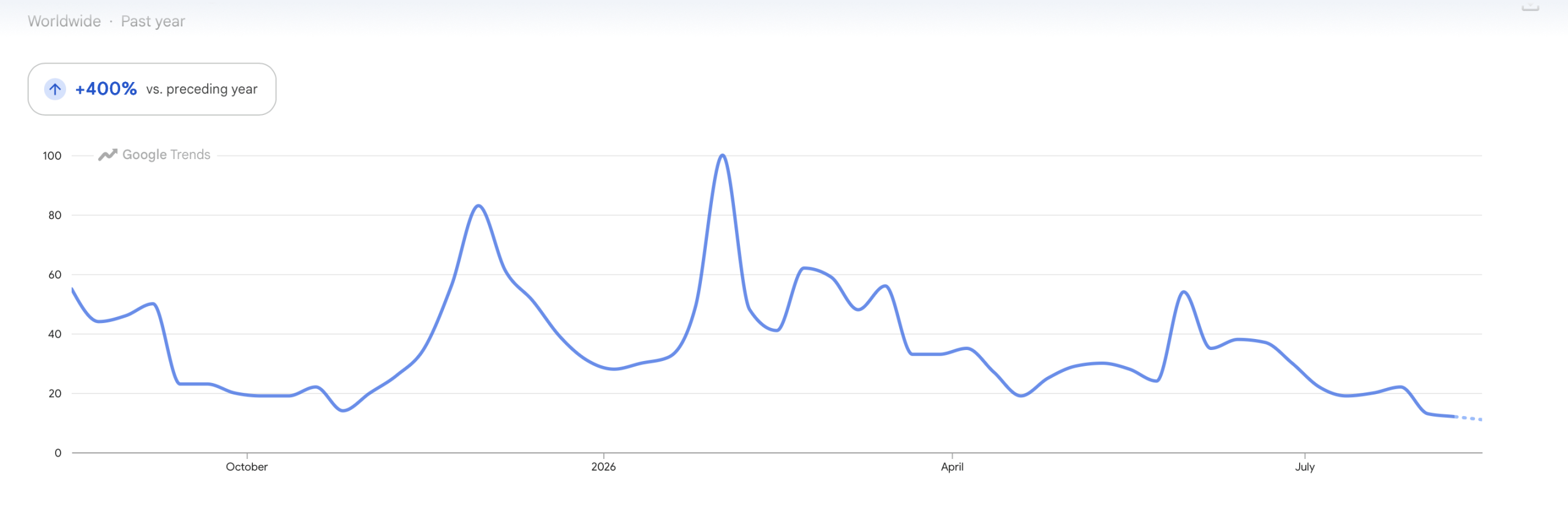
Google Trends chart for the search term "bitcoin dead" over the past 12 months.

Google Trends shows the public is also susceptible to this trend: this year, global search interest in the phrase "bitcoin dead" reached a perfect score of 100 during the week of January 31 to February 7, 2026. More recently, from May 30 to June 6, the score dropped to 52, and last week, the 'death' talk almost vanished, reaching only 12.

475 'Obituaries,' 21 in 2026

Among the services keeping count, the website bitcoindeaths.com has tallied no fewer than 475 Bitcoin 'obituaries,' and by its calculations, this 'cemetery' is quite costly. If you bought $100 worth of $BTC after each such pronouncement, it would have cost $47,500; that amount is now worth approximately $65,606, yielding a profit of $18,106.
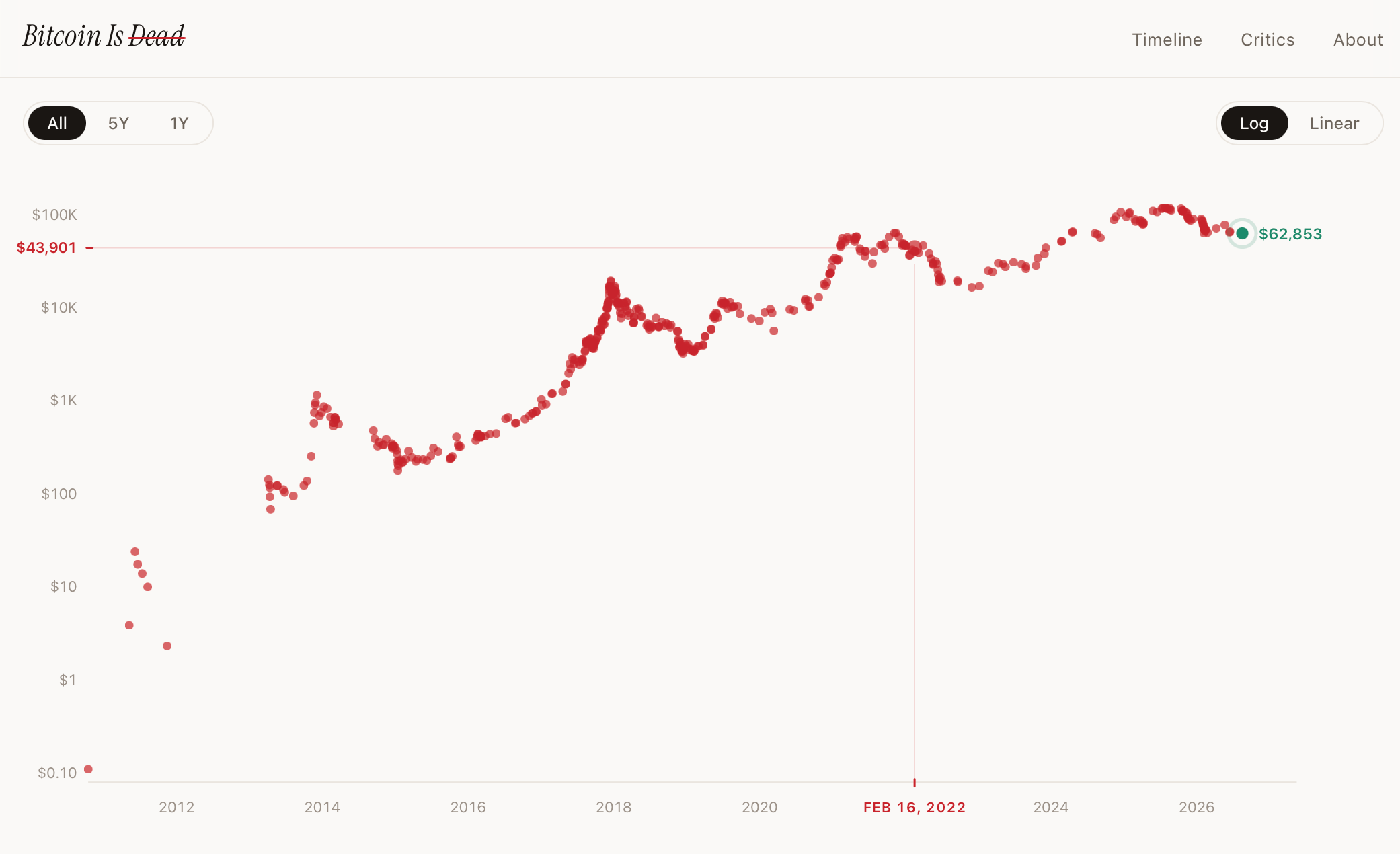
Screenshot from the website bitcoindeaths.com.

This year has already seen 21 so-called 'obituary messages,' with plenty of 2026 still remaining, and the latest 'death sentence' was handed down by long-time Bitcoin critic and ardent gold proponent Peter Schiff.

Schiff's prediction of Bitcoin's 'death,' voiced on June 16, 2026, sounds like a broken record:

"But for all practical purposes for most investors, it'll be zero... Bitcoin is going to lose over 99% of its market value even if its price is still above zero."

2026 Remains Slightly Below Average

Tallying from 2010 through 2026, no year has 'buried' Bitcoin as harshly as 2017, when critics released a record 93 'obituaries,' and 2018 with 74. On the opposite pole is 2012, which for some reason had zero. Bitcoin's earliest years, from 2010 to 2012, were relatively quiet, with almost no one bothering to write its epitaph.

Over the entire 17-year period, the average number of 'obituaries' is approximately 27.9 per year. Lately, the 'gravediggers' have been less active: 2024 saw just 10 so-called 'death announcements,' and the 2026 figure remains slightly below Bitcoin's long-term average. Apart from Schiff, critics on the 'deceased' list include David Tait, Steve Keen, George Noble, Paul Krugman, and Ulrich Bindseil.

Nobel laureate in economics Paul Krugman stated in December 2024:

"It's not digital gold — it's digital Beanie Babies."

Bitcoin Critics Smell Blood, But History Has Burned Them Before

Bitcoin's 'digital gold' looks much less shiny today: it's trading 50% below its all-time high ($ATH) set just above $126,000 in the first week of October 2025, as Bitcoin continues to struggle through a prolonged bear market. A 50% drop seems minor compared to the crash of $BTC from its 2017 $ATH — the record year for 'obituaries' — to the brutal crash that defined 2018 and 2019.

Predictions of 'death' will keep coming, but will Bitcoin actually die or go to zero? Proponents and even many outside observers doubt it, no matter how many times Krugman, Schiff, and other perennial critics have read Bitcoin its last rites.


Trending Cryptos

Related Questions

QWhat is the purpose of 'Bitcoin obituaries' or 'Bitcoin death lists' as mentioned in the article?

ABitcoin obituaries or death lists are an archive of public statements, headlines, articles, tweets, and predictions that declare Bitcoin dead, dying, obsolete, useless, or inevitably headed to zero. They serve to record every notable 'death' proclamation from journalists, economists, bankers, politicians, and prominent Bitcoin critics, as independently tracked by enthusiasts.

QAccording to Google Trends data cited in the article, when in 2026 did global searches for the phrase 'bitcoin dead' reach a perfect score of 100?

AAccording to the article, global searches for the phrase 'bitcoin dead' on Google Trends reached a perfect score of 100 during the week from January 31 to February 7, 2026.

QBased on the count from bitcoindeaths.com, how many 'obituaries' for Bitcoin were declared in the record-breaking year of 2017?

AAccording to the article, 2017 was the record-breaking year for Bitcoin obituaries, with critics issuing a record 93 'obituaries'.

QWho was cited as the most recent critic to declare Bitcoin 'dead' in June 2026, and what is their known stance?

AThe most recent critic cited to declare Bitcoin 'dead' in June 2026 was Peter Schiff. He is described as a long-time Bitcoin critic and a convinced gold advocate.

QHow does the article describe Bitcoin's current price performance compared to its 2025 all-time high, and what historical period does it contrast this with?

AThe article states that Bitcoin is trading 50% below its all-time high (ATH) of just over $126,000 set in early October 2025. It contrasts this 50% drop with the more severe crash from its 2017 ATH, which defined the brutal bear market of 2018 and 2019.

Related Reads

U.S. 'Operation Economic Outcast' Targets Iran's Crypto Sector, Over $100 Million in Oil-Related Payments Allegedly Facilitated via Cryptocurrency

U.S. Treasury Launches "Operation Economic Outcast," Sanctions Iran's Crypto Sector On August 24, the U.S. Treasury Department initiated "Operation Economic Outcast," a government-wide economic campaign against Iran. As part of this, the Office of Foreign Assets Control (OFAC) issued a sectoral sanctions determination targeting digital assets under Executive Order 13902, significantly expanding its authority. The Treasury stated that Iran is increasingly using cryptocurrency as a "tool of choice" to evade sanctions and support transactions linked to the Islamic Revolutionary Guard Corps (IRGC). Concurrently, OFAC sanctioned Ukrainian-Emirati broker Ivan Obukhov and his company, Foscom FZE. The Treasury alleges that since 2023, Obukhov has processed over $100 million in cryptocurrency payments to facilitate oil sales on behalf of the IRGC-Quds Force. Nearly 60 other entities, individuals, and vessels involved in nuclear procurement, cyber operations, and oil revenue networks were also sanctioned. This move marks an escalation from prior actions against specific exchanges, now establishing a broad basis to sanction any foreign entity deemed to operate in or support Iran's digital asset sector. Treasury Secretary Scott Bessent warned that any entity engaging economically with the Iranian regime will face the full reach of U.S. power, calling the operation an "economic D-Day" aimed at isolating Tehran.

marsbit9m ago

U.S. 'Operation Economic Outcast' Targets Iran's Crypto Sector, Over $100 Million in Oil-Related Payments Allegedly Facilitated via Cryptocurrency

marsbit9m ago

Is Your Account Still Blocked? Rosfinmonitoring Gets Direct Access to SBP and 'Mir'

Starting September 1, 2026, Russia's Federal Law No. 461-FZ grants Rosfinmonitoring (the Federal Financial Monitoring Service) direct access to transaction data from the National Payment Card System (NSPK), the operator of the Mir payment card system and the Faster Payments System (SBP). This allows the agency to bypass individual banks when reconstructing transaction trails for anti-money laundering (AML) purposes. The data, provided free of charge and without requiring customer consent or court orders, includes information on operations via SBP, the unified QR-code, and Mir cards, with no minimum transaction threshold. Customers will not be notified when their data is shared. The law does not introduce new taxes, automatic account freezes, or new enforcement powers. If suspicious activity is identified under existing AML laws, existing procedures with banks and law enforcement will apply. The agreement's specific terms between Rosfinmonitoring and NSPK, including the scope and historical depth of accessible data, are not public. The change centralizes access to a vast volume of domestic payments, potentially speeding up financial investigations. However, it also creates a single point of concentration for sensitive data and reduces transparency for cardholders, as customers are not informed about data requests. Observers note a global trend of expanding supervisory powers, with differences in the Russian model being the non-public agreement and the lack of customer notification.

cryptonews.ru12m ago

Is Your Account Still Blocked? Rosfinmonitoring Gets Direct Access to SBP and 'Mir'

cryptonews.ru12m ago

Solana Price Forecast Hits $110 as Bitwise's BSOL Posts Record Trading Volume

Solana (SOL) price is testing a critical resistance zone between $102-$103, having recently risen above $100 and now trading at $101.36. Technical analysis indicates a bullish but cautious trend, with the Parabolic SAR signaling a bullish short-term trend and the MACD gaining momentum. The price is within a rising wedge pattern, suggesting a potential breakout or sharper pullback. Key bullish factors include sustained, record-high network activity, with Solana processing over 1 billion transactions for the fourth consecutive week. Strong institutional demand is also evident, as Bitwise's Solana ETF (BSOL) recorded its highest-ever daily trading volume of over $108 million, contributing to significant daily inflows into SOL ETFs. However, caution is warranted. A major whale unstaked and transferred over 45,000 SOL, realizing a $3.3 million loss. Additionally, long-dated futures are trading at a discount to spot prices, indicating some long-term trader skepticism. **Price Forecast:** * **Bullish Case (Target: $110):** A confirmed daily close above the $102-$103 wedge resistance, supported by strong network usage and ETF inflows, could propel SOL towards $110. * **Bearish Risk (Support: $93-$95):** A rejection at resistance and a breakdown from the rising wedge's support could see the price retreat to the $93-$95 zone, especially if the whale's exit signals broader caution. In conclusion, the outlook is balanced between strong fundamental demand and emerging caution from large holders. The price action around the $102-$103 resistance will be decisive in determining the next significant move.

cryptonews.ru12m ago

Solana Price Forecast Hits $110 as Bitwise's BSOL Posts Record Trading Volume

cryptonews.ru12m ago

Trading

Spot

Hot Articles

What is $BITCOIN

DIGITAL GOLD ($BITCOIN): A Comprehensive Analysis Introduction to DIGITAL GOLD ($BITCOIN) DIGITAL GOLD ($BITCOIN) is a blockchain-based project operating on the Solana network, which aims to combine the characteristics of traditional precious metals with the innovation of decentralized technologies. While it shares a name with Bitcoin, often referred to as “digital gold” due to its perception as a store of value, DIGITAL GOLD is a separate token designed to create a unique ecosystem within the Web3 landscape. Its goal is to position itself as a viable alternative digital asset, although specifics regarding its applications and functionalities are still developing. What is DIGITAL GOLD ($BITCOIN)? DIGITAL GOLD ($BITCOIN) is a cryptocurrency token explicitly designed for use on the Solana blockchain. In contrast to Bitcoin, which provides a widely recognized value storage role, this token appears to focus on broader applications and characteristics. Notable aspects include: Blockchain Infrastructure: The token is built on the Solana blockchain, known for its capacity to handle high-speed and low-cost transactions. Supply Dynamics: DIGITAL GOLD has a maximum supply capped at 100 quadrillion tokens (100P $BITCOIN), although details regarding its circulating supply are currently undisclosed. Utility: While precise functionalities are not explicitly outlined, there are indications that the token could be utilized for various applications, potentially involving decentralized applications (dApps) or asset tokenization strategies. Who is the Creator of DIGITAL GOLD ($BITCOIN)? At present, the identity of the creators and development team behind DIGITAL GOLD ($BITCOIN) remains unknown. This situation is typical among many innovative projects within the blockchain space, particularly those aligning with decentralized finance and meme coin phenomena. While such anonymity may foster a community-driven culture, it intensifies concerns about governance and accountability. Who are the Investors of DIGITAL GOLD ($BITCOIN)? The available information indicates that DIGITAL GOLD ($BITCOIN) does not have any known institutional backers or prominent venture capital investments. The project seems to operate on a peer-to-peer model focused on community support and adoption rather than traditional funding routes. Its activity and liquidity are primarily situated on decentralized exchanges (DEXs), such as PumpSwap, rather than established centralized trading platforms, further highlighting its grassroots approach. How DIGITAL GOLD ($BITCOIN) Works The operational mechanics of DIGITAL GOLD ($BITCOIN) can be elaborated on based on its blockchain design and network attributes: Consensus Mechanism: By leveraging Solana’s unique proof-of-history (PoH) combined with a proof-of-stake (PoS) model, the project ensures efficient transaction validation contributing to the network's high performance. Tokenomics: While specific deflationary mechanisms have not been extensively detailed, the vast maximum token supply implies that it may cater to microtransactions or niche use cases that are still to be defined. Interoperability: There exists the potential for integration with Solana’s broader ecosystem, including various decentralized finance (DeFi) platforms. However, the details regarding specific integrations remain unspecified. Timeline of Key Events Here is a timeline that highlights significant milestones concerning DIGITAL GOLD ($BITCOIN): 2023: The initial deployment of the token occurs on the Solana blockchain, marked by its contract address. 2024: DIGITAL GOLD gains visibility as it becomes available for trading on decentralized exchanges like PumpSwap, allowing users to trade it against SOL. 2025: The project witnesses sporadic trading activity and potential interest in community-led engagements, although no noteworthy partnerships or technical advancements have been documented as of yet. Critical Analysis Strengths Scalability: The underlying Solana infrastructure supports high transaction volumes, which could enhance the utility of $BITCOIN in various transaction scenarios. Accessibility: The potential low trading price per token could attract retail investors, facilitating wider participation due to fractional ownership opportunities. Risks Lack of Transparency: The absence of publicly known backers, developers, or an audit process may yield skepticism regarding the project's sustainability and trustworthiness. Market Volatility: The trading activity is heavily reliant on speculative behavior, which can result in significant price volatility and uncertainty for investors. Conclusion DIGITAL GOLD ($BITCOIN) emerges as an intriguing yet ambiguous project within the rapidly evolving Solana ecosystem. While it attempts to leverage the “digital gold” narrative, its departure from Bitcoin's established role as a store of value underscores the need for a clearer differentiation of its intended utility and governance structure. Future acceptance and adoption will likely depend on addressing the current opacity and defining its operational and economic strategies more explicitly. Note: This report encompasses synthesised information available as of October 2023, and developments may have transpired beyond the research period.

2.1k Total ViewsPublished 2025.05.13Updated 2025.05.13

What is $BITCOIN

Discussions

Welcome to the HTX Community. Here, you can stay informed about the latest platform developments and gain access to professional market insights. Users' opinions on the price of BTC (BTC) are presented below.

活动图片