Important Bitcoin Macro Cycle Durations You Should Know About

bitcoinistPublished on 2026-02-10Last updated on 2026-02-10

Abstract

A crypto analyst identifies a consistent macro cycle pattern in Bitcoin's price history, characterized by long bull markets followed by shorter bear markets. Historical data reveals that each bull cycle lasts approximately 1,064 days, followed by a bear market lasting about 364 days. This pattern was observed in the 2015-2017 bull cycle (peaking in December 2017) and the 2018-2021 bull cycle (peaking in November 2021). According to the analysis, the current cycle, which began in 2022, ended its bull phase on October 6, 2025, with Bitcoin reaching approximately $126,000. The analyst predicts the ongoing bear market will last until October 5, 2026, with BTC potentially bottoming near $38,500—a decline of roughly 40% from current levels above $69,000. This recurring structure is used to anticipate Bitcoin's future major price movements.

A crypto analyst argues that Bitcoin (BTC) price history reveals a consistent macro cycle pattern characterized by long bull markets followed by shorter bear markets. This repeating structure has appeared across multiple market cycles and is now being used to frame expectations for Bitcoin’s current and future price movements.

Bitcoin Macro Cycles Reveal Recurrent Pattern

Bitcoin’s macro cycles have often served as a historical blueprint for a typical 4-year cycle. Over the years, BTC has formed key patterns and cyclical movements that serve as a foundation for interpreting current market conditions and, to some degree, tracking future price action. Against this backdrop, pseudonymous crypto analyst Rekt Fencer has unveiled a chart analysis, highlighting historical Bitcoin macro durations that reveal a consistent repeating structure that could help anticipate the cryptocurrency’s next major move.

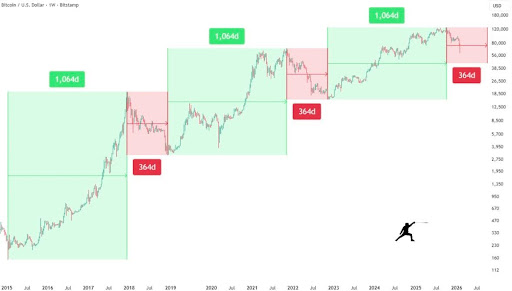
Rekt Fencer’s analysis dates back to the 2015-2017 bull cycle, when Bitcoin experienced its first major expansion phase, driven by global awareness and growing participation among early investors. The chart showed prices accelerating steadily over 1,064 days from January 12, 2015, before reaching a euphoric peak on December 11, 2017. Bitcoin had risen from roughly $160 to over $12,500 at the time, setting the stage for the market’s first large-scale bear trend.

The 2017- 2018 bear market reflected the aftermath of speculative excess, as investor sentiment shifted rapidly from optimism to caution. Over roughly 364 days, Bitcoin retraced much of its gains, dropping below $3,950 and hitting a bottom.
Source: Chart from Rekt Fencer on X

During the 2018 to 2021 bull cycle, Bitcoin experienced a more mature, institutionally driven rally lasting approximately 1,064 days. This period saw the leading cryptocurrency gain mainstream financial recognition and widespread adoption. The hype during this cycle had pushed BTC’s price from under $3,950 on December 10, 2018, to a former ATH of over $60,000 on 8, November 2021.

The bear market that followed this cycle lasted approximately 364 days, from November 8, 2021, to November 7, 2022. This downturn followed a series of high-profile crypto company failures and a shift in sentiment that led to Bitcoin declining below $18,500 from its ATH.

The major factor that stands out in Rekt Fencer’s analysis is the consistency in the duration of Bitcoin’s market phases. Each bull cycle ran for 1,064 days, followed by a 364-day correction. Building on this pattern, the analyst suggests that the current cycle may unfold along a similar timeline.

Where The Market Is In The Current Cycle

Based on Rekt Fencer’s chart, the 2022 to 2025 bull cycle has officially ended and is now in its bear market phase. The cycle also lasted 1,064 days, with the BTC price crossing $126,000 on October 6, 2025. Now that the cryptocurrency is in a bear market, Rekt Fencer predicts it could also run for 364 days from October 6, 2025, to October 5, 2026. During that time, BTC is projected to reach a bottom near $38,500, marking a roughly 40% decline from current levels above $69,000.

BTC trading at $68,785 on the 1D chart | Source: BTCUSDT on Tradingview.com

Related Questions

QAccording to the analyst Rekt Fencer, what is the consistent duration pattern of Bitcoin's macro cycles?

AThe pattern consists of bull markets lasting 1,064 days, followed by bear markets lasting 364 days.

QWhat was the start and end date of the 2022-2025 bull cycle, and what price did Bitcoin reach at its peak according to the article?

AThe bull cycle started in 2022 and ended on October 6, 2025, with Bitcoin reaching a peak price of $126,000.

QBased on the identified pattern, what is the predicted timeframe and price bottom for the current bear market?

AThe bear market is predicted to last from October 6, 2025, to October 5, 2026, with Bitcoin reaching a bottom near $38,500.

QWhat were the two main drivers mentioned for the 2018-2021 bull cycle?

AThe two main drivers were mainstream financial recognition and widespread institutional adoption.

QWhat event is cited as a major factor contributing to the bear market that began in November 2021?

AThe bear market was triggered by a series of high-profile crypto company failures and a shift in investor sentiment.

Related Reads

Kicked Out of PayPal, Musk Aims for a Comeback in the Crypto Market

Elon Musk's X (formerly Twitter) has launched its "Smart Cashtags" feature, generating approximately $1 billion in trading volume within days of its April 2026 pilot launch. The feature allows users to click on stock or crypto tickers (or even full Solana token contract addresses) in posts to view real-time price charts and discussions without leaving the app. Initially available to iPhone users in the US and Canada, with a partnership in Canada enabling direct trading via the Wealthsimple app. This move is part of Musk's broader "Everything App" vision, spearheaded by the upcoming X Money platform. Analysts, such as Mizuho's Dan Dolev, see this as a potential disruptor to the US payments market, even prompting a downgrade of PayPal's stock. X Money's beta offers services like 6% APY on deposits, cashback, and P2P transfers, with speculation it may later incorporate crypto trading and stablecoin settlements for faster transactions. However, the ambitious plan faces significant regulatory scrutiny. Senator Elizabeth Warren has questioned the sustainability of the high 6% yield and raised concerns over X's banking partner, Cross River Bank, which has a history of regulatory violations. Additional risks involve the "GENIUS Act," which may create loopholes for stablecoin issuance without full FDIC insurance coverage, potentially leaving users unprotected. The integration of social trading on a platform with over 500 million users could inject new liquidity and retail interest into the crypto market. Yet, it also amplifies risks like herd mentality and the blurring of lines between entertainment and financial speculation. Musk's return to finance, after his ouster from PayPal, hinges on balancing innovation with regulatory compliance.

marsbit50m ago

Kicked Out of PayPal, Musk Aims for a Comeback in the Crypto Market

marsbit50m ago

Trading

Spot
Futures

Hot Articles

What is $BITCOIN

DIGITAL GOLD ($BITCOIN): A Comprehensive Analysis Introduction to DIGITAL GOLD ($BITCOIN) DIGITAL GOLD ($BITCOIN) is a blockchain-based project operating on the Solana network, which aims to combine the characteristics of traditional precious metals with the innovation of decentralized technologies. While it shares a name with Bitcoin, often referred to as “digital gold” due to its perception as a store of value, DIGITAL GOLD is a separate token designed to create a unique ecosystem within the Web3 landscape. Its goal is to position itself as a viable alternative digital asset, although specifics regarding its applications and functionalities are still developing. What is DIGITAL GOLD ($BITCOIN)? DIGITAL GOLD ($BITCOIN) is a cryptocurrency token explicitly designed for use on the Solana blockchain. In contrast to Bitcoin, which provides a widely recognized value storage role, this token appears to focus on broader applications and characteristics. Notable aspects include: Blockchain Infrastructure: The token is built on the Solana blockchain, known for its capacity to handle high-speed and low-cost transactions. Supply Dynamics: DIGITAL GOLD has a maximum supply capped at 100 quadrillion tokens (100P $BITCOIN), although details regarding its circulating supply are currently undisclosed. Utility: While precise functionalities are not explicitly outlined, there are indications that the token could be utilized for various applications, potentially involving decentralized applications (dApps) or asset tokenization strategies. Who is the Creator of DIGITAL GOLD ($BITCOIN)? At present, the identity of the creators and development team behind DIGITAL GOLD ($BITCOIN) remains unknown. This situation is typical among many innovative projects within the blockchain space, particularly those aligning with decentralized finance and meme coin phenomena. While such anonymity may foster a community-driven culture, it intensifies concerns about governance and accountability. Who are the Investors of DIGITAL GOLD ($BITCOIN)? The available information indicates that DIGITAL GOLD ($BITCOIN) does not have any known institutional backers or prominent venture capital investments. The project seems to operate on a peer-to-peer model focused on community support and adoption rather than traditional funding routes. Its activity and liquidity are primarily situated on decentralized exchanges (DEXs), such as PumpSwap, rather than established centralized trading platforms, further highlighting its grassroots approach. How DIGITAL GOLD ($BITCOIN) Works The operational mechanics of DIGITAL GOLD ($BITCOIN) can be elaborated on based on its blockchain design and network attributes: Consensus Mechanism: By leveraging Solana’s unique proof-of-history (PoH) combined with a proof-of-stake (PoS) model, the project ensures efficient transaction validation contributing to the network's high performance. Tokenomics: While specific deflationary mechanisms have not been extensively detailed, the vast maximum token supply implies that it may cater to microtransactions or niche use cases that are still to be defined. Interoperability: There exists the potential for integration with Solana’s broader ecosystem, including various decentralized finance (DeFi) platforms. However, the details regarding specific integrations remain unspecified. Timeline of Key Events Here is a timeline that highlights significant milestones concerning DIGITAL GOLD ($BITCOIN): 2023: The initial deployment of the token occurs on the Solana blockchain, marked by its contract address. 2024: DIGITAL GOLD gains visibility as it becomes available for trading on decentralized exchanges like PumpSwap, allowing users to trade it against SOL. 2025: The project witnesses sporadic trading activity and potential interest in community-led engagements, although no noteworthy partnerships or technical advancements have been documented as of yet. Critical Analysis Strengths Scalability: The underlying Solana infrastructure supports high transaction volumes, which could enhance the utility of $BITCOIN in various transaction scenarios. Accessibility: The potential low trading price per token could attract retail investors, facilitating wider participation due to fractional ownership opportunities. Risks Lack of Transparency: The absence of publicly known backers, developers, or an audit process may yield skepticism regarding the project's sustainability and trustworthiness. Market Volatility: The trading activity is heavily reliant on speculative behavior, which can result in significant price volatility and uncertainty for investors. Conclusion DIGITAL GOLD ($BITCOIN) emerges as an intriguing yet ambiguous project within the rapidly evolving Solana ecosystem. While it attempts to leverage the “digital gold” narrative, its departure from Bitcoin's established role as a store of value underscores the need for a clearer differentiation of its intended utility and governance structure. Future acceptance and adoption will likely depend on addressing the current opacity and defining its operational and economic strategies more explicitly. Note: This report encompasses synthesised information available as of October 2023, and developments may have transpired beyond the research period.

363 Total ViewsPublished 2025.05.13Updated 2025.05.13

What is $BITCOIN

Discussions

Welcome to the HTX Community. Here, you can stay informed about the latest platform developments and gain access to professional market insights. Users' opinions on the price of BTC (BTC) are presented below.

活动图片















