If 2026 brings an alteason, will ETH, BNB, XRP, SOL and DOGE be the top performers?

cointelegraphPublished on 2025-12-23Last updated on 2025-12-23

Abstract

The cryptocurrency market in 2025 saw selective altcoin gains but lacked a broad rally, with Bitcoin maintaining above 55.5% dominance. Analysts note most sectors underperformed BTC, indicating concentrated capital. For 2026, key altcoins face critical levels: Ether (ETH) is below key moving averages, with support at $2,623; a break below could lead to $1,600. BNB is range-bound; a drop below $775 may test $500 support. XRP is nearing $1.61 support; a break could trigger a fall to $1. Solana (SOL) may decline to $95, with a breakdown risking $50. Dogecoin (DOGE) is at range bottom $0.13; sustained selling could push it to $0.09. Recovery requires breaking above respective resistance levels, but overall bearish momentum persists.

The cryptocurrency market witnessed pockets of outperformance from select altcoins in 2025, but a broad-based altcoin rally failed to materialize. According to CoinMarketCap data, Bitcoin (BTC) did not breach its yearly low dominance of 55.5% hit on Jan. 5, 2025, signaling that traders did not abandon BTC and rush into altcoins.

Glassnode said in a recent post on X that nearly all crypto sectors had underperformed BTC over the past 3 months, signaling “a market environment where capital concentration favors BTC.”

Could the major altcoins make a comeback in 2026? Let’s analyze the charts of the top 5 major altcoins to find out.

Ether price prediction

Ether (ETH) pierced the $4,868 resistance in August, but the breakout turned out to be a bull trap.
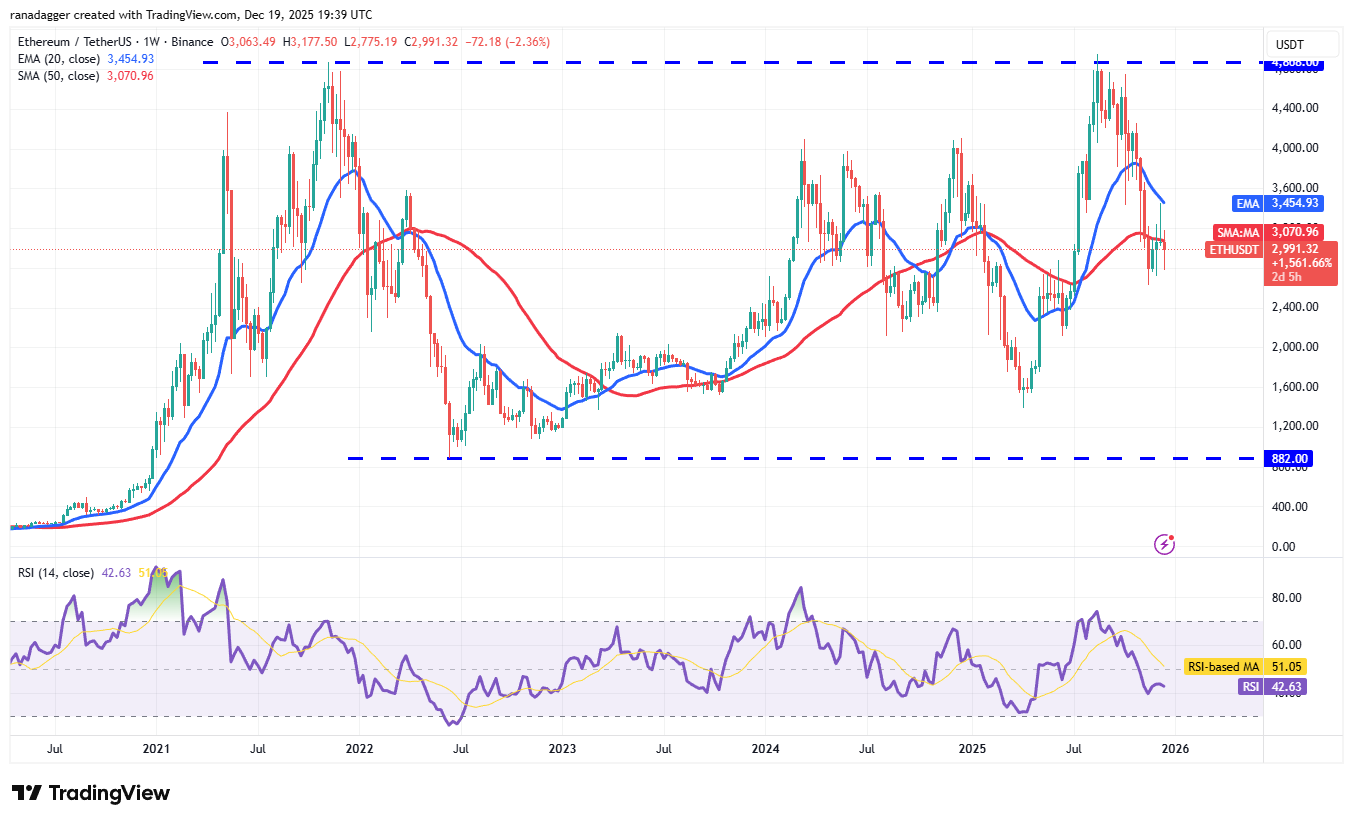
ETH/USDT weekly chart. Source: Cointelegraph/TradingView

The Ether price has dipped below the 50-week simple moving average ($3,070), indicating that bears have the upper hand. Buyers attempted to start a recovery but are facing selling at the 20-week exponential moving average ($3,454).

There is support at $2,623, but if the level cracks, the ETH/USDT pair could plummet to $2,111 and then to $1,600. Buyers are expected to fiercely defend the zone between $1,600 and $1,385.

The first sign of strength will be a break and close above the 20-week EMA. That suggests the bears are losing their grip. The pair may then attempt a rally to $4,000 and eventually to $4,956. Above $4,956, the pair could soar to $6,194 and then to $9,030.

BNB price prediction

BNB (BNB) has been stuck between the moving averages, indicating a balance between supply and demand.
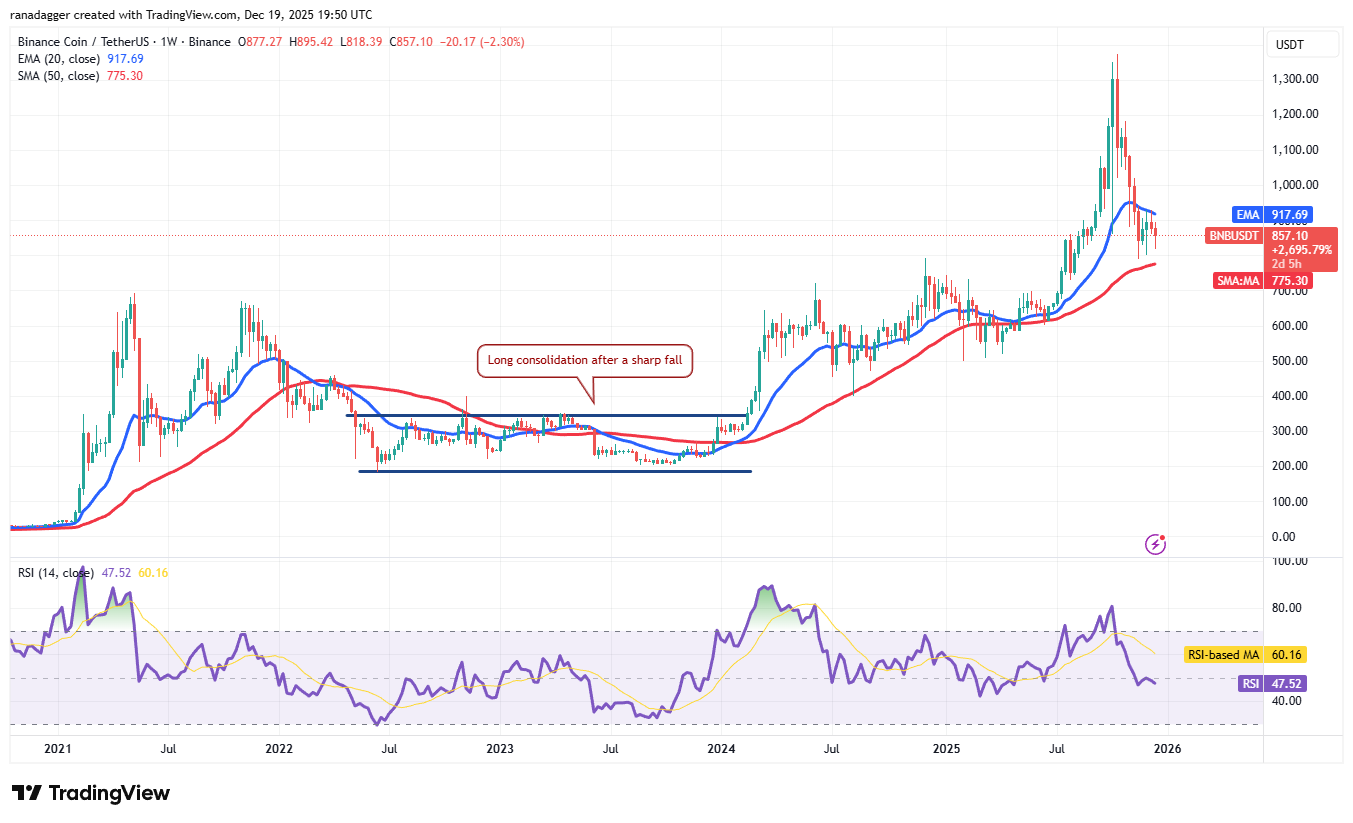
BNB/USDT weekly chart. Source: Cointelegraph/TradingView

If the price breaks below the 50-week SMA ($775), it suggests that the bears have overpowered the bulls. The BNB price could then tumble to the solid support at $500. Buyers are expected to fiercely defend the $400 to $500 zone.

Typically, after a sharp fall, the price tends to consolidate before making the next directional move, as seen from the range-bound action from May 2022 to February 2024. If history repeats, the BNB/USDT pair may range between $500 and $930 for some time.

Contrary to this assumption, if the price breaks above the 20-week EMA, it suggests that the bulls are attempting to take charge. The pair may then climb to $1,182 and eventually to the all-time high of $1,375.

XRP price prediction

XRP (XRP) has been sliding toward the solid support at $1.61, where the buyers are expected to step in.
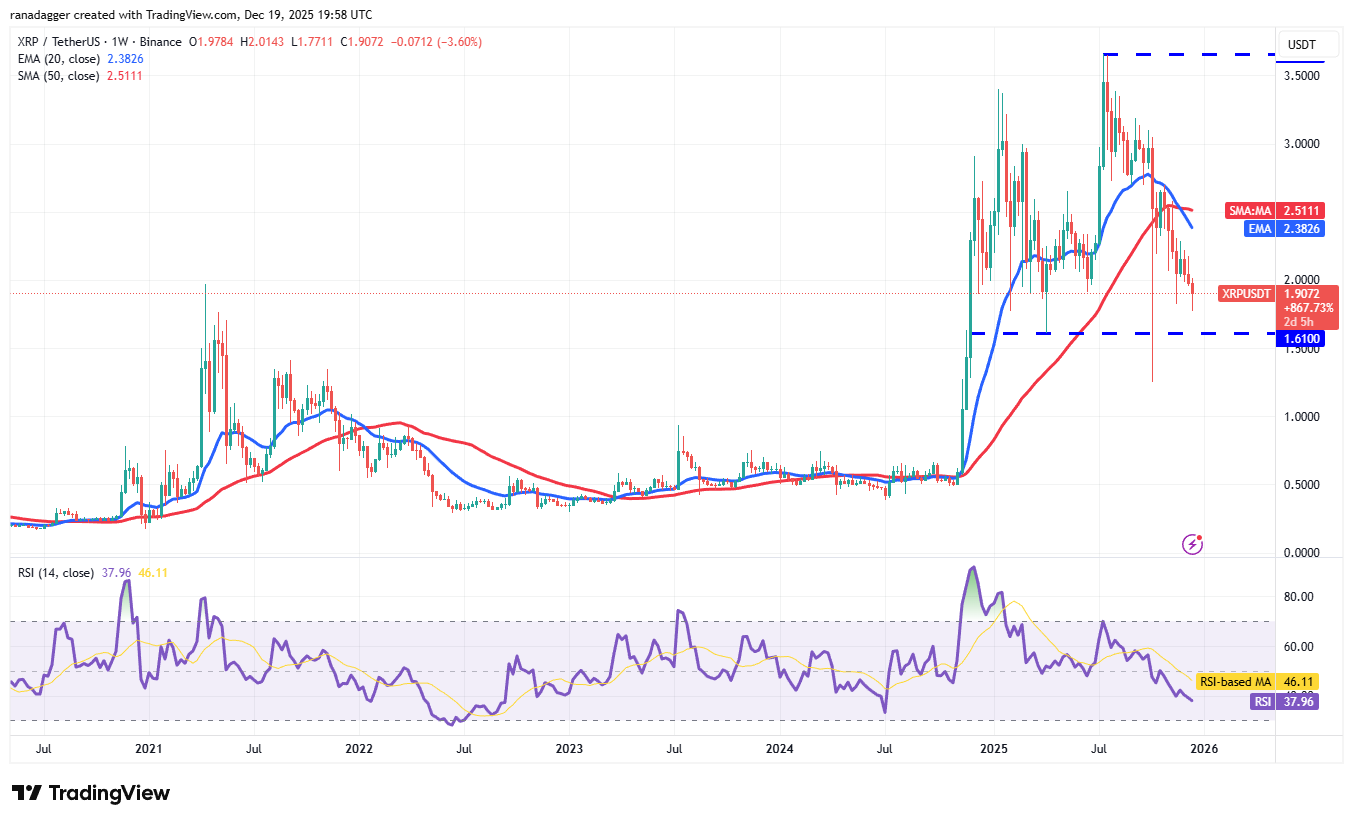
XRP/USDT weekly chart. Source: Cointelegraph/TradingView

A bounce off the $1.61 level is likely to face strong selling at the 20-week EMA ($2.38). If the price turns down sharply from the 20-week EMA, it increases the likelihood of a break below the $1.61 support. If that happens, the XRP/USDT pair could plunge to $1.25 and subsequently to the psychological support at $1.

Alternatively, if the price turns up from the current level or the $1.61 support and breaks above the 20-week EMA, it signals that the bearish momentum is weakening. The pair may then climb to $3, bringing the large $1.61 to $3.66 range into play. A close above $3.66 could catapult the XRP price to $5.19.

Solana price prediction

Solana (SOL) has been trading below the moving averages and is likely to decline to the $95 support.
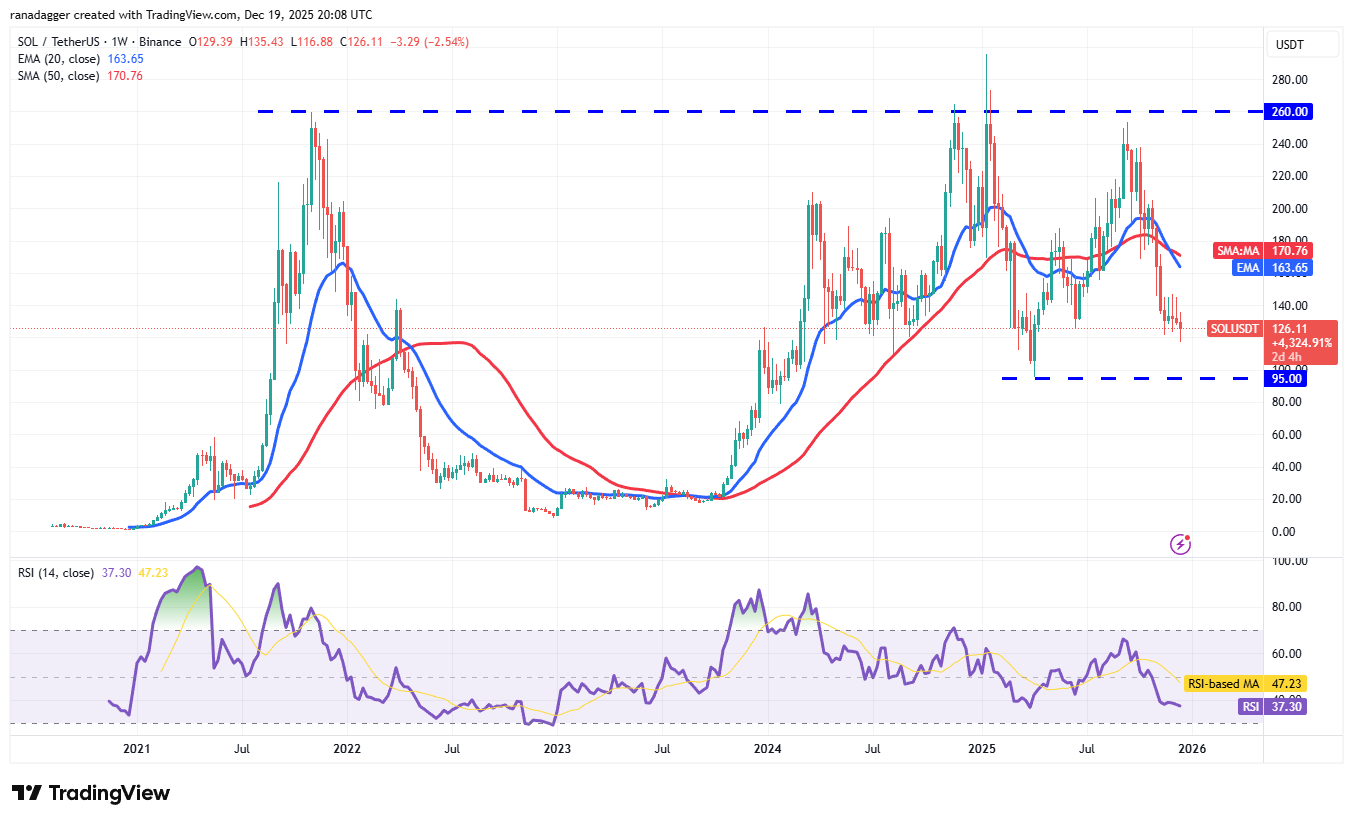
SOL/USDT weekly chart. Source: Cointelegraph/TradingView

Buyers are expected to fiercely defend the $95 level, but the relief rally is likely to face selling at the moving averages. If the price turns down sharply from the moving averages, it signals a negative sentiment. The bears will then make one more attempt to sink the SOL/USDT pair below $95. If they succeed, the pair could descend to $80 and later to $50.

Contrarily, if the Solana price turns up and breaks above the moving averages, it signals a possible range-bound action between $95 and $260 for a few more weeks. The next leg of the up move could begin on a close above $260. The pair could then soar to $425.

Dogecoin price prediction

Dogecoin (DOGE) has dipped to the bottom of the $0.13 to $0.29 range, where the buyers are expected to step in.
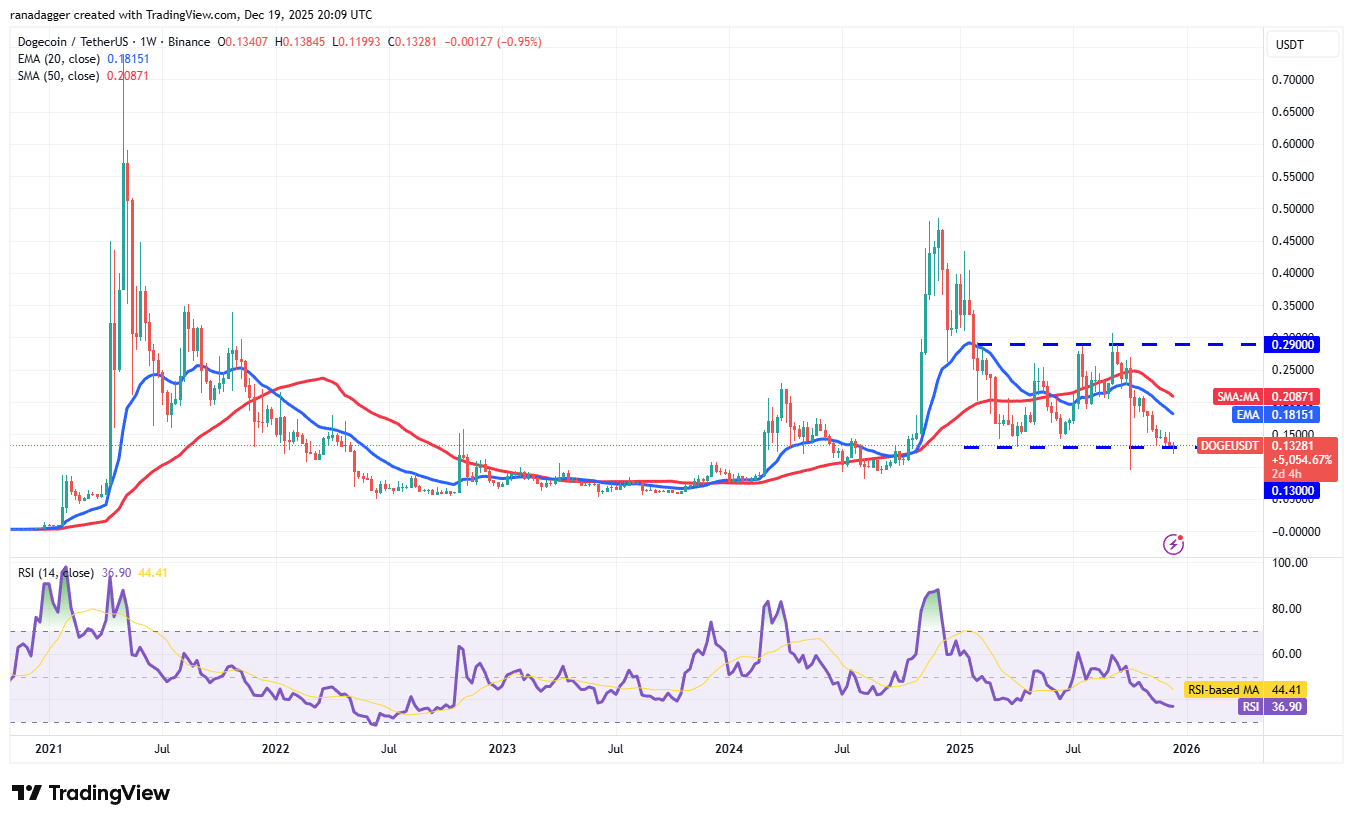
DOGE/USDT weekly chart. Source: Cointelegraph/TradingView

Both moving averages are sloping down, and the RSI is in the negative territory, indicating that bears are in control. If the price sustains below the $0.13 level, the selling could intensify, and the DOGE/USDT pair may collapse to $0.09.

Time is running out for the bulls. They will have to aggressively defend the $0.13 level and push the Dogecoin price above the moving averages to extend the consolidation for some more time.

The longer the consolidation, the stronger the eventual breakout from it. If buyers drive the price above $0.29, the pair is expected to pick up momentum and accelerate toward $0.48.

This article does not contain investment advice or recommendations. Every investment and trading move involves risk, and readers should conduct their own research when making a decision. While we strive to provide accurate and timely information, Cointelegraph does not guarantee the accuracy, completeness, or reliability of any information in this article. This article may contain forward-looking statements that are subject to risks and uncertainties. Cointelegraph will not be liable for any loss or damage arising from your reliance on this information.


Trending Cryptos

Related Questions

QAccording to the article, what was Bitcoin's dominance level on January 5, 2025, and what did it signal about trader behavior?

ABitcoin's dominance was 55.5% on January 5, 2025. This signaled that traders did not abandon BTC and rush into altcoins.

QWhat is the critical support level for Ether (ETH) that, if broken, could lead to a decline to $2,111?

AThe critical support level for Ether is $2,623. If this level cracks, the price could plummet to $2,111.

QWhat historical price action does the article suggest could be repeated for BNB if it breaks below its 50-week SMA?

AThe article suggests that if BNB breaks below its 50-week SMA, it may enter a prolonged period of range-bound action between $500 and $930, similar to the consolidation seen from May 2022 to February 2024.

QFor the XRP/USDT pair, what is the significance of a break above the 20-week EMA?

AA break above the 20-week EMA would signal that the bearish momentum is weakening and could lead to a climb towards the $3 level, bringing the large range between $1.61 and $3.66 into play.

QWhat does the article state is the consequence of a prolonged consolidation period for Dogecoin (DOGE)?

AThe article states that the longer the consolidation within the $0.13 to $0.29 range, the stronger the eventual breakout from it will be. A breakout above $0.29 could lead to a rally towards $0.48.

Related Reads

The "Impossible Triad" Is Fundamentally a Pseudo-Problem

The article argues that blockchain's fundamental limitation is not the scalability trilemma (decentralization, scalability, security), which has been largely solved, but the lack of **privacy** and, until recently, clear **legitimacy**. Blockchain is described as a slow, expensive, globally shared computer whose core value is censorship resistance and verifiability. While ideal for native digital assets like money (e.g., stablecoins), its default transparency acts as a **tax**, exposing all transactions and enabling MEV extraction, which deters serious institutional capital. Simultaneously, its permissionless nature created regulatory ambiguity. The piece contends that **privacy** is the missing critical feature. It rejects the false choice between total transparency and complete anonymity. Modern cryptography (like zero-knowledge proofs) enables **compliant privacy**: users can prove facts (solvency, KYC status, compliance) without revealing the underlying sensitive data (specific holdings, identities). This preserves auditability for regulators and eliminates the leak of financial information. With recent regulatory progress (e.g., the GENIUS Act) addressing legitimacy, adding default, provably compliant privacy becomes a pure upgrade. It transforms blockchain from a costly, public ledger into a confidential settlement layer, finally bridging the gap to mainstream institutional and individual adoption of on-chain finance.

链捕手4h ago

The "Impossible Triad" Is Fundamentally a Pseudo-Problem

链捕手4h ago

Optical Chips: Collective Capacity Expansion

The global optical chip industry is experiencing a massive wave of expansion driven by surging AI data center demand. Major players across the US, Japan, Europe, and China are aggressively investing to ramp up production capacity. In the US, Coherent is expanding its 6-inch Indium Phosphide (InP) semiconductor fab in Texas, supported by CHIPS Act funding and a $2 billion strategic investment from NVIDIA. Lumentum is building a new factory for InP optical devices, and Nokia is scaling its advanced photonic chip packaging and testing capabilities. NVIDIA's investments aim to secure future supply of critical lasers and optical interconnect products for AI infrastructure. Japan's JX Advanced Metals, a leading InP substrate supplier, plans a multi-billion yen investment to increase its capacity 7-10 times, strengthening its grip on the crucial upstream materials market. In Europe, IQE and Tower Semiconductor settled a patent dispute and signed a multi-year InP epitaxial wafer supply agreement, highlighting that next-generation silicon photonics platforms will integrate high-performance InP components. STMicroelectronics and Sivers Semiconductors are also expanding silicon photonics production and partnerships. China is rapidly building out its domestic supply chain. Dongshan Precision's subsidiary, Source Photonics, announced a $12 billion project to expand optical chip and module production. Companies like Sanan Optoelectronics and Yunnan Germanium are scaling up InP chip manufacturing and substrate production, moving towards vertical integration from materials to modules. While debate continues around the exact future architecture—whether CPO (Co-Packaged Optics), NPO, or pluggables will dominate—analysts like Morgan Stanley argue the underlying driver is unchangeable: the explosive growth in bandwidth demand. This will inevitably increase the volume of optical engines, lasers, and related content per GPU, regardless of the final technical path. The competition for "more light" in the AI era has intensified into a global, full-chain capacity race.

marsbit6h ago

Optical Chips: Collective Capacity Expansion

marsbit6h ago

Stablecoins Finally Find Real Yield: An In-Depth Look at On-Chain Reinsurance Re | A Conversation with Re Founder Karan Saroya

Stablecoin Real Yield Found: A Deep Dive into On-Chain Reinsurance with Re's Karan Saroya As stablecoin supply exceeds $170 billion, the search for sustainable, non-speculative yield intensifies. Re, an on-chain reinsurance platform, provides an answer: connecting stablecoin capital to the trillion-dollar traditional reinsurance market. Re operates as a regulated reinsurer, accepting stablecoin deposits as collateral to back US insurance companies. These insurers pay premiums, generating yield that flows back to on-chain depositors. Currently supporting 35 insurers and underwriting $500 million, Re projects scaling to over $1 billion soon. Key insights from a Bankless podcast with founder Karan Saroya and investor Avichal of Electric Capital: 1. **Uncorrelated, Real-World Yield:** Re offers stablecoin holders access to reinsurance returns (targeting 12-14%+), an asset class entirely separate from crypto or equity markets. 2. **Operational Efficiency via Smart Contracts:** Re replaces traditional, labor-intensive capital fundraising with smart contracts, allowing a ~12-person team to compete with industry giants. 3. **Regulatory Leverage:** For every $1 of collateral, regulations allow backing $5-7 in written premiums. This leverage amplifies returns from the underlying risk-free rate. 4. **DeFi Integration:** Depositors receive receipt tokens, which can be used in protocols like Morpho for "looping," potentially pushing yields to 18-20%+. 5. **The "DeFi Mullet" Model:** A compliant front-end (regulated reinsurer) paired with a decentralized back-end (smart contracts, DeFi capital markets). 6. **RE Governance Token:** Modeled on Lloyd's of London, the token governs the central capital pool's allocation, counterparty acceptance, and parameters. 7. **Real Economic Impact:** Capital funds real-world productivity (factories, clinics, businesses) via insurance, moving beyond crypto's internal loops. The discussion highlights a pivotal moment: DeFi's supply-side infrastructure is now met by real demand for productive yield, potentially kickstarting a flywheel where vast on-chain stablecoin capital seeks these real-world returns.

链捕手7h ago

Stablecoins Finally Find Real Yield: An In-Depth Look at On-Chain Reinsurance Re | A Conversation with Re Founder Karan Saroya

链捕手7h ago

1996 or 1999? Walsh's First Test is 'How to View AI'

"1996 or 1999? Wall's First Big Test Is 'How to View AI'" Federal Reserve Chairman Wall's initial challenge is not whether to raise or cut rates, but a more fundamental judgment: what kind of boom is the current AI boom? This will determine the Fed's policy path and define his legacy. Economics is split between two opposing views, according to reporter Nick Timiraos. One sees imminent productivity gains that will increase supply and cool inflation, allowing the Fed to hold steady. The other argues that while productivity benefits are distant, demand shocks are here now, and waiting for data confirmation risks missing the intervention window, forcing sharper rate hikes later. Wall has signaled a leaning toward the first view, echoing 1996-era Alan Greenspan, who embraced strong, productivity-driven growth without fear of inflation. However, Wall faces a different macro environment than Greenspan did, with tariff pressures, expanding fiscal deficits, and diminishing globalization benefits, which could force more significant inflation pressures even if AI benefits materialize. Wall's logic, expressed before taking office, is that AI-driven productivity gains won't show in official data for years. If the Fed waits for confirmation, it might mistakenly tighten policy and choke off the very growth that could suppress inflation. This argues for using forward-looking narratives over lagging data. Chicago Fed President Austan Goolsbee presents a key counter-argument. He distinguishes between expected and unexpected productivity booms. A widely anticipated boom, like the current AI wave, can cause people to spend future wealth gains in advance, overheating the economy before productivity actually rises, thus requiring preemptive rate hikes. He cites rising costs for AI data centers as evidence of such overheating. Fed Governor Christopher Waller offers a rebuttal to Goolsbee, noting the "expected spending" mechanism only works if people can borrow against future income, which many households cannot do due to borrowing constraints. Wall also faces a paradox related to his desire to reduce the Fed's use of "forward guidance" (pre-announcing policy moves). This practice was established in 1999 when Greenspan began signaling hikes to avoid market shocks. If the economy follows a less optimistic path, Wall may be forced to choose between using the guidance he wants to abolish or risking market volatility by staying silent. The ultimate question defining Wall's first major test remains: Is this 1996 or 1999?

marsbit9h ago

1996 or 1999? Walsh's First Test is 'How to View AI'

marsbit9h ago

Trading

Spot
Futures

Hot Articles

What is DOGE M

Doge Matrix ($doge m): The New Breed of Community-Driven Cryptocurrency Introduction In the ever-evolving landscape of cryptocurrency, new projects constantly emerge, each aiming to capture the interest of investors and enthusiasts alike. One of the latest entrants to this domain is Doge Matrix, represented by the ticker symbol $doge m. This project has attracted attention thanks to its roots in the popular meme culture surrounding Dogecoin, establishing its place within the web3 space. This article aims to provide a comprehensive analysis of Doge Matrix, covering its overview, creator, investors, functionality, timeline, and notable aspects. What is Doge Matrix ($doge m)? Doge Matrix is a community-driven cryptocurrency project that seemingly builds upon the widespread appeal of Dogecoin, a digital currency known for its Shiba Inu mascot and its meme origins. While the overarching objectives of Doge Matrix are not extensively defined, it is characterized by a commitment to harnessing community involvement and support. Unlike traditional cryptocurrencies that often emphasize utility or intrinsic value through underlying technologies, Doge Matrix positions itself within a space that embraces the cultural phenomenon of cryptocurrencies, particularly appealing to those who resonate with the ethos of meme-based assets. Drawing on the strengths of the Dogecoin community, Doge Matrix operates as part of a broader ecosystem, inviting participation and engagement from users who share an interest in cryptocurrency and the digital landscape. Who is the Creator of Doge Matrix ($doge m)? The identity of the creator of Doge Matrix remains unknown. This lack of transparency is not an uncommon occurrence in the cryptocurrency space, where some projects are launched without revealing the identities of their founders. The absence of information regarding the founding team can raise questions among potential investors about the project’s accountability and direction. Who are the Investors of Doge Matrix ($doge m)? As it stands, there is no publicly available information detailing the investors or investment foundations that back Doge Matrix. The project appears to rely primarily on community support rather than institutional investment. This model aligns with the community-driven nature of the initiative, fostering an environment where the direction of the project is shaped by its participants rather than being dictated by a select few financial backers. How Does Doge Matrix ($doge m) Work? The specifics regarding the operational mechanisms of Doge Matrix are somewhat vague, reflecting a broader trend of projects in the meme coin space where innovative functionalities are not always clearly articulated. Nonetheless, Doge Matrix seems designed to tap into the existing cryptocurrency ecosystem by encouraging user participation while tapping into the familiar cultural references associated with Dogecoin. Its potentially unique characteristics derive from community interactions rather than technological advancements, emphasizing shared experiences and collaboration among token holders. While the exact innovations have not been explicitly outlined, the project appears to create a space where community members can engage, share ideas, and propel the project's potential forward. Timeline of Doge Matrix ($doge m) Reflecting on the project’s timeline reveals notable events that have defined its journey thus far: November 25, 2024: Doge Matrix reached its all-time high value, marking a significant milestone in its early history. January 1, 2025: Conversely, Doge Matrix hit its all-time low value, illustrating the volatility often associated with cryptocurrencies, especially in the early stages of a project's lifecycle. Ongoing: The project continues to be actively traded and supported by its community, although specific future milestones or objectives have yet to be disclosed. Key Points About Doge Matrix ($doge m) Community Focus At the heart of Doge Matrix is a commitment to community engagement. The project thrives on the premise of collaboration and shared objectives among its members, emphasizing the importance of collective effort. Unlike centralized projects that often have a defined leadership structure, Doge Matrix at present showcases a more fluid approach to governance, where every community member's voice matters. Volatility The cryptocurrency market is notorious for its volatility, and Doge Matrix is no exception. Its price history reflects significant fluctuations between high and low values, which is typical of many new cryptocurrencies but underscores the risks associated with investment in emerging tokens. Lack of Detailed Information One of the most striking features about Doge Matrix is the scarcity of detailed information regarding its technological underpinnings and operational mechanisms. This ambiguity necessitates that potential investors conduct thorough due diligence before engaging with the project. Conclusion In summary, Doge Matrix ($doge m) illustrates a new wave of cryptocurrency projects that lean heavily on community engagement and cultural relevance. While lacking in certain specifics—such as clear leadership, defined objectives, and detailed functionality—the project has managed to generate interest within the crypto community, leveraging the established appeal of meme culture. As with any investment in the cryptocurrency space, understanding the inherent risks and conducting comprehensive research is essential for potential participants. Doge Matrix stands as a reminder of the dynamic, sometimes unpredictable nature of the crypto industry, marked by constant evolution and enthusiasm for community-driven initiatives.

3.8k Total ViewsPublished 2025.02.03Updated 2025.02.03

What is DOGE M

Discussions

Welcome to the HTX Community. Here, you can stay informed about the latest platform developments and gain access to professional market insights. Users' opinions on the price of DOGE (DOGE) are presented below.

活动图片