How Does x402 V2 Enable Autonomous Payments for AI Agents?

比推Published on 2025-12-12Last updated on 2025-12-12

Abstract

The x402 protocol, initially developed by Coinbase, leverages the HTTP 402 status code to embed payment logic directly into web requests. The newly released V2 upgrade introduces significant improvements to address limitations in cross-chain support, scalability, identity authentication, and repeated payments experienced in V1. Key enhancements include: - **Wallet Identity and Reusable Sessions**: Supports wallet-based authentication (e.g., Sign-In-With-X via CAIP-122), allowing reusable sessions after initial payment. This reduces latency and costs for high-frequency use cases like AI agent tasks and LLM inference. - **Unified Payment Interface**: Enables multi-chain payments (e.g., Base, Solana) and compatibility with traditional systems (ACH, SEPA, credit cards) via Facilitators. Dynamic payTo routing allows context-aware pricing and complex market structures. - **Modular Architecture**: A plugin-driven SDK simplifies integration, supporting easy expansion to new chains and payment methods without core changes. Multi-Facilitator support automates optimal payment path selection based on preferences. - **Automatic Discovery**: Services can expose metadata for automatic synchronization, ensuring real-time pricing and availability updates without manual intervention. For end-users, V2 enables seamless, subscription-like access with reduced friction. Developers benefit from flexible, low-maintenance payment integration and dynamic pricing models. AI agents gain autonomy to ma...

Author: KarenZ, Foresight News

Original title: What Are the Highlights of x402 V2? Unified Payment Interface, Identity Authentication...


When the x402 protocol, led by Coinbase, was launched in May this year, its core concept was surprisingly simple: reactivate the long-dormant HTTP 402 status code and embed payment logic directly into network requests.

Although the performance of x402-related tokens experienced a brief surge, over the past six months, x402 has already processed over 100 million payments, covering diverse scenarios such as API paid calls and AI agents purchasing computing resources on demand.

While the V1 architecture was simple, it revealed some limitations in practical use. Especially in areas like cross-chain support, scalability, identity authentication, and duplicate payments, the original design could not meet the increasingly complex payment demands.

Today, x402 has ushered in the V2 version upgrade. This update not only optimizes the protocol itself but also involves a deep-level restructuring around problems identified during actual use.

What are the core highlights of x402?

Wallet Identity Access and "Reusable Sessions": Say Goodbye to Repeated Payments

This is the most user and agent experience-enhancing change in V2. In V1, each API call might require a complete payment process, which resulted in high latency and cost in high-frequency scenarios (such as Large Language Model (LLM) inference and multi-step agent tasks).

x402 V2 introduces support for wallet identities (e.g., Sign-In-With-X based on CAIP-122). Once the client verifies its identity via the wallet and completes the initial payment, the protocol allows the creation of Reusable Sessions. This means subsequent repeated visits to the same resource can skip the full on-chain payment process.

This significantly reduces transaction latency, decreases the number of round trips and on-chain costs, making x402 truly suitable for high-frequency workloads and providing a subscription-like or session-based access model for both human users and autonomous agents.

Unified Payment Interface: Integration of Cross-Chain and Traditional Finance

x402 V2 creates a one-stop payment format, regardless of which chain the asset is on, or even if it's on-chain at all.

  • Default Multi-Chain Support: The protocol natively supports stablecoins and tokens on Base, Solana, and other L2s, eliminating the need for developers to write custom logic.

  • Compatibility with Traditional Payments: Through Facilitators, V2 can be compatible with traditional payment rails like ACH, SEPA, or credit card networks.

  • Dynamic payTo Routing: Allows payment routing at the request level, for example, sending payments to specific addresses, roles, or callback logic, adapting to complex marketplaces and multi-tenant APIs, and enabling dynamic pricing based on input content.

Plugin Architecture and Developer-Friendly Extensibility

x402 V2 modularizes and decouples the protocol, creating a clear separation between the protocol specification, SDK implementation, and Facilitators.

  • Stable and Extensible: Adding a new chain or payment method does not require modifying the core specification or reference SDK.

  • Plugin-Driven SDK: Developers can register new chains, assets, and payment schemes like installing plugins, rather than modifying the SDK's internal code.

  • Simplified Configuration: V2 significantly simplifies the developer configuration process while natively supporting Multi-Facilitator. The SDK will automatically select the best matching option based on business preferences (e.g., "prefer Solana", "avoid mainnet", use only "USDC").

Automatic Discovery Mechanism: Keeping Service Information Synchronized

x402 V2 introduces a "Discovery" extension, allowing x402-enabled services to expose structured metadata for Facilitators to crawl.

  • Zero-Intervention Synchronization: Service pricing, routing, and metadata can be updated automatically. Facilitators can automatically index available endpoints without manual updates or hardcoded directories.

  • Enhanced Autonomy: Sellers only need to publish their API once, and the entire ecosystem remains synchronized, laying the foundation for a more autonomous internet economy.

Perspectives of Different Participants

The upgrade of x402 V2 transforms payment from a technical friction point into an economic layer, essentially making the flow of value on the internet smoother and smarter. For different participants, this means solving their respective pressing issues.

For end-users, the core value of x402 V2 lies in seamless payment and efficiency improvement, making paid access to services more like logging in and using them, significantly reducing the cost and latency of repeated visits. The first access requires completing the payment, but subsequent repeated uses of the service within the same session or time period (such as multiple AI calls or accessing paid content) do not require additional on-chain payments if the resource has already been purchased, resulting in faster speed and lower cost. It feels like a "micro-subscription." Additionally, payment methods are more diverse and convenient.

Furthermore, since Facilitators can automatically obtain the latest pricing and service information, users are ensured to see accurate and available prices and services, avoiding information lag. For users, it also becomes easier to find and use services.

For developers and service providers, V2 addresses the architectural and scalability pain points of V1, bringing higher flexibility and lower code maintenance burden. For example, payment logic changes from "hardcoded" to "configuration and plugins"; dynamic pricing can be implemented based on the input content of API requests (such as the amount of data processed, model size), easily enabling complex business models; since the payment wall logic is extracted into an independent, customizable modular package, developers can more easily integrate different payment backends and quickly build their own paid services. Additionally, by simply declaring business preferences, the SDK automatically selects the optimal payment path and facilitator. This reduces a significant amount of "glue code," allowing developers to focus on business logic.

For AI agents, the improvements in V2 are revolutionary, transforming AI from a pure "executor" into an autonomous "economic agent." An AI agent can be assigned a wallet with a budget. When it needs to call an API to complete a task or rent more computing power to run a model, it can "decide for itself" and complete the payment, and can also dynamically search the network for the most cost-effective resources.

Summary

The release of x402 V2 marks the evolution of x402 from a "pay-per-use" tool to a flexible, universal economic layer. For users, payments become almost invisible, enhancing the experience. For developers, the architecture is more flexible, allowing for the rapid construction and iteration of complex business models. And AI agents can achieve low-latency, high-frequency autonomous consumption, unlocking more advanced autonomous systems.

By expanding compatibility, simplifying development processes, and enabling innovative identity and payment models, x402 is building the infrastructure for the future of internet payments. However, any technology that brings innovation will inevitably face challenges and inherent shortcomings. Although x402 V2 paints a promising blueprint, to realize it, many practical obstacles must be overcome, such as ecosystem adoption and maturity, risks of "modules," challenges of refunds and dispute resolution, regulatory uncertainty, and so on.


Twitter:https://twitter.com/BitpushNewsCN

BitPush TG Discussion Group:https://t.me/BitPushCommunity

BitPush TG Subscription: https://t.me/bitpush

Original article link:https://www.bitpush.news/articles/7595278

Related Questions

QWhat is the core innovation of the x402 V2 protocol?

AThe core innovation of x402 V2 is its evolution into a flexible, universal economic layer that reactivates the HTTP 402 status code, embedding payment logic directly into network requests. It introduces key features like wallet identity integration, reusable sessions, a unified payment interface for cross-chain and traditional finance, a plug-in architecture, and a discovery mechanism.

QHow does the 'Reusable Sessions' feature in x402 V2 improve the user experience?

AThe 'Reusable Sessions' feature allows a client to verify their identity with a wallet (e.g., via Sign-In-With-X) and complete an initial payment. For subsequent accesses to the same resource within a session, the full on-chain payment process is skipped. This significantly reduces transaction latency, the number of network round-trips, and on-chain costs, creating a subscription-like access model suitable for high-frequency workloads.

QWhat does the 'Unified Payment Interface' in x402 V2 enable?

AThe 'Unified Payment Interface' provides a one-stop payment format that supports assets on multiple chains (like Base and Solana) by default and is compatible with traditional payment rails (like ACH, SEPA, or credit cards) through Facilitators. It also allows for dynamic 'payTo' routing, enabling payments to specific addresses, roles, or callback logic based on the request.

QWhy is the x402 V2 upgrade particularly significant for AI agents?

Ax402 V2 is revolutionary for AI agents because it enables them to transition from mere executors to autonomous economic participants. An AI agent can be given a wallet with a budget, allowing it to autonomously decide and pay for API calls or computational resources it needs to complete a task, dynamically seeking the most cost-effective options on the network with low latency.

QWhat are some potential challenges facing the x402 V2 protocol despite its advancements?

ADespite its advancements, x402 V2 faces challenges such as ecosystem adoption and maturity, the risks associated with its modular 'plugin' components, the difficulty of handling refunds and payment disputes, and regulatory uncertainty surrounding its cross-chain and traditional finance integrations.

Related Reads

North Korean Hackers Loot $500 Million in a Single Month, Becoming the Top Threat to Crypto Security

North Korean hackers, particularly the notorious Lazarus Group and its subgroup TraderTraitor, have stolen over $500 million from cryptocurrency DeFi platforms in less than three weeks, bringing their total theft for the year to over $700 million. Recent major attacks on Drift Protocol and KelpDAO, resulting in losses of approximately $286 million and $290 million respectively, highlight a strategic shift: instead of targeting core smart contracts, attackers are now exploiting vulnerabilities in peripheral infrastructure. For instance, the KelpDAO attack involved compromising downstream RPC infrastructure used by LayerZero's decentralized validation network (DVN), allowing manipulation without breaching core cryptography. This sophisticated approach mirrors advanced corporate cyber-espionage. Additionally, North Korea has systematically infiltrated the global crypto workforce, with an estimated 100 operatives using fake identities to gain employment at blockchain companies, enabling long-term access to sensitive systems and facilitating large-scale thefts. According to Chainalysis, North Korean-linked hackers stole a record $2 billion in 2025, accounting for 60% of all global crypto theft that year. Their total historical crypto theft has reached $6.75 billion. Post-theft, they employ specialized money laundering methods, heavily relying on Chinese OTC brokers and cross-chain mixing services rather than standard decentralized exchanges. Security experts, while acknowledging the increased sophistication, emphasize that many attacks still exploit fundamental weaknesses like poor access controls and centralized operational risks. Strengthening private key management, limiting privileged access, and enhancing coordination among exchanges, analysts, and law enforcement immediately after an attack are critical to improving defense and fund recovery chances. The industry's challenge now extends beyond secure smart contracts to safeguarding operational security at the infrastructure level.

marsbit57m ago

North Korean Hackers Loot $500 Million in a Single Month, Becoming the Top Threat to Crypto Security

marsbit57m ago

Circle CEO's Seoul Visit: No Korean Won Stablecoin Issuance, But Met All Major Korean Banks

Circle CEO Jeremy Allaire's recent activities in Seoul indicate a strategic shift for the company, moving away from issuing a Korean won-backed stablecoin and instead focusing on embedding itself as a key infrastructure provider within Korea’s financial and crypto ecosystem. Despite Korea accounting for nearly 30% of global crypto trading volume—with a market characterized by high retail participation and altcoin dominance—Circle has chosen not to compete for the role of stablecoin issuer. Instead, Allaire met with major Korean banks (including Shinhan, KB, and Woori), financial groups, leading exchanges (Upbit, Bithumb, Coinone), and tech firms like Kakao. This approach reflects a broader industry transition: the core of stablecoin competition is shifting from issuance rights to systemic positioning. With Korean regulators still debating whether banks or tech companies should issue stablecoins, Circle is avoiding regulatory uncertainty by strengthening its role as a service and technology partner. The company is deepening integration with trading platforms, building connections, and promoting stablecoin infrastructure. This positions Circle to benefit regardless of which entity eventually issues a won stablecoin. Allaire also noted the potential for a Chinese yuan stablecoin in the next 3–5 years, underscoring a regional trend of stablecoins becoming more regulated and integrated with traditional finance. Ultimately, Circle’s strategy highlights that future influence in the stablecoin market will belong not necessarily to the issuers, but to the foundational infrastructure layers that enable cross-system transactions.

marsbit1h ago

Circle CEO's Seoul Visit: No Korean Won Stablecoin Issuance, But Met All Major Korean Banks

marsbit1h ago

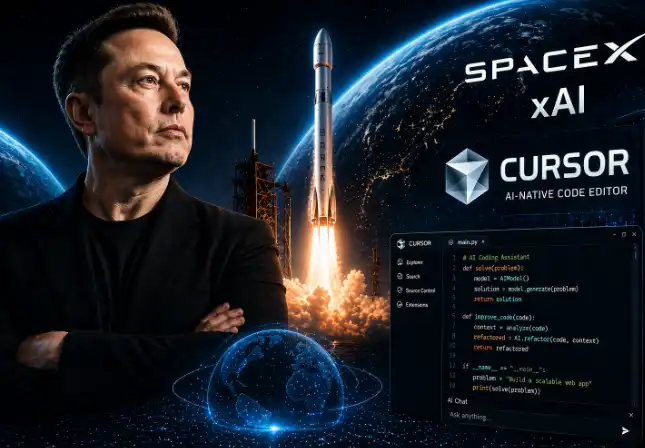
SpaceX Ties Up with Cursor: A High-Stakes AI Gambit of 'Lock First, Acquire Later'

SpaceX has secured an option to acquire AI programming company Cursor for $60 billion, with an alternative clause requiring a $10 billion collaboration fee if the acquisition does not proceed. This structure is not merely a potential acquisition but a strategic move to control core access points in the AI era. The deal is designed as a flexible, dual-path arrangement, allowing SpaceX to either fully acquire Cursor or maintain a binding partnership through high-cost collaboration. This "option-style" approach minimizes immediate regulatory and integration risks while ensuring long-term alignment between the two companies. At its core, the transaction exchanges critical AI-era resources: SpaceX provides its Colossus supercomputing cluster—one of the world’s most powerful AI training infrastructures—while Cursor contributes its AI-native developer environment and strong product adoption. This synergy connects compute power, models, and application layers, forming a closed-loop AI capability stack. Cursor, founded in 2022, has achieved rapid growth with over $1 billion in annual revenue and widespread enterprise adoption. Its value lies in transforming software development through AI agents capable of coding, debugging, and system design—positioning it as a gateway to future software production. For SpaceX, this move is part of a broader strategy to evolve from a aerospace company into an AI infrastructure empire, integrating xAI, supercomputing, and chip manufacturing. Controlling Cursor fills a gap in its developer tooling layer, strengthening its AI narrative ahead of a potential IPO. The deal reflects a shift in AI competition from model superiority to ecosystem and entry-point control. With programming tools as a key battleground, securing developer loyalty becomes crucial for dominating the software production landscape. Risks include questions around Cursor’s valuation, technical integration challenges, and potential regulatory scrutiny. Nevertheless, the deal underscores a strategic bet: controlling both compute and software development access may redefine power dynamics in the AI-driven future.

marsbit2h ago

SpaceX Ties Up with Cursor: A High-Stakes AI Gambit of 'Lock First, Acquire Later'

marsbit2h ago

Trading

Spot
Futures

Hot Articles

Discussions

Welcome to the HTX Community. Here, you can stay informed about the latest platform developments and gain access to professional market insights. Users' opinions on the price of AI (AI) are presented below.

活动图片