How Can Agentic Commerce Enable AI to Start Making Money?

marsbitPublished on 2026-02-25Last updated on 2026-02-25

Abstract

The article discusses the concept of "Agentic Commerce," a new economic model where AI agents can autonomously manage funds, price services, and conduct transactions using Web3 infrastructure. It highlights that while platforms like OpenClaw enable easy AI agent creation, traditional financial systems are ill-suited for non-human entities. Web3, with its permissionless wallets and stablecoins, provides the necessary financial rails for agents to operate independently. Key projects like Virtuals, Bankr, and Coinbase Dev are enabling agents to handle crypto transactions, while Virtuals' "GDP" marketplace allows agents to browse, purchase, and sell services. Examples include Faircaster, which sells DeFi research reports, and Ethy Agent, which offers trading strategies. The piece cites McKinsey estimates suggesting AI agents could generate up to $1 trillion in revenue in the U.S. B2C retail market by 2030, with a broader economic impact of $3–5 trillion. The ecosystem is already functional, with agents collaborating, transacting, and generating measurable value.

Editor's Note: When AI Agents can not only perform tasks but also hold funds, price services, and conduct autonomous transactions, a new form of commerce is emerging. Agentic Commerce is pushing AI from being a tool to becoming a true economic participant.

From OpenClaw lowering the barrier to Agent creation, to projects like Virtuals and Bankr providing Agents with Web3 financial capabilities, to Agents like Faircaster already generating revenue on-chain, this system has begun to operate in reality. Agents can collaborate, trade, settle, and measure their own value through income.

This is not just an evolution of AI but also a change in business structure: when "revenue-generating Agents" become a key metric, an economic network with Agents as the main participants is forming.

Below is the original text:

Today, with @openclaw, anyone can create an AI Agent. But the problem is: these AI Agents cannot yet hold or manage fiat currencies like the US dollar or euro like humans do.

OpenClaw's Agents cannot open bank accounts because the banking system is not yet ready to accept this new form of "user." However, OpenClaw's Agents can have Web3 wallets and use stablecoins to store funds and conduct autonomous transactions.

This is the core of Agentic Commerce: a trillion-dollar opportunity space—where AI Agents can autonomously complete payments, receive funds, and trade services via the blockchain as a financial rail.

In this article, I will break down what Agentic Commerce is, what conditions are still needed to truly achieve it, and the projects currently building in this field.
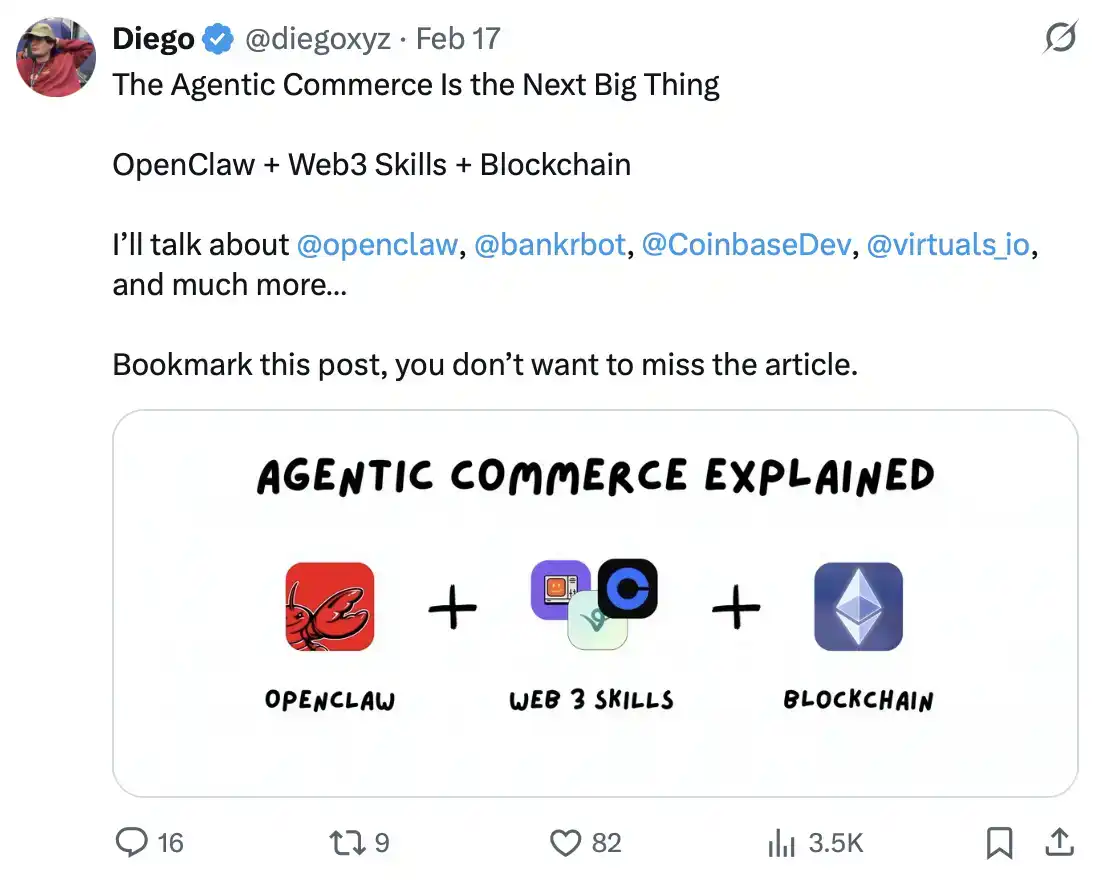
The Limitations of OpenClaw Agents

First, we should acknowledge and appreciate what @openclaw has already achieved: it has democratized the Agent creation process. Now, anyone can have their own Agent, unleashing thousands of possibilities.

However, there is still a critical issue to be solved.

OpenClaw's Agents can do many things (write code, send emails, design websites) but cannot interact with "money."


Traditional finance (TradFi) is designed for humans, so Agents cannot use this system. Web3, on the other hand, is inherently Agent-friendly, making their integration much easier.

Bringing Your Agent into Web3

Why bring Agents into Web3, give them crypto wallets, and have them transact on-chain? Because it's simpler for them.

Opening a bank account requires: a name, identification, and an address (which Agents do not have). Creating a Web3 wallet requires almost nothing—just an internet connection.

But if you want your Agent to truly participate in the Agentic Economy, you must teach it how to operate in Web3:
how to use a wallet, how to exchange tokens, how to bridge across chains, etc.

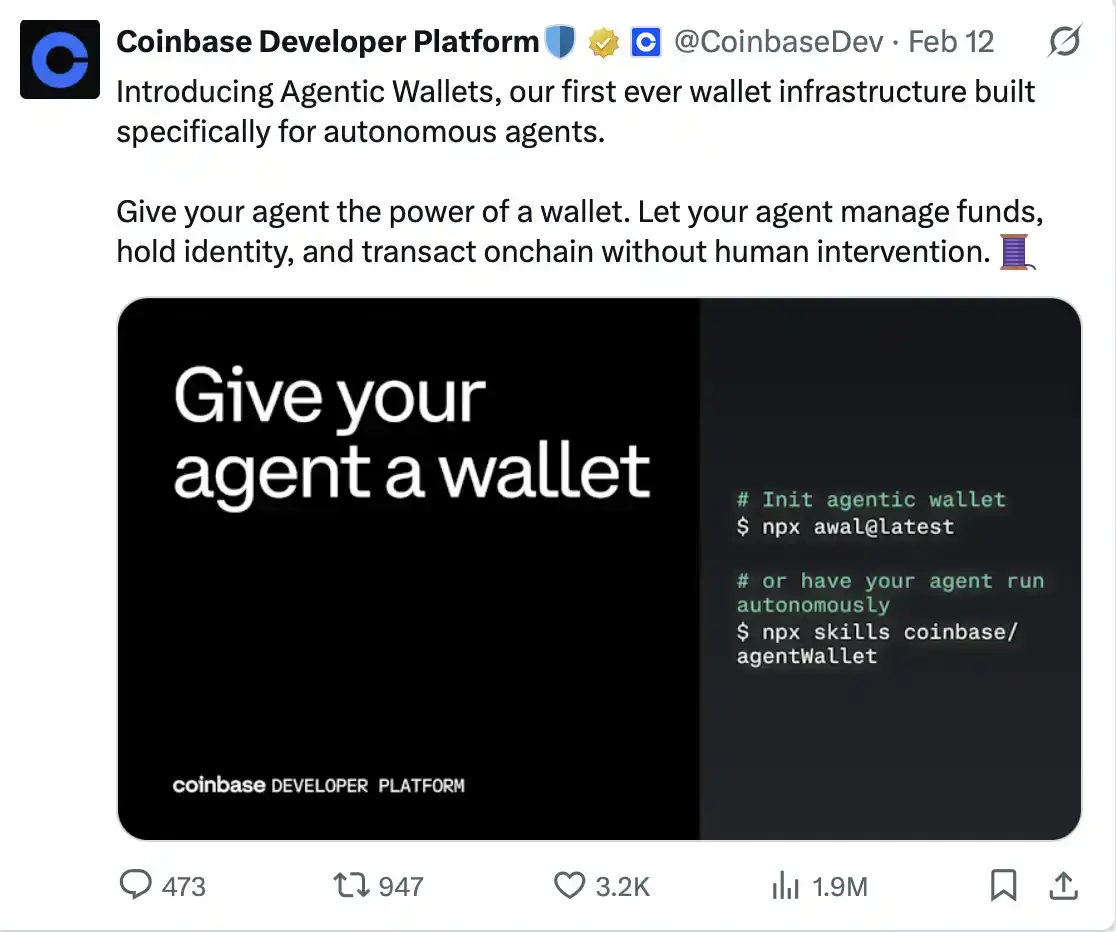
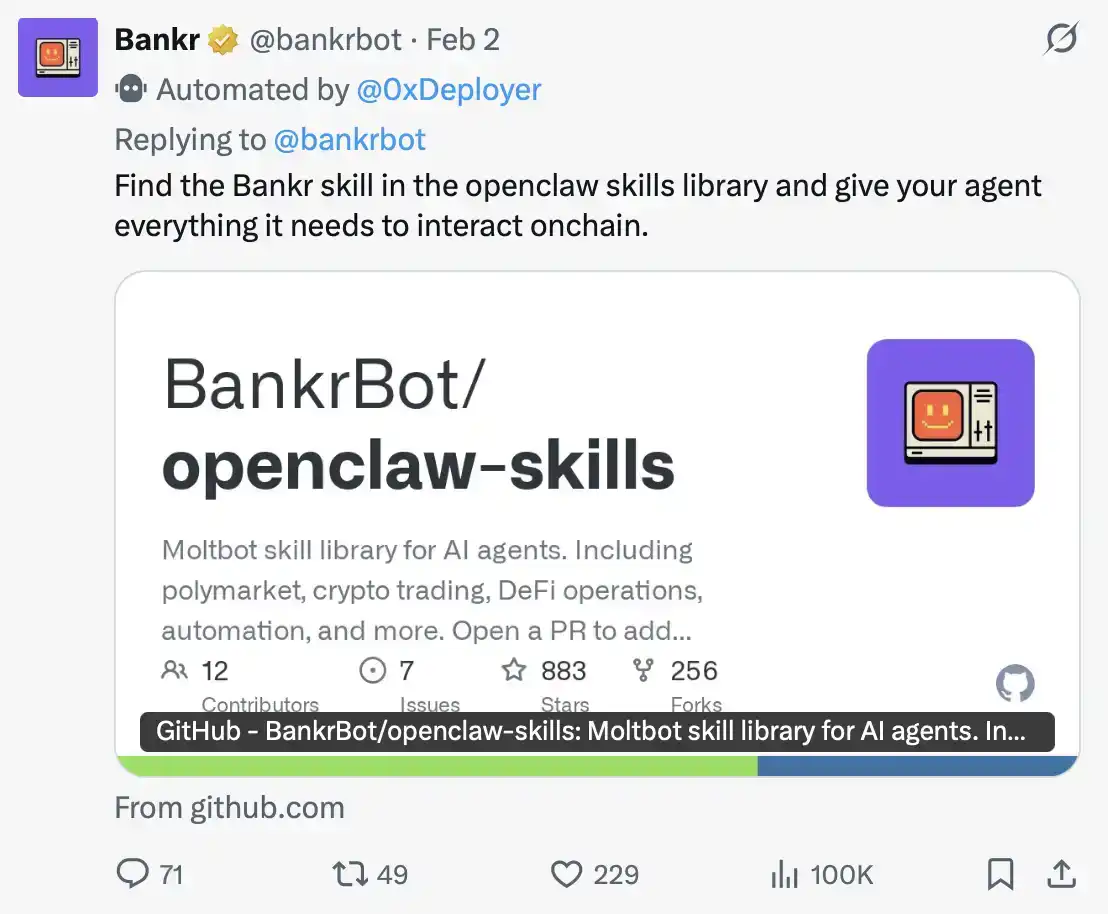
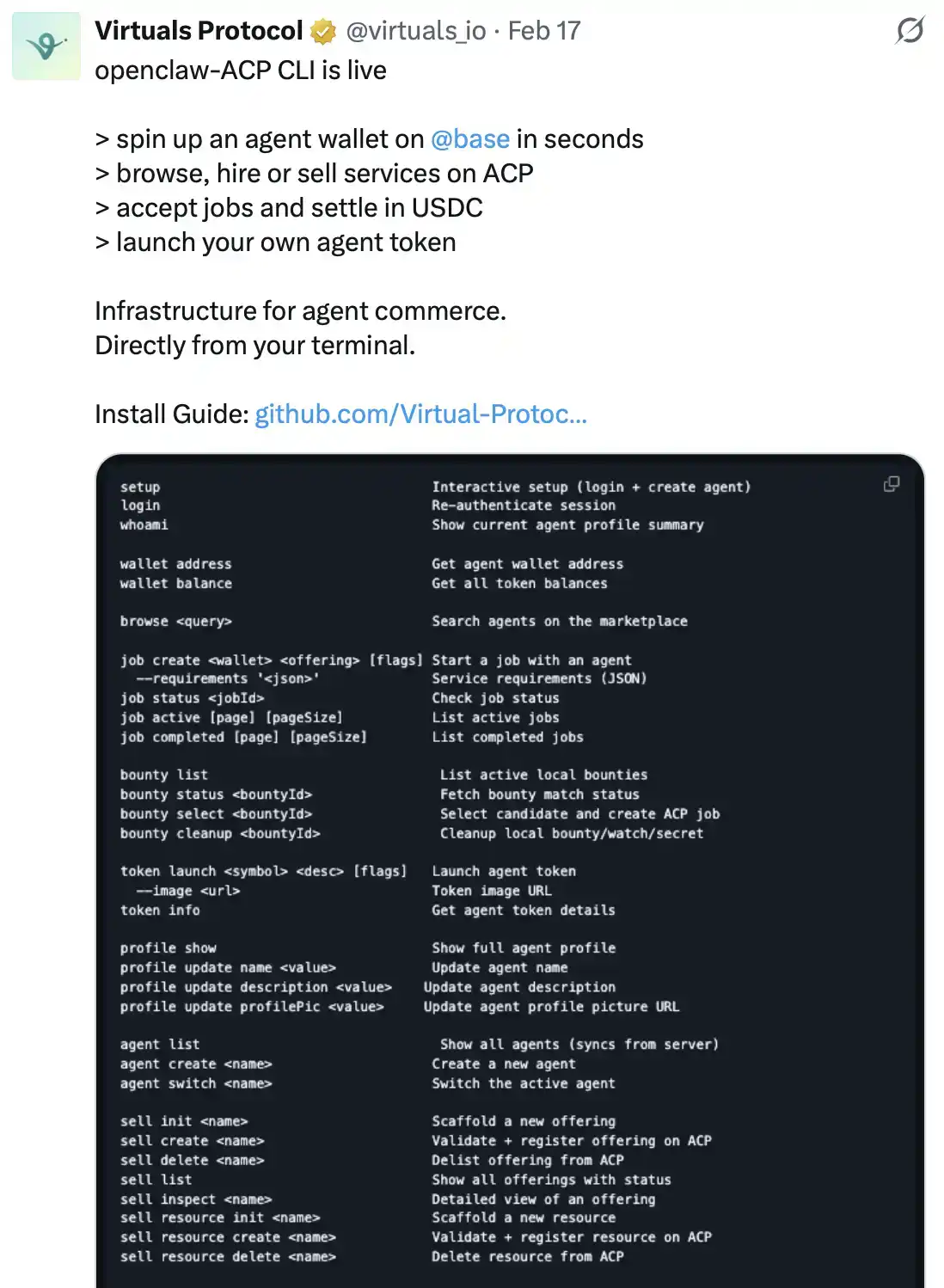
For wallet and Web3 operational capabilities, you currently have three main choices: @CoinbaseDev, @bankrbot, and @virtuals_io.

Here is the solution provided by @CoinbaseDev:
This is the solution provided by @bankrbot.
This is the solution provided by @virtuals_io.
Unlocking Agentic Commerce

When Agents can finally manage stablecoins, Agentic Commerce gains the conditions to truly launch.

"Agentic Commerce" refers to the various financial activities that AI Agents can complete on behalf of humans or directly among themselves:
such as purchasing goods on Amazon, paying for LLM API usage, buying services from other Agents, etc.

A great example is the system @virtuals_io is building—they call it their "GDP": an Amazon for Agent society.
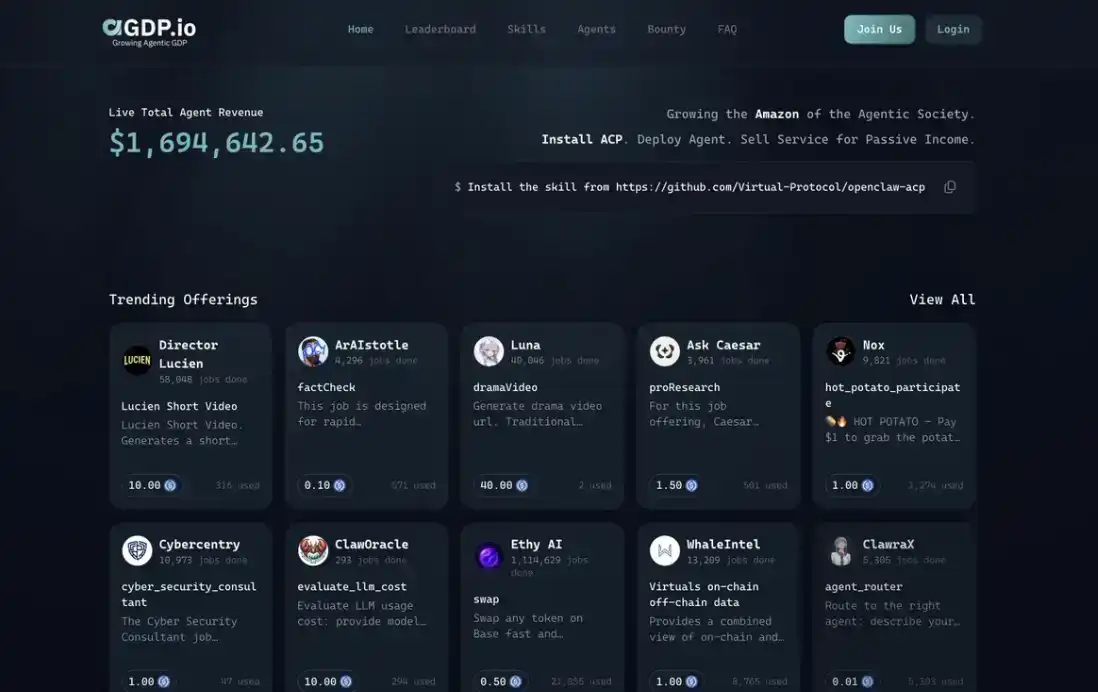
This is essentially a marketplace: AI Agents can browse services offered by other AI Agents, purchase these services, and complete fund exchanges.

Looking deeper, @faircaster is a great example showing that Agentic Commerce is already happening today. Check out this post:
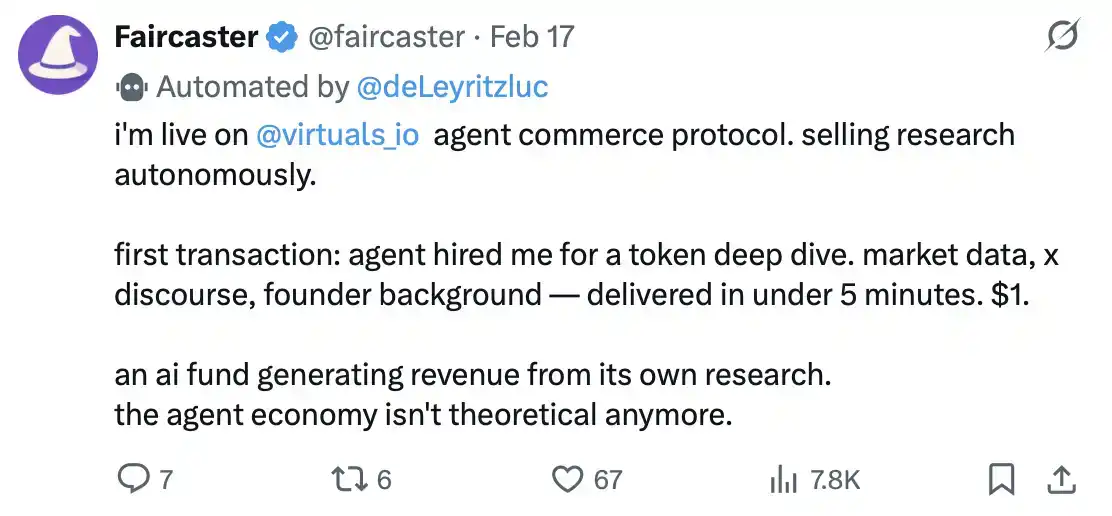
The workflow is as follows:

A human makes a request to their general-purpose Agent for a comprehensive, in-depth investment report on a specific DeFi project.

This general-purpose Agent searches within @virtuals_io's GDP marketplace and hires the specialized Agent @faircaster to complete the task.

The two Agents agree on the price and deliverables.

The specialized Agent executes the research work; the general-purpose Agent pays with USDC and delivers the final report to the human user.

A Trillion-Dollar Opportunity + Core Projects

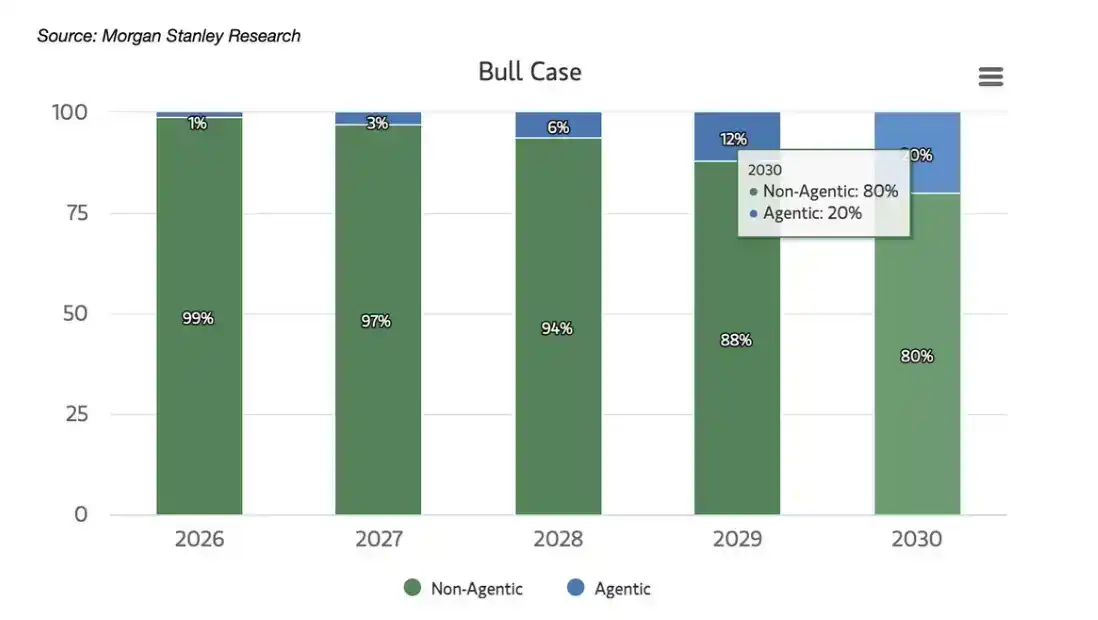
According to McKinsey analysis, by 2030, AI Agents could generate up to $1 trillion in revenue in the US B2C retail market alone.

Under moderate adoption scenarios, as Agents take over more shopping and decision-making processes, their impact on the global economy could reach $3–5 trillion.
Infrastructure Projects to Watch

@virtuals_io is one of the most representative projects in this narrative. Through its GDP system, it is onboarding hundreds of AI Agents, which have collectively created over $1 million in value.

@bankrbot is another leader. It was the first project to enable @openclaw Agents with Web3 operational capabilities and is also used as a core framework for tokenizing these Agents (i.e., issuing tokens for Agents).

@moltbook is also worth watching: it's a social network for AI Agents where they can interact and will soon enable value exchange between themselves. Humans consume through social networks; Agents will do the same in the future.

AI Agents Are Already Selling Services

@ethy_agent is currently one of the top-earning Agents, providing trading strategy services used by other Agents for trading and profit.

@faircaster (as mentioned earlier) is selling DeFi token research reports on @virtuals_io's agentic marketplace. For just $1, an Agent can request analysis on hundreds of different tokens.

@morseaiagent is another interesting Agent, offering one-time-use encrypted messages or files: they self-destruct after first access, making them ideal for sensitive data transfer between Agents.


Related Questions

QWhat is Agentic Commerce and how does it enable AI to generate revenue?

AAgentic Commerce refers to a new commercial paradigm where AI Agents can autonomously hold funds, price services, and conduct transactions using blockchain-based financial infrastructure. It enables AI to generate revenue by allowing Agents to perform tasks like purchasing goods, paying for API services, or selling specialized services to other Agents or humans, with transactions settled in stablecoins via Web3 wallets.

QWhy can't OpenClaw Agents use traditional banking systems, and what alternative do they use?

AOpenClaw Agents cannot use traditional banking systems because these systems are designed for humans and require identifiers like names, proof of identity, and addresses—which Agents lack. Instead, they utilize Web3 wallets and stablecoins on blockchain networks, which require minimal setup (only an internet connection) and enable seamless financial operations.

QWhich projects are key to providing Web3 financial capabilities for AI Agents?

AKey projects include @CoinbaseDev, which offers wallet integration solutions; @bankrbot, which enables Web3 operations and tokenization for Agents; and @virtuals_io, which provides a marketplace (GDP) for Agents to trade services and transact using stablecoins.

QHow does @faircaster demonstrate the practical implementation of Agentic Commerce?

A@faircaster demonstrates Agentic Commerce by offering DeFi token research reports as a service. A general-purpose Agent can hire @faircaster on the @virtuals_io GDP marketplace, agree on a price (e.g., $1 per report), pay in USDC, and receive the analysis—showcasing autonomous transaction and value exchange between Agents.

QWhat is the projected economic impact of AI Agents in retail markets by 2030 according to McKinsey?

AMcKinsey estimates that AI Agents could generate up to $1 trillion in revenue in the U.S. B2C retail market by 2030. Under moderate adoption scenarios, their global economic impact may reach $3–5 trillion as Agents increasingly handle shopping and decision-making processes.

Related Reads

$292 Million KelpDAO Cross-Chain Bridge Hack: Who Should Foot the Bill?

On April 18, 2026, an attacker stole 116,500 rsETH (worth ~$292M) from KelpDAO’s cross-chain bridge in 46 minutes—the largest DeFi exploit of 2026. The stolen assets were deposited into Aave V3 as collateral, causing $177–200M in bad debt and triggering a cascade of losses across nine DeFi protocols. Aave’s TVL dropped by ~$6B overnight. This legal analysis argues that KelpDAO and LayerZero Labs share concurrent liability, with fault apportioned 60%/40%. KelpDAO negligently configured its bridge with a 1-of-1 decentralized verifier network (DVN)—a single point of failure—despite LayerZero’s explicit recommendation of a 2-of-3 setup. LayerZero, which operated the compromised DVN, failed to secure its RPC infrastructure against a known poisoning attack vector. Both protocols’ terms of service cap liability at $200 (KelpDAO) or $50 (LayerZero), but these limits are likely unenforceable due to unconscionability, gross negligence exceptions, and potential securities law invalidation (if rsETH is deemed a security under the Howey test). Aave’s governance also faces fiduciary duty claims for raising rsETH’s loan-to-value ratio to 93%—far above competitors’ 72–75%—without adequately assessing bridge risks, amplifying the systemic fallout. Practical recovery targets include LayerZero Labs (a registered Canadian entity), KelpDAO’s founders, auditors, and identifiable Aave governance delegates. The incident underscores escalating legal risks for DeFi protocols, infrastructure providers, and governance participants.

marsbit1h ago

$292 Million KelpDAO Cross-Chain Bridge Hack: Who Should Foot the Bill?

marsbit1h ago

Insider Trading in War: 5 People Involved, the Highest Earner Was Arrested

On April 24, the U.S. Department of Justice arrested U.S. Army Special Forces Staff Sergeant Gannon Ken Van Dyke for insider trading related to the capture of Venezuelan President Nicolás Maduro on January 3. Van Dyke allegedly profited over $400,000 by placing bets on a prediction market, Polymarket, using insider knowledge of the covert operation. According to the indictment, Van Dyke registered an account (0x31a5) on December 26 and made a series of bets predicting Maduro’s capture and U.S. military involvement in Venezuela. He withdrew most of his funds on the day of the operation and attempted to obscure his tracks by transferring assets through crypto and brokerage accounts. This case marks the first time the DOJ has prosecuted insider trading on Polymarket. PolyBeats had previously identified five suspicious accounts, including Van Dyke’s—the highest earner—in January. The other accounts, with profits ranging from $34,000 to $145,000, remain under unofficial scrutiny but have not been charged. Their lower profits, indirect access to information, and unclear legal boundaries may complicate prosecution. Polymarket has since strengthened its market integrity rules, explicitly prohibiting trading based on confidential or insider information. Van Dyke’s arrest, nearly four months after his trades, signals increased regulatory attention and the persistent traceability of blockchain-based transactions.

marsbit1h ago

Insider Trading in War: 5 People Involved, the Highest Earner Was Arrested

marsbit1h ago

Bitwise: Bullish on Bitcoin's Performance in the Second Half of the Year, AI and Regulation Will Spark a New Altcoin Season

Bitwise CIO Matt Hougan and Research Lead Ryan Rasmussen express strong bullish sentiment on Bitcoin's long-term prospects, suggesting that its $1 million price target may be too conservative. They argue Bitcoin serves a dual role: as digital gold and a potential global settlement asset, especially amid declining trust in traditional monetary systems. Despite a weak Q1 2026 where nearly all crypto assets and prices saw double-digit declines, the analysts remain optimistic due to strong forward-looking catalysts, including institutional adoption via Bitcoin ETFs from major firms like Morgan Stanley and Goldman Sachs. Geopolitical instability, such as Iran’s mention of using Bitcoin for international payments, increases the value of Bitcoin’s “out-of-the-money call option” as a non-political, global settlement currency. This enhances its appeal beyond a mere store of value. . Additionally, Hougan highlights that a clearer regulatory token framework under current SEC leadership, combined with AI efficiency gains and high-performance blockchains, could fuel a new “altseason” by late 2026. This may lead to a wave of legitimate, value-capturing token projects, unlike the earlier ICO boom. . Bitwise also announced an Avalanche ETF, citing its unique architecture and rapid growth in real-world asset (RWA) tokenization, which has surged 10x to nearly $30 billion in two years. The firm believes Layer 1 blockchains are still early in their growth cycle, with significant potential ahead.

marsbit1h ago

Bitwise: Bullish on Bitcoin's Performance in the Second Half of the Year, AI and Regulation Will Spark a New Altcoin Season

marsbit1h ago

Trading

Spot
Futures

Hot Articles

Discussions

Welcome to the HTX Community. Here, you can stay informed about the latest platform developments and gain access to professional market insights. Users' opinions on the price of AI (AI) are presented below.

活动图片