Hong Kong Unveils New Rules To Allow Crypto Margin Financing And Perpetual Contracts

bitcoinistPublished on 2026-02-12Last updated on 2026-02-12

Abstract

Hong Kong's Securities and Futures Commission (SFC) has introduced new rules allowing licensed virtual asset brokers to offer crypto margin financing and perpetual contracts to professional investors. Under the ASPIRe roadmap's Pillar P, eligible clients with strong credit and sufficient collateral can use Bitcoin and Ether as collateral for margin trading. The move aims to enhance market liquidity, provide risk management tools, and strengthen Hong Kong's position as a global virtual asset hub. The SFC emphasized the need for robust risk controls, as these products carry distinct risks. Executive Director Eric Yip stated that these measures are part of a broader strategy to cultivate market depth and investor confidence through regulated innovation.

Hong Kong financial authorities have announced new rules to expand the scope of product offerings, allowing the integration of crypto margin financing and perpetual contracts into the local virtual assets market.

Hong Kong Approves Crypto Margin Financing, Perps

On Wednesday, Hong Kong’s Securities and Futures Commission (SFC) unveiled a framework for licensed corporations that provide virtual asset dealing services (VA brokers) to offer virtual asset financing.

According to the SFC’s circular, the financial watchdog will permit VA brokers to extend credit to margin clients with strong credit profiles and sufficient securities collateral, under Pillar P of its Access, Safeguards, Products, Infrastructure and Relationships (ASPIRe) roadmap.

This will allow eligible margin clients to “increase their participation in VA trading, which can enhance the liquidity of Hong Kong’s VA market. At the same time, this can also facilitate the development of VA financing in a risk-controlled environment.”

Under the new guidance, only the two leading cryptocurrencies, Bitcoin (BTC) and Ether (ETH), will be eligible as VA collateral. The regulator also released a high-level framework for licensed virtual asset trading platforms to offer crypto perpetual contracts to professional investors.

“Under the ASPIRe roadmap, Pillar P reflects the SFC’s commitment to expanding the scope of product offerings, including Perps. This initiative aims to deepen market liquidity, broaden risk management tools for investors, and further strengthen Hong Kong’s position as a leading global virtual asset hub,” the watchdog affirmed.

The SFC emphasized that the introduction of Perps will bring new opportunities to the market, but noted that it also carries “a range of risks that are distinct from those associated with traditional futures or spot trading of virtual assets.”

Therefore, the framework requires platform operators to have robust management measures and transparent processes governing valuation, margining, collateralization, and liquidation management.

Hong Kong Digital Landscape In ‘Defining Stage’

Speaking at Consensus Hong Kong 2026 on Wednesday, Eric Yip, SFC’s Executive Director of Intermediaries, shared his views on the watchdog’s regulatory enhancements for the next phase of Hong Kong’s crypto assets ecosystem.

Yip affirmed that Hong Kong’s crypto asset development has entered a “defining stage, shaped by the SFC’s ASPIRe roadmap that outlines a future-proof regulatory framework aimed at deepening market quality, resilience, and global competitiveness.”

He emphasized this year’s focus on liquidity, “cultivating market depth, strengthening price discovery, and building investor confidence through a strategic blend of expanded access and responsible product innovation.”

As the executive explained, the SFC is expanding the city’s crypto product suite under Pillar P while maintaining regulatory guardrails aligned with traditional financial market standards.

Notably, Yip highlighted the SFC’s greenlight of crypto margin financing, which will be anchored to the existing securities margin financing framework. He noted that it will provide clarification on the use of crypto assets as collateral, “enabling responsible leverage that supports liquidity without undermining financial stability.”

In addition, he also outlined the new high-level framework for leveraged perpetual contracts for professional investors, which sets out a principles-based model.

Discussing how to bridge innovation and regulatory clarity, he pointed to the upcoming Digital Asset Accelerator to be set up under Pillar Re, which will serve as a structured communication channel between the regulatory agency and industry innovators.

He concluded that “liquidity does not emerge organically; it must be cultivated through openness, strong governance, and a purposeful regulatory design. Through targeted access reforms, product expansion, and structured innovation support, Hong Kong is well-positioned to become a leading global digital assets centre where liquidity thrives on a foundation of integrity, resilience, and international cooperation.”
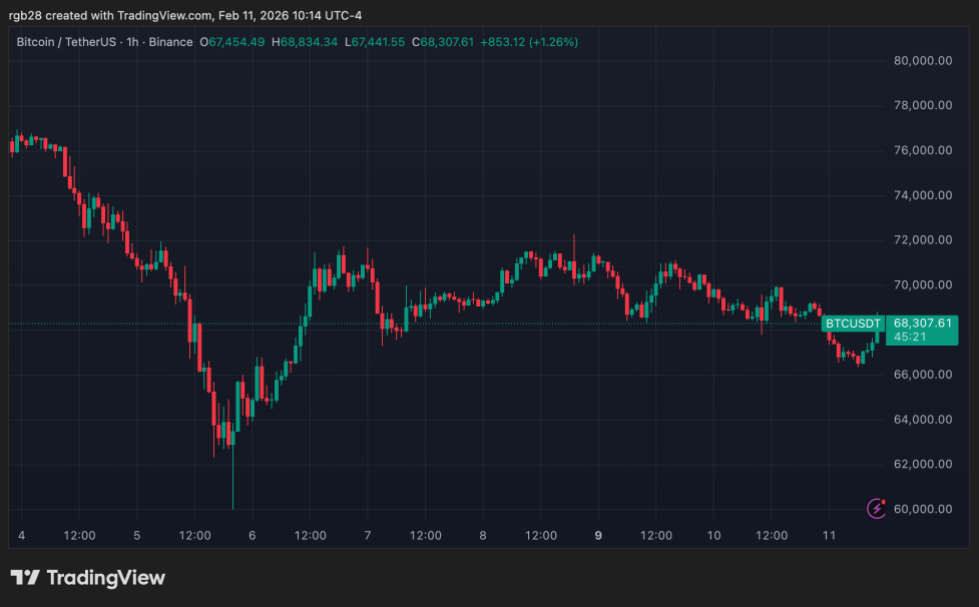
Bitcoin trades at $68,307 in the one-week chart. Source: BTCUSDT on TradingView

Related Questions

QWhat new financial products has Hong Kong's SFC approved for the virtual assets market?

AHong Kong's SFC has approved crypto margin financing and perpetual contracts for professional investors.

QWhich two specific cryptocurrencies are eligible to be used as collateral under the new margin financing rules?

AOnly Bitcoin (BTC) and Ether (ETH) are eligible as virtual asset collateral under the new guidance.

QWhat is the name of the SFC's roadmap that outlines this new regulatory framework?

AThe regulatory framework is part of the SFC's ASPIRe (Access, Safeguards, Products, Infrastructure and Relationships) roadmap.

QAccording to the SFC executive, what stage has Hong Kong's crypto asset development entered?

AAccording to Eric Yip, Hong Kong's crypto asset development has entered a 'defining stage'.

QWhat is the primary goal of introducing these new products like margin financing and perpetual contracts?

AThe primary goals are to enhance market liquidity, broaden risk management tools for investors, and strengthen Hong Kong's position as a leading global virtual asset hub.

Related Reads

Interview with Robinhood Executive: Meme + Tokenized US Stocks as "Barbell" Customer Acquisition Strategy, All Business Lines Achieve Hundreds of Millions in Revenue

Interview with Robinhood executive Johann Kerbrat reveals the company's "barbell" customer acquisition strategy for its new Robinhood Chain, combining meme tokens with tokenized stocks. Three weeks after mainnet launch, the chain has seen over $3B in weekly DEX volume and 105M transactions. Kerbrat explains the logic behind the permissionless chain: meme tokens attract DeFi users, while tokenized real-world assets (RWA), currently over 90 US stocks and ETFs accessible in 120+ countries, serve global users. The goal is to bring Robinhood's 27 million funded accounts on-chain by simplifying DeFi with a user-friendly interface, exemplified by features like Robinhood Earn which offers yield without requiring wallet management. Built on Arbitrum's technology stack for its speed, low cost, and Ethereum's security, the chain focuses on financial products like Earn, spot trading, and perpetuals. Kerbrat downplays direct competition with platforms like Base, emphasizing the goal of expanding the overall market for on-chain assets. He details selective partnerships (e.g., Morpho, Lighter) based on compliance, unique UX, and differentiation. While regulatory clarity is pending for US perpetuals, the expansion continues via Bitstamp in Europe. Finally, Kerbrat positions Robinhood as a "super app" integrating stocks, options, crypto, banking, and AI trading, with all major business lines generating hundreds of millions in revenue. For the chain, current priority is driving adoption over maximizing gas fee revenue.

marsbit1h ago

Interview with Robinhood Executive: Meme + Tokenized US Stocks as "Barbell" Customer Acquisition Strategy, All Business Lines Achieve Hundreds of Millions in Revenue

marsbit1h ago

Fidelity Q3 Report: BTC, ETH, and SOL Continue to Build Bottoms; How Much Further Will This Crypto Bear Market Go?

Fidelity's Q3 Crypto Signal Report analyzes the current bear market, noting Bitcoin (BTC), Ethereum (ETH), and Solana (SOL) are in a prolonged bottoming phase. Key indicators like the weighted Net Unrealized Profit/Loss (NUPL) have turned negative (-0.01), signaling the market is slightly below its aggregate cost basis, with BTC acting as the primary stabilizing asset. BTC's dominance has risen to 68%, indicating a lack of capital rotation to other digital assets. Performance has been weak across the board, with BTC, ETH, and SOL down significantly year-to-date. Market sentiment is depressed, exacerbated by substantial outflows from spot ETPs and a challenging macro environment. The report compares the current ~203-day downtrend to historical ~300-day bottoming cycles, suggesting the process may be two-thirds complete, with late 2026 as a potential timeframe to monitor. For Bitcoin, NUPL at 0.09 indicates cautious sentiment, while momentum signals remain negative. The Yardstick metric points to potential undervaluation relative to network security (hashrate). Ethereum's NUPL is deep in the "capitulation" zone at -0.43, a historically positive signal for future returns, though its momentum and network fee revenue are negative. Solana shows the deepest NUPL at -0.72 but demonstrates relative resilience in on-chain activity and stablecoin transfer volume. The report concludes that while several metrics are near historical capitulation levels, a definitive market bottom has not yet been established. The path forward likely involves continued consolidation, with BTC's relative strength and fundamental on-chain usage for ETH and SOL providing key areas for investor observation.

marsbit1h ago

Fidelity Q3 Report: BTC, ETH, and SOL Continue to Build Bottoms; How Much Further Will This Crypto Bear Market Go?

marsbit1h ago

Trading

Spot
活动图片