Here’s How The Bitcoin Price Has Performed In The Last 9 FOMC Meetings And What To Expect Next

bitcoinistPublished on 2026-05-01Last updated on 2026-05-01

The Bitcoin price has entered another post-FOMC window, and there’s a pattern that has become difficult to ignore. According to crypto analyst and commentator Ardi, Bitcoin has sold off in the week following eight of the last nine FOMC meetings, with the average seven-day decline coming in near 11%.

That history is now being tested again. Bitcoin was trading around $77,000 around the latest Fed decision, and the history shows a hint of how the price action might resolve in the coming days.

Bitcoin’s Trend In Post-FOMC Weeks

The Federal Reserve wrapped up its April 28-29 meeting on Wednesday, holding interest rates unchanged at a target range of 3.50% to 3.75%. This decision was already anticipated, and the CME FedWatch had priced in a 99% probability of a hold in the days prior.

Crypto analyst and commentator Ardi published his findings on X alongside a Bitcoin daily chart across May 2025 to late April 2026. His observation was that Bitcoin has sold off hard in the week following eight of the last nine FOMC meetings. The lone exception was May 2025, when BTC had already fallen about 24% from its all-time high before the meeting even began.
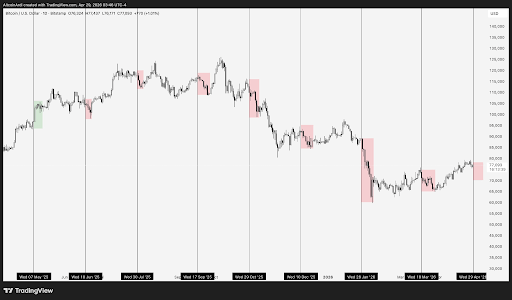
Source: Chart from Ardi on X

Every other meeting produced a post-decision drop. The policy direction was almost irrelevant, and Bitcoin’s price dropped whether the Fed cut rates, held them, or delivered hawkish commentary.

The chart Ardi shared shows the pattern visually, with successive red zones showing the post-FOMC sell windows across September, October, and December 2025, then January and March 2026, each one landing as BTC worked its way from its all-time high above $126,000 in October 2025 down to the $60,000s by early February 2026.

An Average Drop Of 11%

Ardi’s data goes further than simply noting direction. The trend is that Bitcoin has dropped in eight of the last nine post-FOMC periods, with an average decline of about 11% over the following week.

Applied to BTC’s price heading into this week’s meeting, which was trading in the $76,000 to $79,000 range after a 21% April rally from early-month lows near $65,000, an 11% drop would return the price to $70,000 within the next week.

The Fed said economic activity has been expanding at a solid pace, but also pointed to elevated inflation, partly linked to higher global energy prices. That matters for Bitcoin because the asset remains highly sensitive to liquidity expectations. A clear path to rate cuts would support risk appetite, weaken the dollar, and improve sentiment across the crypto industry. A cautious Fed environment does the opposite.

On one side, Bitcoin had already recovered strongly from its recent lows and was supported by a better April trend. On the other side, the FOMC meeting places Bitcoin in a risky historical position that might see it return to $70,000 in the coming days.

BTC trading at $77,340 on the 1D chart | Source: BTCUSDT on Tradingview.com

Trending Cryptos

Related Reads

Elon Musk Building Terafab: The Largest Chip Factory for AI, Robots, and Space Data Centers

Elon Musk's SpaceX and Tesla have launched the Terafab project to build a massive semiconductor facility in Grimes County, Texas. The plant, exceeding 9.3 million square meters, aims to integrate logic chip manufacturing, memory production, advanced packaging, and testing. The initial phase requires $16.8 billion in capital investment, with a long-term goal of producing over 1 terawatt of computing power annually. This capacity will support Tesla's Optimus robots and Cybercab autonomous vehicles, as well as SpaceX's orbital data centers. Texas Governor Greg Abbott confirmed the project's start in August 2026, highlighting 3,000 new jobs and a $30 million state grant. Elon Musk emphasized the strategic advantage of combining logic, memory, and packaging under one roof. Musk called the future complex the "largest and most valuable building on Earth," with an area roughly 50 times that of the Pentagon. Intel is the key technology partner, with plans to use its 14A process node for chip production. This partnership aims to diversify supply chains currently dominated by TSMC. The project aligns with the U.S. Pax Silica initiative to secure semiconductor supply chains. An AI analysis notes the project's scale and potential challenges, comparing it to delays seen in other U.S. megafab projects like Intel's Ohio facility. It questions whether Terafab can avoid similar pitfalls related to timelines, budgets, workforce, and supply chain stability. The facility's success could significantly shift the global semiconductor balance and strengthen the U.S. position in the tech race.

cryptonews.ru2h ago

Elon Musk Building Terafab: The Largest Chip Factory for AI, Robots, and Space Data Centers

cryptonews.ru2h ago

Elon Musk is Building Terafab: The Largest Chip Plant for AI, Robots, and Space Data Centers

Elon Musk's SpaceX and Tesla have launched the massive Terafab project to build a semiconductor plant in Grimes County, Texas. Spanning over 9.3 million square meters, the facility will integrate logic chip and memory production, advanced packaging, and testing. The initial phase requires $16.8 billion in capital investment, with a long-term goal of producing over 1 terawatt of computing power annually. This output is intended to supply Tesla's Optimus robots and Cybercab autonomous vehicles, as well as SpaceX's orbital data centers. Texas Governor Greg Abbott confirmed the project's start on August 6, 2026, highlighting the creation of 3,000 jobs and a $30 million grant from the Texas Enterprise Fund. Musk emphasized the strategic advantage of combining chip design, memory production, and packaging under one roof to accelerate hardware development. He stated the fully built complex would be "the largest and most valuable building on Earth," about 50 times larger than the Pentagon. An estimated 25% of production is earmarked for Tesla's robotics, with 75% for SpaceX's space-based AI systems. Earlier tax documents suggested a total project cost of up to $119 billion, but this has not been officially confirmed. Intel is the key technology partner, with plans to use its 14A process node for chip manufacturing. This partnership aims to diversify supply chains and reduce dependence on dominant foundries like TSMC. The initiative aligns with the broader U.S. Pax Silica program, which seeks to build secure international semiconductor supply chains with allied nations. An AI-driven analysis notes that megafab projects, such as Intel's delayed Ohio facility, often face schedule and budget overruns. While Terafab represents a significant step toward U.S. semiconductor self-sufficiency and could shift the global tech balance, its success will depend on factors like skilled labor availability, energy supply, and supply chain stability. The final outcome may not be clear until the late 2030s.

cryptonews.ru2h ago

Elon Musk is Building Terafab: The Largest Chip Plant for AI, Robots, and Space Data Centers

cryptonews.ru2h ago

Trading

Spot

Hot Articles

What is $BITCOIN

DIGITAL GOLD ($BITCOIN): A Comprehensive Analysis Introduction to DIGITAL GOLD ($BITCOIN) DIGITAL GOLD ($BITCOIN) is a blockchain-based project operating on the Solana network, which aims to combine the characteristics of traditional precious metals with the innovation of decentralized technologies. While it shares a name with Bitcoin, often referred to as “digital gold” due to its perception as a store of value, DIGITAL GOLD is a separate token designed to create a unique ecosystem within the Web3 landscape. Its goal is to position itself as a viable alternative digital asset, although specifics regarding its applications and functionalities are still developing. What is DIGITAL GOLD ($BITCOIN)? DIGITAL GOLD ($BITCOIN) is a cryptocurrency token explicitly designed for use on the Solana blockchain. In contrast to Bitcoin, which provides a widely recognized value storage role, this token appears to focus on broader applications and characteristics. Notable aspects include: Blockchain Infrastructure: The token is built on the Solana blockchain, known for its capacity to handle high-speed and low-cost transactions. Supply Dynamics: DIGITAL GOLD has a maximum supply capped at 100 quadrillion tokens (100P $BITCOIN), although details regarding its circulating supply are currently undisclosed. Utility: While precise functionalities are not explicitly outlined, there are indications that the token could be utilized for various applications, potentially involving decentralized applications (dApps) or asset tokenization strategies. Who is the Creator of DIGITAL GOLD ($BITCOIN)? At present, the identity of the creators and development team behind DIGITAL GOLD ($BITCOIN) remains unknown. This situation is typical among many innovative projects within the blockchain space, particularly those aligning with decentralized finance and meme coin phenomena. While such anonymity may foster a community-driven culture, it intensifies concerns about governance and accountability. Who are the Investors of DIGITAL GOLD ($BITCOIN)? The available information indicates that DIGITAL GOLD ($BITCOIN) does not have any known institutional backers or prominent venture capital investments. The project seems to operate on a peer-to-peer model focused on community support and adoption rather than traditional funding routes. Its activity and liquidity are primarily situated on decentralized exchanges (DEXs), such as PumpSwap, rather than established centralized trading platforms, further highlighting its grassroots approach. How DIGITAL GOLD ($BITCOIN) Works The operational mechanics of DIGITAL GOLD ($BITCOIN) can be elaborated on based on its blockchain design and network attributes: Consensus Mechanism: By leveraging Solana’s unique proof-of-history (PoH) combined with a proof-of-stake (PoS) model, the project ensures efficient transaction validation contributing to the network's high performance. Tokenomics: While specific deflationary mechanisms have not been extensively detailed, the vast maximum token supply implies that it may cater to microtransactions or niche use cases that are still to be defined. Interoperability: There exists the potential for integration with Solana’s broader ecosystem, including various decentralized finance (DeFi) platforms. However, the details regarding specific integrations remain unspecified. Timeline of Key Events Here is a timeline that highlights significant milestones concerning DIGITAL GOLD ($BITCOIN): 2023: The initial deployment of the token occurs on the Solana blockchain, marked by its contract address. 2024: DIGITAL GOLD gains visibility as it becomes available for trading on decentralized exchanges like PumpSwap, allowing users to trade it against SOL. 2025: The project witnesses sporadic trading activity and potential interest in community-led engagements, although no noteworthy partnerships or technical advancements have been documented as of yet. Critical Analysis Strengths Scalability: The underlying Solana infrastructure supports high transaction volumes, which could enhance the utility of $BITCOIN in various transaction scenarios. Accessibility: The potential low trading price per token could attract retail investors, facilitating wider participation due to fractional ownership opportunities. Risks Lack of Transparency: The absence of publicly known backers, developers, or an audit process may yield skepticism regarding the project's sustainability and trustworthiness. Market Volatility: The trading activity is heavily reliant on speculative behavior, which can result in significant price volatility and uncertainty for investors. Conclusion DIGITAL GOLD ($BITCOIN) emerges as an intriguing yet ambiguous project within the rapidly evolving Solana ecosystem. While it attempts to leverage the “digital gold” narrative, its departure from Bitcoin's established role as a store of value underscores the need for a clearer differentiation of its intended utility and governance structure. Future acceptance and adoption will likely depend on addressing the current opacity and defining its operational and economic strategies more explicitly. Note: This report encompasses synthesised information available as of October 2023, and developments may have transpired beyond the research period.

1.9k Total ViewsPublished 2025.05.13Updated 2025.05.13

What is $BITCOIN

Discussions

Welcome to the HTX Community. Here, you can stay informed about the latest platform developments and gain access to professional market insights. Users' opinions on the price of BTC (BTC) are presented below.

活动图片