Author: HashGlobal KK, Founder of Hash Global
Compiled by: Jiahuan, ChainCatcher
The author has liquidated all ETH holdings. This article was published on May 24.
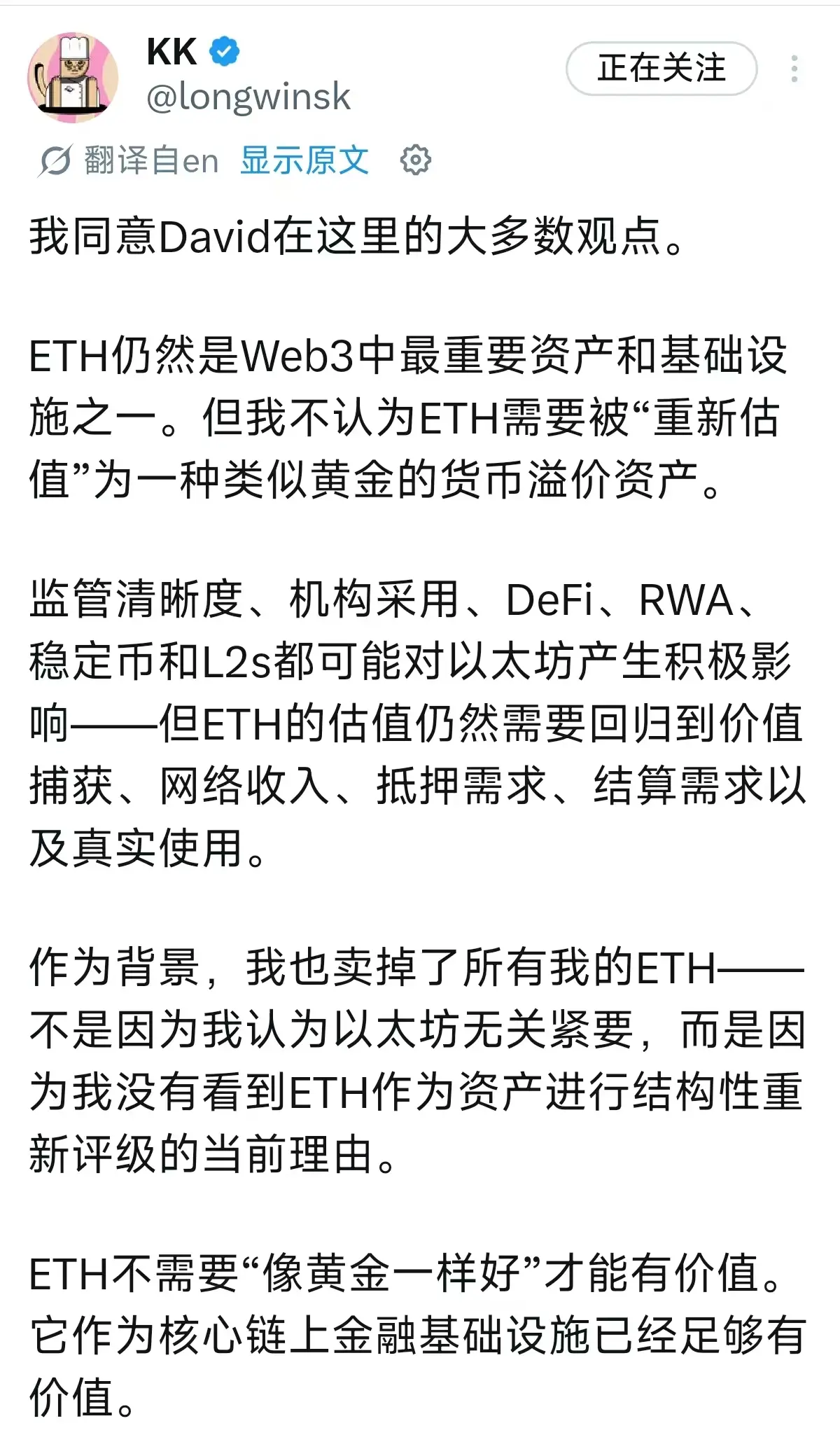
Recently, I read an article arguing that if the U.S. CLARITY Act passes, Ethereum will become the biggest winner.
Its core argument is that ETH may become the only asset in the U.S. regulatory framework that combines the attributes of a "decentralized digital commodity" and a "programmable smart contract platform." Therefore, ETH's valuation framework should shift from a network revenue logic to a monetary premium logic similar to BTC, gold, or even sovereign reserve assets.
I find this perspective enlightening, but the conclusion may be overly extended.
This is not to say I am bearish on ETH or deny the positive impact of CLARITY.
On the contrary, regulatory clarity is undoubtedly a major positive for ETH. It will reduce compliance concerns for institutional allocation to ETH and help further develop ETFs, custody services, staking, institutional DeFi, RWA, and on-chain settlement businesses.
However, regulatory clarity is not equivalent to a monetary premium.
CLARITY may solve ETH's "regulatory discount" issue, but it will not automatically open up valuation spaces associated with gold, real estate, or global reserve assets.
These are two entirely different matters and should be analyzed separately.
1. The Market Hasn't Bought This Logic Yet
If ETH were truly viewed by the market as "programmable gold" or an "interest-bearing monetary asset," its valuation should be closer to BTC's.
But that's not the case.
When evaluating ETH, the market still focuses on specific metrics:
- Ethereum mainnet revenue;
- DeFi activity;
- Whether stablecoins and RWAs are primarily settled within the Ethereum ecosystem;
- Value flow from L2s to L1;
- ETH staking yield;
- Inflows into ETH ETFs;
- Competition from ecosystems like Solana, BNB Chain, and Base.
These are essentially valuation logics for network assets, platform assets, and ecosystem assets.
BTC is different. It has no cash flow, no application ecosystem, and no need to discuss network revenue. Its logic is simple: 21 million supply, non-sovereign, censorship-resistant, digital gold. People may disagree with this narrative, but it's simple, clear, and easy to disseminate.
ETH's narrative is much more complex. ETH serves as gas fees, a staking asset, DeFi collateral, L2 settlement asset, and infrastructure for institutional on-chain finance. While multiple functions are advantageous, monetary premiums typically require an extremely simple narrative.
Complexity is beneficial for ecosystem development but doesn't necessarily contribute to forming a monetary premium like gold and BTC.
2. Legal Classification Is Just an Entry Ticket
The original article makes a crucial leap: because ETH may be legally recognized as a decentralized digital commodity, it should enter the valuation framework of top-tier monetary premium assets.
I believe this inference is problematic.
Legal classification addresses issues like: Can institutions hold it compliantly? Can they trade it compliantly? Can they custody it compliantly? Can they develop related products compliantly?
Monetary premium addresses issues like: Is the global market willing to hold it as a long-term store of wealth?
These are two different questions.
Gold has a monetary premium not because any single law classifies it as such, but because millennia of historical consensus, physical scarcity, central bank reserve demand, and geopolitical safe-haven attributes have collectively formed immense consensus.
BTC has a monetary premium not because it can execute smart contracts, but because it is simple enough, pure enough, and resembles "digital gold" enough.
For ETH to gain a monetary premium, regulatory classification alone is insufficient. It must also prove that global capital is willing to hold ETH as a long-term store of value, not merely as a critical on-chain financial infrastructure asset.
There is still a significant gap between these two states.
3. DeFi Will Undermine ETH's "Sole Yield-Bearing" Narrative
The original article emphasizes an advantage of ETH: ETH can generate yield through staking, while BTC and gold cannot.
While this holds some truth today, the situation may change in the coming years.
With the development of DeFi and RWA, many assets will be tokenized in the future. Gold, treasury bonds, money market funds, real estate funds, income rights, commodities, and stock ETFs can all enter the on-chain financial system as tokens.
Once these assets are on-chain, they will also gain new capabilities:
- Can be used as collateral;
- Can be lent/borrowed;
- Can be used for market making;
- Can be combined into structured yield products;
- Can be integrated with DeFi protocols;
- Can form closed-loop on-chain capital flows with stablecoins.
Therefore, in the future, ETH will not be the only "yield-bearing" asset.
Tokenized gold integrated with DeFi can also generate on-chain yield. Tokenized treasury bonds and money market funds inherently have baseline yields. Tokenized real estate funds and other RWAs can generate cash flows.
By then, the question will no longer be "ETH can generate yield, gold cannot."
The real questions will become: Who is the better collateral? Which has lower volatility? Whose yield source is clearer? Who has higher regulatory acceptance? Who is more suitable for institutional balance sheets? Who is more likely to be held long-term by global capital?
From this perspective, ETH may not have an advantage compared to tokenized gold, tokenized treasury bonds, or tokenized money market funds.
ETH's staking yield comes from network security mechanisms, not traditional risk-free returns. It carries protocol risk, validator risk, slashing risk, liquid staking protocol risk, regulatory risk, and price volatility risk.
For institutions, ETH staking is certainly a valuable feature, but it should not be equated directly with "superior to gold."
4. Monetary Premium Belongs to BTC, Gold, and Tokenized Gold
I tend to believe that future monetary premiums will primarily belong to BTC, gold, and potentially tokenized gold.
BTC's positioning is clear: digital gold.
Gold's positioning is also clear: the traditional world's most important non-sovereign store of value.
If tokenized gold develops, the situation could be very attractive. It would inherit gold's historical credibility while gaining on-chain liquidity, composability, and collateral capability. In this scenario, gold's monetary premium might not flow to ETH; instead, it might be further strengthened due to tokenized gold.
This isn't necessarily bad for ETH. These tokenized assets also need on-chain infrastructure and can be issued, traded, and collateralized on Ethereum or Ethereum L2s.
However, this means ETH is more of an infrastructure asset than the ultimate monetary premium asset.
Infrastructure certainly has value. But infrastructure valuations typically revert to usage metrics, revenue, network effects, and value capture, not direct analogies to gold's total market cap, real estate's monetary premium, or global reserve asset pools.
5. Ethereum's Value Capture Problem Remains Unresolved
The original article posits that CLARITY will widen the gap between ETH and other smart contract platforms, with other L1s potentially entering a second-tier valuation while ETH remains in the first tier.
This judgment also requires caution.
The real world won't choose blockchains based solely on U.S. regulatory classifications.
Different countries, assets, and institutions will select underlying networks based on various factors:
- Cost;
- Performance;
- Compliance interfaces;
- KYC/AML requirements;
- Local regulatory attitudes;
- Ecosystem resources;
- Liquidity;
- Relationships with asset issuers and service providers;
- Whether a permissioned environment is needed.
Many RWA, stablecoin, and payment scenarios won't necessarily choose the Ethereum mainnet. They might choose L2s, app-chains, consortium chains, or other L1s that better fit local regulations and business needs.
More importantly, even with significant activity within the Ethereum ecosystem, there's no guarantee that ETH can capture value proportionally.
As we've seen in recent years, while L2s expand the Ethereum ecosystem, they also raise a question: once L2s scale, how much value truly flows back to ETH?
If substantial transaction volume occurs on L2s with declining fees, and the application layer and L2s themselves capture more user value, while the ETH mainnet only handles final settlement and security, then ETH's value capture ability remains to be proven.
We cannot assume that ETH's value appreciates synchronously with Ethereum ecosystem growth.
That's why I believe ETH's valuation must return to specific questions like network revenue, settlement demand, collateral demand, staking yield, and ecosystem value flow.
6. Using Ethereum ≠ Buying ETH
Another distinction needs to be made: institutional entry into on-chain finance does not mean they will allocate ETH as a core asset.
Institutions might:
- Use the Ethereum network;
- Use Ethereum L2s;
- Issue tokenized funds;
- Use stablecoins for settlement;
- Use on-chain custody and compliant transfer tools;
- Use DeFi or permissioned DeFi;
- Indirectly access on-chain finance through service providers.
None of these require them to purchase large amounts of ETH.
Just as enterprises heavily using cloud services don't necessarily buy shares of the cloud service company, institutions using blockchain infrastructure don't necessarily need to hold the underlying token long-term.
For ETH to transform from a "network being used" to an "asset held long-term," a clear value capture mechanism is required.
If such a mechanism remains unclear, the market will continue to evaluate ETH based on revenue, fees, staking yield, and ecosystem growth.
7. Grand Narratives Can't Support Valuation Anymore
In the last cycle, the market was willing to assign valuation based on grand narratives.
"World computer," "internet of value," "global settlement layer," "foundation of decentralized finance"—these narratives were very powerful. Ethereum was undoubtedly the most important representative.
But the market has changed.
Investors are increasingly asking: Where is the revenue? Where are the users? Where is the value capture? Where is the real demand? What's the regulatory path? Where's the closed-loop business logic?
As we've emphasized repeatedly in recent years, Web3 cannot remain at the vision stage; it must ultimately return to fundamental value and basic business logic.
Can it generate profit? Can it provide a better user experience? Can it create real economic value? If these questions cannot be answered, even the grandest narratives will struggle to sustain valuation long-term.
The same applies to ETH.
While it is certainly one of the most important Web3 infrastructures, to command a higher valuation, the market may need to see:
- Re-growth of DeFi;
- Recovery of mainnet revenue;
- Clearer value flow from L2s to L1;
- Real settlement demand for stablecoins and RWAs within the Ethereum ecosystem;
- Sustained growth in ETH collateral demand;
- Institutions not just using Ethereum, but genuinely needing to hold ETH.
None of this can be automatically achieved through a single piece of legislation.
8. CLARITY's True Significance Is Fixing the Regulatory Discount
Therefore, I prefer to view CLARITY's impact on ETH as reducing the regulatory discount, not unlocking a multi-trillion-dollar monetary premium revaluation potential.
ETH indeed faced regulatory uncertainty in the past. If U.S. regulators more clearly recognize ETH's commodity status, that would be a significant positive.
However, this would shift ETH from a "network asset with regulatory tail risk" to a "network asset with clearer regulation."
That is already significant.
But it doesn't mean ETH will automatically become a substitute for gold, BTC, or global reserve assets.
If the market continues to evaluate ETH based on network revenue, staking yield, L2 value flow, DeFi activity, RWA settlement volume, and institutional usage, then ETH's valuation will remain constrained by fundamentals.
This isn't necessarily bad. High-quality infrastructure assets deserve high value. But they are not equivalent to monetary premium assets.
9. My Stance on ETH
I still believe ETH is one of the most important assets in the digital asset industry.
Its long-term value stems from the following aspects: First, it is the most important open smart contract network.
Second, it is the key settlement layer for DeFi, stablecoins, RWAs, and on-chain finance.
Third, from a regulatory perspective, it is one of the most defensible decentralized infrastructures.
Fourth, it has accumulated long-term recognition from developers, applications, assets, and institutions.
Fifth, as Web3 enters large-scale commercial applications, it may become an extremely important underlying trust and settlement asset.
However, this value is more akin to infrastructure value, network value, ecosystem value, and collateral value.
It may enjoy some scarcity premium, regulatory clarity premium, and network effect premium, but not necessarily the pure monetary premium enjoyed by BTC or gold.
ETH possesses significant long-term value, but its valuation framework should not be mistakenly substituted.
10. CLARITY Benefits ETH, But Don't Treat ETH Like Gold
My core judgment on this matter is straightforward:
CLARITY benefits ETH, but this doesn't mean ETH should be valued like gold.
Regulatory clarity is a positive, but it is not equivalent to a monetary premium.
ETH is an extremely important on-chain financial infrastructure asset, but it may not become the ultimate store of value for global wealth.
In the future, those truly enjoying monetary premiums will likely still be mainly BTC, gold, and potentially tokenized gold and other high-credit stores of value. ETH is more likely to serve as the core infrastructure for on-boarding, circulating, collateralizing, settling, and compositing these assets.
This position is already important enough; there's no need to force ETH into a "superior to gold" narrative.
A more robust valuation framework for ETH might be: regulatory clarity drives discount repair; institutional entry drives increased demand; DeFi, RWA, stablecoins, and L2 ecosystems determine network usage; network revenue, collateral demand, and value flow determine long-term valuation; monetary premium can be considered an optimistic scenario but should not be the base assumption.
These are my main reservations regarding the ETH revaluation thesis.
The Web3 industry often extrapolates real positives into huge valuation stories. While imagination is valuable, returning to fundamental questions is more critical.
What problem does this asset actually solve? Who will hold it long-term? What are the returns and risks of holding it? Where does its value truly come from? If the ecosystem develops, will the value indeed accrue to this token?
If these questions cannot be answered clearly, regulatory classification alone will struggle to support a genuine valuation leap.




















