Has Bitcoin found a floor near $86K? ONE BTC indicator says…

ambcryptoPublished on 2026-01-26Last updated on 2026-01-26

Abstract

Bitcoin's price decline toward $86,000 has weakened market sentiment, with the NUPL (Net Unrealized Profit/Loss) indicator remaining positive—suggesting a market bottom has not yet been reached. Historically, NUPL turning negative signals a cycle low and precedes strong rebounds, but current levels indicate continued selling pressure. Despite some accumulation activity, spot demand remains weak, with recent net outflows from exchanges. Technically, BTC is testing a key demand zone, and a break above the $89,228–$90,180 resistance could trigger a move toward the $93,673–$94,977 fair value gap. Market recovery depends on improved spot inflows and a shift in on-chain momentum.

Bitcoin’s price action failed to attract fresh interest. Instead, it printed a lower low and kept sentiment fragile.

As BTC slipped toward the $86,000 region, on-chain data pointed to weakening momentum and potential downside continuation.

Fear dominated positioning, and further declines remained possible.

Bitcoin has not reached a market bottom

Bitcoin’s [BTC] Net Unrealized Profit/Loss (NUPL) continued to trend lower at press time, indicating that a growing number of investors are panic-selling, either to lock in profits or cut losses.

This behavior aligned with broader sentiment. The Fear and Greed Index stayed in the “fear” zone at 29, based on CoinMarketCap data.

Historically, NUPL tracked cycle structure well when measured against zero.

When NUPL dips into negative territory, it often marks a market bottom—a phase characterized by rising accumulation, a market reset, and the early stages of a rally that expands Bitcoin’s market capitalization.

Over the past five cycles, every move into this negative zone preceded a sharp rebound, each time pushing Bitcoin to fresh price highs.

At press time, NUPL remained positive. That structure suggested downside pressure could persist while the metric trended lower.

Even so, a momentum shift, marked by rising NUPL, could stabilize conditions and support a recovery attempt.

Accumulation builds, but conviction remains uneven

A negative NUPL would likely benefit BTC over the long term, potentially laying the groundwork for a move beyond its $126,000 all-time high. However, investors have yet to fully align behind that scenario.

Despite the uncertain price structure, investors continue to accumulate Bitcoin, signaling that many may view current levels as discounted entry points.

Accumulation still appeared in the Delta Growth Rate, which compared Market Cap against Realized Cap.

The Delta Growth Rate had already turned negative, signaling a shift from speculation toward fundamental accumulation. Historically, this phase reduced capitulation risk unless driven by macro shocks or systemic risk events.

However, Spot demand remained weak.

Centralized exchanges recorded roughly $213 million in net Spot selling over the past week.

By contrast, the week ending the 19th of January saw $943.7 million in Spot buying, which supported price stability during that period.

That shift left BTC dependent on renewed spot inflows to regain upside traction.

Chart structure highlights rebound potential

From a technical perspective, the chart suggested that Bitcoin may attempt a rebound.

BTC has entered a key demand zone, highlighted in blue, which previously acted as a launchpad for rallies on three separate occasions. This zone could once again support higher prices.

However, any recovery is unlikely to be smooth. Bitcoin must first overcome a resistance band between $89,228 and $90,180.
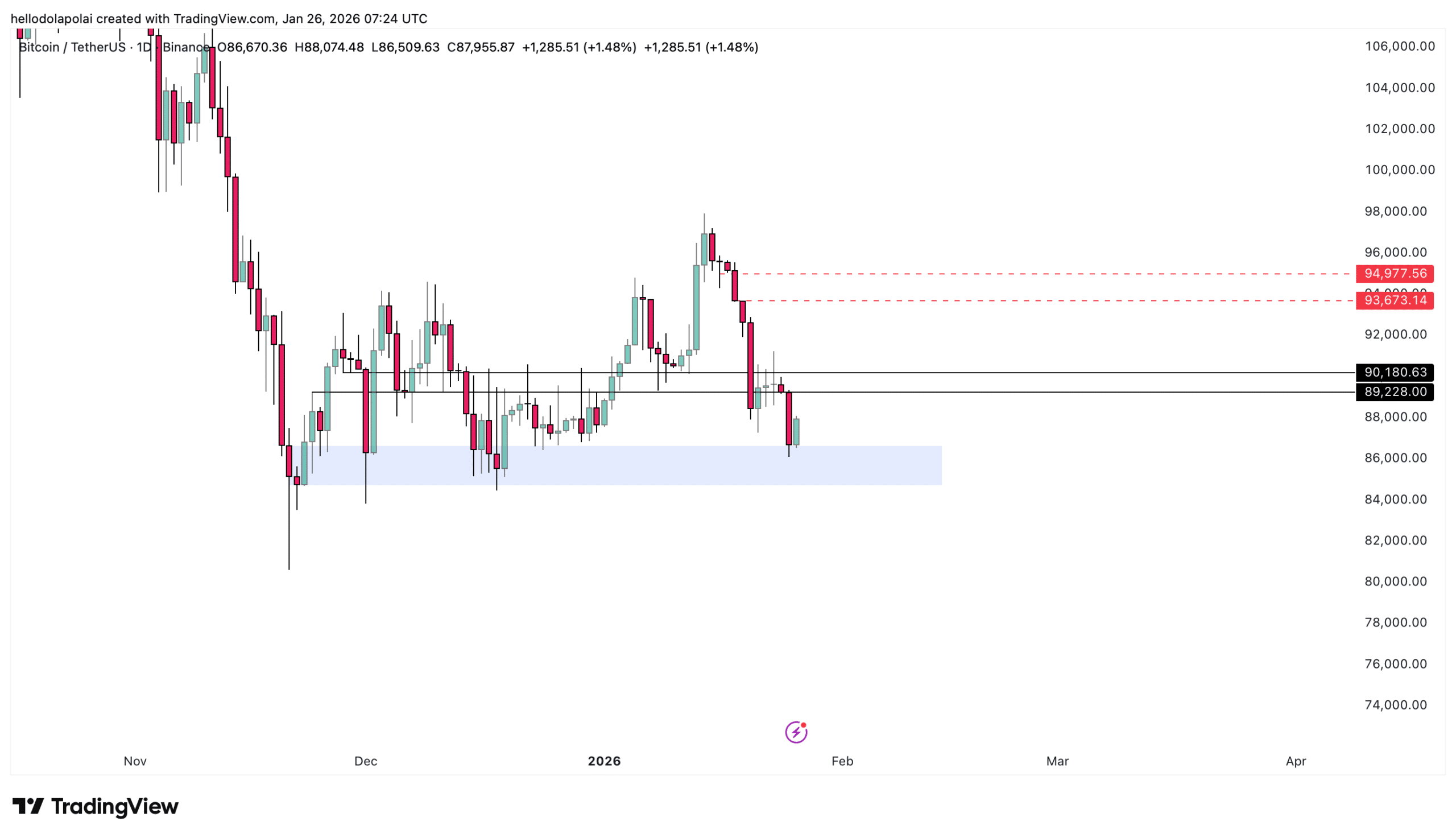
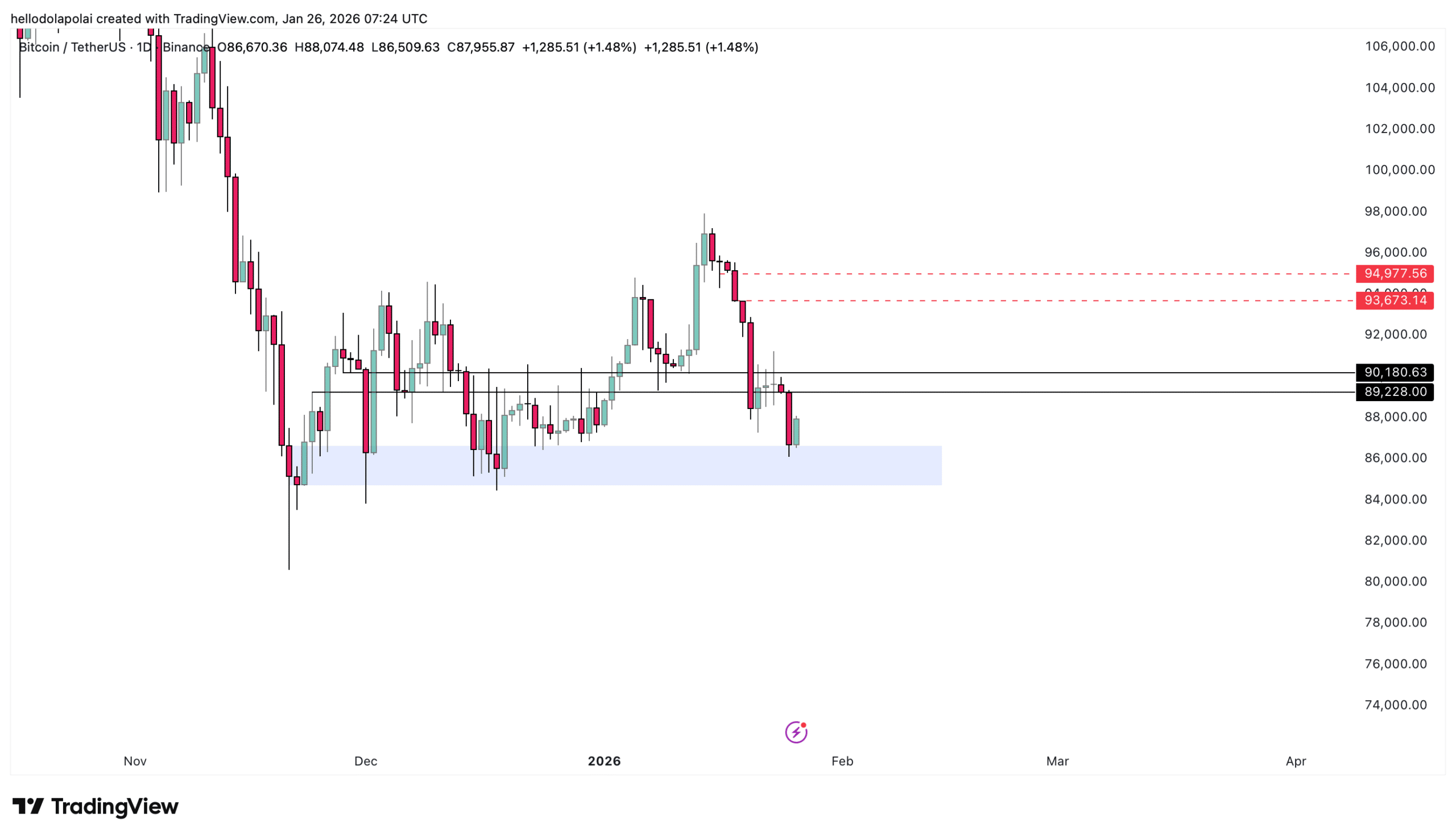
A decisive break above this range could open the door to filling the fair value gap (FVG) between $93,673 and $94,977. Fair value gaps often attract price action, as markets tend to revisit these zones over time.

Despite lingering uncertainty, Bitcoin remains at a pivotal level, where shifts in sentiment, spot demand, or on-chain momentum could define its next major move.


Final Thoughts

  • Bitcoin’s NUPL remains above negative territory, which suggests many investors are still selling out of fear rather than accumulating with conviction.
  • Stronger spot buying and a rise in NUPL, combined with a move above $90k, could improve market confidence.


Related Questions

QWhat does Bitcoin's Net Unrealized Profit/Loss (NUPL) indicate about the current market?

ABitcoin's NUPL trending lower indicates that a growing number of investors are panic-selling, either to lock in profits or cut losses. It remains positive, suggesting that a market bottom has not been reached and downside pressure could persist.

QWhat is the significance of the NUPL metric dipping into negative territory historically?

AHistorically, when NUPL dips into negative territory, it often marks a market bottom—a phase characterized by rising accumulation, a market reset, and the early stages of a rally. In past cycles, this move preceded a sharp rebound that pushed Bitcoin to fresh price highs.

QWhat does the Delta Growth Rate signal about the current market phase for Bitcoin?

AThe Delta Growth Rate has turned negative, signaling a shift from speculation toward fundamental accumulation. Historically, this phase reduces capitulation risk unless it is driven by macro shocks or systemic risk events.

QWhat is the current state of Spot demand for Bitcoin on centralized exchanges?

ASpot demand remains weak. Centralized exchanges recorded roughly $213 million in net Spot selling over the past week, a significant shift from the $943.7 million in Spot buying seen the previous week.

QFrom a technical perspective, what key levels must Bitcoin overcome for a potential rebound?

ABitcoin must first overcome a resistance band between $89,228 and $90,180. A decisive break above this range could open the door to filling the fair value gap (FVG) between $93,673 and $94,977.

Related Reads

US Stocks Suffer Worst Plunge Since 2025: Three Triggers Ignite Tech Stock Valuation Reset

The US stock market experienced its most severe sell-off since the 2025 tariff crisis on June 5th, 2025. The Nasdaq Composite plummeted 4.18%, the S&P 500 fell 2.64%, and the Dow Jones dropped 695 points. The panic stemmed from three converging factors. First, Broadcom's earnings report ignited fears of a slowdown in AI growth. While its AI chip revenue surged 143% YoY to $10.8B, its Q3 AI revenue guidance of $16B fell short of the $17.2B consensus. This triggered a massive sector-wide sell-off, with the Philadelphia Semiconductor Index crashing 10.26% and semiconductor stocks losing roughly $1.3 trillion in market value in a single day. Second, a shockingly strong May jobs report crushed hopes for Federal Reserve rate cuts. Non-farm payrolls added 172,000 jobs, doubling expectations. This robust data, combined with persistently high oil prices above $92/barrel due to the ongoing Iran war and blockade of the Strait of Hormuz, drastically increased market expectations for a potential Fed rate hike instead of a cut. Higher interest rates compress the valuations of growth-heavy tech stocks. Third, the prolonged Iran conflict continues to fuel inflationary pressures, complicating the Fed's policy decisions and undermining the "inflation is tamed" narrative. Together, these events challenged the twin pillars of the market rally: the "limitless AI growth" story and expectations for imminent monetary easing. The sell-off spread globally, impacting Asian and European markets and cryptocurrencies. The article posits this is likely a severe "valuation repricing" rather than the end of the AI story. The underlying demand for AI remains strong, but investor expectations for growth speed and the prices they are willing to pay are being recalibrated. Key upcoming factors include the June FOMC meeting, future AI company earnings, and developments in the Iran conflict.

marsbit3h ago

US Stocks Suffer Worst Plunge Since 2025: Three Triggers Ignite Tech Stock Valuation Reset

marsbit3h ago

From Madison Square Garden to Kalshi: Prediction Markets Break into the NBA Finals

From Madison Square Garden to Kalshi: Prediction Markets Break into the NBA Finals Prediction markets are playing a significant role in the 2026 NBA Finals, particularly around the New York Knicks' unexpected 2-0 series lead. Platforms like Kalshi and Polymarket have seen massive trading volumes, exceeding hundreds of millions of dollars on championship and related markets. Their influence extends beyond online trading. Kalshi's official partnership with Madison Square Garden has given it prominent physical branding at the arena. Furthermore, local businesses like The Jeffrey bar are using prediction market contracts to hedge the risk of game-result-based promotions, turning potential losses into manageable costs—a concept similar to the famous "Mattress Mack" strategy from traditional sports betting. These markets differentiate themselves by offering a wider, more entertainment-focused range of "event contracts" beyond typical game outcomes, such as predicting celebrity attendance. They also have broader accessibility across the U.S. compared to age- and location-restricted traditional sportsbooks. However, their rapid integration into sports raises regulatory and ethical questions. The NBA is cautiously engaging, discussing integrity frameworks with regulators like the CFTC. While the league permits minor investments like Giannis Antetokounmpo's stake in Kalshi, it advocates for strict rules to prevent insider trading. Many fans express concern on platforms like Reddit, fearing that the close ties between prediction markets, the league, and players could compromise the game's integrity. The NBA Finals has thus become a high-stakes testing ground, showcasing prediction markets' commercial potential while challenging traditional boundaries between financial trading, entertainment, and gambling.

marsbit6h ago

From Madison Square Garden to Kalshi: Prediction Markets Break into the NBA Finals

marsbit6h ago

Recursive Self-Improvement AI Gains Traction, Google Pours Cold Water, While DeepSeek and Others Approach the Fringes

The term "recursive self-improvement" (RSI), where AI improves itself autonomously, is gaining momentum in the AI industry. Startups like Recursive Superintelligence and projects such as Andrej Karpathy's Auto-Research aim to create systems where AI designs, implements, and validates its own research, moving toward superintelligence. While Google CEO Sundar Pichai cautions that such exponential acceleration is not yet a reality, progress is evident. For instance, Anthropic reported its Claude Code writes nearly 100% of the team's code, though it still lacks true self-direction. Analysts frame RSI development in stages: "adequacy" (systems functioning without humans), "parity" (matching human research quality), and "supremacy" (exceeding human-AI collaboration). Reaching parity could trigger rapid, unpredictable advancement due to AI's continuous operation. In China, companies like DeepSeek and Baidu incorporate self-optimization techniques without explicitly branding them as RSI, focusing on algorithmic efficiency and reinforcement learning. However, challenges remain, including "model collapse" from training on AI-generated data and the immense computational and open-collaboration requirements. Ultimately, RSI represents a trend of increasing automation in AI development, potentially reducing human oversight in the creation process itself.

marsbit6h ago

Recursive Self-Improvement AI Gains Traction, Google Pours Cold Water, While DeepSeek and Others Approach the Fringes

marsbit6h ago

Trading

Spot
Futures

Hot Articles

What is $BITCOIN

DIGITAL GOLD ($BITCOIN): A Comprehensive Analysis Introduction to DIGITAL GOLD ($BITCOIN) DIGITAL GOLD ($BITCOIN) is a blockchain-based project operating on the Solana network, which aims to combine the characteristics of traditional precious metals with the innovation of decentralized technologies. While it shares a name with Bitcoin, often referred to as “digital gold” due to its perception as a store of value, DIGITAL GOLD is a separate token designed to create a unique ecosystem within the Web3 landscape. Its goal is to position itself as a viable alternative digital asset, although specifics regarding its applications and functionalities are still developing. What is DIGITAL GOLD ($BITCOIN)? DIGITAL GOLD ($BITCOIN) is a cryptocurrency token explicitly designed for use on the Solana blockchain. In contrast to Bitcoin, which provides a widely recognized value storage role, this token appears to focus on broader applications and characteristics. Notable aspects include: Blockchain Infrastructure: The token is built on the Solana blockchain, known for its capacity to handle high-speed and low-cost transactions. Supply Dynamics: DIGITAL GOLD has a maximum supply capped at 100 quadrillion tokens (100P $BITCOIN), although details regarding its circulating supply are currently undisclosed. Utility: While precise functionalities are not explicitly outlined, there are indications that the token could be utilized for various applications, potentially involving decentralized applications (dApps) or asset tokenization strategies. Who is the Creator of DIGITAL GOLD ($BITCOIN)? At present, the identity of the creators and development team behind DIGITAL GOLD ($BITCOIN) remains unknown. This situation is typical among many innovative projects within the blockchain space, particularly those aligning with decentralized finance and meme coin phenomena. While such anonymity may foster a community-driven culture, it intensifies concerns about governance and accountability. Who are the Investors of DIGITAL GOLD ($BITCOIN)? The available information indicates that DIGITAL GOLD ($BITCOIN) does not have any known institutional backers or prominent venture capital investments. The project seems to operate on a peer-to-peer model focused on community support and adoption rather than traditional funding routes. Its activity and liquidity are primarily situated on decentralized exchanges (DEXs), such as PumpSwap, rather than established centralized trading platforms, further highlighting its grassroots approach. How DIGITAL GOLD ($BITCOIN) Works The operational mechanics of DIGITAL GOLD ($BITCOIN) can be elaborated on based on its blockchain design and network attributes: Consensus Mechanism: By leveraging Solana’s unique proof-of-history (PoH) combined with a proof-of-stake (PoS) model, the project ensures efficient transaction validation contributing to the network's high performance. Tokenomics: While specific deflationary mechanisms have not been extensively detailed, the vast maximum token supply implies that it may cater to microtransactions or niche use cases that are still to be defined. Interoperability: There exists the potential for integration with Solana’s broader ecosystem, including various decentralized finance (DeFi) platforms. However, the details regarding specific integrations remain unspecified. Timeline of Key Events Here is a timeline that highlights significant milestones concerning DIGITAL GOLD ($BITCOIN): 2023: The initial deployment of the token occurs on the Solana blockchain, marked by its contract address. 2024: DIGITAL GOLD gains visibility as it becomes available for trading on decentralized exchanges like PumpSwap, allowing users to trade it against SOL. 2025: The project witnesses sporadic trading activity and potential interest in community-led engagements, although no noteworthy partnerships or technical advancements have been documented as of yet. Critical Analysis Strengths Scalability: The underlying Solana infrastructure supports high transaction volumes, which could enhance the utility of $BITCOIN in various transaction scenarios. Accessibility: The potential low trading price per token could attract retail investors, facilitating wider participation due to fractional ownership opportunities. Risks Lack of Transparency: The absence of publicly known backers, developers, or an audit process may yield skepticism regarding the project's sustainability and trustworthiness. Market Volatility: The trading activity is heavily reliant on speculative behavior, which can result in significant price volatility and uncertainty for investors. Conclusion DIGITAL GOLD ($BITCOIN) emerges as an intriguing yet ambiguous project within the rapidly evolving Solana ecosystem. While it attempts to leverage the “digital gold” narrative, its departure from Bitcoin's established role as a store of value underscores the need for a clearer differentiation of its intended utility and governance structure. Future acceptance and adoption will likely depend on addressing the current opacity and defining its operational and economic strategies more explicitly. Note: This report encompasses synthesised information available as of October 2023, and developments may have transpired beyond the research period.

363 Total ViewsPublished 2025.05.13Updated 2025.05.13

What is $BITCOIN

Discussions

Welcome to the HTX Community. Here, you can stay informed about the latest platform developments and gain access to professional market insights. Users' opinions on the price of BTC (BTC) are presented below.

活动图片