Grayscale cuts fees ahead of MSOL launch – Will institutions drive Solana’s next rally?

ambcryptoPublished on 2026-06-26Last updated on 2026-06-26

Abstract

Grayscale has reduced the fee for its Spot Solana (SOL) ETF from 0.35% to 0.19%, positioning it among the lowest-cost Solana ETFs. This move is seen as a competitive response to Morgan Stanley's planned launch of a Solana ETF (MSOL) with an even lower 0.14% fee. While the broader crypto market is weak, with over $100 billion flowing out recently, institutional interest in Solana appears to be growing strategically. This interest is underpinned by Solana's on-chain strength, including a record Real-World Asset (RWA) ecosystem value surpassing $3.10 billion. Additional institutional support comes from listings like the Solana ETF on the Kazakhstan Stock Exchange. Analysts suggest these converging signals—ETF competition, sustained on-chain activity, and institutional positioning—could set the stage for a stronger institutional cycle for SOL in Q3, potentially diverging from broader market weakness.

Institutional moves in a volatile market are rarely a coincidence.

On the macro side, things are still looking risk-off. Over $100 billion has flowed out of crypto this week, dragging total market cap down to $1.99 trillion, levels not seen since September 2024.

Clearly, the market is in a weak phase, where technical downside could start lining up with softer on-chain signals.

But is Solana starting to diverge from the broader trend? From a technical view, SOL’s 5.7% weekly pullback shows it’s still tracking the wider market weakness, and a move toward $60 isn’t off the table if pressure continues.

That said, Grayscale’s move has definitely sparked some attention around SOL’s Q3 setup.
Source: X

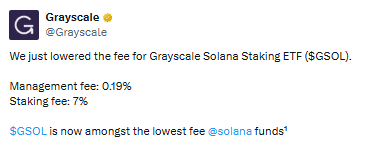
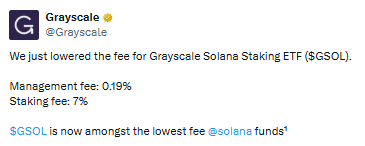
As the post above highlights, Grayscale has cut its Spot Solana [SOL] ETF annual fee to 0.19%, down from 0.35%. More importantly, that now puts it among the lowest-fee Solana ETFs in the market (tied with FT), which is a pretty aggressive positioning shift compared to its earlier standing.

However, when you look at the recent move by Morgan Stanley, Grayscale’s decision doesn’t seem random. On Thursday, the firm filed amended Form S-1 statements with the SEC for its ETF lineup, signaling plans to undercut current market offerings with a 0.14% fee for its Solana ETF (MSOL).

In essence, Grayscale looks like it’s reacting to growing fee competition in the ETF space.

Notably, timing matters here. Solana’s technical setup is still weak, but institutional interest hasn’t really faded. Instead, it appears that positioning is continuing or rotating quietly even as broader market conditions stay soft.

And when you factor in Solana’s on-chain activity, these strategic moves don’t look random.

Institutional flows hint at Solana Q3 setup

The market is betting on a strong foundation building for Solana over the next 18 months.

At the developer level, this is driven by tokenomics improvements, tokenized asset trading, and renewed speculation across meme coins and AI plays. On top of that, Solana’s RWA sector is already seeing record activity this year.

The RWA ecosystem has surpassed $3.10 billion in total value, hitting a new all-time high, while the number of holders has crossed 290,000.

Supporting this view, Multicoin co-founder Tushar Jain says Hyperliquid [HYPE] is “complementary” to the firm’s SOL positions, with Solana leading in spot trading, while Hyperliquid leads in derivatives. Jain adds that while the two may compete, Multicoin expects both to outperform the rest of the field.


Source: X

Against this backdrop, Grayscale’s latest move extends beyond simple fee competition.

Further supporting Solana ETF momentum, the Kazakhstan Stock Exchange (KASE), one of Central Asia’s largest exchanges, has listed the Volatility Shares Solana ETF (SOLZ), adding another layer of institutional access and global distribution to the ecosystem narrative.

Hence, calling Solana’s Q3 setup a strong institutional cycle for SOL might not be too far-fetched. Instead, with ETF momentum and on-chain signals starting to converge, Solana increasingly looks like it’s entering a phase where institutional flows could start catching up with fundamentals.



Final Summary

Trending Cryptos

Related Questions

QWhy did Grayscale cut its Spot Solana ETF annual fee?

AGrayscale cut its Spot Solana ETF annual fee from 0.35% to 0.19% as a competitive response to fee pressures in the market, notably ahead of Morgan Stanley's planned launch of its own Solana ETF (MSOL) with an even lower fee of 0.14%.

QWhat is the current state of the broader crypto market according to the article?

AThe broader crypto market is in a risk-off and weak phase, with over $100 billion flowing out this week, dragging the total market cap down to $1.99 trillion, a level not seen since September 2024.

QWhat are some of the fundamental factors supporting institutional interest in Solana (SOL)?

AKey factors include tokenomics improvements, growth in tokenized asset trading, activity in meme coins and AI projects, and a rapidly expanding Real-World Asset (RWA) ecosystem, which has surpassed $3.10 billion in total value and has over 290,000 holders.

QHow is Solana's price action currently relating to the broader market trend?

ASolana is still largely tracking the broader market weakness, with a 5.7% weekly pullback, and a potential move toward $60 is not off the table if selling pressure continues.

QWhat recent development adds to the institutional access for Solana ETFs?

AThe Kazakhstan Stock Exchange (KASE), one of Central Asia's largest exchanges, has listed the Volatility Shares Solana ETF (SOLZ), adding another layer of institutional access and global distribution to the Solana ecosystem.

Related Reads

Bitcoin Withdrawals Continue: 8 Years of Storage in a Coldcard Cold Wallet Ended in Zero

Coldcard Hardware Wallet Hacked: Losses Mount Due to Vulnerable Seed Generation A critical vulnerability in Coldcard hardware wallets has led to a continued wave of fund thefts. According to Galaxy Research, the total stolen has reached 1,367.05 BTC (approx. $88.6 million) from 4,585 addresses, a significant increase from the initial 594.5 BTC reported on July 30, 2026. Most of the stolen funds remain on the attackers' addresses. The issue is not with the current firmware, which Coinkite has updated, but with seed phrases generated on vulnerable devices between March 2021 and the release of fixed firmware versions. Due to a programmer error, devices switched from using a hardware random number generator to the software-based Yasmarang generator, which was initialized with publicly accessible data like the chip's serial number. This made the seed phrases predictable through offline brute-force attacks, meaning wallets remain at risk until funds are moved to a new wallet generated with the patched firmware. Affected devices include Mk2/Mk3 with firmware 4.0.1–4.1.9 (and up to 5.0.3), Mk4/Mk5 up to version 5.6.0, and Q models up to 1.5.0Q. The only exceptions are seeds created with a high-entropy method like at least 50 independent dice rolls or a strong unique BIP-39 passphrase. All other owners must generate a new seed on the fixed firmware and transfer their assets. A case highlighting the human impact involves a 39-year-old long-term investor who lost 2 BTC (approx. $130,000) in minutes. He had accumulated the Bitcoin over eight years through physical labor, viewing it as a financial lifeline and a retirement plan in a country suffering from hyperinflation. His story underscores that even conservative "buy and hold in cold storage" strategies can be compromised by such underlying technical flaws. From a technical perspective, this incident echoes historical failures where weak random number generators undermined cryptographic security, challenging the assumption that offline storage is automatically foolproof.

cryptonews.ru4h ago

Bitcoin Withdrawals Continue: 8 Years of Storage in a Coldcard Cold Wallet Ended in Zero

cryptonews.ru4h ago

Trading

Spot

Hot Articles

Discussions

Welcome to the HTX Community. Here, you can stay informed about the latest platform developments and gain access to professional market insights. Users' opinions on the price of SOL (SOL) are presented below.

活动图片