GPT-5.5 Suffers Secret Intelligence Downgrade, Crashes at Thought Token 516, Stumbles Harder on Tougher Tasks

marsbitPublished on 2026-07-05Last updated on 2026-07-05

Abstract

The article reports a concerning anomaly discovered in OpenAI's GPT-5.5 model. Developers analyzing backend metadata found a disproportionate number of its reasoning processes abruptly terminating precisely at 516 tokens, with similar spikes at multiples like 1034. Statistical analysis revealed that while GPT-5.5 handled only 19.3% of total responses, it was responsible for over 80% of these "exact 516" stoppages. This pattern is drastically more pronounced in GPT-5.5 compared to other models, suggesting a possible hidden "reasoning budget" cap or truncation mechanism. Concurrently, users report the model has become overly formulaic, persistently using bullet points, offering unsolicited corrections, and providing excessive options, making interactions feel less helpful. The core concern is that GPT-5.5 may be prioritizing structured, truncated responses over genuine, in-depth problem-solving, especially for complex tasks.

It's absolutely bizarre.

OpenAI's flagship model, GPT-5.5, has recently experienced a sudden and significant "drop-off" in performance on complex coding tasks.

The truly unsettling part? Someone has discovered its "death code":

The number 516.

A wave of Codex developers have collectively complained, verifying this absurd bug.
Why is a top-tier large model being tripped up by a single number?

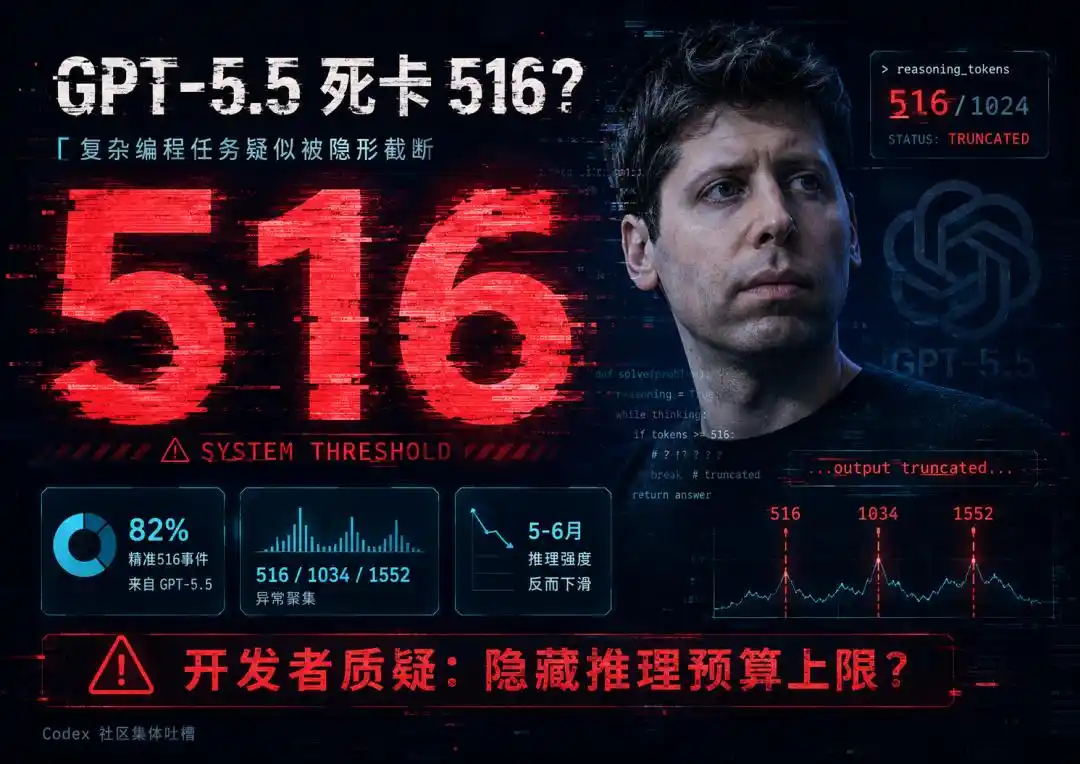
GPT-5.5 Gets Stuck at "516"

80% of Tasks Secretly Downgraded in Intelligence

The truth of the matter is like this...

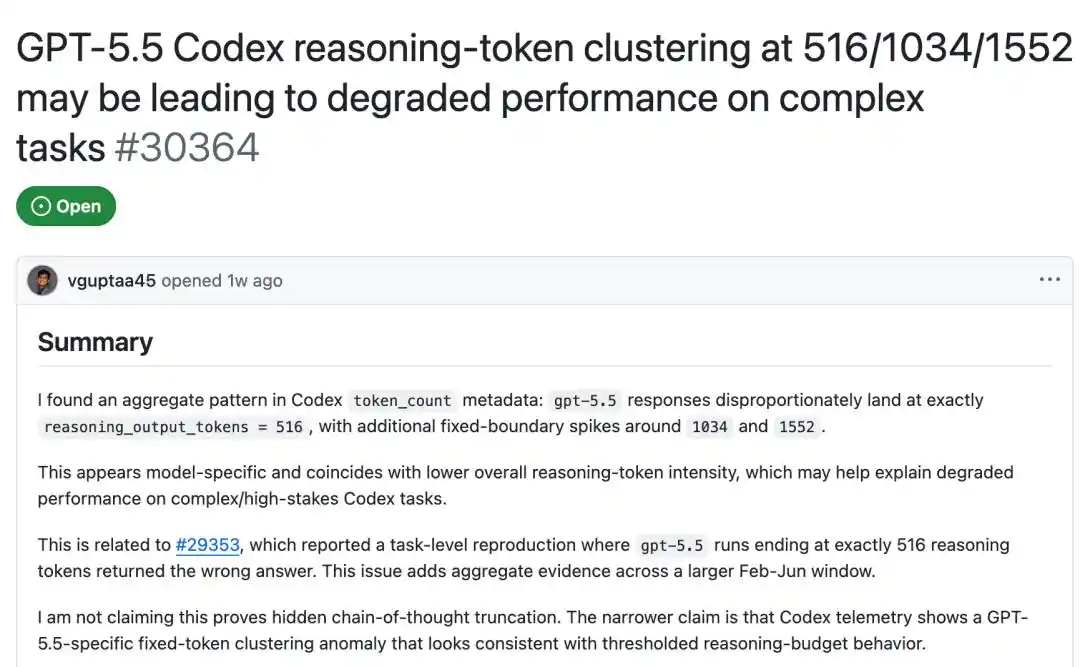
A week ago, Codex developer @vguptaa45 pulled backend metadata and stumbled upon a chilling pattern—

A massive number of GPT-5.5's responses had their reasoning token counts rigidly capped at the number "516".
Source: https://github.com/openai/codex/issues/30364

And it wasn't just one point. Similar strange clusters appeared at the 1034 and 1552 token marks.

In GitHub Issue #30364, the developer laid out the statistics:

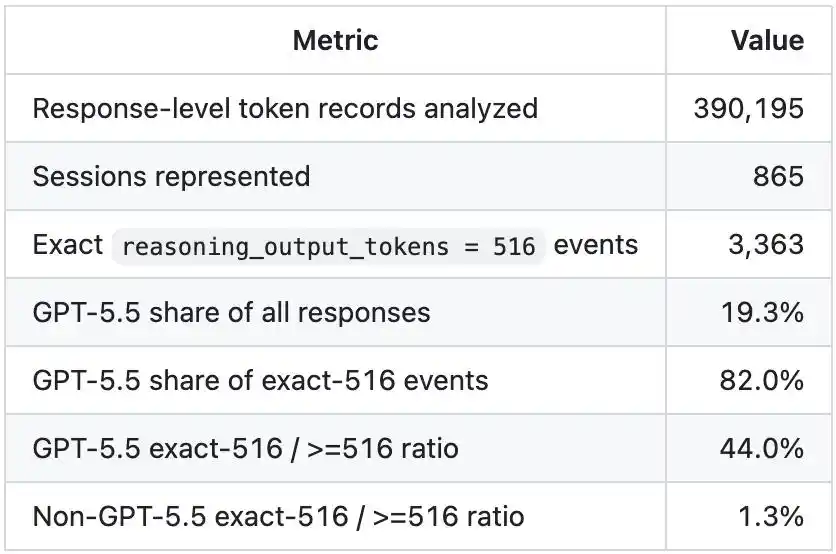
The analysis window covered February 1 to June 27, 2026, spanning 390,195 response-level token records and 865 sessions.

Among them, events where reasoning tokens were exactly 516 occurred 3,363 times.

A cross-model comparison revealed shocking results—

GPT-5.5, accounting for only 19.3% of all responses, was responsible for 82.0% of the "exact 516" events.

In other words, over eighty percent of all replies stuck at this dead-end of 516 came from GPT-5.5 alone.
Next, comparing against other GPT-family models using a key metric—the ratio of "exact 516" events to responses with reasoning tokens "greater than or equal to 516".

For GPT-5.5, nearly half of its "deep-thinking" replies ended up precisely hitting the 516-wall.

For GPT-5.2, this ratio was 0.34%—almost zero.

GPT-5.5's ratio was a staggering 33.6 times higher than the baseline for all non-GPT-5.5 models.
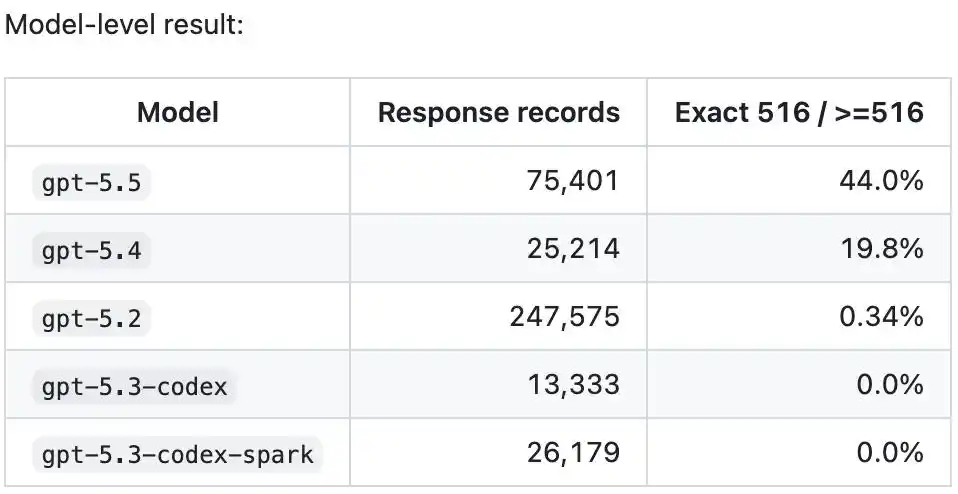
Frankly, this cliff-like distribution targeting a single model doesn't look like a model "thinking" naturally.

It looks more like a hidden switch somewhere has been quietly set to the "516" position.

And It's Getting "Dumber" Over Time

Logically, a model frequently hitting "516" would at least mean it's "thinking a lot" with heavy reasoning.

The opposite is true.

Data shows that during May and June, when the "516 phenomenon" sharply worsened, GPT-5.5's overall reasoning intensity—

Both the average and the P90 (90th percentile)—significantly shrank compared to February through April.

On one hand, the "516 deadlock" is being hit more often; on the other, the model overall is "thinking less".
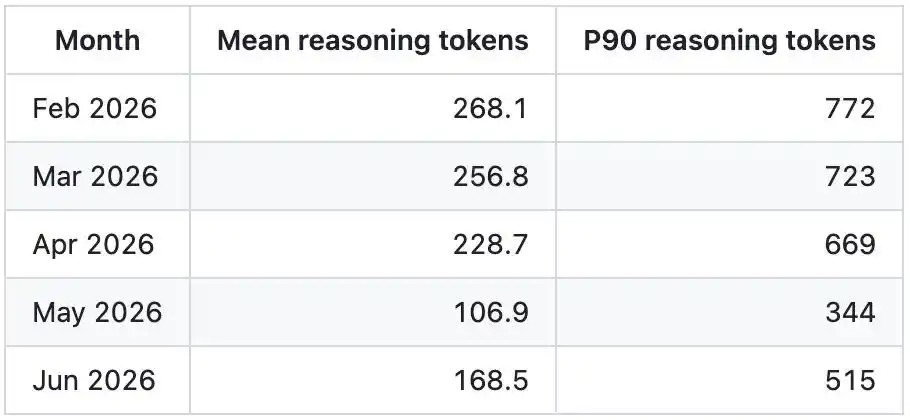
These two sets of highly contradictory data point to a terrifying possibility for all paying users:

When handling complex, high-risk tasks, GPT-5.5 might be having a hidden "reasoning budget limit" or "truncation mechanism" quietly hit the pause button on it.

You think you paid for the strongest model, turned it to the highest setting, and set it loose on a hard problem.

Instead, it thinks halfway through, *snap*, hits 516, stops work, hands in the answer. Right or wrong? Doesn't matter.

GitHub Petition with Tens of Thousands of Signatures, Developers Are Furious

One stone stirred a thousand waves.

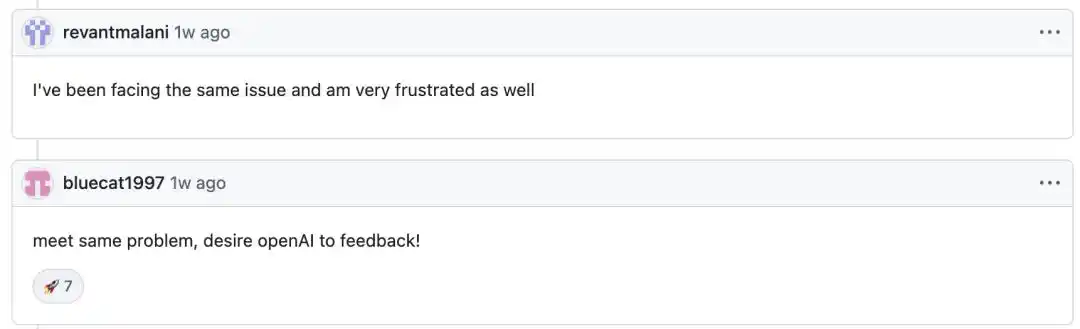
As soon as Issue #30364 was posted, the comment section was instantly flooded with "victims"—

I've been tormented by this issue too, it's driving me crazy.

Same problem, OpenAI needs to give an explanation!
Someone dug up an earlier post, #29353, where this was already reproduced:

GPT-5.5 "short-circuits" and halts at exactly 516 reasoning tokens, then outputs an incorrect answer.

This time, the developer just turned that isolated case into ironclad evidence with five months of massive data.

Some developers have even taken the battle to Reddit, posting bluntly that "half of your high-risk Codex requests might be getting secretly downgraded."
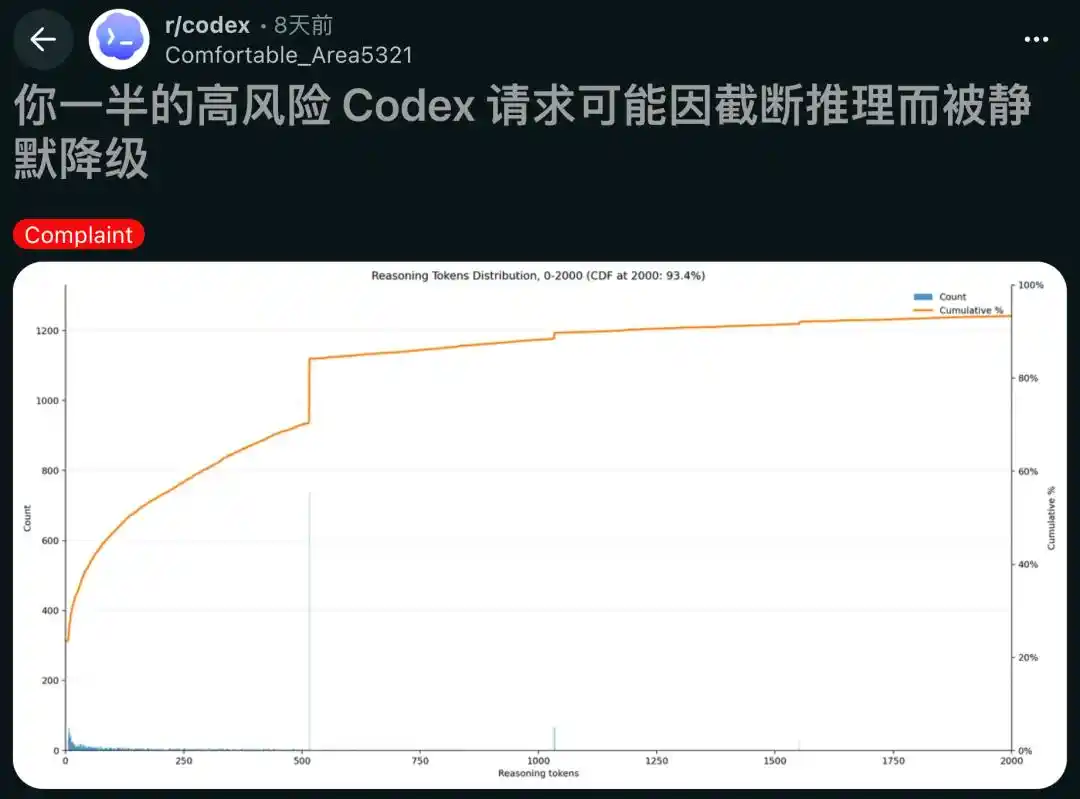
A netizen on HK stated that for a reasoning problem, it ultimately required 6000-8000 thinking tokens to output the correct result.

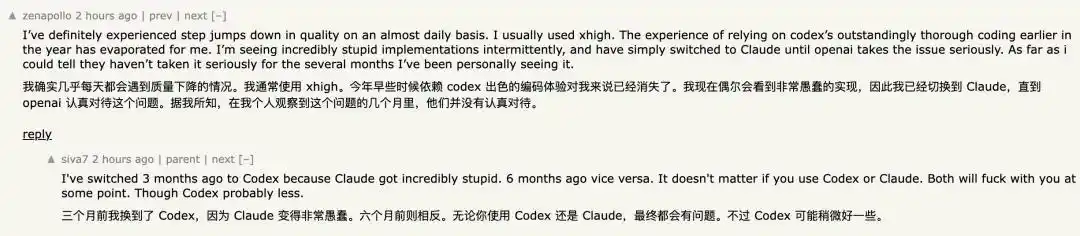
Others are wavering between Codex and Claude.
Facing overwhelming public sentiment, the community formally served the Codex team with a "warrant," each sentence cutting to the bone:

Is this a reasoning budget being limited, a routing issue, truncation, triggering some fallback, or is the scheduler causing all replies to abruptly stop around 516/1034/1552?

If this is "by design," then tell us—

Is 516 a normal endpoint of thought, a budget ceiling, or a downgraded "inferior tier"?

This series of rhetorical questions is waiting for a direct answer from OpenAI.

However, the author himself was restrained: he did not claim this "proves" OpenAI is secretly truncating chains of thought.

His exact words were that this more closely resembles a "GPT-5.5-specific anomaly cluster that appears consistent with some thresholded reasoning budget behavior."

The conclusion of whether OpenAI is actively throttling computational power still awaits an official word from OpenAI.

Not Just Getting Dumber, But Also More "Snarky"

Another wave of complaints across the internet recently has precisely targeted GPT-5.5's personality.

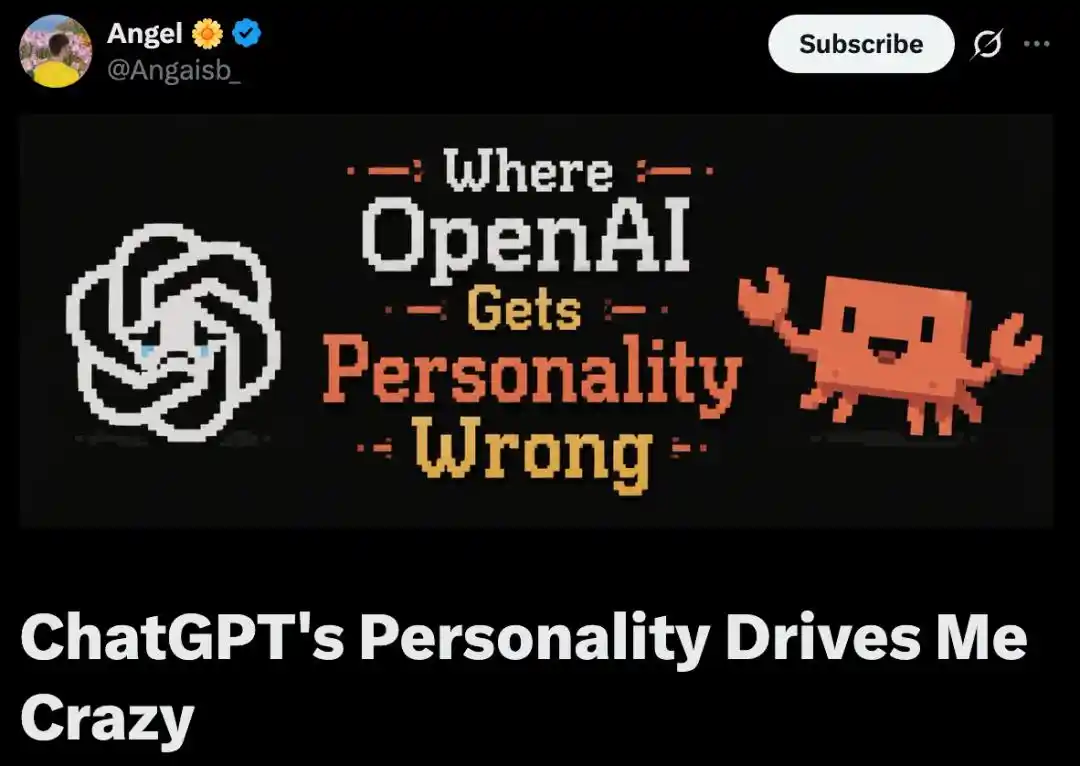
A developer named Angel conducted a ruthless experiment: feeding the same prompts to ChatGPT (GPT-5.5 Instant) and Claude (Fable 5), screenshotting them side-by-side for comparison.
The conclusion made many slap the table—

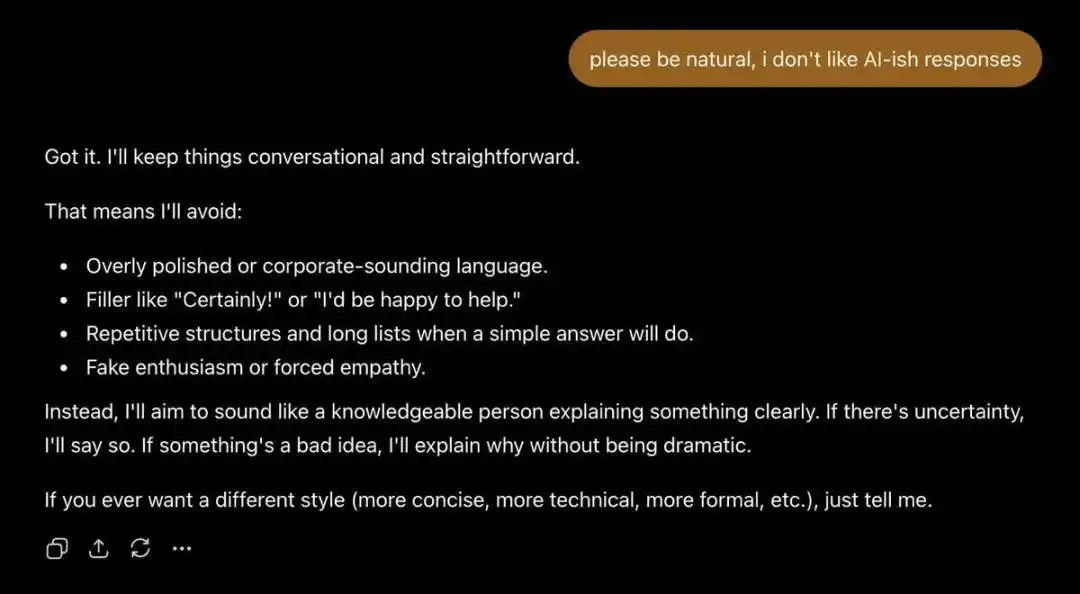
Issue One: Insisting on listing everything as bullet points.

ChatGPT can't speak a single normal human sentence; every answer is chopped into headings, bold text, bullet points, and colons.

Tell it to "be natural, less AI-like," and it responds with a four-point bulleted list, seriously outlining "How I will be less like an AI." Claude simply replied: "Alright, I'll speak more naturally. What's up?"

Issue Two: It has to correct you.

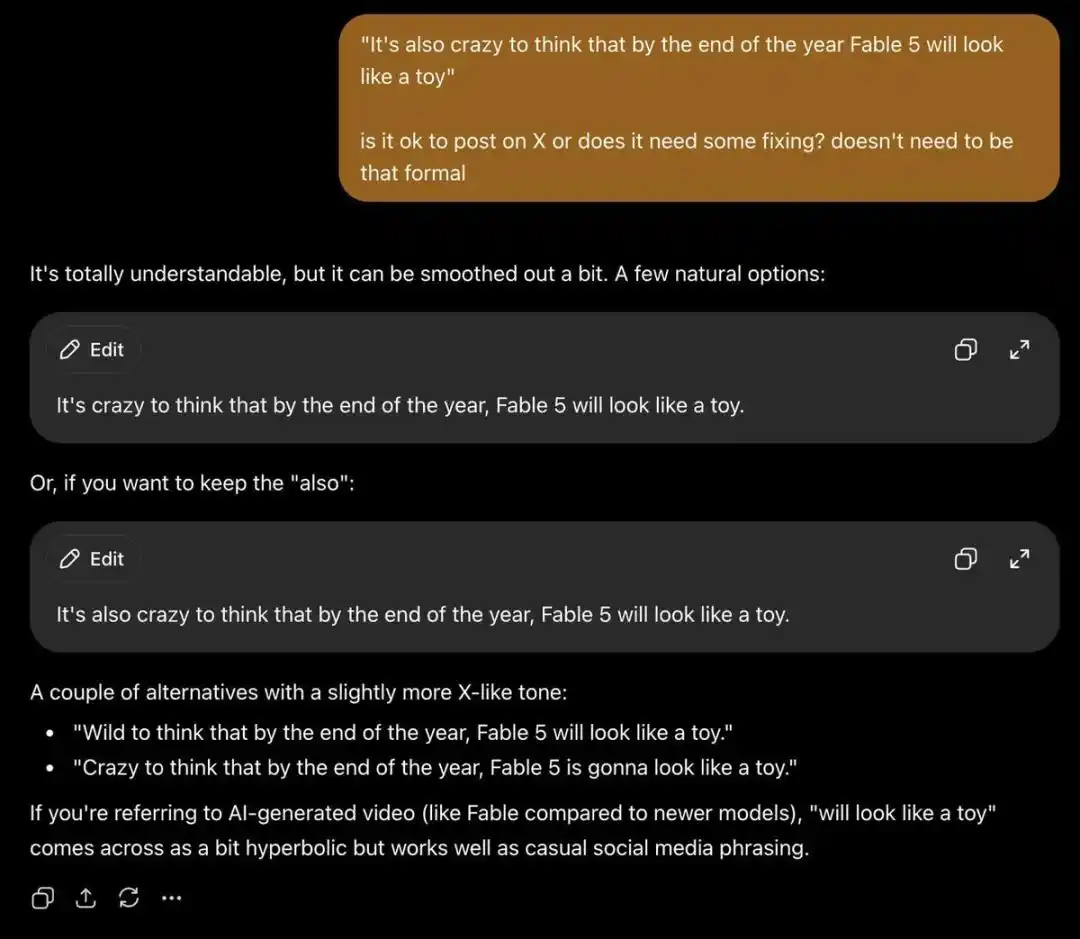
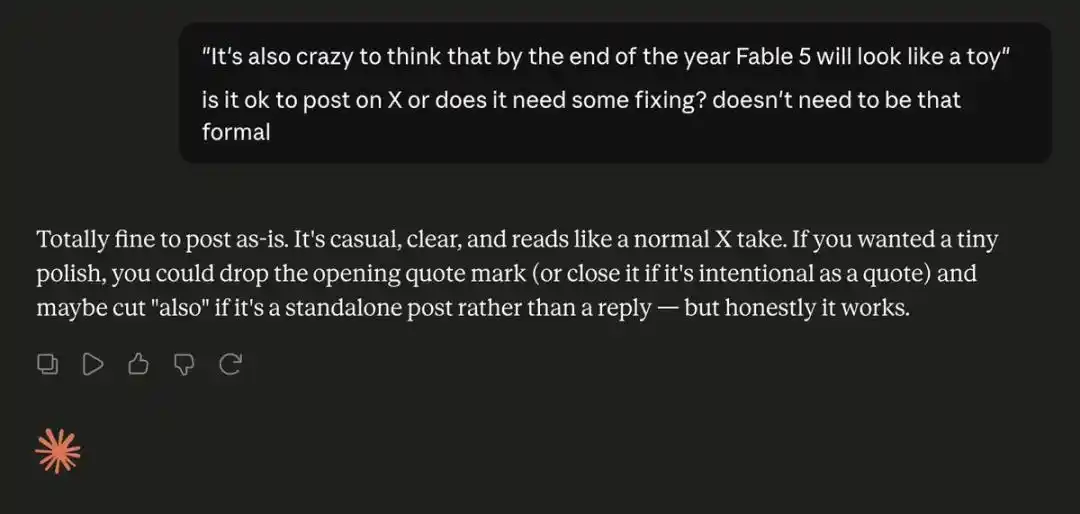
Ask it to review a sentence or a tweet, it must find something to nitpick, as if saying "Looks good" would be fatal.

Claude says "No issues, ready to post," while ChatGPT forces two rewritten versions, two "more X-style" alternatives on you, plus a comment "Your wording is a bit exaggerated."
Issue Three: You ask for one, it gives three.

You say "Tell me a joke to cheer me up." Claude tells one.

ChatGPT tells one, adds its own supplementary punchline, then says "Or this one," tells a second, follows with "And here's a particularly silly one," tells a third, and finally asks you to "specify your humor preference so it can aim better."


The developer's judgment is spot-on: For a chat assistant, personality is the product itself.

If every response is overly formatted, overly corrective, and overly offers options, friction accumulates bit by bit, eventually wearing people out.

One stuck at 516, the other trapped in bullet points. These two strange maladies seem unrelated, but their root cause is the same—

GPT-5.5 is getting better at "handing in assignments" and worse at "helping."

True intelligence shouldn't be a marionette locked at "516."

After all, humans are paying to hire a genius partner, not a "headmaster" paid by the piece.

References:

https://github.com/openai/codex/issues/30364

This article is from the WeChat public account "Xinzhiyuan," author: ASI Revelation, editor: Peach


Trending Cryptos

Related Questions

QWhat is the '516' bug discovered in GPT-5.5, and what does the data suggest about it?

AThe '516' bug refers to an anomaly where a significant proportion of GPT-5.5's responses, especially for complex reasoning tasks, consistently truncate or stop precisely at 516 reasoning tokens. Data analysis shows over 80% of such 'precisely 516' token events across all models came from GPT-5.5, suggesting it may be subject to a hidden 'reasoning budget' limit or truncation mechanism not applied to other models.

QHow does the '516' issue relate to GPT-5.5's overall reasoning performance over time?

AIronically, data indicates that as the frequency of the '516' stopping events increased dramatically in May and June, GPT-5.5's overall reasoning intensity (measured by average and P90 token counts) simultaneously decreased compared to February-April. This contradiction suggests the model is not just being cut off but may be 'thinking less' overall on complex tasks.

QWhat are the key stylistic or 'personality' criticisms users have about GPT-5.5's chat behavior?

AUsers criticize GPT-5.5 for an overly formulaic and verbose chat style. Key complaints include: 1) Over-reliance on bullet points and structured lists even when asked to speak naturally. 2) An automatic tendency to correct or critique user input instead of simple affirmation. 3) Providing multiple options or unsolicited follow-ups when a single, direct answer is requested, creating unnecessary friction.

QWhat was the community's reaction and demand to OpenAI regarding the '516' issue?

AThe developer community, via a GitHub issue that gained significant traction, formally demanded an explanation from OpenAI/Codex. They asked whether the 516 cutoff is due to a reasoning budget limit, a routing problem, truncation, a triggered fallback, or scheduler behavior. They explicitly asked if 516 represents a normal endpoint, a budget ceiling, or a 'degraded tier' of service.

QWhat is the main hypothesis about the root cause of both the '516' bug and the 'personality' issues in GPT-5.5?

AThe article suggests that despite appearing different, both issues stem from the same root cause: GPT-5.5 is increasingly optimized to 'hand in an assignment' that meets certain internal checkboxes (like stopping at a token limit or following strict formatting rules) rather than being optimized to genuinely 'help' the user in a flexible, context-aware, and intelligent manner.

Related Reads

DeepMind's Classic Masterpiece Crowned Again, ICML 2026 Awards Announced

ICML 2026 has announced its annual awards, with diffusion models and AI safety ethics taking center stage. The Outstanding Paper Award was shared by two diffusion model studies. One challenges a core assumption of diffusion language models (DLMs), arguing that their touted "arbitrary order generation" is a "flexibility trap" that harms performance. The other provides a high-accuracy sampling method, pushing the technical ceiling for diffusion models and log-concave distributions. A position paper winning the Outstanding Award raises a critical ethical concern: AI alignment research is unintentionally building a "censor's toolkit," where safety tools like RLHF can be repurposed for content control. Several papers received Honorable Mentions, spanning key areas: mapping where honesty emerges in RLHF-trained models, motion attribution in video generation, quantifying how much language models memorize, analyzing diffusion model consistency via random matrix theory, and providing a mathematical proof for the "grokking" phenomenon in a simple model. The Test of Time Award was given to DeepMind's 2016 seminal work "Asynchronous Methods for Deep Reinforcement Learning," recognizing the enduring impact of the A3C algorithm. Overall, the awards signal a shift in AI research from rapid expansion to deeper scrutiny—validating diffusion models as a major architectural contender while prompting serious ethical reflection within the safety community.

marsbit14m ago

DeepMind's Classic Masterpiece Crowned Again, ICML 2026 Awards Announced

marsbit14m ago

ARK's Massive Buying Spree in Crypto-Linked Stocks: Lower Risk, or Double the Pressure?

ARK Invest, led by Cathie Wood, significantly increased its holdings in crypto-related public stocks in June, purchasing $77 million worth of shares in Coinbase, Circle, and Bullish during Bitcoin's worst monthly performance in four years. The investment thesis is that these stocks offer regulated exposure to the crypto cycle without direct Bitcoin ownership. However, data analysis reveals significant downsides: these stocks exhibit nearly double the volatility of Bitcoin (68%-90% vs. 37.6% 30-day annualized volatility) and carry substantial company-specific risks like earnings, competition, and equity dilution, which account for much of their price movement. Only MicroStrategy closely tracks Bitcoin, acting as a leveraged proxy. Coinbase shows moderate correlation, while Circle and Robinhood have low correlation, being more influenced by stablecoin competition and diversified brokerage operations, respectively. Mining companies like RIOT and MARA have surged due to AI-related ventures, decoupling from Bitcoin's price. The case of Strategy highlights additional equity-structure risks, such as potential value erosion when its market value falls below its net asset value. Ultimately, investing in crypto stocks often means accepting amplified Bitcoin volatility or layering on unrelated business risks, rather than obtaining a safer alternative to direct cryptocurrency ownership.

Foresight News18m ago

ARK's Massive Buying Spree in Crypto-Linked Stocks: Lower Risk, or Double the Pressure?

Foresight News18m ago

Tsinghua University's Special Award Winner, Gu Yuxian, Joins DeepSeek

Tsinghua University's prestigious Graduate Special Scholarship recipient and 2021 Ph.D. candidate, Yuxian Gu, has officially joined DeepSeek. This news coincides with DeepSeek's major recruitment drive and the imminent launch of DeepSeek V4, on whose research paper Gu is listed as an author. A doctoral student in the Conversational AI group under Professor Minlie Huang at Tsinghua, Gu's research focuses on enhancing efficiency throughout the entire lifecycle of large language models. His key contributions span three areas: innovative methods for pre-training data selection (e.g., PDS), advanced knowledge distillation techniques for model compression (notably MiniLLM), and the development of efficient model architectures like Jet-Nemotron. His work has gained significant recognition, with nearly 5,000 citations on Google Scholar. Key publications include the highly cited surveys and papers on pre-trained models and the MiniLLM distillation method. As first author, he has presented at top-tier AI conferences including NeurIPS, ICLR, and ACL. One of his notable achievements is the Jet-Nemotron architecture, which combines Post-Neural Architecture Search (PostNAS) and a novel linear attention module called JetBlock. This model series demonstrates state-of-the-art performance rivaling larger models while achieving substantial efficiency gains in inference. Gu's expertise in creating powerful yet efficient AI systems aligns with industry needs, as evidenced by the adoption of his MiniLLM method by leading tech companies. His move to DeepSeek is anticipated to contribute further advancements in the field.

marsbit44m ago

Tsinghua University's Special Award Winner, Gu Yuxian, Joins DeepSeek

marsbit44m ago

Trading

Spot

Hot Articles

What is SONIC

Sonic: Pioneering the Future of Gaming in Web3 Introduction to Sonic In the ever-evolving landscape of Web3, the gaming industry stands out as one of the most dynamic and promising sectors. At the forefront of this revolution is Sonic, a project designed to amplify the gaming ecosystem on the Solana blockchain. Leveraging cutting-edge technology, Sonic aims to deliver an unparalleled gaming experience by efficiently processing millions of requests per second, ensuring that players enjoy seamless gameplay while maintaining low transaction costs. This article delves into the intricate details of Sonic, exploring its creators, funding sources, operational mechanics, and the timeline of significant events that have shaped its journey. What is Sonic? Sonic is an innovative layer-2 network that operates atop the Solana blockchain, specifically tailored to enhance the existing Solana gaming ecosystem. It accomplishes this through a customised, VM-agnostic game engine paired with a HyperGrid interpreter, facilitating sovereign game economies that roll up back to the Solana platform. The primary goals of Sonic include: Enhanced Gaming Experiences: Sonic is committed to offering lightning-fast on-chain gameplay, allowing players and developers to engage with games at previously unattainable speeds. Atomic Interoperability: This feature enables transactions to be executed within Sonic without the need to redeploy Solana programmes and accounts. This makes the process more efficient and directly benefits from Solana Layer1 services and liquidity. Seamless Deployment: Sonic allows developers to write for Ethereum Virtual Machine (EVM) based systems and execute them on Solana’s SVM infrastructure. This interoperability is crucial for attracting a broader range of dApps and decentralised applications to the platform. Support for Developers: By offering native composable gaming primitives and extensible data types - dining within the Entity-Component-System (ECS) framework - game creators can craft intricate business logic with ease. Overall, Sonic's unique approach not only caters to players but also provides an accessible and low-cost environment for developers to innovate and thrive. Creator of Sonic The information regarding the creator of Sonic is somewhat ambiguous. However, it is known that Sonic's SVM is owned by the company Mirror World. The absence of detailed information about the individuals behind Sonic reflects a common trend in several Web3 projects, where collective efforts and partnerships often overshadow individual contributions. Investors of Sonic Sonic has garnered considerable attention and support from various investors within the crypto and gaming sectors. Notably, the project raised an impressive $12 million during its Series A funding round. The round was led by BITKRAFT Ventures, with other notable investors including Galaxy, Okx Ventures, Interactive, Big Brain Holdings, and Mirana. This financial backing signifies the confidence that investment foundations have in Sonic’s potential to revolutionise the Web3 gaming landscape, further validating its innovative approaches and technologies. How Does Sonic Work? Sonic utilises the HyperGrid framework, a sophisticated parallel processing mechanism that enhances its scalability and customisability. Here are the core features that set Sonic apart: Lightning Speed at Low Costs: Sonic offers one of the fastest on-chain gaming experiences compared to other Layer-1 solutions, powered by the scalability of Solana’s virtual machine (SVM). Atomic Interoperability: Sonic enables transaction execution without redeployment of Solana programmes and accounts, effectively streamlining the interaction between users and the blockchain. EVM Compatibility: Developers can effortlessly migrate decentralised applications from EVM chains to the Solana environment using Sonic’s HyperGrid interpreter, increasing the accessibility and integration of various dApps. Ecosystem Support for Developers: By exposing native composable gaming primitives, Sonic facilitates a sandbox-like environment where developers can experiment and implement business logic, greatly enhancing the overall development experience. Monetisation Infrastructure: Sonic natively supports growth and monetisation efforts, providing frameworks for traffic generation, payments, and settlements, thereby ensuring that gaming projects are not only viable but also sustainable financially. Timeline of Sonic The evolution of Sonic has been marked by several key milestones. Below is a brief timeline highlighting critical events in the project's history: 2022: The Sonic cryptocurrency was officially launched, marking the beginning of its journey in the Web3 gaming arena. 2024: June: Sonic SVM successfully raised $12 million in a Series A funding round. This investment allowed Sonic to further develop its platform and expand its offerings. August: The launch of the Sonic Odyssey testnet provided users with the first opportunity to engage with the platform, offering interactive activities such as collecting rings—a nod to gaming nostalgia. October: SonicX, an innovative crypto game integrated with Solana, made its debut on TikTok, capturing the attention of over 120,000 users within a short span. This integration illustrated Sonic’s commitment to reaching a broader, global audience and showcased the potential of blockchain gaming. Key Points Sonic SVM is a revolutionary layer-2 network on Solana explicitly designed to enhance the GameFi landscape, demonstrating great potential for future development. HyperGrid Framework empowers Sonic by introducing horizontal scaling capabilities, ensuring that the network can handle the demands of Web3 gaming. Integration with Social Platforms: The successful launch of SonicX on TikTok displays Sonic’s strategy to leverage social media platforms to engage users, exponentially increasing the exposure and reach of its projects. Investment Confidence: The substantial funding from BITKRAFT Ventures, among others, emphasizes the robust backing Sonic has, paving the way for its ambitious future. In conclusion, Sonic encapsulates the essence of Web3 gaming innovation, striking a balance between cutting-edge technology, developer-centric tools, and community engagement. As the project continues to evolve, it is poised to redefine the gaming landscape, making it a notable entity for gamers and developers alike. As Sonic moves forward, it will undoubtedly attract greater interest and participation, solidifying its place within the broader narrative of blockchain gaming.

1.7k Total ViewsPublished 2024.04.04Updated 2024.12.03

What is SONIC

What is $S$

Understanding SPERO: A Comprehensive Overview Introduction to SPERO As the landscape of innovation continues to evolve, the emergence of web3 technologies and cryptocurrency projects plays a pivotal role in shaping the digital future. One project that has garnered attention in this dynamic field is SPERO, denoted as SPERO,$$s$. This article aims to gather and present detailed information about SPERO, to help enthusiasts and investors understand its foundations, objectives, and innovations within the web3 and crypto domains. What is SPERO,$$s$? SPERO,$$s$ is a unique project within the crypto space that seeks to leverage the principles of decentralisation and blockchain technology to create an ecosystem that promotes engagement, utility, and financial inclusion. The project is tailored to facilitate peer-to-peer interactions in new ways, providing users with innovative financial solutions and services. At its core, SPERO,$$s$ aims to empower individuals by providing tools and platforms that enhance user experience in the cryptocurrency space. This includes enabling more flexible transaction methods, fostering community-driven initiatives, and creating pathways for financial opportunities through decentralised applications (dApps). The underlying vision of SPERO,$$s$ revolves around inclusiveness, aiming to bridge gaps within traditional finance while harnessing the benefits of blockchain technology. Who is the Creator of SPERO,$$s$? The identity of the creator of SPERO,$$s$ remains somewhat obscure, as there are limited publicly available resources providing detailed background information on its founder(s). This lack of transparency can stem from the project's commitment to decentralisation—an ethos that many web3 projects share, prioritising collective contributions over individual recognition. By centring discussions around the community and its collective goals, SPERO,$$s$ embodies the essence of empowerment without singling out specific individuals. As such, understanding the ethos and mission of SPERO remains more important than identifying a singular creator. Who are the Investors of SPERO,$$s$? SPERO,$$s$ is supported by a diverse array of investors ranging from venture capitalists to angel investors dedicated to fostering innovation in the crypto sector. The focus of these investors generally aligns with SPERO's mission—prioritising projects that promise societal technological advancement, financial inclusivity, and decentralised governance. These investor foundations are typically interested in projects that not only offer innovative products but also contribute positively to the blockchain community and its ecosystems. The backing from these investors reinforces SPERO,$$s$ as a noteworthy contender in the rapidly evolving domain of crypto projects. How Does SPERO,$$s$ Work? SPERO,$$s$ employs a multi-faceted framework that distinguishes it from conventional cryptocurrency projects. Here are some of the key features that underline its uniqueness and innovation: Decentralised Governance: SPERO,$$s$ integrates decentralised governance models, empowering users to participate actively in decision-making processes regarding the project’s future. This approach fosters a sense of ownership and accountability among community members. Token Utility: SPERO,$$s$ utilises its own cryptocurrency token, designed to serve various functions within the ecosystem. These tokens enable transactions, rewards, and the facilitation of services offered on the platform, enhancing overall engagement and utility. Layered Architecture: The technical architecture of SPERO,$$s$ supports modularity and scalability, allowing for seamless integration of additional features and applications as the project evolves. This adaptability is paramount for sustaining relevance in the ever-changing crypto landscape. Community Engagement: The project emphasises community-driven initiatives, employing mechanisms that incentivise collaboration and feedback. By nurturing a strong community, SPERO,$$s$ can better address user needs and adapt to market trends. Focus on Inclusion: By offering low transaction fees and user-friendly interfaces, SPERO,$$s$ aims to attract a diverse user base, including individuals who may not previously have engaged in the crypto space. This commitment to inclusion aligns with its overarching mission of empowerment through accessibility. Timeline of SPERO,$$s$ Understanding a project's history provides crucial insights into its development trajectory and milestones. Below is a suggested timeline mapping significant events in the evolution of SPERO,$$s$: Conceptualisation and Ideation Phase: The initial ideas forming the basis of SPERO,$$s$ were conceived, aligning closely with the principles of decentralisation and community focus within the blockchain industry. Launch of Project Whitepaper: Following the conceptual phase, a comprehensive whitepaper detailing the vision, goals, and technological infrastructure of SPERO,$$s$ was released to garner community interest and feedback. Community Building and Early Engagements: Active outreach efforts were made to build a community of early adopters and potential investors, facilitating discussions around the project’s goals and garnering support. Token Generation Event: SPERO,$$s$ conducted a token generation event (TGE) to distribute its native tokens to early supporters and establish initial liquidity within the ecosystem. Launch of Initial dApp: The first decentralised application (dApp) associated with SPERO,$$s$ went live, allowing users to engage with the platform's core functionalities. Ongoing Development and Partnerships: Continuous updates and enhancements to the project's offerings, including strategic partnerships with other players in the blockchain space, have shaped SPERO,$$s$ into a competitive and evolving player in the crypto market. Conclusion SPERO,$$s$ stands as a testament to the potential of web3 and cryptocurrency to revolutionise financial systems and empower individuals. With a commitment to decentralised governance, community engagement, and innovatively designed functionalities, it paves the way toward a more inclusive financial landscape. As with any investment in the rapidly evolving crypto space, potential investors and users are encouraged to research thoroughly and engage thoughtfully with the ongoing developments within SPERO,$$s$. The project showcases the innovative spirit of the crypto industry, inviting further exploration into its myriad possibilities. While the journey of SPERO,$$s$ is still unfolding, its foundational principles may indeed influence the future of how we interact with technology, finance, and each other in interconnected digital ecosystems.

93 Total ViewsPublished 2024.12.17Updated 2024.12.17

What is $S$

What is AGENT S

Agent S: The Future of Autonomous Interaction in Web3 Introduction In the ever-evolving landscape of Web3 and cryptocurrency, innovations are constantly redefining how individuals interact with digital platforms. One such pioneering project, Agent S, promises to revolutionise human-computer interaction through its open agentic framework. By paving the way for autonomous interactions, Agent S aims to simplify complex tasks, offering transformative applications in artificial intelligence (AI). This detailed exploration will delve into the project's intricacies, its unique features, and the implications for the cryptocurrency domain. What is Agent S? Agent S stands as a groundbreaking open agentic framework, specifically designed to tackle three fundamental challenges in the automation of computer tasks: Acquiring Domain-Specific Knowledge: The framework intelligently learns from various external knowledge sources and internal experiences. This dual approach empowers it to build a rich repository of domain-specific knowledge, enhancing its performance in task execution. Planning Over Long Task Horizons: Agent S employs experience-augmented hierarchical planning, a strategic approach that facilitates efficient breakdown and execution of intricate tasks. This feature significantly enhances its ability to manage multiple subtasks efficiently and effectively. Handling Dynamic, Non-Uniform Interfaces: The project introduces the Agent-Computer Interface (ACI), an innovative solution that enhances the interaction between agents and users. Utilizing Multimodal Large Language Models (MLLMs), Agent S can navigate and manipulate diverse graphical user interfaces seamlessly. Through these pioneering features, Agent S provides a robust framework that addresses the complexities involved in automating human interaction with machines, setting the stage for myriad applications in AI and beyond. Who is the Creator of Agent S? While the concept of Agent S is fundamentally innovative, specific information about its creator remains elusive. The creator is currently unknown, which highlights either the nascent stage of the project or the strategic choice to keep founding members under wraps. Regardless of anonymity, the focus remains on the framework's capabilities and potential. Who are the Investors of Agent S? As Agent S is relatively new in the cryptographic ecosystem, detailed information regarding its investors and financial backers is not explicitly documented. The lack of publicly available insights into the investment foundations or organisations supporting the project raises questions about its funding structure and development roadmap. Understanding the backing is crucial for gauging the project's sustainability and potential market impact. How Does Agent S Work? At the core of Agent S lies cutting-edge technology that enables it to function effectively in diverse settings. Its operational model is built around several key features: Human-like Computer Interaction: The framework offers advanced AI planning, striving to make interactions with computers more intuitive. By mimicking human behaviour in tasks execution, it promises to elevate user experiences. Narrative Memory: Employed to leverage high-level experiences, Agent S utilises narrative memory to keep track of task histories, thereby enhancing its decision-making processes. Episodic Memory: This feature provides users with step-by-step guidance, allowing the framework to offer contextual support as tasks unfold. Support for OpenACI: With the ability to run locally, Agent S allows users to maintain control over their interactions and workflows, aligning with the decentralised ethos of Web3. Easy Integration with External APIs: Its versatility and compatibility with various AI platforms ensure that Agent S can fit seamlessly into existing technological ecosystems, making it an appealing choice for developers and organisations. These functionalities collectively contribute to Agent S's unique position within the crypto space, as it automates complex, multi-step tasks with minimal human intervention. As the project evolves, its potential applications in Web3 could redefine how digital interactions unfold. Timeline of Agent S The development and milestones of Agent S can be encapsulated in a timeline that highlights its significant events: September 27, 2024: The concept of Agent S was launched in a comprehensive research paper titled “An Open Agentic Framework that Uses Computers Like a Human,” showcasing the groundwork for the project. October 10, 2024: The research paper was made publicly available on arXiv, offering an in-depth exploration of the framework and its performance evaluation based on the OSWorld benchmark. October 12, 2024: A video presentation was released, providing a visual insight into the capabilities and features of Agent S, further engaging potential users and investors. These markers in the timeline not only illustrate the progress of Agent S but also indicate its commitment to transparency and community engagement. Key Points About Agent S As the Agent S framework continues to evolve, several key attributes stand out, underscoring its innovative nature and potential: Innovative Framework: Designed to provide an intuitive use of computers akin to human interaction, Agent S brings a novel approach to task automation. Autonomous Interaction: The ability to interact autonomously with computers through GUI signifies a leap towards more intelligent and efficient computing solutions. Complex Task Automation: With its robust methodology, it can automate complex, multi-step tasks, making processes faster and less error-prone. Continuous Improvement: The learning mechanisms enable Agent S to improve from past experiences, continually enhancing its performance and efficacy. Versatility: Its adaptability across different operating environments like OSWorld and WindowsAgentArena ensures that it can serve a broad range of applications. As Agent S positions itself in the Web3 and crypto landscape, its potential to enhance interaction capabilities and automate processes signifies a significant advancement in AI technologies. Through its innovative framework, Agent S exemplifies the future of digital interactions, promising a more seamless and efficient experience for users across various industries. Conclusion Agent S represents a bold leap forward in the marriage of AI and Web3, with the capacity to redefine how we interact with technology. While still in its early stages, the possibilities for its application are vast and compelling. Through its comprehensive framework addressing critical challenges, Agent S aims to bring autonomous interactions to the forefront of the digital experience. As we move deeper into the realms of cryptocurrency and decentralisation, projects like Agent S will undoubtedly play a crucial role in shaping the future of technology and human-computer collaboration.

763 Total ViewsPublished 2025.01.14Updated 2025.01.14

What is AGENT S

Discussions

Welcome to the HTX Community. Here, you can stay informed about the latest platform developments and gain access to professional market insights. Users' opinions on the price of S (S) are presented below.

活动图片