Google's AI Talent Loss: A Stress Test or a Prelude to an 'Obituary'?

marsbitPublished on 2026-06-21Last updated on 2026-06-21

Abstract

The departure of high-profile AI talent from Google, including transformer pioneer Noam Shazeer and AlphaFold's John Jumper, has sparked debate about the company's competitive position. However, this is less a sign of decline than a pressure test typical of the pre-IPO talent wars among AI giants like OpenAI and Anthropic. Google's true strength lies not just in models but in its unparalleled full-stack position: extensive AI research, proprietary infrastructure (TPU, Google Cloud), a massive user base across products (Search, YouTube, Android), and established enterprise relationships. It is simultaneously a competitor and a key infrastructure provider for rivals. While facing the innovator's dilemma inherent to protecting its core search business, Google is aggressively integrating AI across its ecosystem. The narrative shouldn't focus on individual departures but on Google's systemic advantages—its deep talent pool, integrated product strategy, and capacity to compete across every layer of the AI stack for the long term.

Author: Vivi

When a top AI researcher leaves Google, people might say it's a career choice. But when three high-profile AI talents leave one after another, many start writing Google's 'obituary'.

Noam Shazeer, Google Engineering VP and co-lead of Gemini, announced his departure from Google to join OpenAI. Noam is no ordinary AI researcher. He was one of the authors of the legendary 2017 paper 'Attention Is All You Need'. It was this paper that proposed the Transformer architecture, laying the foundation for today's era of large language models.

Image source: Noam Shazeer LinkedIn Profile

John Jumper, Google DeepMind VP, is leaving Google DeepMind to join Anthropic. Jumper helped create AlphaFold, the protein structure prediction system that revolutionized biology and drug discovery. In 2024, he and Demis Hassabis, co-founder and CEO of Google DeepMind, shared the Nobel Prize in Chemistry.

Image source: The Gairdner Foundation

Daniel De Freitas, longtime collaborator of Noam Shazeer and co-founder of Character.AI, is also part of this talent exodus story. He is not as widely known as Noam, but is very important in the history of conversational AI. He and Noam both worked on conversational AI at Google early on, later leaving Google in 2021 to found Character.AI, which created one of the earliest wildly popular consumer-grade AI chatbots. In 2024, Google brought them and part of the Character.AI team back to Google through a deal reportedly worth up to $2.7 billion. Now, their names are once again linked to the question: 'Can Google retain the talent that defined the conversational AI era?'

Image source: Business Insider

So, yes, market concern is understandable because this is not just ordinary employee turnover. These three individuals touch upon the three most important threads of modern AI: Transformer, conversational AI, and AlphaFold.

For a Google that is trying hard to prove to the world that Gemini can compete with OpenAI and Anthropic, this is undoubtedly painful.

But an 'obituary' is not the right framework. Talent drain is a warning signal, not a death certificate.

Interpreting from another angle - Google is being poached not because it's already unimportant. On the contrary, precisely because it remains critically important.

OpenAI and Anthropic are both young, hungry, AI giants on the eve of their IPOs. They are competing for talent, credibility, and market momentum. Where do they go when they want the world's top AI talent?

They go to Google.

Looking at it another way, this itself says one thing: Google is still one of the world's deepest pools of AI talent.

These departures are certainly not meaningless. Losing talents like Noam Shazeer, John Jumper, and Daniel De Freitas is certainly painful. They are not names that can be easily replaced.

But the real question should not just be: 'What exactly is wrong with Google?'

It should be: 'Beyond any individual genius, what else does Google have?'

I'd prefer to see it as a stress test, and Google might still be one of the few companies capable of withstanding this pressure test.

Let me elaborate.

1. First Look at the Background: This is a Classic Talent War on the Eve of IPOs

First, we must understand this is not just a Google story. It's also a classic Silicon Valley talent war on the eve of IPOs.

OpenAI and Anthropic are no longer the small research labs of a few years ago; they are now AI giants, entering the period scrutinized by capital markets.

Image source: TechCrunch

They need capital, customers, computing power, enterprise trust, regulatory credibility, and, most importantly, top-tier talent.

At this stage, top AI talent itself becomes part of the valuation narrative.

Noam Shazeer joining OpenAI sends the signal: OpenAI can still attract those who invented the foundational technology of the LLM era.

John Jumper joining Anthropic sends the signal: Anthropic is not just about Claude; it also wants to be seen as a serious frontier AI and AI for Science institution.

These hirings tell investors, employees, clients, and the entire AI community: the best people still believe in our mission.

This is also why this talent war appears so dramatic.

But it's too simplistic to interpret it as: 'Google must have a huge problem, that's why talent is leaving.'

Silicon Valley has never operated that way. Talent flows. Excellent people leaving excellent companies is a normal thing. They might leave for a new mission, bigger equity returns, faster decision-making, more autonomy, or simply entering a different stage in life.

This isn't necessarily a scandal.

In fact, a key reason Silicon Valley became an innovation engine is its extremely high talent mobility. Especially in California, where non-compete clauses are heavily restricted, people can freely move, start companies, compete, and start over.

This freedom is, of course, uncomfortable for many companies. But for the ecosystem, it's crucial.

2. Looking at Google's Real Advantage: It's Not Just a Model Company

Another common misconception is reducing the AI race to model leaderboards.

But Google's advantage is much bigger than benchmarks.

Of course, benchmarks are important.

Power users care about whether Claude writes code better, GPT has stronger reasoning, Gemini has better long-context, multimodal, or tool-calling performance, or if a model has a better personality, usability, or stronger agentic workflows.

Gemini also still needs to prove itself in areas where OpenAI and Anthropic have already established strong mindshare.

But the AI market is far larger than benchmarks.

Most average users don't wake up thinking: 'Which model should I use today?'

They want their email summarized, their schedule organized, their photos searchable, YouTube videos interpreted, and Docs, Gmail, Search, Maps, and Android to become smarter.

This is precisely Google's massive advantage.

OpenAI and Anthropic are excellent model companies. But Google's positioning is completely different: it's a full-stack AI company.
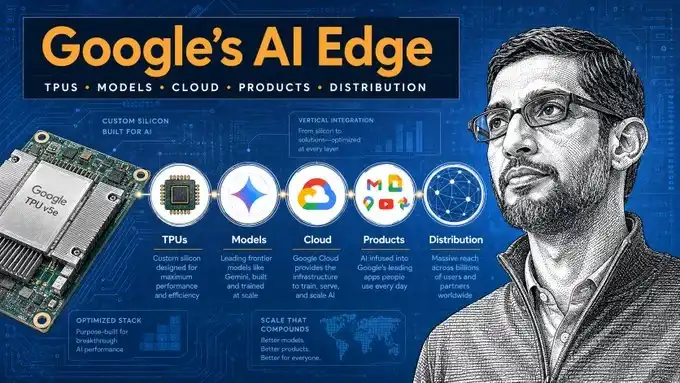
It has infrastructure: TPUs, data centers, Google Cloud, AI Hypercomputer.

It has models: Gemini, Gemma, Veo, Imagen, AlphaFold, and the deep research heritage from Google Brain and DeepMind.

It has products: Search, YouTube, Android, Chrome, Gmail, Workspace, Maps, Photos, Pixel.

It has revenue engines: Search Ads, YouTube Ads, subscriptions, Cloud, enterprise products.

Most importantly, it has distribution: billions of users are already in its ecosystem.

Most AI startups spend heavily to acquire users; Google already has a massive existing user base. Most AI startups need to build user habits from scratch; Google is already part of many people's daily routines.

Similarly, most AI startups need to convince enterprises to trust them; Google is already selling Cloud, Workspace, security, productivity, and infrastructure services to enterprises globally.

This is why the 'Google is doomed' narrative doesn't hold up.

Public opinion easily amplifies panic, but a calm look reveals Google possesses advantages most companies don't: an invisible AI intelligence layer.

The most successful consumer AI might not make users feel they're 'using AI'.

OpenAI and Anthropic need to pull users into their products; Google can push AI into the products users already use every day.

This is a very deep distribution advantage.

Search is also part of this advantage, even though it's often portrayed as Google's biggest weakness.

The bearish logic is clear: if AI changes how people access information, Google's core search business could be disrupted.

This risk is real.

Google's search advertising business is one of the most profitable in tech history. It funds AI research, YouTube infrastructure, Cloud expansion, moonshots, and massive capital expenditures.

So Google's moves here will be extra cautious. But Search isn't just a weakness for Google; it's also a superweapon.

Search gives Google distribution, user intent data, advertiser relationships, billions of daily user interactions, and a direct channel to push AI to mainstream users.

If Google can manage this transition well, Search won't simply be replaced by AI; it will become AI-native.

This process will inevitably create messy scenes - publishers will complain, advertisers will have issues, regulators will watch closely, and users will need time to build trust in AI-generated answers.

But if Google can evolve Search from a list of links into a personalized, multimodal, agentic answer engine, it will still be one of the most important gateways to the internet.

The question now is: Can Google change itself before someone else changes Search?

Google has another severely underestimated advantage: Google can even win when its competitors succeed.

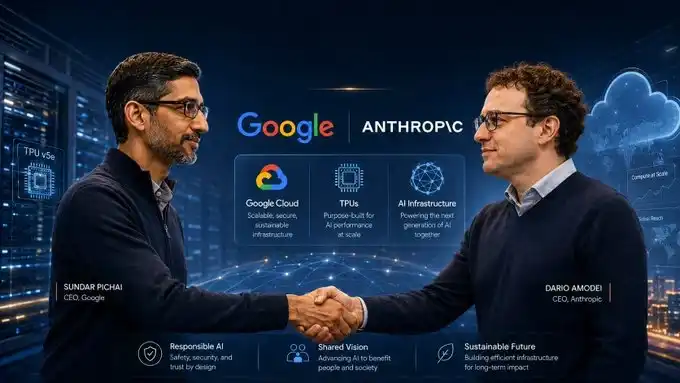
Anthropic isn't just Google's competitor. It's also its strategic partner.

Let's look at the data:

Google's parent company Alphabet has committed to invest up to $400 billion in Anthropic, including a $100 billion cash investment at a reported valuation of $3.5 trillion, with another $300 billion tied to performance goals.

Meanwhile, Anthropic reportedly committed to spending $2 trillion on Google Cloud over five years.

This isn't just a financial investment. Anthropic also announced plans to use up to 1 million Google TPUs, worth hundreds of billions of dollars, and expects to bring over 1GW of computing capacity.

This means one of Google's most important AI rivals could also become one of Google Cloud's most important AI infrastructure customers.
OpenAI has also reportedly turned to Google Cloud for additional computing power.

So Google isn't just participating in the AI model race; it's also becoming part of the underlying infrastructure for other frontier AI companies.

In the AI gold rush, Google isn't just trying to dig for gold itself.

It's also selling shovels, roads, electricity, and cloud infrastructure.

This is a very strong position.

The model race is extremely expensive. Training and serving frontier models requires massive computing power. Even the most successful AI companies need infrastructure partners.

Google has spent many years building its own chips, cloud capacity, and AI infrastructure. Now, even its rivals may need to rely on parts of its tech stack. This is its underlying strength.

Finally, it's worth mentioning that Google's AI ambitions aren't limited to chatbots; they also include AI for Science.

The Nobel Prize-winning AlphaFold is the best example. AlphaFold changed scientists' understanding of protein structure prediction, accelerated biological research, and proved AI isn't just for generating text but can solve truly difficult scientific problems.

This is crucial for the long-term AI race because, ultimately, the biggest AI winners might not just be the companies with the strongest consumer chatbots; they could also be those that can apply AI to science, medicine, climate, education, robotics, and deep technology infrastructure.

Google DeepMind has always had this larger ambition.

Indeed, John Jumper's departure might be Google's 'what could have been', as he represented one of Google's most important victories in AI for Science.

But AlphaFold wasn't the product of any single genius working alone. It came from a team and a research culture: the determination to commit long-term to world-class problems before the market was fully focused.

This culture is rare, and Google still has it.

3. The Real Innovator's Dilemma

So, does Google face the Innovator's Dilemma?

Certainly, no company is immune.

Google's core Search business is both its greatest asset and its biggest constraint.

Startups can charge forward with pure hunger. Google must protect a global business, a brand, regulatory risks, advertisers, publishers, enterprise clients, and billions of users.

This slows decision-making, makes product launches more cautious, and complicates internal coordination - this is the part many criticize.

Google has certainly made mistakes, for instance, Bard's launch was rocky.

Gemini itself has experienced its fair share of public setbacks.

But the important question isn't whether Google has weaknesses; it's: Is Google adapting and adjusting?

I think it is.

The Character.AI story well illustrates this boldness.

Noam Shazeer and Daniel De Freitas left Google to found Character.AI in 2021 and grew quickly. Later, Google decisively brought them and part of the Character.AI team back to Google through a massive deal.

This is the core tension in Google's AI story: Google was too cautious early on, appearing sluggish compared to startups; but later, Google reorganized, refocused, and started pushing Gemini across its entire ecosystem, turning it into an intelligence layer spanning Search, Workspace, Android, Cloud, and consumer products.

This doesn't mean Google can move like a 200-person startup. That's unrealistic.

But when the organization is aligned, it can move like a full-stack AI empire.

This distinction is very important - the Innovator's Dilemma is real, but Google isn't ignoring it.

From revolutionizing Search to integrating Gemini, what we see is the effort of a tech giant in transition.

4. Conclusion: This is a Stress Test, Not an Obituary

The departure of top-tier talent is more like a stress test for Google, not an obituary.

This company is facing one of the most difficult transitions in its history, but it's also one of the few with enough resources, tech stack, and distribution power to navigate this transition.

In the AI era, the shiniest model might win a news cycle; the most aggressive startup might grab headlines in the talent war.

But the best integrated system might win the next decade.

This is why I remain confident in Google - not because Google is perfect, but because Google is one of the few companies that can compete at every layer of the AI future.

The AI race is far from over, and Google is playing a long game.

Trending Cryptos

Related Questions

QWhat is the main reason the article suggests for the recent high-profile AI talent departures from Google?

AThe article frames the departures primarily as part of a typical 'IPO eve talent war,' where companies like OpenAI and Anthropic are seeking top talent to bolster their credibility and market narrative before going public, rather than solely as a sign of Google's internal decline.

QAccording to the article, what is Google's key strategic advantage over pure model companies like OpenAI and Anthropic?

AGoogle's key advantage is its position as a 'full-stack AI company.' It has a massive ecosystem of widely-used products (Search, YouTube, Android, Workspace, etc.), vast infrastructure (TPUs, data centers, Google Cloud), and billions of existing users, allowing it to integrate AI directly into daily user habits rather than having to pull users into a new product.

QHow does the article reframe Google's role in the AI competition beyond just being a model competitor?

AThe article reframes Google as also being a crucial infrastructure provider in the AI 'gold rush.' It notes that even competitors like Anthropic and OpenAI are becoming significant customers of Google Cloud and its TPU chips, meaning Google profits from and underpins the infrastructure needs of the broader AI ecosystem.

QWhat example does the article give to show that Google is willing to be aggressive and adapt, despite its size?

AThe article cites the Character.AI story. After Noam Shazeer and Daniel De Freitas left Google to found Character.AI, Google later orchestrated a massive deal (reportedly around $27 billion) to bring them and part of their team back into the company, demonstrating a willingness to make bold moves to secure strategic talent and assets.

QWhat is the article's final conclusion about the significance of the AI talent leaving Google?

AThe article concludes that the talent departures are more accurately seen as a 'stress test' for Google, not an 'obituary.' It argues that while painful, Google possesses the unique resources, technology stack, and distribution scale to navigate this transition and compete in the long-term, multi-layered AI landscape.

Related Reads

The Hunter Becomes the Hunted: The Most Profitable MEV Bot Gets Hacked

A well-known and highly profitable Ethereum MEV Bot, Jaredfromsubway.eth, suffered a sophisticated on-chain attack this Saturday, losing over $7.5 million. Analysis by Blockaid and others reveals this was not a conventional phishing or smart contract exploit, but a targeted "counter-MEV honeypot attack." The attacker meticulously laid a trap over several weeks, deploying 66 fake token contracts and liquidity pools disguised as major assets like WETH and USDC. These pools created the illusion of arbitrage opportunities. The MEV Bot's automated system detected these signals, executed trades, and in the process, granted approval permissions to attacker-controlled contracts. These approvals were not revoked, creating a persistent vulnerability. The attacker then exploited this in a single transaction, draining the bot's ETH, USDC, and USDT holdings. Jaredfromsubway.eth is notorious as one of Ethereum's most active and profitable MEV Bots, primarily known for executing "sandwich attacks" to profit from transaction slippage. Estimates suggest it has earned tens of millions in MEV revenue. The incident highlights escalating crypto security threats, demonstrating that even top-tier automated "predators" are vulnerable to novel, logic-based attacks designed to exploit their own operational rules. Following the hack, an unverified X account impersonating Jaredfromsubway.eth emerged, falsely offering a bounty for the return of funds, prompting developer warnings for users to stay vigilant.

marsbit1h ago

The Hunter Becomes the Hunted: The Most Profitable MEV Bot Gets Hacked

marsbit1h ago

The Reality of Payments in Latin America Is Not What You Think

The payment landscape in Latin America is undergoing a fundamental shift, driven by on-the-ground realities that challenge common perceptions. Based on over 500 hours of field research across the region, key insights emerge. Firstly, QR code payments, like Brazil's Pix, are becoming the dominant payment method in most emerging markets, overtaking cards. However, these domestic instant payment systems lack international interoperability, creating a significant gap for cross-border users. Secondly, the narrative around crypto cards is often misunderstood; their primary volume comes from high-net-worth professionals using them for salary conversions (e.g., USDT to local currency via Pix), not retail micro-payments. Competition in payments is shifting from customer acquisition to controlling the settlement layer, leading fintechs to acquire banking licenses for efficiency. Thirdly, treating "Latin America" as a single market is a mistake. Countries like Argentina, Brazil, and Mexico have distinct economic realities, user segments, and regulatory approaches. Brazil alone has at least five distinct user segments with different financial flows. Overlooked markets like Guatemala, Honduras, and El Salvador (the "forgotten five") offer high remittance volumes with lower competitive density. Finally, regulation in Latin America is often ahead of the US, with clearer frameworks for digital assets and a pragmatic approach from regulators focused on safety rather than obstruction. The margin on stablecoin forex is rapidly compressing toward zero, meaning future winners will be those building value-added services on top of the infrastructure, not just the cheapest exchange.

marsbit1h ago

The Reality of Payments in Latin America Is Not What You Think

marsbit1h ago

Making Music in a Bear Market: The Survival Experiment of a Bitcoin Band

"Orange Pill Jam: A Bitcoin Band's Survival in the Bear Market" Orange Pill Jam is a musical group exploring themes of financial sovereignty and privacy, born from the Bitcoin community. Formed after singer Mermaid performed her song "Dollar Apocalypse" at a 2022 conference, the band creates music intended for both Bitcoin enthusiasts and general audiences. Their creative process involves Mermaid writing lyrics and melodies, which producer/multi-instrumentalist Michi then shapes with a precise, rhythm-focused approach, often demanding numerous retakes to achieve his unique standard of timing. Their songs, like "Cypherpunks' Manifesto" and "Fire of Freedom," tackle concepts of digital privacy, the pitfalls of "free" services, and personal sovereignty, influenced by experiences in places like El Salvador. Despite operating in a crypto bear market with a Copyleft model (offering music for free sharing/remixing and accepting optional Bitcoin donations), they face practical challenges. Their growth is slow on platforms like YouTube and Spotify, which aren't optimized for their niche content. The band also navigates the rise of AI-generated music. While acknowledging AI's efficiency for certain tasks, they believe human creativity occupies a unique space that algorithms cannot replicate—the ability to create new genres and capture intangible rhythmic feeling. For Orange Pill Jam, the core argument for both Bitcoin in a downturn and human artistry in the AI age lies in this irreplaceable, intentional, and imperfectly human creative process. Their project persists as an anti-algorithm experiment, valuing the unquantifiable impact of music over scalable metrics.

marsbit1h ago

Making Music in a Bear Market: The Survival Experiment of a Bitcoin Band

marsbit1h ago

Trading

Spot
Futures

Hot Articles

What is SONIC

Sonic: Pioneering the Future of Gaming in Web3 Introduction to Sonic In the ever-evolving landscape of Web3, the gaming industry stands out as one of the most dynamic and promising sectors. At the forefront of this revolution is Sonic, a project designed to amplify the gaming ecosystem on the Solana blockchain. Leveraging cutting-edge technology, Sonic aims to deliver an unparalleled gaming experience by efficiently processing millions of requests per second, ensuring that players enjoy seamless gameplay while maintaining low transaction costs. This article delves into the intricate details of Sonic, exploring its creators, funding sources, operational mechanics, and the timeline of significant events that have shaped its journey. What is Sonic? Sonic is an innovative layer-2 network that operates atop the Solana blockchain, specifically tailored to enhance the existing Solana gaming ecosystem. It accomplishes this through a customised, VM-agnostic game engine paired with a HyperGrid interpreter, facilitating sovereign game economies that roll up back to the Solana platform. The primary goals of Sonic include: Enhanced Gaming Experiences: Sonic is committed to offering lightning-fast on-chain gameplay, allowing players and developers to engage with games at previously unattainable speeds. Atomic Interoperability: This feature enables transactions to be executed within Sonic without the need to redeploy Solana programmes and accounts. This makes the process more efficient and directly benefits from Solana Layer1 services and liquidity. Seamless Deployment: Sonic allows developers to write for Ethereum Virtual Machine (EVM) based systems and execute them on Solana’s SVM infrastructure. This interoperability is crucial for attracting a broader range of dApps and decentralised applications to the platform. Support for Developers: By offering native composable gaming primitives and extensible data types - dining within the Entity-Component-System (ECS) framework - game creators can craft intricate business logic with ease. Overall, Sonic's unique approach not only caters to players but also provides an accessible and low-cost environment for developers to innovate and thrive. Creator of Sonic The information regarding the creator of Sonic is somewhat ambiguous. However, it is known that Sonic's SVM is owned by the company Mirror World. The absence of detailed information about the individuals behind Sonic reflects a common trend in several Web3 projects, where collective efforts and partnerships often overshadow individual contributions. Investors of Sonic Sonic has garnered considerable attention and support from various investors within the crypto and gaming sectors. Notably, the project raised an impressive $12 million during its Series A funding round. The round was led by BITKRAFT Ventures, with other notable investors including Galaxy, Okx Ventures, Interactive, Big Brain Holdings, and Mirana. This financial backing signifies the confidence that investment foundations have in Sonic’s potential to revolutionise the Web3 gaming landscape, further validating its innovative approaches and technologies. How Does Sonic Work? Sonic utilises the HyperGrid framework, a sophisticated parallel processing mechanism that enhances its scalability and customisability. Here are the core features that set Sonic apart: Lightning Speed at Low Costs: Sonic offers one of the fastest on-chain gaming experiences compared to other Layer-1 solutions, powered by the scalability of Solana’s virtual machine (SVM). Atomic Interoperability: Sonic enables transaction execution without redeployment of Solana programmes and accounts, effectively streamlining the interaction between users and the blockchain. EVM Compatibility: Developers can effortlessly migrate decentralised applications from EVM chains to the Solana environment using Sonic’s HyperGrid interpreter, increasing the accessibility and integration of various dApps. Ecosystem Support for Developers: By exposing native composable gaming primitives, Sonic facilitates a sandbox-like environment where developers can experiment and implement business logic, greatly enhancing the overall development experience. Monetisation Infrastructure: Sonic natively supports growth and monetisation efforts, providing frameworks for traffic generation, payments, and settlements, thereby ensuring that gaming projects are not only viable but also sustainable financially. Timeline of Sonic The evolution of Sonic has been marked by several key milestones. Below is a brief timeline highlighting critical events in the project's history: 2022: The Sonic cryptocurrency was officially launched, marking the beginning of its journey in the Web3 gaming arena. 2024: June: Sonic SVM successfully raised $12 million in a Series A funding round. This investment allowed Sonic to further develop its platform and expand its offerings. August: The launch of the Sonic Odyssey testnet provided users with the first opportunity to engage with the platform, offering interactive activities such as collecting rings—a nod to gaming nostalgia. October: SonicX, an innovative crypto game integrated with Solana, made its debut on TikTok, capturing the attention of over 120,000 users within a short span. This integration illustrated Sonic’s commitment to reaching a broader, global audience and showcased the potential of blockchain gaming. Key Points Sonic SVM is a revolutionary layer-2 network on Solana explicitly designed to enhance the GameFi landscape, demonstrating great potential for future development. HyperGrid Framework empowers Sonic by introducing horizontal scaling capabilities, ensuring that the network can handle the demands of Web3 gaming. Integration with Social Platforms: The successful launch of SonicX on TikTok displays Sonic’s strategy to leverage social media platforms to engage users, exponentially increasing the exposure and reach of its projects. Investment Confidence: The substantial funding from BITKRAFT Ventures, among others, emphasizes the robust backing Sonic has, paving the way for its ambitious future. In conclusion, Sonic encapsulates the essence of Web3 gaming innovation, striking a balance between cutting-edge technology, developer-centric tools, and community engagement. As the project continues to evolve, it is poised to redefine the gaming landscape, making it a notable entity for gamers and developers alike. As Sonic moves forward, it will undoubtedly attract greater interest and participation, solidifying its place within the broader narrative of blockchain gaming.

1.7k Total ViewsPublished 2024.04.04Updated 2024.12.03

What is SONIC

What is $S$

Understanding SPERO: A Comprehensive Overview Introduction to SPERO As the landscape of innovation continues to evolve, the emergence of web3 technologies and cryptocurrency projects plays a pivotal role in shaping the digital future. One project that has garnered attention in this dynamic field is SPERO, denoted as SPERO,$$s$. This article aims to gather and present detailed information about SPERO, to help enthusiasts and investors understand its foundations, objectives, and innovations within the web3 and crypto domains. What is SPERO,$$s$? SPERO,$$s$ is a unique project within the crypto space that seeks to leverage the principles of decentralisation and blockchain technology to create an ecosystem that promotes engagement, utility, and financial inclusion. The project is tailored to facilitate peer-to-peer interactions in new ways, providing users with innovative financial solutions and services. At its core, SPERO,$$s$ aims to empower individuals by providing tools and platforms that enhance user experience in the cryptocurrency space. This includes enabling more flexible transaction methods, fostering community-driven initiatives, and creating pathways for financial opportunities through decentralised applications (dApps). The underlying vision of SPERO,$$s$ revolves around inclusiveness, aiming to bridge gaps within traditional finance while harnessing the benefits of blockchain technology. Who is the Creator of SPERO,$$s$? The identity of the creator of SPERO,$$s$ remains somewhat obscure, as there are limited publicly available resources providing detailed background information on its founder(s). This lack of transparency can stem from the project's commitment to decentralisation—an ethos that many web3 projects share, prioritising collective contributions over individual recognition. By centring discussions around the community and its collective goals, SPERO,$$s$ embodies the essence of empowerment without singling out specific individuals. As such, understanding the ethos and mission of SPERO remains more important than identifying a singular creator. Who are the Investors of SPERO,$$s$? SPERO,$$s$ is supported by a diverse array of investors ranging from venture capitalists to angel investors dedicated to fostering innovation in the crypto sector. The focus of these investors generally aligns with SPERO's mission—prioritising projects that promise societal technological advancement, financial inclusivity, and decentralised governance. These investor foundations are typically interested in projects that not only offer innovative products but also contribute positively to the blockchain community and its ecosystems. The backing from these investors reinforces SPERO,$$s$ as a noteworthy contender in the rapidly evolving domain of crypto projects. How Does SPERO,$$s$ Work? SPERO,$$s$ employs a multi-faceted framework that distinguishes it from conventional cryptocurrency projects. Here are some of the key features that underline its uniqueness and innovation: Decentralised Governance: SPERO,$$s$ integrates decentralised governance models, empowering users to participate actively in decision-making processes regarding the project’s future. This approach fosters a sense of ownership and accountability among community members. Token Utility: SPERO,$$s$ utilises its own cryptocurrency token, designed to serve various functions within the ecosystem. These tokens enable transactions, rewards, and the facilitation of services offered on the platform, enhancing overall engagement and utility. Layered Architecture: The technical architecture of SPERO,$$s$ supports modularity and scalability, allowing for seamless integration of additional features and applications as the project evolves. This adaptability is paramount for sustaining relevance in the ever-changing crypto landscape. Community Engagement: The project emphasises community-driven initiatives, employing mechanisms that incentivise collaboration and feedback. By nurturing a strong community, SPERO,$$s$ can better address user needs and adapt to market trends. Focus on Inclusion: By offering low transaction fees and user-friendly interfaces, SPERO,$$s$ aims to attract a diverse user base, including individuals who may not previously have engaged in the crypto space. This commitment to inclusion aligns with its overarching mission of empowerment through accessibility. Timeline of SPERO,$$s$ Understanding a project's history provides crucial insights into its development trajectory and milestones. Below is a suggested timeline mapping significant events in the evolution of SPERO,$$s$: Conceptualisation and Ideation Phase: The initial ideas forming the basis of SPERO,$$s$ were conceived, aligning closely with the principles of decentralisation and community focus within the blockchain industry. Launch of Project Whitepaper: Following the conceptual phase, a comprehensive whitepaper detailing the vision, goals, and technological infrastructure of SPERO,$$s$ was released to garner community interest and feedback. Community Building and Early Engagements: Active outreach efforts were made to build a community of early adopters and potential investors, facilitating discussions around the project’s goals and garnering support. Token Generation Event: SPERO,$$s$ conducted a token generation event (TGE) to distribute its native tokens to early supporters and establish initial liquidity within the ecosystem. Launch of Initial dApp: The first decentralised application (dApp) associated with SPERO,$$s$ went live, allowing users to engage with the platform's core functionalities. Ongoing Development and Partnerships: Continuous updates and enhancements to the project's offerings, including strategic partnerships with other players in the blockchain space, have shaped SPERO,$$s$ into a competitive and evolving player in the crypto market. Conclusion SPERO,$$s$ stands as a testament to the potential of web3 and cryptocurrency to revolutionise financial systems and empower individuals. With a commitment to decentralised governance, community engagement, and innovatively designed functionalities, it paves the way toward a more inclusive financial landscape. As with any investment in the rapidly evolving crypto space, potential investors and users are encouraged to research thoroughly and engage thoughtfully with the ongoing developments within SPERO,$$s$. The project showcases the innovative spirit of the crypto industry, inviting further exploration into its myriad possibilities. While the journey of SPERO,$$s$ is still unfolding, its foundational principles may indeed influence the future of how we interact with technology, finance, and each other in interconnected digital ecosystems.

61 Total ViewsPublished 2024.12.17Updated 2024.12.17

What is $S$

What is AGENT S

Agent S: The Future of Autonomous Interaction in Web3 Introduction In the ever-evolving landscape of Web3 and cryptocurrency, innovations are constantly redefining how individuals interact with digital platforms. One such pioneering project, Agent S, promises to revolutionise human-computer interaction through its open agentic framework. By paving the way for autonomous interactions, Agent S aims to simplify complex tasks, offering transformative applications in artificial intelligence (AI). This detailed exploration will delve into the project's intricacies, its unique features, and the implications for the cryptocurrency domain. What is Agent S? Agent S stands as a groundbreaking open agentic framework, specifically designed to tackle three fundamental challenges in the automation of computer tasks: Acquiring Domain-Specific Knowledge: The framework intelligently learns from various external knowledge sources and internal experiences. This dual approach empowers it to build a rich repository of domain-specific knowledge, enhancing its performance in task execution. Planning Over Long Task Horizons: Agent S employs experience-augmented hierarchical planning, a strategic approach that facilitates efficient breakdown and execution of intricate tasks. This feature significantly enhances its ability to manage multiple subtasks efficiently and effectively. Handling Dynamic, Non-Uniform Interfaces: The project introduces the Agent-Computer Interface (ACI), an innovative solution that enhances the interaction between agents and users. Utilizing Multimodal Large Language Models (MLLMs), Agent S can navigate and manipulate diverse graphical user interfaces seamlessly. Through these pioneering features, Agent S provides a robust framework that addresses the complexities involved in automating human interaction with machines, setting the stage for myriad applications in AI and beyond. Who is the Creator of Agent S? While the concept of Agent S is fundamentally innovative, specific information about its creator remains elusive. The creator is currently unknown, which highlights either the nascent stage of the project or the strategic choice to keep founding members under wraps. Regardless of anonymity, the focus remains on the framework's capabilities and potential. Who are the Investors of Agent S? As Agent S is relatively new in the cryptographic ecosystem, detailed information regarding its investors and financial backers is not explicitly documented. The lack of publicly available insights into the investment foundations or organisations supporting the project raises questions about its funding structure and development roadmap. Understanding the backing is crucial for gauging the project's sustainability and potential market impact. How Does Agent S Work? At the core of Agent S lies cutting-edge technology that enables it to function effectively in diverse settings. Its operational model is built around several key features: Human-like Computer Interaction: The framework offers advanced AI planning, striving to make interactions with computers more intuitive. By mimicking human behaviour in tasks execution, it promises to elevate user experiences. Narrative Memory: Employed to leverage high-level experiences, Agent S utilises narrative memory to keep track of task histories, thereby enhancing its decision-making processes. Episodic Memory: This feature provides users with step-by-step guidance, allowing the framework to offer contextual support as tasks unfold. Support for OpenACI: With the ability to run locally, Agent S allows users to maintain control over their interactions and workflows, aligning with the decentralised ethos of Web3. Easy Integration with External APIs: Its versatility and compatibility with various AI platforms ensure that Agent S can fit seamlessly into existing technological ecosystems, making it an appealing choice for developers and organisations. These functionalities collectively contribute to Agent S's unique position within the crypto space, as it automates complex, multi-step tasks with minimal human intervention. As the project evolves, its potential applications in Web3 could redefine how digital interactions unfold. Timeline of Agent S The development and milestones of Agent S can be encapsulated in a timeline that highlights its significant events: September 27, 2024: The concept of Agent S was launched in a comprehensive research paper titled “An Open Agentic Framework that Uses Computers Like a Human,” showcasing the groundwork for the project. October 10, 2024: The research paper was made publicly available on arXiv, offering an in-depth exploration of the framework and its performance evaluation based on the OSWorld benchmark. October 12, 2024: A video presentation was released, providing a visual insight into the capabilities and features of Agent S, further engaging potential users and investors. These markers in the timeline not only illustrate the progress of Agent S but also indicate its commitment to transparency and community engagement. Key Points About Agent S As the Agent S framework continues to evolve, several key attributes stand out, underscoring its innovative nature and potential: Innovative Framework: Designed to provide an intuitive use of computers akin to human interaction, Agent S brings a novel approach to task automation. Autonomous Interaction: The ability to interact autonomously with computers through GUI signifies a leap towards more intelligent and efficient computing solutions. Complex Task Automation: With its robust methodology, it can automate complex, multi-step tasks, making processes faster and less error-prone. Continuous Improvement: The learning mechanisms enable Agent S to improve from past experiences, continually enhancing its performance and efficacy. Versatility: Its adaptability across different operating environments like OSWorld and WindowsAgentArena ensures that it can serve a broad range of applications. As Agent S positions itself in the Web3 and crypto landscape, its potential to enhance interaction capabilities and automate processes signifies a significant advancement in AI technologies. Through its innovative framework, Agent S exemplifies the future of digital interactions, promising a more seamless and efficient experience for users across various industries. Conclusion Agent S represents a bold leap forward in the marriage of AI and Web3, with the capacity to redefine how we interact with technology. While still in its early stages, the possibilities for its application are vast and compelling. Through its comprehensive framework addressing critical challenges, Agent S aims to bring autonomous interactions to the forefront of the digital experience. As we move deeper into the realms of cryptocurrency and decentralisation, projects like Agent S will undoubtedly play a crucial role in shaping the future of technology and human-computer collaboration.

737 Total ViewsPublished 2025.01.14Updated 2025.01.14

What is AGENT S

Discussions

Welcome to the HTX Community. Here, you can stay informed about the latest platform developments and gain access to professional market insights. Users' opinions on the price of S (S) are presented below.

活动图片