Gold and Silver Have Gone Crazy: Is Bitcoin 'Lagging Behind' or Building Momentum During Christmas Week?

marsbitPublished on 2025-12-23Last updated on 2025-12-23

Abstract

During the Christmas week, global markets saw a surge in safe-haven assets like gold and silver, which reached new all-time highs amid a weaker dollar and falling Treasury yields. In contrast, Bitcoin remained stagnant, trading within a narrow range of $88,000–$89,000, failing to capitalize on favorable macro conditions. Market participants are questioning whether Bitcoin will experience a "Santa Rally," a seasonal uptick often seen in traditional risk assets. Analysts note that the current macro environment remains in a "wait-and-see" mode, with investors cautious ahead of key U.S. economic data releases. ETF flows reflect this uncertainty, with Bitcoin and Ethereum ETFs seeing significant outflows, while smaller altcoins like XRP and Solana saw minor inflows. Technically, Bitcoin is consolidating, with key resistance at $93,000–$95,000 and support near $85,000. A major $24 billion options expiration on Friday adds to the short-term volatility, with bulls targeting $100,000 and bears defending $85,000. Analysts like Gabriel Selby of CF Benchmarks suggest Bitcoin’s current behavior doesn’t align with a typical Santa Rally, noting low volume and a lack of momentum. Legendary trader Peter Brandt reiterated his long-term cycle analysis, predicting a new bull market peak by September 2029 after a significant correction. Historically, Bitcoin’s Christmas performance has been mixed, with an average gain of 7.9% since 2011. This year, however, the focus is on structural consolid...

Entering Christmas week, the global market's initial answer did not belong to the crypto market. Against the backdrop of a weakening US dollar and falling US Treasury yields, risk-aversion sentiment quickly heated up. Gold and silver took the lead, with prices successively刷新历史高位 (hitting new historical highs), becoming the hottest destination for funds.
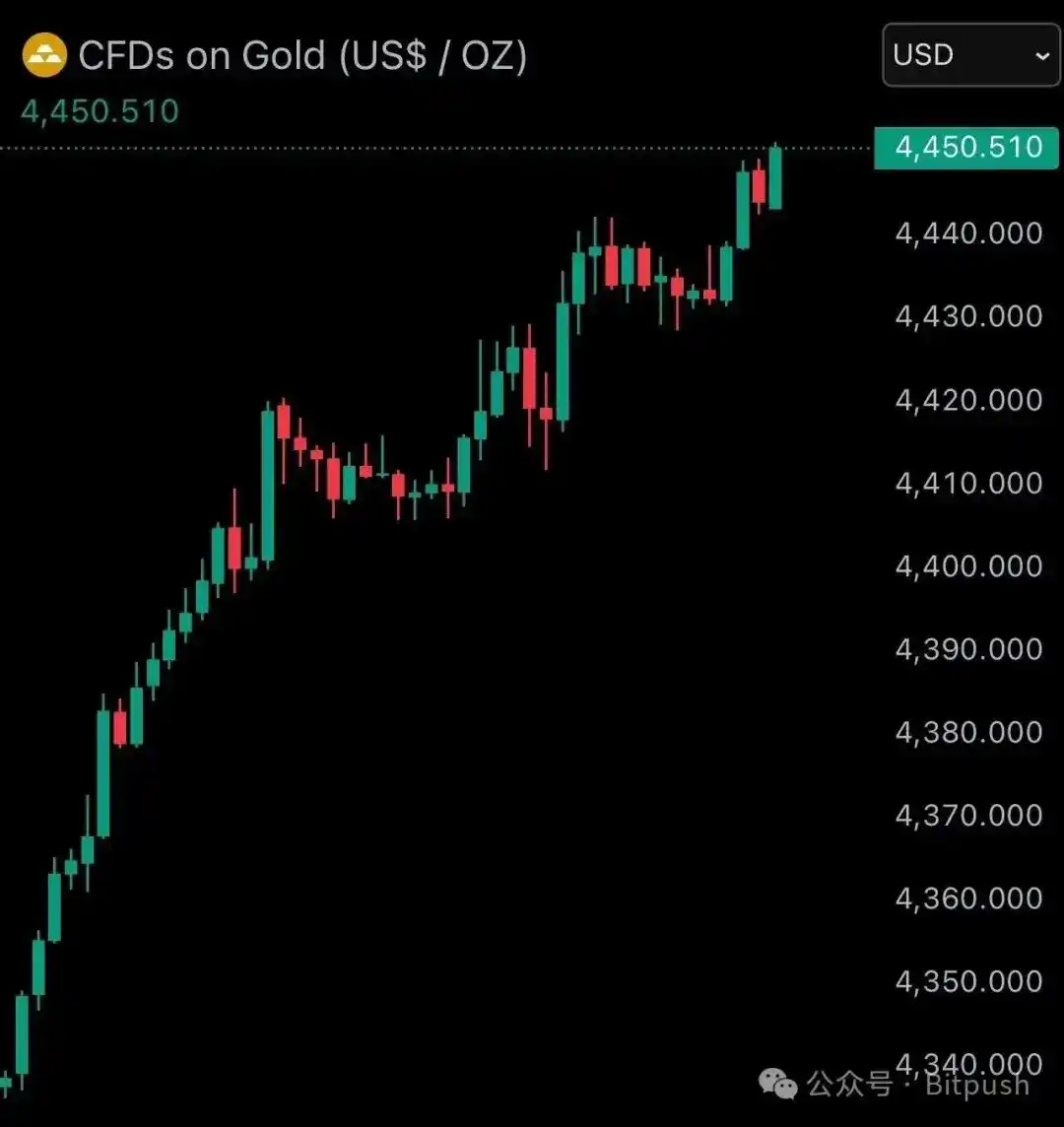
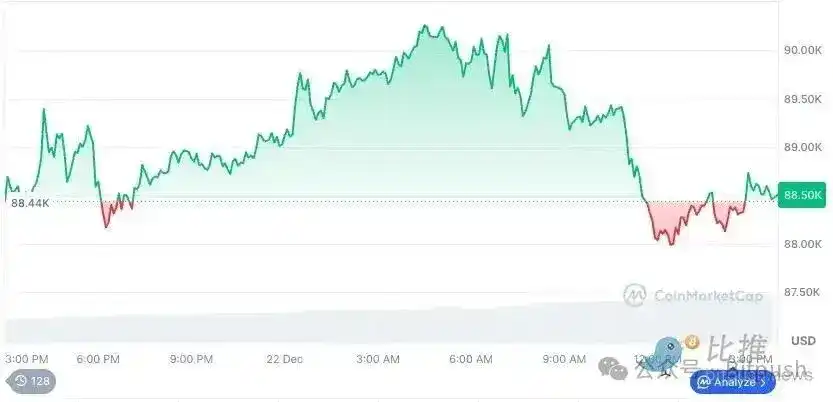
In contrast, the crypto market appears unusually quiet. Bitcoin did not take off with the macroeconomic tailwinds but continues to linger in the $88,000-$89,000 fluctuation range, lacking the offensive posture expected before the holiday.

It is precisely against this反差 (contrast) that the question of "whether Bitcoin will usher in a Santa Rally" has once again become a topic of反复讨论 (repeated discussion) in the market. The so-called Santa Rally, originally a seasonal phenomenon in traditional financial markets, refers to a阶段性上涨 (phased rise) in risk assets around Christmas, driven by improved sentiment and changes in liquidity. However, in the crypto market, this规律 (pattern) has never been stable. Whether this year's Bitcoin is "lagging behind" amidst rising risk-aversion sentiment or quietly building momentum within a high range still requires looking for answers in its real price action and fund structure.
Macro Environment in 'Awaiting Verification', Funds Flow Out of Risk Assets

Gabriel Selby, Research Head at CF Benchmarks, pointed out that before the Federal Reserve obtains data for several consecutive months that clearly points to持续回落 (sustained decline) in inflation, market participants are unlikely to truly increase their allocation to risk assets like Bitcoin. In his view, the current macro environment is still in an "awaiting verification" stage.

This cautious sentiment is closely related to investors' high attention to a series of upcoming US economic data. The Q3 GDP data will be released soon, with market expectations for the annualized growth rate around 3.5%, slightly lower than Q2's 3.8%. Meanwhile, indicators like the Consumer Confidence Index and weekly initial jobless claims will provide more clues about the labor market conditions. The results of these data will directly affect the market's judgment on the Fed's policy path and further influence overall risk appetite.

Looking at other macro factors, a weakening US dollar and falling US Treasury yields do provide a theoretical tailwind environment for risk assets. However, the actual choices of funds have given a completely different answer.

According to statistics from SoSoValue, there has been明显的分化 (obvious divergence) at the ETF level recently: Bitcoin ETFs recorded a net outflow of approximately $158.3 million, and Ethereum ETFs saw an outflow of about $76 million. In contrast, XRP and Solana ETFs recorded small inflows of about $13 million and $4 million respectively, showing that funds are also undergoing结构性调整 (structural adjustment) within the crypto market, rather than a overall回流 (return flow).
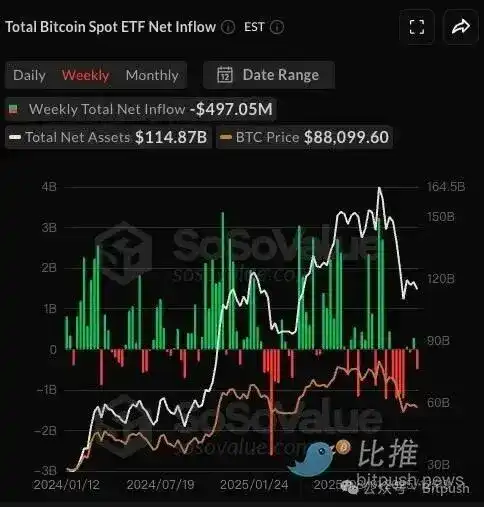
From the perspective of broader digital asset investment products, CoinShares pointed out in its latest weekly fund flow report that digital asset investment products collectively experienced a net outflow of approximately $952 million last week. This is the first net redemption after four consecutive weeks of inflows. CoinShares attributed this capital outflow partly to the regulatory uncertainty caused by the slowed推进节奏 (pace of advancement) of the US Clarity Act, leading institutional investors to倾向于 (tend to) reduce risk exposure in the short term.

Technical Structure: Dominated by Sideways Movement

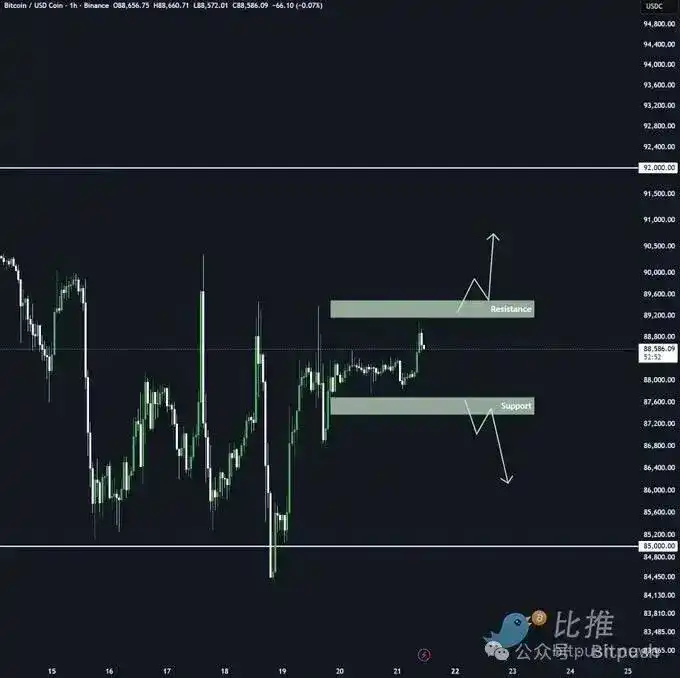
From a technical structure perspective, Bitcoin's current trend is not明显偏空 (obviously bearish), but it can hardly be called strong either. The $88,000 to $89,000 range has become the core fluctuation zone repeatedly tested in the short term, while the area above, from $93,000 to $95,000, constitutes a key resistance that the bulls must break through.

Several traders pointed out that if Bitcoin fails to effectively break through this resistance range during Christmas week, even if there is a short-term rebound, it is more likely to be seen as a technical repair rather than a trend reversal. Conversely, if the price continues to maintain a high-level sideways movement, it means the market is waiting for new driving factors rather than actively choosing a direction.

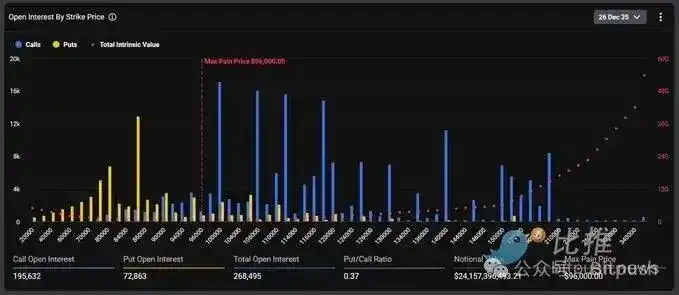
The structure of the derivatives market also explains to some extent why Bitcoin appears particularly restrained during Christmas week. This Friday, the Bitcoin market will witness the largest options expiration in history, with a total value of up to $24 billion. Currently, bulls and bears are engaged in fierce博弈 (game) at key price levels:

  • Bulls: Betting that BTC will break through the $100,000 mark;
  • Bears: Defending the $85,000关口 (level) with all their might;
  • 胜负手 (Decisive factor): $96,000 is seen as the分水岭 (watershed) for this round's trend. Holding above this level maintains the rebound momentum; otherwise, the market will continue to be under pressure.
What Do Analysts Think?

Several market observers pointed out that this year's Christmas week is more like a "structure test" rather than a window for sentiment-driven unilateral行情 (market movement).

Gabriel Selby, Research Head at CF Benchmarks, stated bluntly in a recent interview that Bitcoin's current price action does not conform to the typical characteristics of a Santa Rally. In his view, a real holiday rally is often accompanied by持续占优 (sustained dominance) of buying and trend continuation, rather than反复拉锯 (repeated tug-of-war) within a high range. "What we are seeing now seems more like the market digesting previous gains, rather than building momentum for the next rise." This judgment is also corroborated by the reality of持续偏低 (persistently low) trading volume.

Cryptocurrency analyst DrBullZeus stated that BTC continues to fluctuate between the same support and resistance levels, with no clear breakout yet. Until a clear breakout occurs, the price will remain in a range-bound trend. Breaking above resistance would open the door to the $92,000 level, while breaking below support could lead to a pullback to the $85,000 area.

>
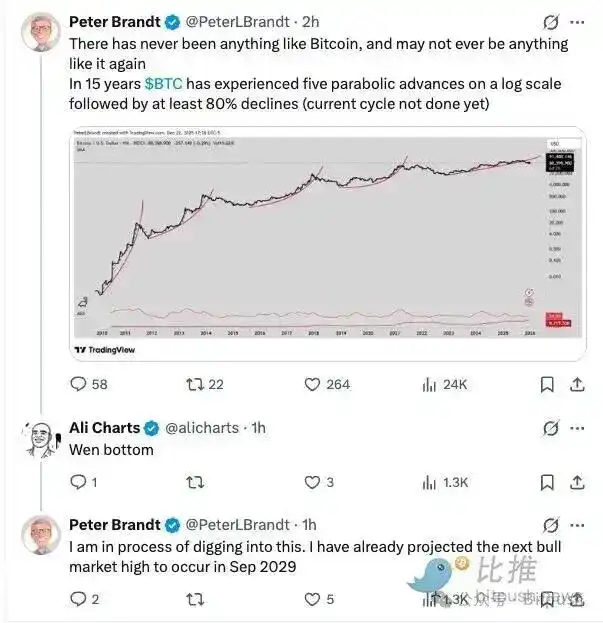
Legendary trader Peter Brandt最新复盘 (recently reviewed) and pointed out that Bitcoin has experienced 5 cycles of "parabolic growth followed by an 80% retracement" in 15 years, and the adjustment in this cycle has not yet bottomed out. Despite the冷酷短期规律 (harsh short-term规律 pattern), through cycle deduction, he predicts the next bull market peak will arrive in September 2029.

Brandt emphasized that the asset属性 (attributes) of something like BTC注定 (destine) it to move towards new highs through extreme洗盘 (shakeouts).
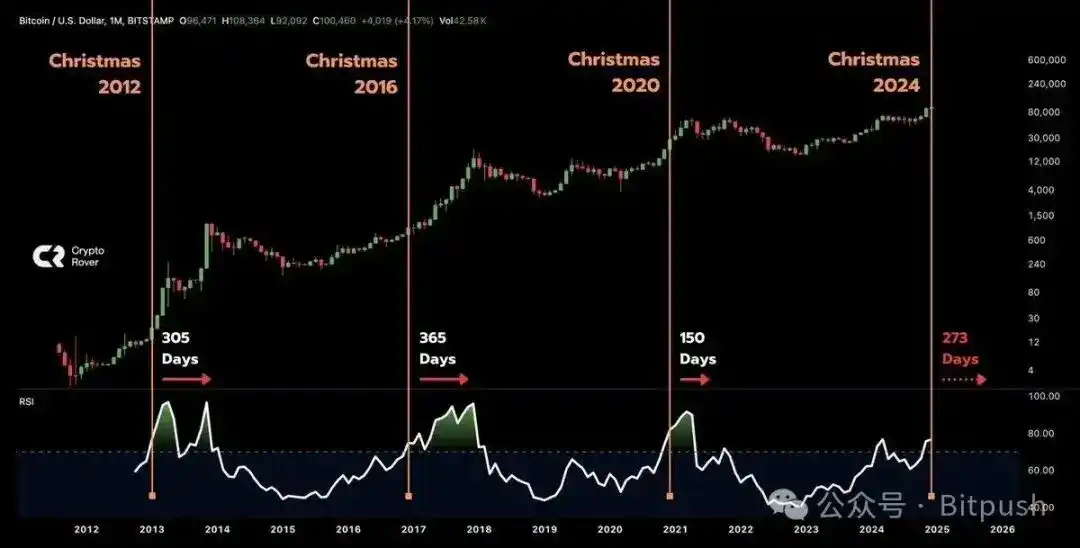
Overall, Bitcoin's "Santa Rally" has always been elusive. Looking back at history, there have been both dazzling performances like surges of 33% and 46% during the holiday period in 2012 and 2016, as well as平淡 (flat) or even declining years. Statistically, since 2011, Bitcoin's average gain during the Christmas period is about 7.9%.
However, judging from the current market structure, it seems difficult to reproduce a typical "Santa Claus rally" this year. The strength of gold and silver reflects more the集中释放 (concentrated release) of market risk-aversion sentiment. In contrast, Bitcoin's relative "calmness" once again highlights that it is still widely regarded as a risk asset in the current stage of global asset allocation.

Therefore, rather than simply attributing Bitcoin's current performance to "lagging behind," it is better to say that it is at a critical and微妙 (subtle) position: on the one hand, it lacks sufficient macroeconomic tailwinds to directly send it on a new upward trajectory; on the other hand, there are no clear signals of a breakdown and weakness yet.

What truly determines whether Bitcoin can走出独立行情 (stage an independent rally) at the end of the year is not the "Christmas" time label, but whether market funds are willing to place bets again at the current position. Until this point is clearly confirmed,窄幅震荡 (narrow-range fluctuation) will likely remain the主旋律 (main theme) of this Christmas week.


Trending Cryptos

Related Questions

QAccording to the article, why did gold and silver prices surge to record highs during the Christmas week, while Bitcoin remained stagnant?

AGold and silver surged due to rising safe-haven demand amid a weaker US dollar and falling Treasury yields, while Bitcoin, still largely viewed as a risk asset, did not benefit from the same macro tailwinds and appeared relatively calm.

QWhat is the term 'Santa Rally' referring to in financial markets, and how has it historically applied to Bitcoin?

A'Santa Rally' is a seasonal phenomenon in traditional financial markets where risk assets experience a staged rise around Christmas, driven by improved sentiment and liquidity changes. For Bitcoin, this pattern has never been stable; historically, its performance during this period has been mixed, with an average gain of about 7.9% since 2011, including some years of significant increases and others of flat or negative returns.

QWhat key economic data are market participants closely watching, and how might it influence Bitcoin's price action?

AMarket participants are closely watching US economic data, including Q3 GDP (expected around 3.5% annualized growth), consumer confidence indices, and weekly initial jobless claims. These data points will affect judgments on the Federal Reserve's policy path and overall risk appetite, thereby influencing Bitcoin's price direction.

QWhat is the significance of the $240 billion Bitcoin options expiration mentioned in the article, and what are the key price levels for bulls and bears?

AThe $240 billion Bitcoin options expiration is the largest in history, with bulls and bears fiercely contesting key price levels: bulls are betting on a breakout above $100,000, bears are defending the $85,000 support level, and $96,000 is seen as a critical trend watershed—holding above it would maintain upward momentum, otherwise, the market could face continued pressure.

QHow do analysts like Gabriel Selby and Peter Brandt characterize Bitcoin's current market behavior and long-term cycle?

AGabriel Selby characterizes Bitcoin's current behavior as a 'structure test' rather than a typical Santa Rally, with price action showing digestion of previous gains rather than accumulation for the next rise. Peter Brandt notes that Bitcoin has undergone five cycles of 'parabolic growth followed by an 80% retracement' and predicts the next bull market peak will arrive in September 2029, emphasizing that extreme volatility is inherent to Bitcoin's asset属性.

Related Reads

From South Korea to the United States: Blue-Collar Jobs Are Becoming Increasingly Popular, Thanks to AI

AI is reshaping the labor market's value proposition. The traditional four-year college degree is losing its appeal as a guaranteed career path, while skilled blue-collar trades like electricians, welders, and plumbers are experiencing historic demand and wage premiums. This shift is driven by dual pressures: AI's displacement of certain white-collar roles and a booming need for physical infrastructure and data center construction. Data confirms the trend. In the U.S., vocational school revenue surged, and a significant portion of recent layoffs are AI-related. Surveys show a majority of Gen Z adults plan to pursue blue-collar work, citing better job security against AI automation. Vocational education interest has exploded recently. Experts cite a psychological shift as younger generations seek tangible, AI-resistant careers and avoid high student debt. In many cases, salaries for skilled trades now match or exceed those requiring a bachelor's degree. In South Korea, semiconductor vocational high schools boast near-total employment, with graduates securing high-paying roles at companies like Samsung. The shortage is structural, exacerbated by a retiring baby boomer workforce and massive infrastructure projects. Companies like JPMorgan Chase, Meta, and Lowe's are investing heavily in training programs. However, overcoming historical stigma and a "perception gap" around trade careers remains a key challenge to closing the talent gap.

marsbit51m ago

From South Korea to the United States: Blue-Collar Jobs Are Becoming Increasingly Popular, Thanks to AI

marsbit51m ago

Qualcomm: AI Hype Subsides, When Will Smartphones Emerge from the Gloom?

Qualcomm reported its Q3 FY2026 results (ending June 2026), with revenue of $9.95B, down 4% YoY but above expectations. Gross margin declined to 53.1%, pressured by rising costs across manufacturing and memory. Key business segments showed mixed performance: Handset revenue fell 19.6% YoY to $5.09B, dragged by an 11% decline in non-Apple Android shipments and weaker high-end mix. Conversely, Automotive revenue surged 61% to $1.59B, and IoT grew 9% to $1.83B. Core operating profit dropped 41% YoY due to margin compression and higher expenses. Management's Q4 FY2026 guidance projects revenue of $9.7B-$10.5B, in line with consensus, but Non-GAAP EPS guidance of $2.05-$2.25 fell short of expectations. Amidst persistent weakness in its core handset market, Qualcomm is pursuing growth in AI, focusing on Edge AI (smartphones, PCs, automotive) and Data Center AI. Its data center strategy includes four pillars: AI accelerators (e.g., AI200), commercial CPUs (Dragonfly C1000), custom silicon, and connectivity solutions. While these initiatives initially boosted its stock, concerns over AI capital expenditure sustainability have since erased those gains. The company targets $5B in data center revenue for FY2027 and $15B for FY2029. The report concludes that with the traditional handset business still under pressure, the data center opportunity is currently viewed as a longer-term option, and a more conservative valuation based on core operations may be warranted until AI contributions materialize.

marsbit56m ago

Qualcomm: AI Hype Subsides, When Will Smartphones Emerge from the Gloom?

marsbit56m ago

From TPU to Self-Evolving Agents: How Jeff Dean Predicts the Next Step in AI

At the 2026 YC Startup School, Jeff Dean outlined his vision for AI's next phase, shifting focus from simply scaling models to building intelligent, autonomous systems. He believes AI's progress is no longer just about creating smarter models, but about integrating them into systems capable of long-term, iterative work, automated experimentation, and continuous learning. This evolution moves the competition from "who has the bigger model" to "who can best organize intelligence." Dean suggests AI capabilities are now comparable to a junior engineer, enabling the automation of complex workflows. However, the true challenge and opportunity lie in managing these AI "workers" at scale. He emphasizes the importance of **context engineering**—structuring tools, memory, and feedback loops—over raw model power. For startups, this means building deep expertise in niche domains where general models currently fail (near 0-1% success rates), leveraging proprietary data, specialized tools, and domain-specific evaluators. A recurring theme is re-examining fundamental constraints. Dean's past work, like moving Google's search index to memory or creating the TPU, stemmed from questioning outdated assumptions about hardware and cost. He sees similar inflection points today, particularly in **specialized inference hardware** to drastically reduce latency and energy consumption for real-time Agent operation. Notably, he points out that in modern AI systems, the dominant cost is often not computation but **data movement**. Reliable, long-running Agents require robust system design, borrowing concepts from distributed computing like checkpointing, state management, and parallel exploration to handle failures and maintain progress over days or weeks. As AI automates execution, the scarcest human skills will shift to **defining clear specifications**, **judging what problems are worth solving** (taste), and designing effective feedback loops. Ultimately, Dean's framework prioritizes understanding the problem deeply, identifying the true bottlenecks, and systematically building closed-loop systems where AI can not only perform tasks but also improve AI itself.

marsbit56m ago

From TPU to Self-Evolving Agents: How Jeff Dean Predicts the Next Step in AI

marsbit56m ago

Trading

Spot

Hot Articles

What is $BITCOIN

DIGITAL GOLD ($BITCOIN): A Comprehensive Analysis Introduction to DIGITAL GOLD ($BITCOIN) DIGITAL GOLD ($BITCOIN) is a blockchain-based project operating on the Solana network, which aims to combine the characteristics of traditional precious metals with the innovation of decentralized technologies. While it shares a name with Bitcoin, often referred to as “digital gold” due to its perception as a store of value, DIGITAL GOLD is a separate token designed to create a unique ecosystem within the Web3 landscape. Its goal is to position itself as a viable alternative digital asset, although specifics regarding its applications and functionalities are still developing. What is DIGITAL GOLD ($BITCOIN)? DIGITAL GOLD ($BITCOIN) is a cryptocurrency token explicitly designed for use on the Solana blockchain. In contrast to Bitcoin, which provides a widely recognized value storage role, this token appears to focus on broader applications and characteristics. Notable aspects include: Blockchain Infrastructure: The token is built on the Solana blockchain, known for its capacity to handle high-speed and low-cost transactions. Supply Dynamics: DIGITAL GOLD has a maximum supply capped at 100 quadrillion tokens (100P $BITCOIN), although details regarding its circulating supply are currently undisclosed. Utility: While precise functionalities are not explicitly outlined, there are indications that the token could be utilized for various applications, potentially involving decentralized applications (dApps) or asset tokenization strategies. Who is the Creator of DIGITAL GOLD ($BITCOIN)? At present, the identity of the creators and development team behind DIGITAL GOLD ($BITCOIN) remains unknown. This situation is typical among many innovative projects within the blockchain space, particularly those aligning with decentralized finance and meme coin phenomena. While such anonymity may foster a community-driven culture, it intensifies concerns about governance and accountability. Who are the Investors of DIGITAL GOLD ($BITCOIN)? The available information indicates that DIGITAL GOLD ($BITCOIN) does not have any known institutional backers or prominent venture capital investments. The project seems to operate on a peer-to-peer model focused on community support and adoption rather than traditional funding routes. Its activity and liquidity are primarily situated on decentralized exchanges (DEXs), such as PumpSwap, rather than established centralized trading platforms, further highlighting its grassroots approach. How DIGITAL GOLD ($BITCOIN) Works The operational mechanics of DIGITAL GOLD ($BITCOIN) can be elaborated on based on its blockchain design and network attributes: Consensus Mechanism: By leveraging Solana’s unique proof-of-history (PoH) combined with a proof-of-stake (PoS) model, the project ensures efficient transaction validation contributing to the network's high performance. Tokenomics: While specific deflationary mechanisms have not been extensively detailed, the vast maximum token supply implies that it may cater to microtransactions or niche use cases that are still to be defined. Interoperability: There exists the potential for integration with Solana’s broader ecosystem, including various decentralized finance (DeFi) platforms. However, the details regarding specific integrations remain unspecified. Timeline of Key Events Here is a timeline that highlights significant milestones concerning DIGITAL GOLD ($BITCOIN): 2023: The initial deployment of the token occurs on the Solana blockchain, marked by its contract address. 2024: DIGITAL GOLD gains visibility as it becomes available for trading on decentralized exchanges like PumpSwap, allowing users to trade it against SOL. 2025: The project witnesses sporadic trading activity and potential interest in community-led engagements, although no noteworthy partnerships or technical advancements have been documented as of yet. Critical Analysis Strengths Scalability: The underlying Solana infrastructure supports high transaction volumes, which could enhance the utility of $BITCOIN in various transaction scenarios. Accessibility: The potential low trading price per token could attract retail investors, facilitating wider participation due to fractional ownership opportunities. Risks Lack of Transparency: The absence of publicly known backers, developers, or an audit process may yield skepticism regarding the project's sustainability and trustworthiness. Market Volatility: The trading activity is heavily reliant on speculative behavior, which can result in significant price volatility and uncertainty for investors. Conclusion DIGITAL GOLD ($BITCOIN) emerges as an intriguing yet ambiguous project within the rapidly evolving Solana ecosystem. While it attempts to leverage the “digital gold” narrative, its departure from Bitcoin's established role as a store of value underscores the need for a clearer differentiation of its intended utility and governance structure. Future acceptance and adoption will likely depend on addressing the current opacity and defining its operational and economic strategies more explicitly. Note: This report encompasses synthesised information available as of October 2023, and developments may have transpired beyond the research period.

1.4k Total ViewsPublished 2025.05.13Updated 2025.05.13

What is $BITCOIN

Discussions

Welcome to the HTX Community. Here, you can stay informed about the latest platform developments and gain access to professional market insights. Users' opinions on the price of BTC (BTC) are presented below.

活动图片














