Global Shift Towards Easing, ETH May Have Taken the 'Best Offensive Position'

比推Published on 2025-12-12Last updated on 2025-12-12

Abstract

Global monetary policy is shifting towards easing, creating a favorable environment for risk assets. Despite a significant market decline in October, the long-term trend of crypto integration with traditional finance continues. A key narrative is emerging: U.S. political and economic elites are building a capital network connecting U.S. Treasury bonds, stablecoins, and Ethereum-based RWA (Real World Assets) protocols. This chain funnels dollar credit into assets ultimately settled on Ethereum and its Layer 2s. Ethereum's recent Fusaka upgrade is a milestone, addressing the issue of L1 value capture diminished by L2 growth. By introducing a dynamic floor price for data blobs (EIP-7918), it ensures L2 activity consistently contributes to ETH burning. Post-upgrade, blob fees have become the primary source of ETH burn, potentially returning ETH to a deflationary state. Technically, ETH appears strong. Leverage in the market is at historically low levels (~4%), and the Long BTC/Short ETH trade has been failing since November. ETH exchange reserves are at a multi-year low, suggesting a potential short squeeze. With anticipated friendly monetary policy from both the U.S. and China, ETH is positioned in a favorable accumulation zone.

Author: Trend Research

Original Title: Under Global Easing Expectations, ETH Has Entered the Value 'Sweet Spot'


Since the market crash on October 11, the entire cryptocurrency market has been sluggish, with market makers and investors suffering heavy losses. The recovery of capital and sentiment will take time.

However, the cryptocurrency market is never short of new fluctuations and opportunities, and we remain optimistic about the future market.

This is because the trend of mainstream crypto assets integrating with traditional finance to form new ecosystems has not changed; instead, it has rapidly built moats during the market downturn.

I. Wall Street Consensus Strengthens

On December 3, U.S. SEC Chairman Paul Atkins stated in an exclusive interview with FOX on the New York Stock Exchange: "In the coming years, the entire U.S. financial market may migrate to the blockchain."

Atkins said:

  1. The core advantage of tokenization is that if assets exist on the blockchain, the ownership structure and asset attributes will be highly transparent. Currently, listed companies often do not know who their shareholders are, where they are located, or where the shares are held.

  2. Tokenization is also expected to achieve "T+0" settlement, replacing the current "T+1" trading settlement cycle. In principle, the delivery versus payment (DVP)/receive versus payment (RVP) mechanism on-chain can reduce market risks and improve transparency. The time gap between clearing, settlement, and fund delivery is currently a source of systemic risk.

  3. Tokenization is seen as an inevitable trend in financial services, with mainstream banks and brokerages already moving toward tokenization. The world may not even take 10 years... perhaps it will become a reality in just a few years. We are actively embracing new technologies to ensure the U.S. remains at the forefront in areas like cryptocurrency.

In reality, Wall Street and Washington have already built a capital network deeply embedded in crypto, forming a new narrative chain: U.S. political and economic elites → U.S. bonds (Treasury bonds) → Stablecoins / Crypto treasury companies → Ethereum + RWA + L2
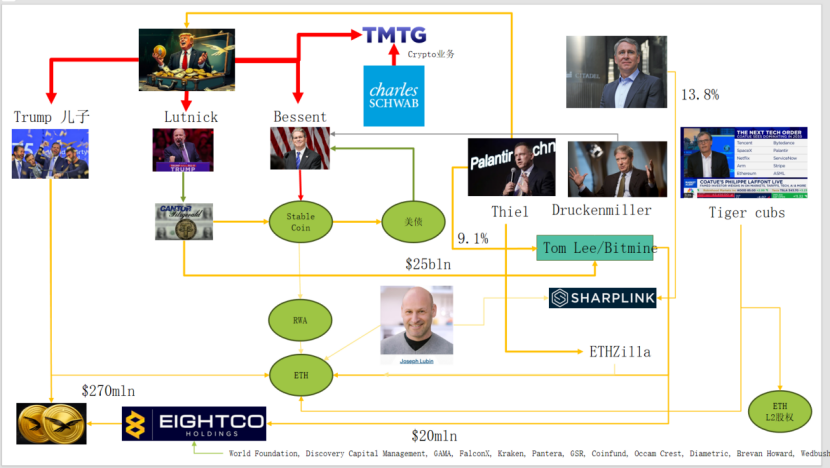
From this chart, we can see the intricate connections between the Trump family, traditional bond market makers, the Treasury, tech companies, and crypto companies, with the green elliptical links forming the backbone:

(1) Stable Coins (USDT, USDC, dollar assets behind WLD, etc.)

The majority of reserve assets are short-term U.S. bonds + bank deposits, held through brokers like Cantor.

(2) U.S. Bonds (U.S. Treasuries)

Issued and managed by the Treasury / Bessent side.

Used by Palantir, Druckenmiller, Tiger Cubs, etc., as low-risk interest rate base holdings.

Also the yield assets pursued by stablecoins / treasury companies.

(3) RWA (Real World Assets)

From U.S. bonds, mortgages, accounts receivable to housing finance.

Tokenized through Ethereum L1 / L2 protocols.

(4) ETH & ETH L2 Equity

Ethereum is the main chain承接 RWA, stablecoins, DeFi, and AI-DeFi.

L2 equity / Token represents a claim on future trading volume and fee cash flows.

This chain expresses:

U.S. dollar credit → U.S. bonds → Stablecoin reserves → Various crypto treasury / RWA protocols → Ultimately沉淀 on ETH / L2.

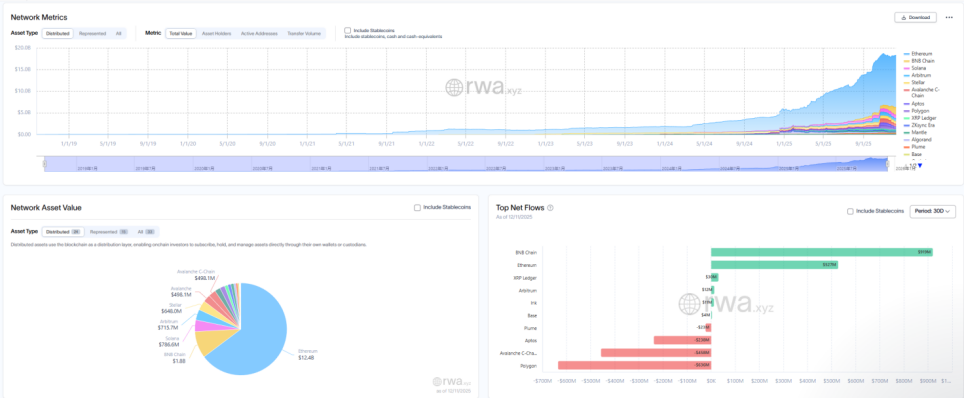
In terms of RWA TVL, compared to other public chains that declined after the October 11 crash, ETH is the only public chain that quickly recovered and rose. Its current TVL is $12.4 billion, accounting for 64.5% of the total crypto market.
II. Ethereum Explores Value Capture

The recent Ethereum Fusaka upgrade did not cause much stir in the market, but from the perspective of network structure and economic model evolution, it is a "milestone event." Fusaka is not just about scaling through EIPs like PeerDAS but also attempts to address the issue of insufficient value capture by the L1 mainnet due to L2 development.
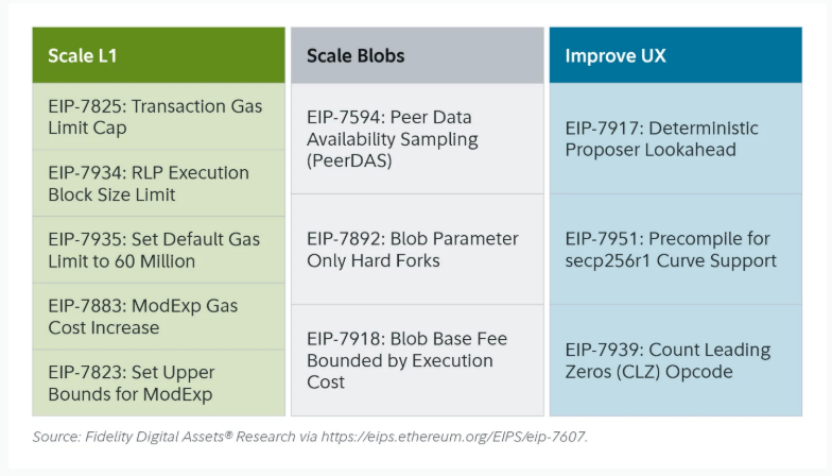
Through EIP-7918, ETH introduces a "dynamic floor price" for blob base fees, binding its lower limit to the L1 execution layer base fee, requiring blobs to pay at least about 1/16 of the L1 base fee unit price for DA fees. This means Rollups can no longer occupy blob bandwidth at near-zero cost for extended periods, and the corresponding fees will be burned and回流 to ETH holders.
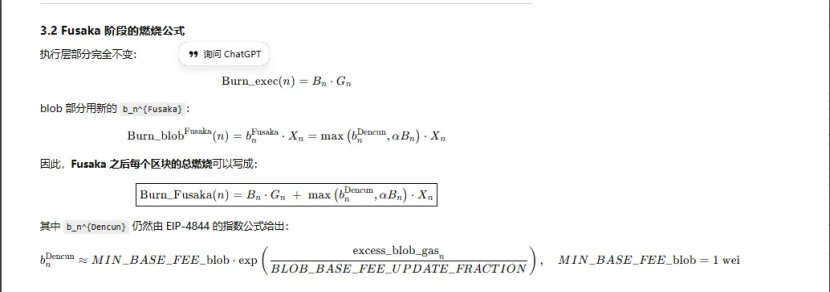
There have been three upgrades related to "burning" in Ethereum:

(1) London (Single-dimension): Only burned the execution layer; ETH began to experience structural burning due to L1 usage.

(2) Dencun (Dual-dimension + independent blob market): Burned execution layer + blob; L2 data写入 blob also burned ETH, but during low demand, the blob portion was almost 0.

(3) Fusaka (Dual-dimension + blob bound to L1): To use L2 (blob), one must pay at least a fixed proportion of the L1 base fee, which is burned. L2 activity is more stably mapped to ETH burning.
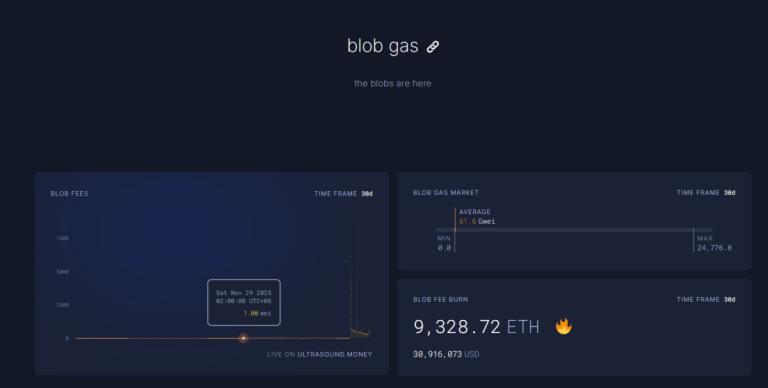
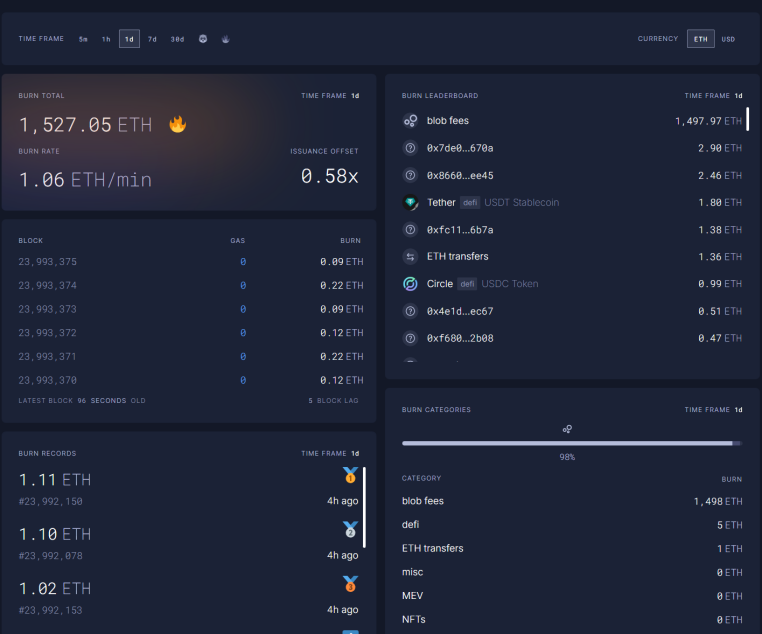
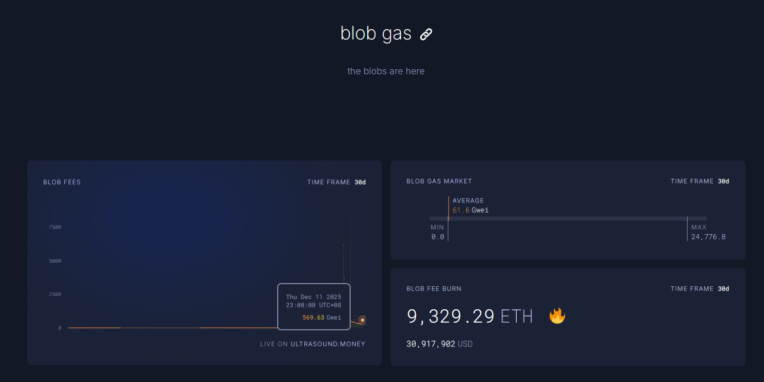
As of December 11, 23:00, the 1-hour blob fees have reached 569.63 billion times the pre-Fusaka upgrade level, burning 1,527 ETH in one day. Blob fees now contribute the highest proportion to burning,高达 98%. As ETH L2 becomes more active, this upgrade is expected to return ETH to deflation.

III. Ethereum Technicals Strengthen

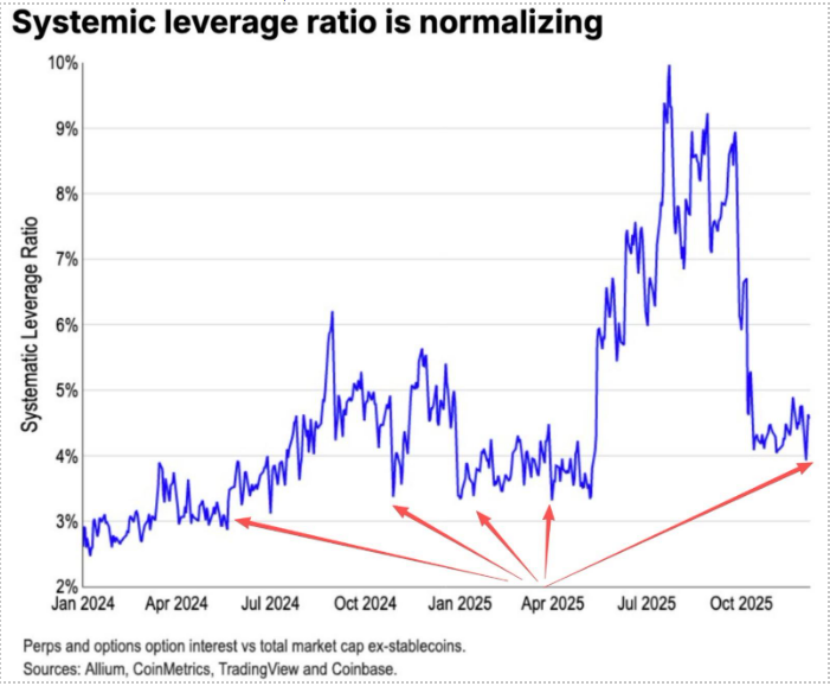
During the October 11 crash, ETH's futures leverage was thoroughly cleared, eventually reaching the spot leverage盘. At the same time, many with insufficient faith in ETH led to many early OG investors reducing their holdings and fleeing. According to Coinbase data, speculative leverage in the crypto圈 has dropped to a historically low region of 4%.
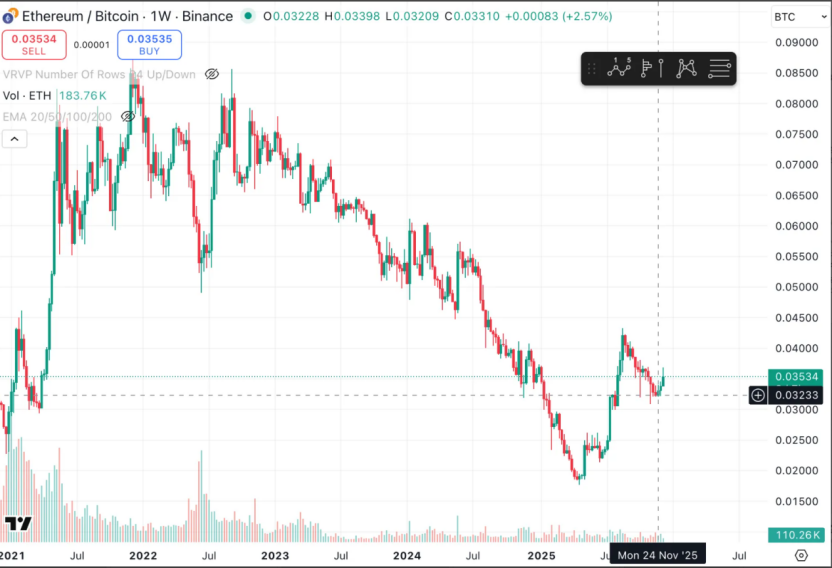
In the past, a significant portion of ETH short positions came from traditional Long BTC/Short ETH paired trades, which generally performed very well during bear markets. However, this time an意外 occurred. The ETH/BTC ratio has maintained a sideways resistance trend since November.
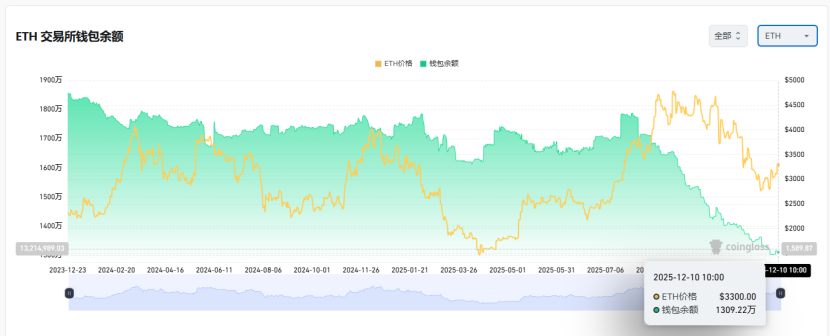
ETH's current存量 on exchanges is 13 million coins, about 10% of the total supply, at a historical low. As the Long BTC/Short ETH pairing has failed since November, during extreme panic, a "short squeeze" opportunity may gradually emerge.
As we approach the interaction between 2025 and 2026, future monetary and fiscal policies from both China and the U.S. have released friendly signals:

The U.S. will actively pursue tax cuts, interest rate reductions, and relaxed crypto regulations. China will implement appropriate easing and financial stability (suppressing volatility).

Under the expectations of relative easing in China and the U.S., and scenarios suppressing downward asset volatility, during extreme panic when capital and sentiment have not fully recovered, ETH is still in a good buying "sweet spot."


Twitter:https://twitter.com/BitpushNewsCN

Bitpush TG Discussion Group:https://t.me/BitPushCommunity

Bitpush TG Subscription: https://t.me/bitpush

Original Link:https://www.bitpush.news/articles/7595197

Trending Cryptos

Related Questions

QWhat is the new narrative chain formed by Wall Street and Washington in the crypto space according to the article?

AThe narrative chain is: U.S. political and economic elites → U.S. Treasury bonds (national debt) → Stablecoins / crypto treasury companies → Ethereum + RWA + L2.

QHow does the Fusaka upgrade aim to address the issue of L1 value capture on Ethereum?

AThe Fusaka upgrade introduces EIP-7918, which binds the blob base fee to a 'dynamic floor price' linked to the L1 execution layer base fee. This requires Rollups to pay at least approximately 1/16 of the L1 base fee for data availability, ensuring fees are burned and value flows back to ETH holders.

QWhat advantage does tokenization bring to asset ownership and settlement as highlighted by SEC Chairman Paul Atkins?

ATokenization provides high transparency in ownership structure and asset attributes, and enables 'T+0' settlement, replacing the current 'T+1' cycle, thereby reducing market risk and improving transparency.

QWhy is ETH considered to be in a good 'buying zone' or 'best offensive position' according to the article?

AETH is in a favorable position due to low leverage in the market (4%), reduced exchange supply (10% of total supply), the failure of Long BTC/Short ETH paired trades, and expectations of宽松 monetary policies from both the U.S. and China in 2025-2026.

QWhat role does Ethereum play in the RWA (Real World Assets) ecosystem based on the article?

AEthereum is the main chain hosting RWA protocols, stablecoins, and DeFi, with its L1/L2 used for tokenizing assets like U.S. Treasury bonds, mortgages, and accounts receivable. It holds 64.5% of the total crypto TVL in RWA.

Related Reads

A New Scaling Variable for Text-to-Image Generation, Discovered by ByteDance's Seed Team

ByteDance's SEED team investigated a crucial but often overlooked scaling variable in text-to-image diffusion models: the amount of image-grounded information in training captions. They found that simply increasing caption length with natural language does not improve model performance, as it often adds redundancy without new, usable visual supervision. The core discovery is that the final training loss of a diffusion model can be predicted by the *information content* of its text condition, measured by two complementary metrics: Grounded Perplexity Gain (GPG) and Effective Detailness (ED). This establishes a scaling relationship for text conditioning. To systematically increase information content, the team proposed **Structured Prompt (SP)**, a JSON-based representation that organizes visual variables (global scene, object attributes, spatial relationships) into clear fields, enhancing **Diffusability**—the model's ability to learn from captions. For inference, an LLM **Prompter** is trained to convert user queries into detailed SP instances, defining **Promptability**. The overall generation quality is viewed as a product of Diffusability and Promptability. A three-stage training strategy (SFT, cold-start reasoning distillation, and verifier-guided reinforcement) significantly improves the prompter's capability. The structured format also enables efficient iterative refinement through a *refine-render-judge* loop. In matched-control experiments using the same Qwen-Image backbone, data, and compute, the SP-based system substantially outperformed its natural-language counterpart, demonstrating that gains stem from the structured information interface, not just more training. The work shows that scaling text-to-image models requires scaling the *usable visual information* in conditions, not just model size or data volume.

marsbit18m ago

A New Scaling Variable for Text-to-Image Generation, Discovered by ByteDance's Seed Team

marsbit18m ago

In Just 6 Months, 4 Rounds of Funding: West Lake University Professor's Venture Takes Off

Westlake Robotics, an embodied artificial intelligence company, has completed its Series A financing round within just six months and a total of four rounds, raising a cumulative 5 billion RMB. The investor lineup includes prominent institutions such as SAIF Partners, Xiaomiao Langcheng, Henan Investment Group Huirong Fund, and Haiyuan Fund, forming a high-quality capital matrix comprising state-owned, industrial, and leading venture capital. The rapid and intensive capital injection reflects strong market confidence in the company's technological approach, product deployment capabilities, and long-term potential. The newly acquired funds will be primarily allocated to the research and development of a unified large model for humanoid robots and the establishment of a talent cultivation base for embodied AI. Founded in 2024, Westlake Robotics originated from the industrial transformation of pioneering achievements in AI and robotics at Westlake University. The founding team is led by Wang Donglin, a leading figure in China's embodied AI and robot learning field, and co-founder Zhang Yue, an expert in natural language processing. The core R&D members hail from top-tier tech companies like Alibaba, ByteDance, Tencent, and Huawei, as well as prestigious global universities. The company follows a fully self-developed strategy integrating a "universal brain + humanoid body-specific cerebellum + proprietary humanoid hardware." It is one of the few domestic enterprises capable of holistically connecting the three core areas of embodied AGI cognitive reasoning, full-body motion control, and humanoid hardware. Its proprietary technologies include the General Motion Model-GAE system for low-latency teleoperation and motion generalization, and a dual pre-trained architecture for general and body-specific processing to bridge cognitive reasoning and physical movement. In 2026, Westlake Robotics launched its self-developed humanoid robot "Westlake o1," completing the full technology chain from underlying algorithms to pre-trained models and hardware. The company has secured nearly 100 million RMB in orders, with applications in scientific research, education, data collection, and power inspection. Future targets include high-risk industrial inspection, post-disaster search and rescue, and remote precision assembly. The company has also partnered with the Longyou County government to establish a county-wide real-scenario training base for humanoid robots, aimed at collecting high-quality motion data and validating technology in authentic environments. With the latest funding, Westlake Robotics plans to further advance its core model development and talent acquisition strategy, accelerating progress toward the "GPT moment" for embodied intelligence in China.

marsbit42m ago

In Just 6 Months, 4 Rounds of Funding: West Lake University Professor's Venture Takes Off

marsbit42m ago

Volatility Plummets to Historic Lows, When Will Bitcoin's 'Summer Sideways Move' End?

Bitcoin is experiencing a classic summer of stagnant price action, trapped in a tight range between approximately $62,000 and $66,000. Analysts point to historically low implied volatility and thin summer liquidity as key characteristics of the current market. The consensus among traders is that the catalyst for a decisive breakout will come from macroeconomic factors, not internal crypto dynamics. The immediate focus is on upcoming U.S. CPI data, which could influence Federal Reserve policy expectations. A softer inflation print is seen as potentially supportive for risk assets like Bitcoin. Furthermore, the pending *Clarity Act* legislation is identified as a crucial long-term catalyst that could boost institutional participation by providing regulatory clarity. While U.S. spot Bitcoin ETFs, led by BlackRock's IBIT, have seen their strongest inflows since April, providing underlying support, this buying pressure is being offset by selling from miners and other large holders. This has resulted in continued consolidation even as global crypto trading volumes hit multi-year lows. Market participants expect the range-bound, low-volatility environment to persist for several more weeks, at least until there is clearer progress on macro policy or regulatory fronts. Any sustained break above or below the current range is likely to trigger a significant expansion in volatility. Long-term bullish narratives around adoption, institutional demand, and Bitcoin's unique attributes as collateral remain intact, but the short-term path depends on external macroeconomic catalysts.

marsbit45m ago

Volatility Plummets to Historic Lows, When Will Bitcoin's 'Summer Sideways Move' End?

marsbit45m ago

Trading

Spot

Hot Articles

Discussions

Welcome to the HTX Community. Here, you can stay informed about the latest platform developments and gain access to professional market insights. Users' opinions on the price of ETH (ETH) are presented below.

活动图片