Ghana passes law to legalize crypto trading, central bank governor says

cointelegraphPublished on 2025-12-22Last updated on 2025-12-22

Abstract

Ghana has legalized cryptocurrency trading by passing the Virtual Asset Service Providers Bill, establishing a regulatory framework for the industry. The Bank of Ghana (BoG) will serve as the primary regulator, with powers to license and supervise crypto asset service providers. According to BoG Governor Johnson Asiama, the law aims to manage risks such as fraud and money laundering, support innovation, and improve financial inclusion, especially among youth and tech entrepreneurs. Ghana ranks among the top five Sub-Saharan African countries in crypto adoption, with the region experiencing significant growth in on-chain value.

Ghana has legalized cryptocurrency trading by establishing a regulatory framework targeting the industry.

Ghana’s parliament has passed the Virtual Asset Service Providers Bill into law, Bank of Ghana (BoG) Governor Johnson Asiama said, according to a report on Sunday by the state-owned Daily Graphic news agency.

“Virtual asset trading is now legal, and no one will be arrested for engaging in cryptocurrency, but we now have a framework to manage the risks involved,” Asiama said on Friday at the BoG’s annual Nine Lessons, Carols and Thanksgiving Service.

The timing aligns with earlier central bank communications, as Asiama had previously indicated Ghana was targeting the introduction of crypto regulation by the end of 2025.

Ghana’s central bank gains supervisory powers

Under the legislation, the Bank of Ghana becomes the primary regulator for cryptocurrency activity, with powers to license and supervise crypto asset service providers (CASPs).

The law positions Ghana to better protect consumers from fraud, money laundering and systemic risks, while removing uncertainty over the legal status of cryptocurrency, Asiama said, adding:

“What this means is that now we have the framework to manage it and to manage the risks that can involve that kind of activity [...] These are not just legal milestones; they are enablers of better policies, stronger supervision and more effective regulation.”

The governor also mentioned that the crypto law is intended to support innovation and expand Ghana’s financial inclusion, particularly among young people and tech-driven entrepreneurs.

Ghana ranks among Sub-Saharan Africa’s top five crypto economies

Ghana’s move to regulate cryptocurrency activity comes as the country emerges as a significant player in crypto adoption across the region.

According to Chainalysis’ 2025 Geography of Cryptocurrency Report, Ghana ranked among the top five Sub-Saharan African countries by total crypto value received between July 2024 and June 2025.
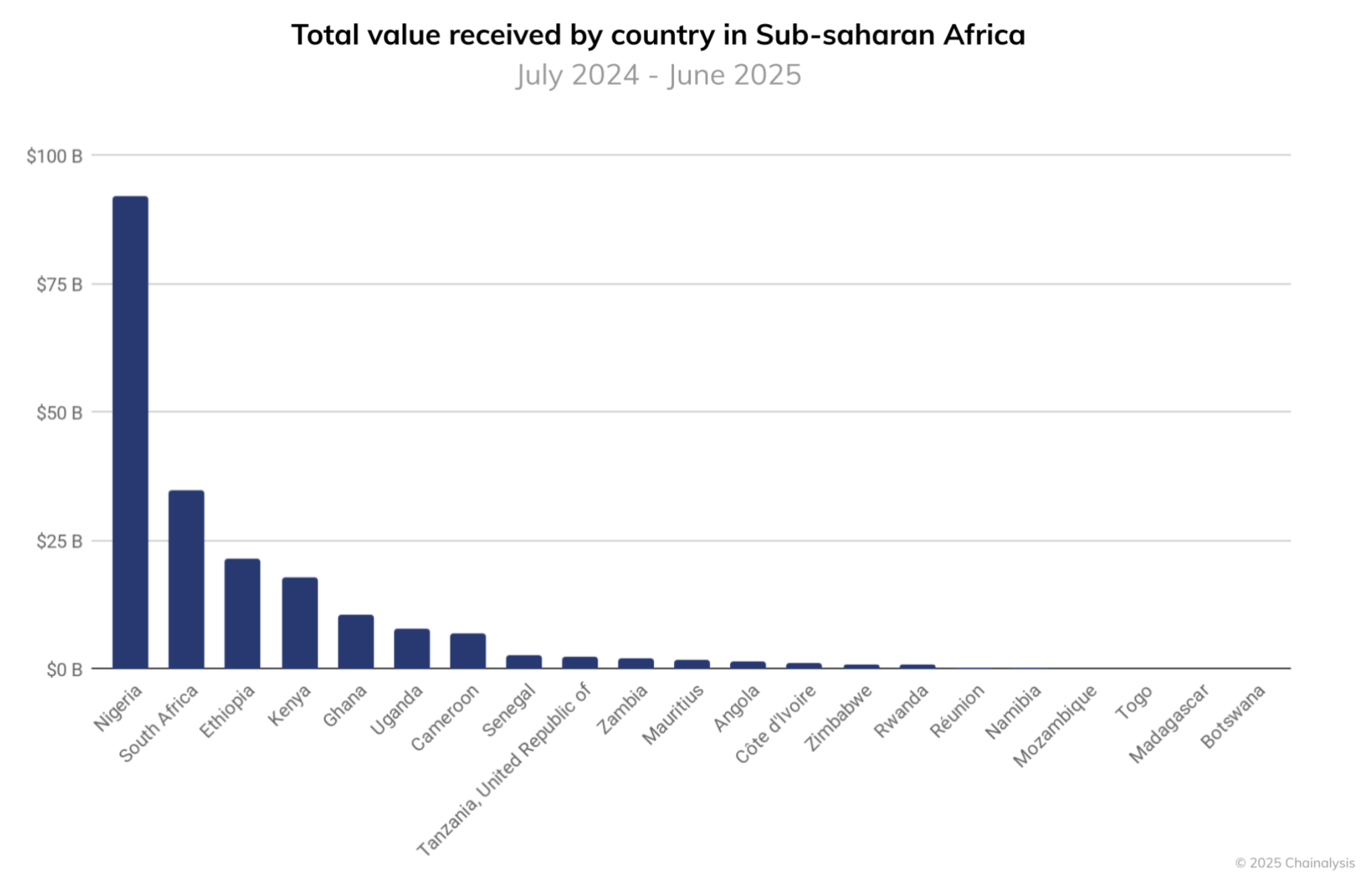
Total crypto value received by country in Sub-Saharan Africa from July 2024 to June 2025. Source: Chainalysis

In the meantime, Nigeria continued to dominate the region, receiving at least $92 billion in crypto value over the period, or nearly three times the amount recorded by South Africa, the report showed.

Related: CAR’s crypto push fueled ‘state capture’ by elites, criminal networks: Report

The Sub-Saharan region received over $205 billion in on-chain value, up about 52% from the previous year. This growth makes it the third-fastest growing region in the world, just behind Asia-Pacific and Latin America, according to Chainalysis.


Related Questions

QWhat is the key legislative action Ghana has taken regarding cryptocurrency trading?

AGhana has passed the Virtual Asset Service Providers Bill into law, legalizing cryptocurrency trading and establishing a regulatory framework for the industry.

QWho is the primary regulator for cryptocurrency activity in Ghana according to the new law?

AThe Bank of Ghana (BoG) is the primary regulator, with powers to license and supervise crypto asset service providers (CASPs).

QWhat did Governor Johnson Asiama state about the purpose of the new crypto law?

AHe stated that the law provides a framework to manage risks, protect consumers from fraud and money laundering, support innovation, and expand financial inclusion, especially among young people and tech-driven entrepreneurs.

QHow does Ghana rank in cryptocurrency adoption in Sub-Saharan Africa according to the Chainalysis report?

AGhana ranked among the top five Sub-Saharan African countries by total crypto value received between July 2024 and June 2025.

QWhat was the total on-chain value received by the Sub-Saharan Africa region and its growth rate?

AThe Sub-Saharan Africa region received over $205 billion in on-chain value, which is an increase of about 52% from the previous year.

Related Reads

Breaking: OpenAI Undergoes Major Reorganization, President Brockman Assumes Command

OpenAI has announced a major internal reorganization just months before its anticipated IPO. The company is merging its three flagship product lines—ChatGPT, Codex, and the API platform—into a single, unified product organization. The most significant leadership change involves co-founder and President Greg Brockman moving from a background technical role to take full, permanent control over all product strategy. This follows the indefinite medical leave of AGI Deployment CEO Fidji Simo. Additionally, ChatGPT's longtime lead, Nick Turley, has been reassigned to enterprise products, with former Instagram executive Ashley Alexander taking over consumer offerings. The consolidation, internally framed as a strategic move towards an "Agentic Future," aims to break down internal silos and create a cohesive "Super App." This planned desktop application would integrate ChatGPT's conversational abilities, Codex's coding power, and a rumored internal web browser named "Atlas" to autonomously perform complex user tasks. The reorganization occurs amid significant internal and external pressures. OpenAI has recently seen a wave of high-profile departures, including Sora co-lead Bill Peebles and other senior technical leaders, leading to concerns about a thinning executive bench. Externally, rival Anthropic recently secured funding at a staggering $900 billion valuation, surpassing OpenAI's own. Google's upcoming I/O developer conference also poses a competitive threat. Analysts suggest the dramatic restructure is a pre-IPO move to present a clearer, more focused narrative to Wall Street—streamlining operations and demonstrating decisive leadership under Brockman to counter internal turbulence and intense market competition.

marsbit1h ago

Breaking: OpenAI Undergoes Major Reorganization, President Brockman Assumes Command

marsbit1h ago

Two Survival Structures of Market Makers and Arbitrageurs

Market makers and arbitrageurs represent two distinct survival structures in high-frequency trading. Market makers primarily use limit orders (makers) to profit from the bid-ask spread, enjoying high capital efficiency (nominally 100%) but bearing inventory risk. This "inventory risk" arises from passive, fragmented, and discontinuous order fills in the limit order book (LOB). This risk, while a potential cost, can also contribute to excess profit if managed within control boundaries, allowing for mean reversion. Market makers essentially sell "time" (uncertainty over execution timing) to the market for price control and low fees. In contrast, cross-exchange arbitrageurs typically use market orders (takers) to exploit price differences or funding rates, resulting in lower nominal capital efficiency (requiring capital on both exchanges) and higher transaction costs. Their risk exposure stems from asymmetries in exchange rules (e.g., minimum order sizes), execution latency, and infrastructure risks (e.g., ADL, oracle drift). These exposures are active, exogenous gaps that primarily erode profits rather than contribute to them. Arbitrageurs essentially sell "space" (capital sunk across venues) for localized, immediate certainty. Both strategies engage in a trade-off between execution friction and residual risk. Optimal systems allow for temporary, controlled risk exposure rather than enforcing zero exposure at all costs. Their evolution converges towards hybrid models: arbitrageurs may use maker orders to reduce costs, while market makers may use taker orders or hedges for risk management. Ultimately, both use different forms of risk exposure—market makers exposing inventory, arbitrageurs immobilizing capital—to extract marginal, hard-won certainty from the market.

链捕手1h ago

Two Survival Structures of Market Makers and Arbitrageurs

链捕手1h ago

Who Will Define the Rules of the AI Era? Anthropic Discusses the 2028 US-China AI Landscape

This article, based on Anthropic's analysis, outlines the intensifying systemic competition between the U.S./allies and China for AI leadership by 2028. It argues that access to advanced computing power ("compute") is the critical bottleneck, where the U.S. currently holds a significant advantage through chip export controls and allied innovation. However, China's AI labs remain competitive by exploiting policy loopholes—via chip smuggling, overseas data center access, and "model distillation" attacks to copy U.S. model capabilities—keeping them close to the frontier. The piece presents two contrasting scenarios for 2028. In the first, decisive U.S. action to tighten compute controls and curb distillation locks in a 12-24 month AI capability lead, cementing democratic influence over global AI norms, security, and economic infrastructure. In the second, policy inaction allows China to achieve near-parity through continued access to U.S. technology, enabling Beijing to promote its AI stack globally and integrate advanced AI into its military and governance systems, altering the strategic balance. Anthropic contends that maintaining a decisive U.S. lead is essential for shaping safe AI development and governance. The core recommendation is for U.S. policymakers to urgently close compute and model access loopholes while promoting global adoption of the U.S. AI technology stack to secure a lasting strategic advantage.

marsbit3h ago

Who Will Define the Rules of the AI Era? Anthropic Discusses the 2028 US-China AI Landscape

marsbit3h ago

Trading

Spot
Futures

Hot Articles

What is $BANK

Bank AI: A Revolutionary Step in the Future of Banking Introduction In an era marked by rapid advancements in technology, Bank AI stands at the intersection of artificial intelligence (AI) and banking services. This innovative project seeks to redefine the financial landscape, enhancing operational efficiency, security measures, and customer experiences through the power of AI. As we embark on this exploration of Bank AI, we will delve into what the project entails, its operational dynamics, its historical context, and significant milestones. What is Bank AI? At its core, Bank AI represents a transformative initiative aimed at integrating artificial intelligence into various banking operations. This project harnesses the capabilities of AI to automate processes, improve risk management protocols, and enhance customer interaction through personalised services. The primary objectives of Bank AI include: Automation of Banking Functions: By leveraging AI technologies, Bank AI aims to automate routine tasks, reducing the burden on human resources and enhancing efficiency. Enhanced Risk Management: The project utilises AI algorithms to predict and identify risks, thereby fortifying security measures against fraud and other threats. Personalisation of Banking Services: Bank AI focuses on offering tailored financial products and services by analysing customer data and behaviours. Improving Customer Experience: The implementation of AI-driven solutions, such as chatbots and virtual assistants, aims to provide users with more human-like interactions, revolutionising the way customers engage with banks. With these goals, Bank AI positions itself as a crucial player in rendering banking more efficient, secure, and user-centric. Who is the Creator of Bank AI? Details regarding the creator of Bank AI remain unknown. As such, no specific individual or organisation has been identified in the available information. The anonymity surrounding the project's inception raises questions but does not detract from its ambitious vision and objectives. Who are the Investors of Bank AI? Similar to the project's creator, specific information regarding the investors or supporting organisations of Bank AI has not been disclosed. Without this information, it is challenging to outline the financial backing and institutional support that might be propelling the project forward. Nevertheless, the importance of having a robust investment foundation is pivotal for sustaining development in such an innovative field. How Does Bank AI Work? Bank AI operates on several innovative fronts, focusing on unique factors that differentiate it from traditional banking frameworks. Below are key operational features: Automation: By applying machine learning algorithms, Bank AI automates various manual processes within banks. This results in reduced operational costs and allows human workers to redirect their efforts towards more strategic activities. Advanced Risk Management: The integration of AI into risk management practices equips banks with tools to accurately predict potential threats such as fraud, ensuring that customer information and assets remain secure. Tailored Financial Recommendations: Through continuous learning from customer interactions, the AI systems develop a nuanced understanding of user needs, enabling them to offer tailored advice on financial decisions. Enhanced Customer Interactions: Utilizing chatbots and virtual assistants powered by AI, Bank AI enables a more engaging customer experience, allowing users to have their queries resolved quickly, thus reducing wait times and improving satisfaction levels. Together, these operational features position Bank AI as a pioneer in the banking sector, establishing new benchmarks for service delivery and operational excellence. Timeline of Bank AI Understanding the trajectory of Bank AI requires a look at its historical context. Below is a timeline highlighting important milestones and developments: Early 2010s: The conceptualisation of AI integration into banking services began to gain attention as banking institutions recognised the potential benefits. 2018: A marked increase in the implementation of AI technologies occurred when banks started using AI tools like chatbots for basic customer service and risk management systems for improved security handling. 2023: The sophistication of AI continued to advance, with generative AI being introduced for more complex tasks such as document processing and real-time investment analysis. This year marked a significant leap in the capabilities afforded to banks by AI technology. 2024-Current Status: As of this year, Bank AI is on an upward trajectory, with ongoing research and developments poised to further enhance capabilities in banking operations. Continued exploration of AI applications hints at exciting developments yet to come. Key Points About Bank AI Integration of AI in Banking: Bank AI focuses on adopting artificial intelligence to streamline banking processes and improve user experiences. Automation and Risk Management Focus: The project strongly emphasises these areas, aiming to shift the burden of routine tasks while enhancing security frameworks through predictive analytics. Personalised Banking Solutions: By harnessing customer data, Bank AI enables tailored banking services that cater to individual user needs. Commitment to Development: Bank AI remains committed to ongoing research and development efforts, ensuring its adaptability and ongoing relevance as technology continues to evolve. Conclusion In summary, Bank AI exemplifies a crucial step forward in the banking industry, leveraging artificial intelligence to reshape operational paradigms, enhance security, and promote customer satisfaction. Despite gaps in information surrounding the creator and investors, the clear objectives and functional mechanisms of Bank AI provide a strong foundation for its ongoing evolution. As AI technology continues to advance and merge with the banking sector, Bank AI is well-positioned to significantly impact the future of financial services, enhancing the way we understand and interact with banking.

152 Total ViewsPublished 2024.04.06Updated 2024.12.03

What is $BANK

Discussions

Welcome to the HTX Community. Here, you can stay informed about the latest platform developments and gain access to professional market insights. Users' opinions on the price of BANK (BANK) are presented below.

活动图片












