Ghana passes law to legalize crypto trading, central bank governor says

cointelegraphPublished on 2025-12-22Last updated on 2025-12-22

Abstract

Ghana has legalized cryptocurrency trading by passing the Virtual Asset Service Providers Bill, establishing a regulatory framework for the industry. The Bank of Ghana (BoG) will serve as the primary regulator, with powers to license and supervise crypto asset service providers. According to BoG Governor Johnson Asiama, the law aims to manage risks such as fraud and money laundering, support innovation, and improve financial inclusion, especially among youth and tech entrepreneurs. Ghana ranks among the top five Sub-Saharan African countries in crypto adoption, with the region experiencing significant growth in on-chain value.

Ghana has legalized cryptocurrency trading by establishing a regulatory framework targeting the industry.

Ghana’s parliament has passed the Virtual Asset Service Providers Bill into law, Bank of Ghana (BoG) Governor Johnson Asiama said, according to a report on Sunday by the state-owned Daily Graphic news agency.

“Virtual asset trading is now legal, and no one will be arrested for engaging in cryptocurrency, but we now have a framework to manage the risks involved,” Asiama said on Friday at the BoG’s annual Nine Lessons, Carols and Thanksgiving Service.

The timing aligns with earlier central bank communications, as Asiama had previously indicated Ghana was targeting the introduction of crypto regulation by the end of 2025.

Ghana’s central bank gains supervisory powers

Under the legislation, the Bank of Ghana becomes the primary regulator for cryptocurrency activity, with powers to license and supervise crypto asset service providers (CASPs).

The law positions Ghana to better protect consumers from fraud, money laundering and systemic risks, while removing uncertainty over the legal status of cryptocurrency, Asiama said, adding:

“What this means is that now we have the framework to manage it and to manage the risks that can involve that kind of activity [...] These are not just legal milestones; they are enablers of better policies, stronger supervision and more effective regulation.”

The governor also mentioned that the crypto law is intended to support innovation and expand Ghana’s financial inclusion, particularly among young people and tech-driven entrepreneurs.

Ghana ranks among Sub-Saharan Africa’s top five crypto economies

Ghana’s move to regulate cryptocurrency activity comes as the country emerges as a significant player in crypto adoption across the region.

According to Chainalysis’ 2025 Geography of Cryptocurrency Report, Ghana ranked among the top five Sub-Saharan African countries by total crypto value received between July 2024 and June 2025.
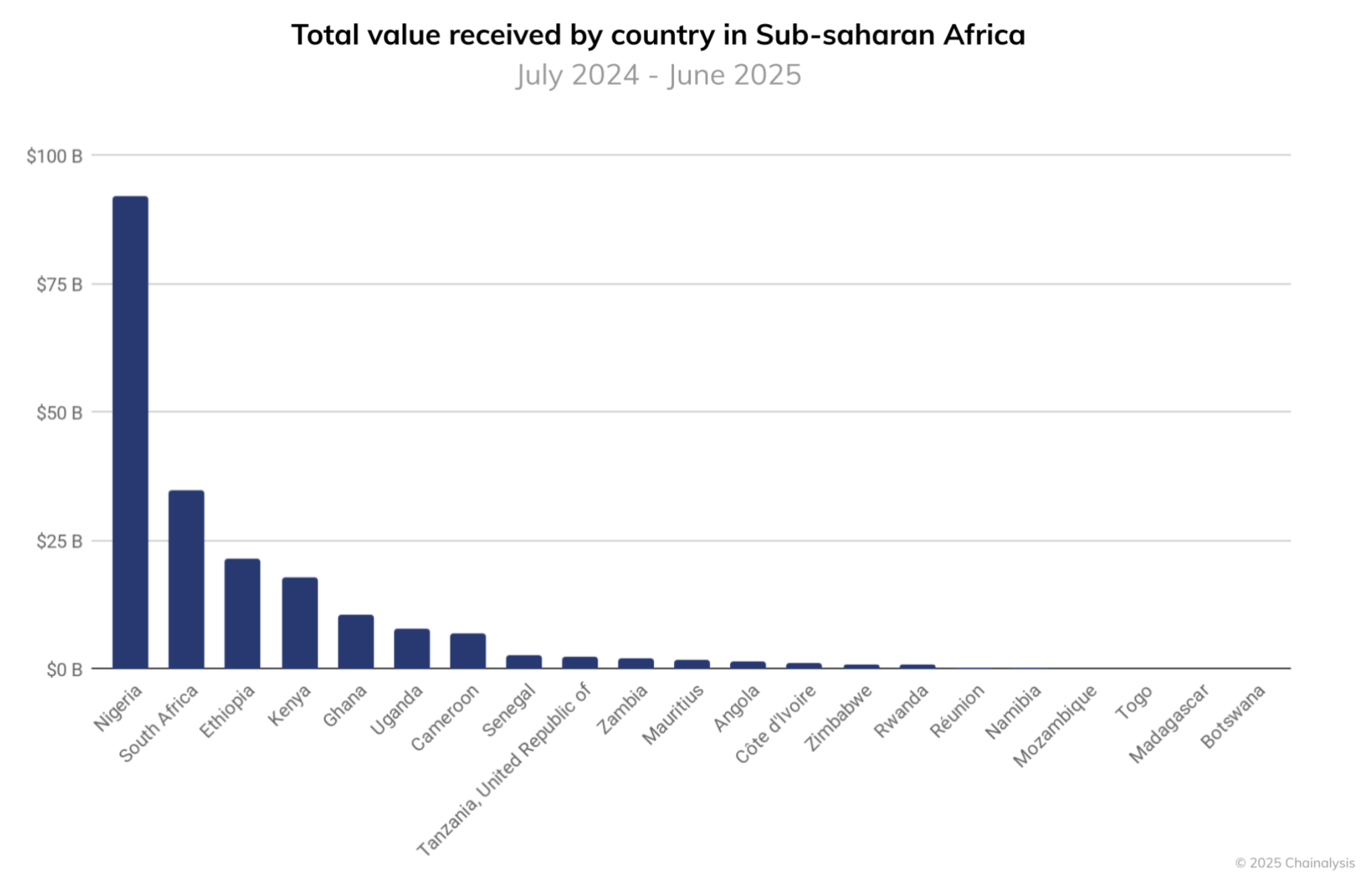
Total crypto value received by country in Sub-Saharan Africa from July 2024 to June 2025. Source: Chainalysis

In the meantime, Nigeria continued to dominate the region, receiving at least $92 billion in crypto value over the period, or nearly three times the amount recorded by South Africa, the report showed.

Related: CAR’s crypto push fueled ‘state capture’ by elites, criminal networks: Report

The Sub-Saharan region received over $205 billion in on-chain value, up about 52% from the previous year. This growth makes it the third-fastest growing region in the world, just behind Asia-Pacific and Latin America, according to Chainalysis.


Related Questions

QWhat is the key legislative action Ghana has taken regarding cryptocurrency trading?

AGhana has passed the Virtual Asset Service Providers Bill into law, legalizing cryptocurrency trading and establishing a regulatory framework for the industry.

QWho is the primary regulator for cryptocurrency activity in Ghana according to the new law?

AThe Bank of Ghana (BoG) is the primary regulator, with powers to license and supervise crypto asset service providers (CASPs).

QWhat did Governor Johnson Asiama state about the purpose of the new crypto law?

AHe stated that the law provides a framework to manage risks, protect consumers from fraud and money laundering, support innovation, and expand financial inclusion, especially among young people and tech-driven entrepreneurs.

QHow does Ghana rank in cryptocurrency adoption in Sub-Saharan Africa according to the Chainalysis report?

AGhana ranked among the top five Sub-Saharan African countries by total crypto value received between July 2024 and June 2025.

QWhat was the total on-chain value received by the Sub-Saharan Africa region and its growth rate?

AThe Sub-Saharan Africa region received over $205 billion in on-chain value, which is an increase of about 52% from the previous year.

Related Reads

Three Scenarios for BTC's Future Direction and a Duel Between Two Strong Forces | Special Invited Analysis

**Title: Three Scenarios for BTC's Future Trajectory and a Key Duel | Invited Analysis** The market remains at a critical juncture. Over the past week, Bitcoin (BTC) consolidated broadly between $79,500 and $80,600, validating previous technical analysis. The current focus is on whether this marks the start of a new uptrend or a pause within a larger correction. **BTC Multi-Cycle Analysis & Three Possible Scenarios** BTC's daily chart structure, following its peak at $126,200 in October 2025, presents three primary technical scenarios based on Elliott Wave theory: 1. **Bullish Scenario (End of Correction):** The corrective A-B-C wave from $126,200 ended at the $60,000 low in February 2026. The current price action is the start of a major Wave I uptrend. A subsequent Wave II pullback would not break below $60,000. 2. **Bearish Scenario 1 (Complex Correction):** The correction is unfolding as an A-B-C-D-E pattern. The current move from $60,000 is a D-wave rally. After its completion, a final E-wave decline could potentially breach the $60,000 level. 3. **Bearish Scenario 2 (Larger Correction):** The entire move down from $126,200 to $60,000 was a large A-wave. The current rally is a B-wave correction within a larger A-B-C structure, to be followed by a C-wave decline below $60,000. *Analysis suggests Scenario 2 is less probable due to time disproportions between waves. The battle is effectively between the Bullish Scenario (1) and Bearish Scenario (3).* **Key BTC Levels & Weekly Strategy** On the 4-hour chart, BTC trades above a crucial consolidation zone ("Central Pivot C"). * **Key Resistance:** $83,500-$84,500; $89,000-$90,500. * **Key Support:** $78,500-$79,500 (pivot upper bound); $73,500-$75,000; $69,500-$70,500. **Weekly Outlook:** The market direction hinges on BTC's ability to hold above or break below the $78,500-$79,500 support zone. * **Mid-term Strategy:** Neutral/Wait-and-see stance due to unclear direction. * **Short-term Tactics:** Two contingency plans using 30% max capital: * **Plan A (Bullish):** Look for long entries if price holds above $78,500-$79,500 with confirming signals. Initial stop-loss below $78,500. * **Plan B (Bearish):** Consider short positions if price breaks below $73,500-$75,000 with confirming signals. Initial stop-loss above $76,500. **HYPE Analysis & Strategy** HYPE's daily chart shows a seven-segment structure from its January low of $20.46, forming a "rising pivot" zone. * **Key Level to Watch:** $45.76 (previous high). A break above would confirm the bullish structure remains intact. * **Short-term Strategy:** Focus on pivot zone boundaries ($38.41 upper, $34.44 lower). * **Long:** Consider on support near $38.41 with bullish confirmation signals. * **Short:** Consider on a break below $34.44 with bearish confirmation signals. * Position size must be below 30% with strict stop-loss discipline. **Risk Management Reminder:** Always set an initial stop-loss upon entry. Move stop-loss to breakeven at +1% profit, then trail it upwards to lock in profits dynamically. All views are based on technical analysis for informational purposes only and do not constitute investment advice. The market is inherently risky.

Odaily星球日报4m ago

Three Scenarios for BTC's Future Direction and a Duel Between Two Strong Forces | Special Invited Analysis

Odaily星球日报4m ago

Sequoia Interview with Hassabis: Information is the Essence of the Universe, AI Will Open Up Entirely New Scientific Branches

Demis Hassabis, co-founder and CEO of Google DeepMind and Nobel laureate, discusses the path to AGI and its profound implications in a Sequoia Capital interview. He outlines his lifelong dedication to AI, tracing his journey from game development (e.g., *Theme Park*)—a perfect AI testing ground—to neuroscience and finally founding DeepMind in 2009. He emphasizes the critical lesson of being "5 years, not 50 years, ahead of time" for successful entrepreneurship. Hassabis reiterates DeepMind's two-step mission: first, solve intelligence by building AGI; second, use AGI to tackle other complex problems. He highlights the transformative potential of "AI for Science," particularly in biology where tools like AlphaFold have revolutionized protein folding. He envisions AI-powered simulations drastically shortening drug discovery from years to weeks and enabling personalized medicine. Furthermore, he predicts AI will spawn new scientific disciplines, such as an engineering science for understanding complex AI systems (mechanistic interpretability) and novel fields enabled by high-fidelity simulators for complex systems like economics. He posits a fundamental worldview where information, not just matter or energy, is the essence of the universe, making AI's information-processing core uniquely suited to understanding reality. He defends classical Turing machines as potentially sufficient for modeling complex phenomena, including quantum systems, as demonstrated by AlphaFold. On consciousness, Hassabis suggests first building AGI as a powerful tool, then using it to explore deep philosophical questions. He believes components like self-awareness and temporal continuity are necessary for consciousness but that defining it fully remains an open challenge. He predicts AGI could arrive around 2030 and, once achieved, would be used to probe the deepest questions of science and reality, much as envisioned in David Deutsch's *The Fabric of Reality*.

链捕手22m ago

Sequoia Interview with Hassabis: Information is the Essence of the Universe, AI Will Open Up Entirely New Scientific Branches

链捕手22m ago

Morgan Stanley 2026 Semiconductor Report: Buy Packaging, Buy Testing, Buy China Chips, Avoid Traditional Tracks

Morgan Stanley 2026 Semiconductor Report: Buy Packaging, Buy Testing, Buy Chinese Chips; Avoid Traditional Segments. The core theme is the shift in AI compute supply from NVIDIA dominance to a three-track system of GPU + ASIC + China-local chips. The key opportunity is capturing share in this expansion, while non-AI semiconductors face marginalization due to resource reallocation to AI. Key investment conclusions, in order of priority: 1. **Advanced Packaging (CoWoS/SoIC) - Highest Conviction**: TSMC is the primary beneficiary of explosive demand, driven by massive cloud capex. Its pricing power and AI revenue share are rising significantly. 2. **Test Equipment - Undervalued & High-Growth Certainty**: Chip complexity is causing test times to double generationally, structurally driving handler/socket/probe card demand. Companies like Hon Hai Precision (Foxconn), WinWay, and MPI offer compelling value. 3. **China AI Chips (GPU/ASIC) - Long-Term Irreversible Trend**: Export controls are accelerating domestic substitution. Companies like Cambricon, with firm customer orders and SMIC's 7nm capacity support, are positioned to benefit from lower TCO (30-60% vs NVIDIA) and growing local cloud demand. 4. **Avoid Non-AI Semiconductors (Consumer/Auto/Industrial)**: These segments face a weak, structurally hindered recovery due to AI's resource "crowding-out" effect on capacity and supply chains. 5. **Memory - Severe Internal Divergence**: Strongly favor HBM (Hynix primary beneficiary) and NOR Flash (Macronix). Be cautious on interpreting price rises in DDR4/NAND as true demand recovery. The report emphasizes a 2026-2027 time window, stating the AI capital expenditure cycle is far from over. Key macro variables include persistent export controls and AI's systemic "crowding-out" effect on traditional semiconductor supply chains.

marsbit1h ago

Morgan Stanley 2026 Semiconductor Report: Buy Packaging, Buy Testing, Buy China Chips, Avoid Traditional Tracks

marsbit1h ago

Circle:Sluggish Market? The Top Stablecoin Stock Continues to Expand

Circle, the issuer of the stablecoin USDC, reported its Q1 2026 earnings on May 11th, Eastern Time. Against a backdrop of weak crypto market sentiment, USDC's average circulation in Q1 was $752 billion, with a modest 2% sequential increase to $770 billion by quarter-end. New minting volumes declined due to the poor crypto market, but remained high, indicating demand expansion beyond crypto trading. USDC's market share remained stable at 28% of the total stablecoin market, while competition from Tether's USDT persists. A key highlight was "Other Revenue," which reached $42 million, more than doubling year-over-year, though sequential growth slowed to 13%. This revenue stream, including fees from services like Web3 software, the Cipher payment network (CPN), and the Arc blockchain, is critical for diversifying away from interest income. Circle's internally held USDC share increased to 18%, helping to improve gross margin by 130 basis points to 41.4% by reducing external sharing costs. However, profitability was pressured as total revenue growth slowed, primarily due to the significant weight of interest income, which is tied to USDC规模 and Treasury rates. Adjusted EBITDA was $133 million with a 19.2% margin. Management maintained its full-year 2026 guidance for adjusted operating expenses ($570-$585 million) and other revenue ($150-$170 million). The long-term target for USDC's CAGR remains 40%, though near-term volatility is expected. The article concludes that while Circle's current valuation of $28 billion appears reasonable after a recent recovery, further upside depends on the pace of stable币 adoption and potential positive sentiment from the advancement of regulatory clarity acts like CLARITY.

链捕手1h ago

Circle:Sluggish Market? The Top Stablecoin Stock Continues to Expand

链捕手1h ago

Tech Stocks' Narrative Is Increasingly Relying on Anthropic

The narrative of tech stocks is increasingly relying on Anthropic. Anthropic, the AI company behind Claude, has become central to the financial stories of major tech giants. Elon Musk dissolved xAI, merging it into SpaceX as SpaceXAI, and secured an exclusive deal to rent the massive "Colossus 1" supercomputing cluster to Anthropic. In return, Anthropic expressed interest in future space-based compute collaborations. Google and Amazon are also deeply invested. Google plans to invest up to $40 billion and provide significant compute power, while Amazon holds a 15-16% stake. Both companies reported massive quarterly profit surges largely due to valuation gains from their Anthropic holdings. Crucially, Anthropic has committed to multi-billion dollar cloud compute contracts with both Google Cloud and AWS. This creates a clear divide: the "A Camp" (Anthropic-Google-Musk) versus the "O Camp" (OpenAI-Microsoft). The A Camp's strategy intertwines equity, compute orders, and profits, making Anthropic a "systemic financial node." Its performance directly impacts its partners' financials and stock prices. In contrast, OpenAI, while leading in user traffic, faces commercialization challenges, lower per-user revenue, and a recently restructured relationship with Microsoft. The AI industry is shifting from a race for raw compute (symbolized by Nvidia) to a focus on monetizable applications, where Anthropic currently excels. However, this concentration of market hope on one company amplifies systemic risk. The rise of powerful open-source models like DeepSeek-V4 poses a significant threat, as they could undermine the value proposition of closed-source models like Claude. The article suggests ongoing geopolitical efforts to suppress such competitors will be a long-term strategic focus for Anthropic's allies.

marsbit1h ago

Tech Stocks' Narrative Is Increasingly Relying on Anthropic

marsbit1h ago

Trading

Spot
Futures

Hot Articles

What is $BANK

Bank AI: A Revolutionary Step in the Future of Banking Introduction In an era marked by rapid advancements in technology, Bank AI stands at the intersection of artificial intelligence (AI) and banking services. This innovative project seeks to redefine the financial landscape, enhancing operational efficiency, security measures, and customer experiences through the power of AI. As we embark on this exploration of Bank AI, we will delve into what the project entails, its operational dynamics, its historical context, and significant milestones. What is Bank AI? At its core, Bank AI represents a transformative initiative aimed at integrating artificial intelligence into various banking operations. This project harnesses the capabilities of AI to automate processes, improve risk management protocols, and enhance customer interaction through personalised services. The primary objectives of Bank AI include: Automation of Banking Functions: By leveraging AI technologies, Bank AI aims to automate routine tasks, reducing the burden on human resources and enhancing efficiency. Enhanced Risk Management: The project utilises AI algorithms to predict and identify risks, thereby fortifying security measures against fraud and other threats. Personalisation of Banking Services: Bank AI focuses on offering tailored financial products and services by analysing customer data and behaviours. Improving Customer Experience: The implementation of AI-driven solutions, such as chatbots and virtual assistants, aims to provide users with more human-like interactions, revolutionising the way customers engage with banks. With these goals, Bank AI positions itself as a crucial player in rendering banking more efficient, secure, and user-centric. Who is the Creator of Bank AI? Details regarding the creator of Bank AI remain unknown. As such, no specific individual or organisation has been identified in the available information. The anonymity surrounding the project's inception raises questions but does not detract from its ambitious vision and objectives. Who are the Investors of Bank AI? Similar to the project's creator, specific information regarding the investors or supporting organisations of Bank AI has not been disclosed. Without this information, it is challenging to outline the financial backing and institutional support that might be propelling the project forward. Nevertheless, the importance of having a robust investment foundation is pivotal for sustaining development in such an innovative field. How Does Bank AI Work? Bank AI operates on several innovative fronts, focusing on unique factors that differentiate it from traditional banking frameworks. Below are key operational features: Automation: By applying machine learning algorithms, Bank AI automates various manual processes within banks. This results in reduced operational costs and allows human workers to redirect their efforts towards more strategic activities. Advanced Risk Management: The integration of AI into risk management practices equips banks with tools to accurately predict potential threats such as fraud, ensuring that customer information and assets remain secure. Tailored Financial Recommendations: Through continuous learning from customer interactions, the AI systems develop a nuanced understanding of user needs, enabling them to offer tailored advice on financial decisions. Enhanced Customer Interactions: Utilizing chatbots and virtual assistants powered by AI, Bank AI enables a more engaging customer experience, allowing users to have their queries resolved quickly, thus reducing wait times and improving satisfaction levels. Together, these operational features position Bank AI as a pioneer in the banking sector, establishing new benchmarks for service delivery and operational excellence. Timeline of Bank AI Understanding the trajectory of Bank AI requires a look at its historical context. Below is a timeline highlighting important milestones and developments: Early 2010s: The conceptualisation of AI integration into banking services began to gain attention as banking institutions recognised the potential benefits. 2018: A marked increase in the implementation of AI technologies occurred when banks started using AI tools like chatbots for basic customer service and risk management systems for improved security handling. 2023: The sophistication of AI continued to advance, with generative AI being introduced for more complex tasks such as document processing and real-time investment analysis. This year marked a significant leap in the capabilities afforded to banks by AI technology. 2024-Current Status: As of this year, Bank AI is on an upward trajectory, with ongoing research and developments poised to further enhance capabilities in banking operations. Continued exploration of AI applications hints at exciting developments yet to come. Key Points About Bank AI Integration of AI in Banking: Bank AI focuses on adopting artificial intelligence to streamline banking processes and improve user experiences. Automation and Risk Management Focus: The project strongly emphasises these areas, aiming to shift the burden of routine tasks while enhancing security frameworks through predictive analytics. Personalised Banking Solutions: By harnessing customer data, Bank AI enables tailored banking services that cater to individual user needs. Commitment to Development: Bank AI remains committed to ongoing research and development efforts, ensuring its adaptability and ongoing relevance as technology continues to evolve. Conclusion In summary, Bank AI exemplifies a crucial step forward in the banking industry, leveraging artificial intelligence to reshape operational paradigms, enhance security, and promote customer satisfaction. Despite gaps in information surrounding the creator and investors, the clear objectives and functional mechanisms of Bank AI provide a strong foundation for its ongoing evolution. As AI technology continues to advance and merge with the banking sector, Bank AI is well-positioned to significantly impact the future of financial services, enhancing the way we understand and interact with banking.

152 Total ViewsPublished 2024.04.06Updated 2024.12.03

What is $BANK

Discussions

Welcome to the HTX Community. Here, you can stay informed about the latest platform developments and gain access to professional market insights. Users' opinions on the price of BANK (BANK) are presented below.

活动图片












