Georgia Teams Up With Tether To Launch National Stablecoin

bitcoinistPublished on 2026-05-26Last updated on 2026-05-26

Abstract

The government of Georgia has partnered with Tether, the issuer of USDT, to launch GEL₮, a national stablecoin pegged to the Georgian Lari. This initiative aims to integrate the national currency directly onto digital asset infrastructure under a new regulatory framework, designed to align with regulations like the U.S. GENIUS Act. Georgia's prime minister and Tether's CEO highlighted the move as a step toward a more transparent and digitally empowered financial system, building on the country's existing digital asset payment infrastructure. While specific launch details for GEL₮ are pending, the announcement coincides with a period of strong regulatory momentum and growth for stablecoins, whose combined market cap is near an all-time high of approximately $322.7 billion.

The government of Georgia has announced a partnership with USDT issuer Tether to launch GEL₮, an official stablecoin for the country.

Tether To Launch Stablecoin Based On The Georgian Lari

As announced on its website, Tether has partnered up with the government of Georgia for a stablecoin. A “stablecoin” is a type of cryptocurrency that has its price tied to a fiat currency. Currently, tokens of this type based on a range of currencies are available in the market, but the most dominant ones are those based on the US Dollar.

Tether is the issuer of one such USD-pegged stablecoin called USDT. In fact, based on the market cap, the firm’s asset ranks the largest among fiat-tied cryptocurrencies and third overall in the sector as a whole.

Now, the company is looking to release a new stablecoin in collaboration with the Georgian government. This token, known as GEL₮, will be based on the Georgian Lari, the official currency of the country. “This marks one of the first joint efforts to place a national currency directly onto digital asset rails under a purpose-built stablecoin regulatory framework,” noted the announcement.

The move is one among many being made by governments around the world when it comes to stablecoin regulation. A major win for the sector has been the GENIUS Act enacted in the United States last year. According to Tether’s press release, Georgia’s framework has been designed to achieve compatibility with the GENIUS Act and other US regulation.

Irakli Kobakhidze, prime minister of Georgia, said:

Together with visionary partners like Tether, Georgia is laying the foundations for a more connected, transparent, and digitally empowered financial world

Georgia already has an advanced system in place for digital asset payments, with regulated intermediaries allowing conversion of cryptocurrencies into local currency for real-world settlements.

Paolo Ardoino, Tether CEO, noted:

Georgia has moved early to create serious regulatory architecture for digital assets and stablecoins, and that clarity creates the foundation for real innovation and adoption.

Further details related to GEL₮ like its release date and rollout structure are still unknown, with the press release noting that they will be announced at a later date.

The positive regulatory momentum related to stablecoins around the world recently has meant that the sector has held up relatively well during the past few months even as the wider digital asset market has struggled. As data from DefiLlama shows, the combined market cap of the stablecoins has been enjoying an uptrend.
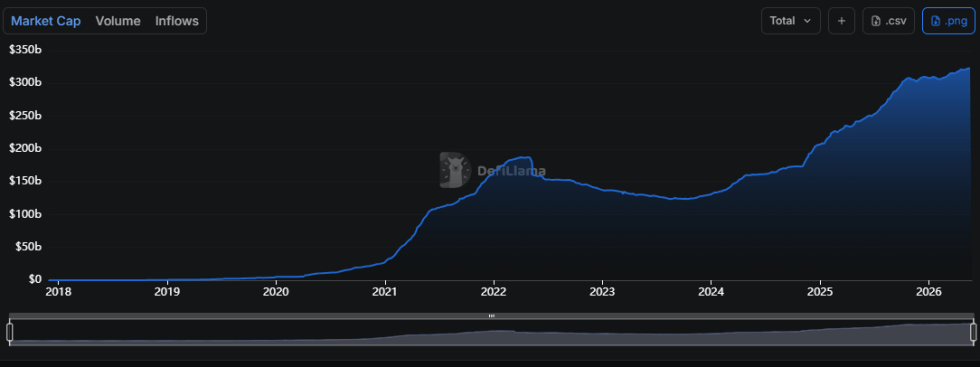
The trend in the market cap of the stablecoins over the years | Source: DefiLlama

Currently, the market cap of these assets is sitting at $322.7 billion, which is around an all-time high (ATH).

Bitcoin Price

At the time of writing, Bitcoin is trading around $77,400, up 0.7% over the past week.

Looks like the price of the coin has rebounded from its dip | Source: BTCUSDT on TradingView


Related Questions

QWhat is the name of the new stablecoin that Tether is launching in partnership with Georgia, and which fiat currency is it pegged to?

AThe new stablecoin is called GEL₮, and it is pegged to the Georgian Lari, the official currency of Georgia.

QAccording to the article, how does the press release describe Georgia's new stablecoin framework in relation to US regulation?

AThe press release notes that Georgia's stablecoin regulatory framework has been designed to achieve compatibility with the GENIUS Act and other US regulations.

QWhat did Paolo Ardoino, Tether CEO, cite as a key reason for Georgia being a suitable partner for this stablecoin initiative?

APaolo Ardoino stated that Georgia has moved early to create a serious regulatory architecture for digital assets and stablecoins, and that clarity creates the foundation for real innovation and adoption.

QWhat is the current total market capitalization of stablecoins according to the data from DefiLlama mentioned in the article?

AAccording to the article, the combined market cap of stablecoins is currently sitting at $322.7 billion, which is around an all-time high.

QWhat was the approximate price and weekly performance of Bitcoin at the time the article was written?

AAt the time of writing, Bitcoin was trading around $77,400, up 0.7% over the past week.

Related Reads

Bitcoin Withdrawals Continue: 8 Years of Storage in a Coldcard Cold Wallet Ended in Zero

Coldcard Hardware Wallet Hacked: Losses Mount Due to Vulnerable Seed Generation A critical vulnerability in Coldcard hardware wallets has led to a continued wave of fund thefts. According to Galaxy Research, the total stolen has reached 1,367.05 BTC (approx. $88.6 million) from 4,585 addresses, a significant increase from the initial 594.5 BTC reported on July 30, 2026. Most of the stolen funds remain on the attackers' addresses. The issue is not with the current firmware, which Coinkite has updated, but with seed phrases generated on vulnerable devices between March 2021 and the release of fixed firmware versions. Due to a programmer error, devices switched from using a hardware random number generator to the software-based Yasmarang generator, which was initialized with publicly accessible data like the chip's serial number. This made the seed phrases predictable through offline brute-force attacks, meaning wallets remain at risk until funds are moved to a new wallet generated with the patched firmware. Affected devices include Mk2/Mk3 with firmware 4.0.1–4.1.9 (and up to 5.0.3), Mk4/Mk5 up to version 5.6.0, and Q models up to 1.5.0Q. The only exceptions are seeds created with a high-entropy method like at least 50 independent dice rolls or a strong unique BIP-39 passphrase. All other owners must generate a new seed on the fixed firmware and transfer their assets. A case highlighting the human impact involves a 39-year-old long-term investor who lost 2 BTC (approx. $130,000) in minutes. He had accumulated the Bitcoin over eight years through physical labor, viewing it as a financial lifeline and a retirement plan in a country suffering from hyperinflation. His story underscores that even conservative "buy and hold in cold storage" strategies can be compromised by such underlying technical flaws. From a technical perspective, this incident echoes historical failures where weak random number generators undermined cryptographic security, challenging the assumption that offline storage is automatically foolproof.

cryptonews.ru5h ago

Bitcoin Withdrawals Continue: 8 Years of Storage in a Coldcard Cold Wallet Ended in Zero

cryptonews.ru5h ago

Trading

Spot
活动图片




