From Power Infrastructure to Token Economy: The 'Seven-Layer Cake' of the AI Industry Chain

marsbitPublished on 2026-05-26Last updated on 2026-05-26

Abstract

From Power Grid to Token Economy: The AI Industry's "Seven-Layer Cake" The AI industry is shifting from a "model-centric" paradigm focused on massive training to a "token-centric" industrial era driven by inference demand. This new phase revolves around the production, distribution, scheduling, and consumption of tokens—the units of computation used by AI agents for every interaction and task. The article proposes a "seven-layer cake" framework for the AI economy: 1. **Power**: The foundational energy source, with competition shifting to securing stable, low-cost electricity. 2. **AIDC (AI Data Centers)**: Large-scale "Token factories." A trend toward smaller, modular, and regionally deployed AI Factories is emerging for efficiency and proximity to users. 3. **GPU**: The core production hardware for tokens. While NVIDIA dominates, competition exists from AMD, ASIC makers, and Chinese chipmakers, with a growing focus on inference efficiency. 4. **LLMs**: The "engines" that generate tokens. The competition is evolving beyond model size to prioritize factors like token cost, inference efficiency, and operational synergy with infrastructure. 5. **Token Distribution**: The "grid" that allocates and rents out compute resources, led by cloud giants and specialized AI-native platforms. 6. **Token Optimization & Intelligent Scheduling**: The critical "brain" layer that intelligently routes tasks (e.g., to local, cloud, or edge models) for optimal cost, latency, and privacy—ma...

Over the past two years, the narrative logic of the AI industry's first half primarily revolved around the 'large model war' initiated by major tech giants. Model parameters progressed from hundreds of billions to trillions, training costs rose from tens of millions to hundreds of millions of US dollars, and GPU clusters expanded from thousands to tens of thousands of cards. Everyone discussed whose model was more powerful, who was closer to AGI, as if the endpoint of AI competition was determined solely by the performance metrics of the large models themselves.

By 2026, the driving logic of the AI industry has shifted. JPMorgan's latest report suggests that what will truly drive the continued expansion of AI infrastructure in the future is no longer model training, but the massive demand for AI inference. The largest consumer of computing power will no longer be just training large models, but the ubiquitous AI Agents scattered across the globe. Every call, every interaction, every task execution is essentially consuming Tokens. The AI industry is transitioning from the 'Model Era' to the 'Token Industry Era.'

Because what will truly power the future AI world is not just the models themselves, but the entire system of Token production, distribution, scheduling, and consumption that forms around them. Especially with the large-scale emergence of AI Agents, how Tokens are generated in real-time, distributed across regions, dynamically scheduled, and efficiently consumed will become the core new challenge for the entire AI industry.

As Jensen Huang recently proposed, AI is not a simple software industry but an infrastructure system akin to electricity and the internet. In his 'five-layer cake' architecture, the AI industry is divided into five structural layers: Energy, Chips, Infrastructure, Models, and Applications. As the AI industry gradually shifts from the 'Training Era' to the 'Inference Era,' GoodVision AI prefers to conceptualize the entire AI economic industrial chain as a 'seven-layer cake structure' revolving around Tokens:

First Layer: Electricity – The Energy Foundation of the AI Era
Second Layer: AIDC – The Token Factory
Third Layer: GPU – The Token Production Equipment
Fourth Layer: LLM – The Token Production Engine
Fifth Layer: Token Distribution – The 'Power Grid' of the AI Era
Sixth Layer: Token Optimization & Intelligent Scheduling – The Brain of the AI Era
Seventh Layer: AI Agent – The Token Consumption Terminal

From energy and GPUs to AIDCs, edge nodes, model inference, and intelligent scheduling, the AI industry is forming an unprecedented 'Token Industrial System.'

However, this system is still far from mature.

Some possess the most advanced GPUs but are constrained by energy supply; some have built massive AIDCs but lack efficient scheduling; some develop powerful AI Agents but face high inference costs and latency; some control edge nodes but cannot form a unified, collaborative network. Although the entire industrial chain is developing rapidly, there remains significant fragmentation, redundancy, and efficiency bottlenecks between layers.

Only when these seven layers of infrastructure are truly interconnected, coordinated, and integrated will the AI industry transition from today's 'Tool Era' to the true 'Mass Adoption Era' belonging to the intelligent world.

First Layer Cake: Electricity – The Energy of the AI Era

The Industrial Revolution competed for coal and oil, the Internet era competed for traffic and servers, and the AI era sees the most fundamental war returning to energy.

Because AI ultimately consumes electricity. The power consumption of a large AI data center is already comparable to that of a medium-sized city. Newly built AIDCs (AI Data Centers) worldwide are facing the same problem: GPUs can be purchased, land can be acquired, but power supply and grid scheduling lag behind.

This is why more and more AI companies are refocusing on energy infrastructure. At GTC 2026, Jensen Huang even defined the future data center as a 'Token Factory.' The upstream of this factory will give rise to a super energy industry.

In the Chinese market, companies like China Yangtze Power, China National Nuclear Power, CGN Power, China Three Gorges Renewables, Longyuan Power, and Huadian New Energy represent core energy directions including hydropower, nuclear power, wind power, and photovoltaics. Among these, nuclear and hydropower, with their stable supply capabilities, are becoming the most important foundational energy sources for AIDCs; while wind and solar benefit from the AI industry's demand for green power and ESG standards. With the advancement of 'East Data West Computing' and large-scale AI data center construction, the synergy between new energy bases and computing power centers is rapidly strengthening.

In the US market, traditional energy giants like NextEra Energy, Dominion Energy, Duke Energy, Southern Co., and Exelon are also benefiting from the expansion of AI data centers. Among them, NextEra is a leader in North American green power; Dominion controls core transmission resources in Northern Virginia's 'Data Center Corridor'; Exelon, with its stable nuclear power supply, is becoming a key beneficiary of the AI era's demand for 'all-weather high-stability power.' Overall, the global power industry is gradually upgrading from a traditional utility to a core resource layer in the AI infrastructure era.
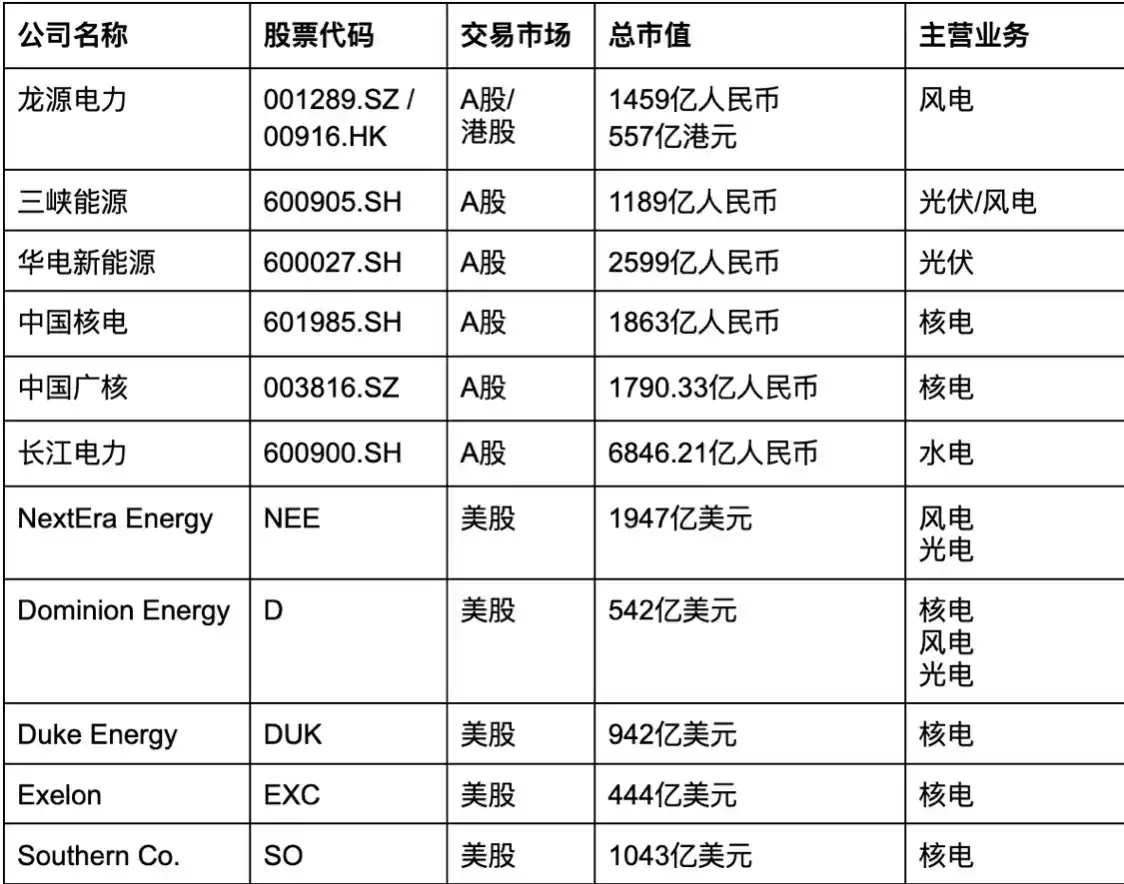
Overall, the competitive landscape at this layer is shifting from the traditional 'electricity price competition' among energy companies to a 'power locking right competition' between downstream AI data centers, cloud providers, and energy companies. Whoever can secure long-term, stable, low-cost energy holds the first dragon ball for Token production.

Second Layer Cake: AIDC – The Raw Token Factory

A single GPU is meaningless; what truly matters is the scaled cluster. Hence, the emergence of the AIDC.

It is like the steel mills, power plants, and assembly line factories of the industrial era, concentrating thousands of GPUs to form stable Token production capacity. But factory problems are also emerging: traditional AIDC construction cycles often last 18 to 36 months, with grid expansion taking even longer. When AI demand grows exponentially, the construction speed of the old-era IDC can no longer meet the needs of the new Token economy.

In the US stock market, Equinix is one of the world's leading data center operators, with over 240 data centers in more than 30 countries. Its core advantage is not just the number of facilities but its global interconnectivity and low-latency network resources, making it a crucial infrastructure node for AI compute deployment.

Digital Realty, through its PlatformDIGITAL, enters the AI infrastructure market, serving large cloud service providers and financial institutions.

In the Chinese market, Runtze Technology is one of the most typical AIDC operators listed on the A-share market. Its core business has gradually upgraded from traditional IDC to AI computing centers, with core competencies lying in large-scale facilities, power resources, and AIDC operational capabilities. Companies like OFFLINE Data and Beijing Sinnet Technology Group are expanding in areas such as regional data centers, cloud infrastructure, and AI compute hosting. Sugon leans more towards government, enterprise, and research collaborations in its AIDC business.

Another category of players comes from 'mining farm transformations.' Companies like CoreWeave, IREN, Applied Digital, and Cipher Mining were originally related to cryptocurrency mining. However, with the explosive demand for AI GPUs, they have rapidly pivoted to AI compute infrastructure. IREN promotes a 'Green Power + AI Compute' model, building high-density GPU data centers using renewable energy. Applied Digital and Cipher Mining are also transitioning from traditional mining farms to high-performance AI computing infrastructure.
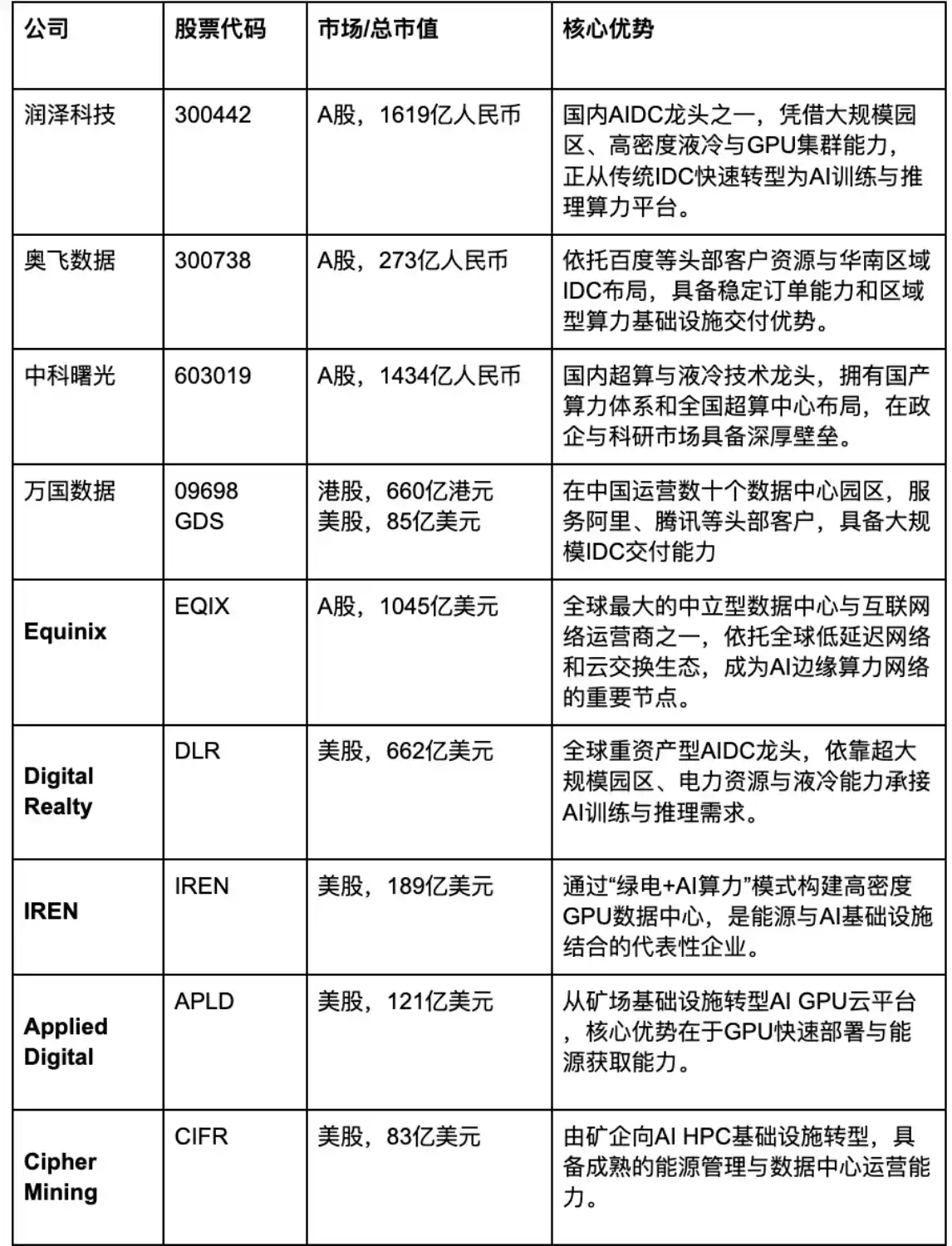
Furthermore, decentralized, smaller-scale, modular AI Factories are becoming a new trend. Just as the internet era moved from mainframes to cloud computing, AI compute needs to diffuse from super-large central nodes to regional edge nodes.

Therefore, GoodVision AI has chosen a different path: building more lightweight, modular, and rapidly replicable AI Factories. Compared to traditional large-scale AIDCs, GoodVision AI emphasizes regional deployment capability, high-density GPU cluster efficiency, and integrated synergy between energy and compute power.

Its core logic is not to build a single mega data center, but to rapidly deploy AI Factory nodes in high-density population areas globally, typically small-scale inference compute facilities of 2-4MW. This model not only allows for quicker access to local energy resources but is also more suitable for the trend of future AI inference demand spreading to the edge.

If traditional AIDCs resemble the large steel mills of the industrial era, then what GoodVision AI is building is more akin to the 'regionalized Token factories' of the AI era – lighter, more flexible, closer to users, and better suited for the development direction of a future globally distributed inference network.

Third Layer Cake: GPU – The Token Production Equipment

If electricity is the energy, then the GPU is the production equipment. In the initial years of the AI boom, GPUs primarily served training; but in the future, the larger demand will come from inference. Because training belongs to only a few leading companies, while inference will permeate every application, every device, every terminal. Robots need inference, autonomous driving needs inference, AI glasses need inference, and even future collaboration between every AI Agent consumes Tokens in real-time.

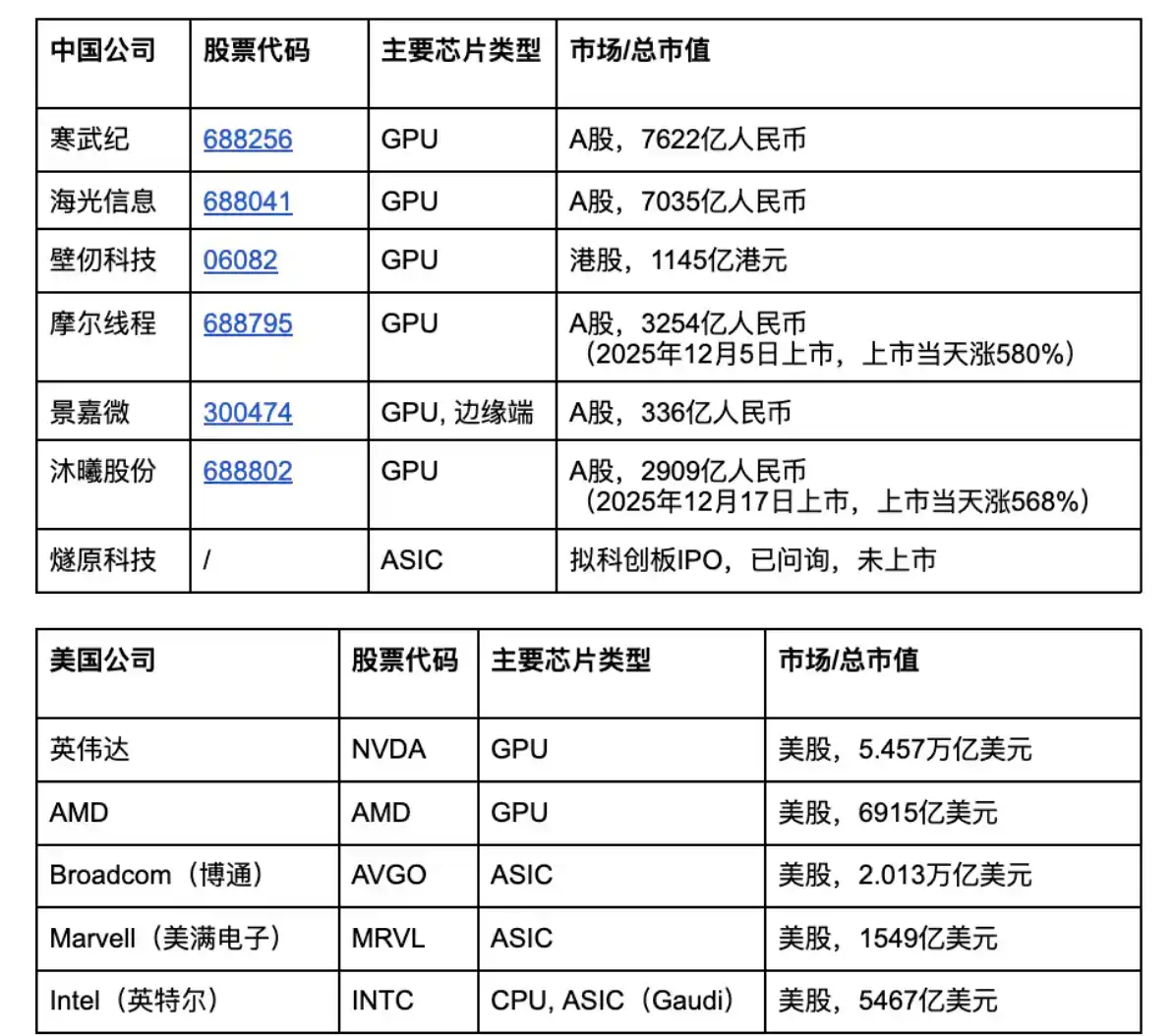
NVIDIA remains the absolute core of the global AI chip industry. Its H100, B200, Blackwell, and other GPU products almost define the current global standards for AI training and inference. More importantly, NVIDIA doesn't just sell chips; it has built a complete ecosystem through software and hardware systems like CUDA, TensorRT, DGX, and HGX. Therefore, its competitors must challenge not only GPU performance but the entire AI software ecosystem.

AMD is currently the primary GPU challenger, with core products including the MI300X and other AI GPUs. Compared to NVIDIA, AMD emphasizes an open ecosystem and the ROCm software platform, hoping to attract AI developers and enterprise customers through a more open approach.

Broadcom and Marvell represent another route – ASIC and high-speed interconnects. As AI inference scenarios become increasingly complex, more companies are experimenting with custom ASIC chips to achieve higher energy efficiency and lower costs.

Intel is entering the AI market through server CPUs and Gaudi AI accelerators, hoping to leverage its CPU ecosystem to re-engage in AI infrastructure competition.

In the Chinese market, Cambricon is one of the most representative domestic AI chip companies, primarily promoting its Siyuan series AI chips and building its self-developed AI framework, Neuware. Hygon Information has AMD Zen architecture licensing, focusing on DCU and the AI inference market.

Domestic GPU companies like Moore Threads, Enflame Technology, MetaX, and Biren Technology represent the direction of 'domestic substitution' for Chinese AI chips. They generally emphasize compatibility with the CUDA ecosystem while attempting to build domestic GPU clusters.
From the CUDA ecosystem to HBM memory to Tensor Cores, the core of the entire AI industry is actually continuously improving 'the efficiency of Token generation per unit time.' Simultaneously, GPUs and their underlying infrastructure—servers, optical modules, liquid cooling, switches, etc.—are also closely related to Token production efficiency.

These elements are not as dazzling as companies like NVIDIA, OpenAI, or AI application developers, but they determine whether the entire AI world can truly function. Just as the Industrial Revolution needed not only steam engines but also railways, power grids, and ports. The AI Revolution will not be just a software revolution. It is a global industrial chain upgrade covering energy, chips, networks, cloud computing, and infrastructure.
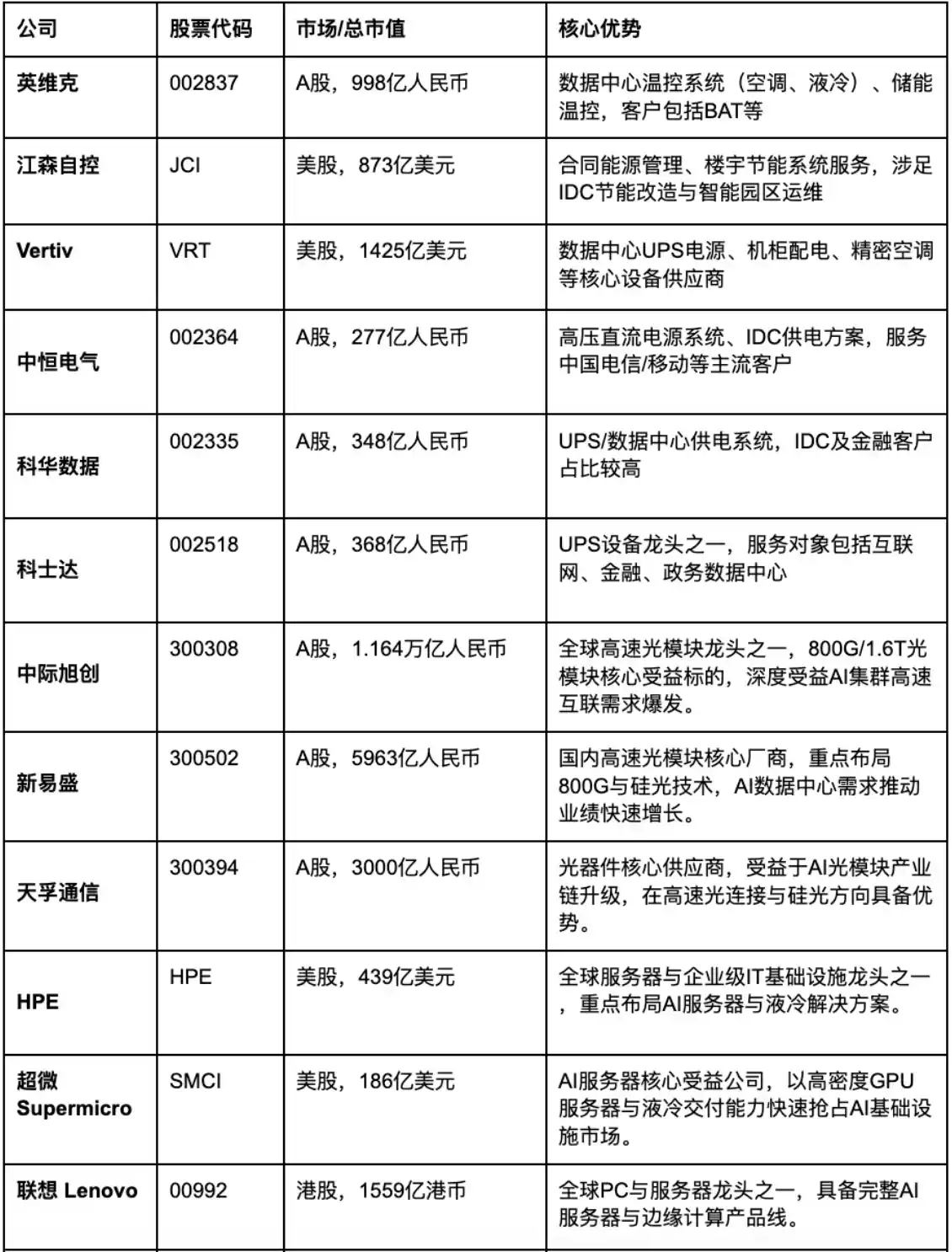
Vertiv is a global leader in data center UPS and power management, providing data center power supply, cabinet power distribution, and precision air conditioning systems.

Envicool is the A-share market leader in liquid cooling and temperature control systems, with clients including BAT and other large internet companies. As GPU power consumption increases, liquid cooling is becoming a crucial standard feature for AIDCs.

Companies like Hangzhou Zhongheng Electric, Kehua Data, and KSTAR have important positions in UPS, power supply systems, and IDC power provision.

In the network and optical module sector, companies like Zhongji Innolight, Eoptolink Technology, and TFC Optical Communication benefit from the surging demand for high-speed communication within AI clusters.

In the server OEM direction, companies like Dell, HPE, Supermicro, Lenovo, and Inspur Information are responsible for the large-scale assembly and delivery of AI servers.

This layer, though not directly facing end-users, determines whether AI infrastructure can truly operate stably. Liquid cooling, UPS, optical modules, switches, energy storage, and server OEMs are becoming the true 'pickaxe sellers' of the AI world, just like the railways, power grids, and ports of the industrial era.

Fourth Layer Cake: LLM – The Token Production Engine

LLMs (Large Language Models) determine how Tokens are understood, generated, and organized. Over the past two years, companies like OpenAI, Anthropic, Google, Meta, xAI, and DeepSeek have ignited a global 'large model competition.' Parameters have scaled from hundreds of billions to trillions, and model capabilities have expanded from text generation to multimodal, reasoning, coding, Agent collaboration, and long-term memory.

However, as the industry develops, the market is beginning to realize: what will truly matter in the future is no longer just 'who has the largest model,' but who can run models continuously at lower costs and higher efficiency. Because the model itself does not directly create value; the real value is created through the inference process of the model being called repeatedly.

This also means that LLMs are evolving from their past role of 'showcasing model capabilities' to becoming the 'Token production engines' in the AI world.

Closed-source and open-source models like OpenAI's, Anthropic's, Google Gemini, and Meta Llama are vying for the future AI ecosystem entry point; while emerging players like DeepSeek are reshaping the competitive landscape through lower costs and higher inference efficiency. Competition in the LLM layer is also gradually shifting away from a pure pursuit of parameter count, with evaluation criteria increasingly turning to comparisons across multiple dimensions:


Token Cost
Inference Efficiency
Context Capability
Multi-Agent Collaboration
Long-Term Memory
Model & Infrastructure Synergy Capability
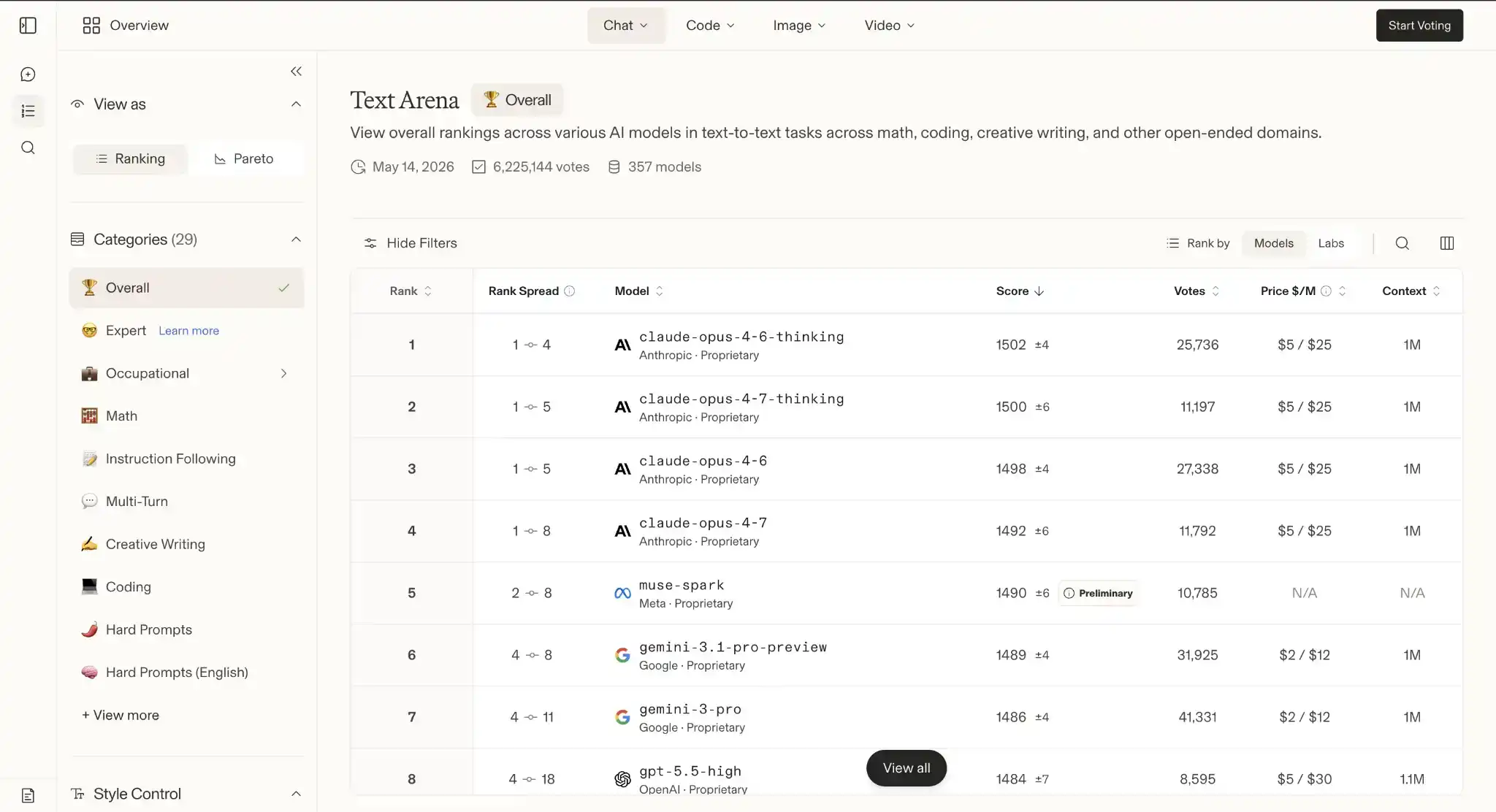
Because what truly matters in the AI era is not just how 'smart' a large model is, but whether the model can be operated continuously, at scale, and at low cost globally. GoodVision AI also has its optimization approach at this layer: by collaborating with large model vendors, deploying large models within its AI Factory facilities, transitioning from traditional compute rental business to directly providing Token services; this not only improves business gross margin but also offers a more user-friendly experience.

Fifth Layer Cake: Token Distribution – The 'Power Grid' of the AI Era

After AIDCs are built, the next question arises: How is this compute power used by the world?

Thus, compute rental platforms have emerged. They function like the 'power grid system' of the AI era, splitting up and distributing originally centralized GPU resources, then renting them on-demand to developers, enterprises, and AI applications.

AWS, Azure, Google Cloud, Alibaba Cloud, and Tencent Cloud remain the most powerful players in this layer. They possess the world's largest cloud computing infrastructure and are gradually integrating AI GPU resources into their IaaS systems.

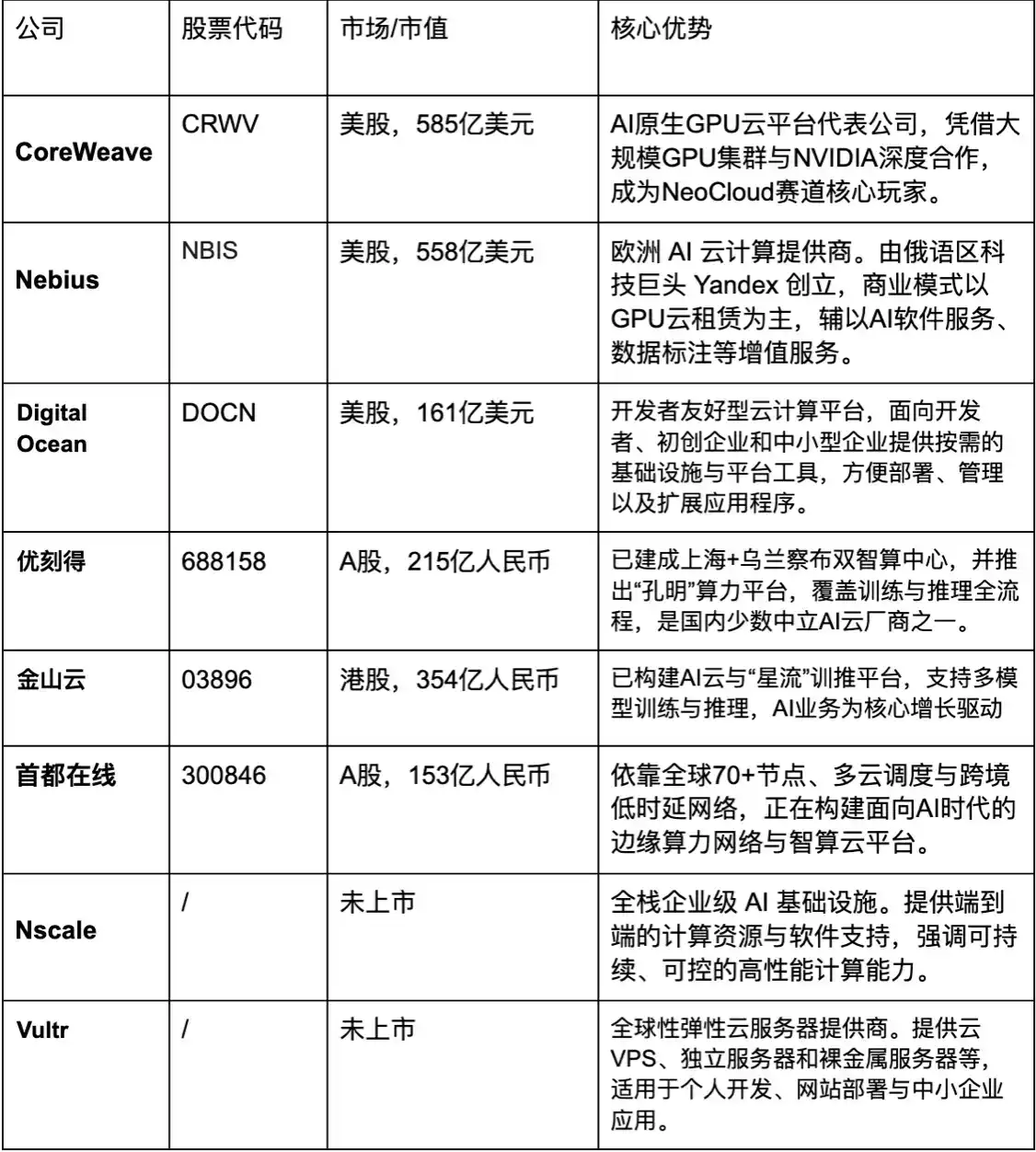
However, simultaneously, a batch of 'AI-native clouds' are rapidly rising. Companies like CoreWeave, Nebius, and Nscale build GPU cloud platforms specifically around AI training and inference needs. Compared to traditional cloud providers, they are more flexible, more focused on AI tasks, and more skilled at GPU cluster optimization.

CoreWeave is one of the most representative companies in the current NeoCloud scene. It initially focused on Ethereum mining, then pivoted entirely to AI GPU cloud services, and is now a key AI infrastructure company supported by NVIDIA.

Lightweight cloud platforms like DigitalOcean and Vultr target small-to-medium developers and startups, emphasizing rapid deployment and low-cost GPU services.

In the Chinese market, apart from the giants, companies like UCloud, Kingsoft Cloud, and Beijing Sinnet Technology Group are major suppliers in the GPU cloud and AI compute rental market. The competitive landscape in this layer is very similar to the early power grid era: how to efficiently distribute decentralized compute power.
Sixth Layer Cake: Token Optimization & Intelligent Scheduling – The Brain of the AI Era

This is perhaps the most underestimated yet most critical 'cake' layer. With the explosion in AI Agent usage, it became apparent that not all tasks warrant calling the most expensive large model. Many simple tasks can be handled by local models; many real-time tasks are better suited for edge inference; many privacy-sensitive tasks cannot even be uploaded to the cloud. After the question of 'Is there compute power?' comes another: 'How to use compute power more intelligently?'

As Token demand grows exponentially, 'Having the right model, on the right compute, handle the right task.' is key to ensuring Tokens are used rationally and efficiently. This is precisely one of the directions GoodVision AI is pursuing besides building AI Token factories.

It's like today's power system: some demand comes from the large grid; some comes from rooftop solar. What's truly important is the intermediate 'intelligent scheduling system.'

The future of AI will follow a similar structure: simple tasks handled by local small models, complex tasks calling cloud-based large models, high-privacy tasks processed at the edge, and high-concurrency tasks dynamically scheduled through hybrid clouds.

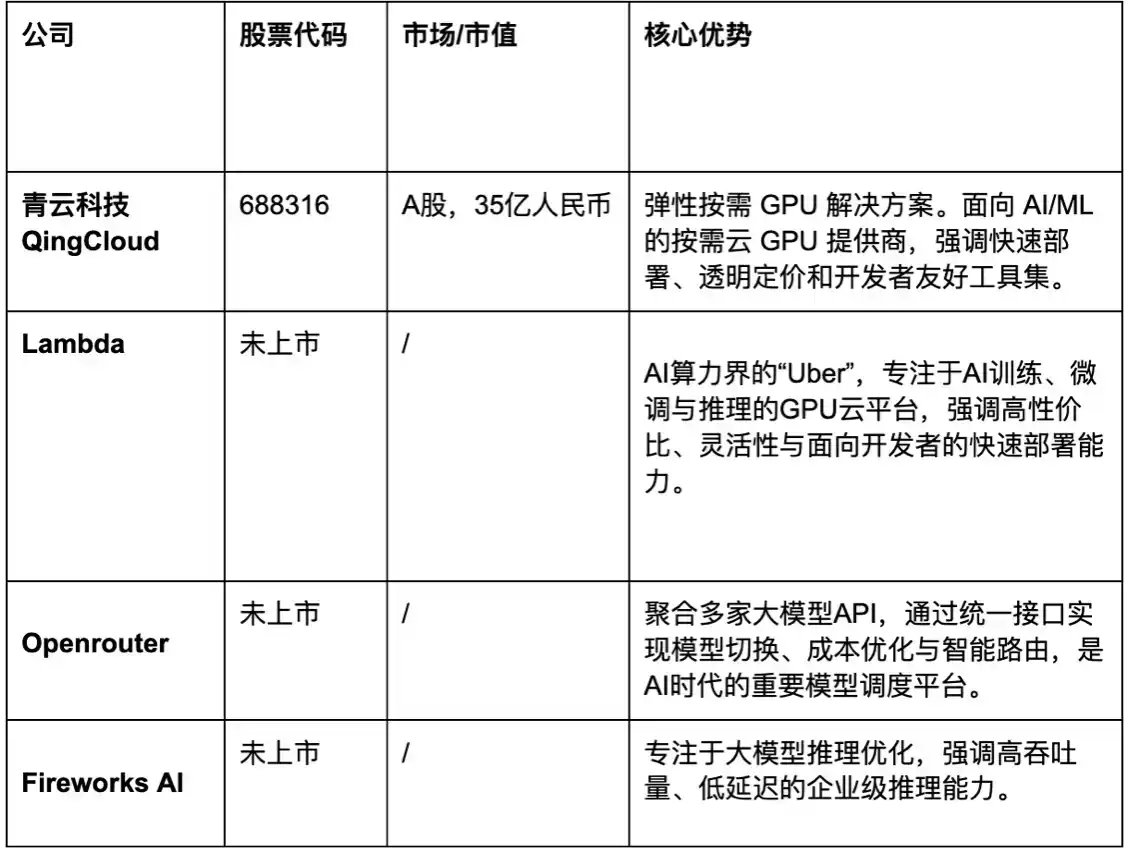
Besides GoodVision AI, companies like QingCloud Technology, Lambda, OpenRouter, and Fireworks AI are also leaders in Token optimization and intelligent scheduling.

This 'cake' layer overlaps significantly with the previous two layers—AIDC and Compute Rental. As GPU resources, regional nodes, and inference task scales continue to expand, merely 'owning compute' is no longer sufficient to build long-term barriers. More and more AIDC operators and GPU cloud platforms are realizing that what will truly determine efficiency and profit margins in the future is not just the number of GPUs, but how to dynamically schedule models, compute power, and Token traffic.

Therefore, many platforms originally focused on AIDC and GPU cloud are also extending into the 'intelligent scheduling layer.' For example, in the Chinese market, companies like UCloud, Beijing Sinnet Technology Group, and Sugon are attempting to integrate their own GPU cloud facilities, multi-cloud resources, and inference scheduling capabilities, gradually shifting from 'selling compute' to 'optimizing compute.'
Seventh Layer Cake: Models & Agents – The Token Consumers

This layer is closest to users and最容易获得流量(easiest to gain traffic), but the competition is also the fiercest. At GTC 2026, Jensen Huang proposed this view: In the future, every company will become a 'Token producer and Token consumer.'

An AI Agent might simultaneously call multiple models, multiple tools, multiple APIs, and continuously perform reasoning, planning, and execution. This means the volume of Tokens consumed by future AI will far exceed the scale of human-AI conversations today. Some current heavy AI users, building systems with multi-agent concurrency and inter-calls, can easily consume 1 billion Tokens per day.

The future is not 1 billion people using AI, but 10 billion, or even 100 billion AI Agents working simultaneously, calling each other. And the real bottleneck will shift from 'model capability' to 'Token scheduling efficiency.'

The tech giants naturally go without saying. Microsoft, Google, Meta, Amazon, etc., are gradually embedding AI capabilities into all their products through office systems, search, social networks, and cloud services.

Enterprise software companies like Adobe, Salesforce, ServiceNow, and Palantir are rapidly advancing in enterprise-grade AI Agents and automated workflow directions. Meanwhile, Hugging Face is becoming the 'GitHub' of the AI era. It's not just a model community but a crucial piece of infrastructure for the global AI development ecosystem.

In the Chinese market, companies like iFLYTEK, Kunlun Tech, 360 Security, Kingsoft Office, and SenseTime are making layouts around AI assistants, AI office tools, and AI Agents.

When the 'Seven-Layer Cake' Truly Takes Shape, the AI World Will Truly Begin

Today's AI industry actually still operates within an infrastructure system that is not yet fully mature.

Some possess the most advanced GPUs but are constrained by energy; some have built massive AIDCs but lack efficient scheduling; some develop powerful models and Agents but face high inference costs and latency; some control edge nodes but cannot form a unified, collaborative network.

From electricity, AIDC, GPU to LLM, Token distribution, intelligent scheduling, and AI Agent, although the entire AI industrial chain is developing rapidly, significant fragmentation, redundancy, and efficiency bottlenecks still exist between layers.

Only when this 'seven-layer cake' is fully constructed and begins to operate efficiently and synergistically will the AI industry transition from today's 'Tool Era' to the true 'Mass Adoption Era' belonging to the intelligent world.

The future AI world will no longer be just about a few tech giants training large models, but about tens of billions of AI Agents being continuously online, collaborating, and calling compute and Tokens. Every conversation, every inference, every tool call, every automated task execution corresponds to the coordinated operation of energy, GPUs, networks, scheduling systems, and inference nodes.

This also means the AI industry is evolving from its past 'software logic' into a super industrial system covering energy, chips, cloud computing, edge networks, and intelligent scheduling.

Just as the Industrial Revolution needed not only steam engines but also railways, power grids, and ports; just as the Internet Revolution needed not only PCs but also fiber optics, data centers, and cloud computing. The true hallmark of the AI Revolution's maturity will not be just one killer application, but the formation, on a global scale, of an 'intelligent infrastructure network' capable of continuously producing, distributing, scheduling, and consuming Tokens.

And when these seven layers of infrastructure are finally truly connected, the competitive logic of the AI industry will be completely restructured. The most important companies of the future might no longer be those with the largest models, but those capable of connecting energy, compute, networks, models, and Token flow.

















Related Questions

QAccording to the article, what is the key driver of AI infrastructure expansion in 2026, shifting away from the previous focus?

AAccording to the article, the key driver of AI infrastructure expansion in 2026 is no longer model training but massive AI inference demand. Future computational power will primarily be consumed by AI Agents performing tasks, interactions, and calls worldwide.

QWhat is the core idea behind GoodVision AI's proposed "seven-layer cake" structure for the AI economy?

AThe core idea behind GoodVision AI's "seven-layer cake" structure is to frame the AI economy as a Token-centric industrial system. It moves from foundational energy (Layer 1) up through Token production (Layers 2-4), distribution and intelligent scheduling (Layers 5-6), to the final consumption by AI Agents (Layer 7).

QHow does the article describe the role and evolution of AIDCs (AI Data Centers) in the "Token Industrial Era"?

AThe article describes AIDCs as "Token factories," evolving from traditional, large-scale, centrally-located facilities to more modular, lightweight, and regionally-deployed "AI Factory" nodes. This shift aims for faster deployment, better local energy integration, and alignment with the trend of AI inference moving to the edge.

QWhat new competitive dimension is emerging in the LLM (Large Language Model) layer beyond just model size and capability?

ABeyond model size and capability, the new competitive dimensions for LLMs include Token cost, inference efficiency, context handling capability, multi-Agent collaboration, long-term memory, and the model's ability to synergize with underlying infrastructure for large-scale, low-cost, and continuous operation.

QWhat does the article identify as the ultimate sign of the AI industry reaching maturity and entering the "Mass Adoption Era"?

AThe article identifies the ultimate sign of AI industry maturity as the formation of a fully connected and efficiently协同运转的 "intelligent infrastructure network." This network seamlessly integrates all seven layers—from energy and chips to models, token调度, and agents—enabling the continuous production, distribution,调度, and consumption of Tokens on a global scale.

Related Reads

Bankless Co-founder: Why I Sold All My ETH

Author David Hoffman, founder of Bankless, explains his decision to sell all his ETH, despite being a prominent figure in the Ethereum ecosystem. He clarifies that his move is not a bearish take on Ethereum itself, which he remains highly optimistic about as a network. His core argument is that the "ETH is money" thesis, which he helped popularize, has largely played out. Hoffman argues that ETH has achieved the market valuation it deserves based on Ethereum's current success and competitive position. He details several reasons for this view. First, the path for ETH to become global money required nearly flawless execution and sustained dominance across Ethereum's entire technical and social stack—a coordination challenge he now believes had a narrower window for success than anticipated. Second, market data shows a strong correlation between L1 chain activity/fees and the price of its native asset; Ethereum's fee dominance has been challenged by competitors like Solana. Third, the "strong version" of crypto (decentralized, native crypto economies) that ETH's monetary thesis relied upon has struggled to maintain a positive mainstream narrative and stable adoption beyond a brief period. Finally, Ethereum's architecture as a "giver"—providing secure block space and tokenization capabilities at cost to L2s and applications—means it doesn't capture premium value directly. Its rollup-centric roadmap further directs most profits to L2s and applications ("fat app theory"). In conclusion, Hoffman believes the opportunity for ETH to be revalued significantly upward as money has diminished. He sold not because ETH will fail, but because its monetary thesis has matured, and he seeks to allocate capital to other opportunities he finds more compelling.

链捕手1h ago

Bankless Co-founder: Why I Sold All My ETH

链捕手1h ago

From Issuer to Infrastructure Owner: Circle's Arc Strategy and the Fatal Gap in the GENIUS Act

Circle raised $222 million for its proprietary Layer-1 blockchain, Arc, positioning itself not just as a stablecoin issuer but as the owner of the settlement infrastructure USDC relies on. This move, backed by investors like BlackRock and Apollo, highlights a significant structural conflict unaddressed by the GENIUS Act of 2025. While the act focuses on stablecoin reserves and issuer oversight, it remains silent on the market structure implications of an issuer controlling the underlying network—a scenario akin to a currency issuer also owning the payment rails. Traditionally, financial regulations separate issuers from settlement infrastructure to ensure neutrality. With Arc, Circle gains control over transaction ordering, fees, and network rules, potentially favoring USDC over competitors. The article argues that this creates a permanent structural temptation, even if no abuse occurs. The solution lies in applying established market infrastructure principles: mandating neutral transaction ordering, transparent fee schedules, and governance separated from Circle’s commercial interests. The current pre-mainnet phase offers a critical window for regulators to establish these rules before Arc becomes entrenched. Once operational, enforcing changes would be costly and disruptive. The core question remains: should a regulated stablecoin issuer be allowed to own the settlement network its competitors must use? The GENIUS Act doesn’t answer this, but Circle’s Arc strategy makes it urgent.

marsbit1h ago

From Issuer to Infrastructure Owner: Circle's Arc Strategy and the Fatal Gap in the GENIUS Act

marsbit1h ago

What Are the Key Variables Determining the AI Bull Market?

Title: What Determines the AI Bull Market? Key Variables Revealed Despite rising oil prices above $100/barrel, persistent inflation, and fragile Fed rate cut expectations—a traditionally hostile environment for high-valuation tech stocks—the AI sector continues to drive the market to new highs. According to analysts, the current AI boom is in a phase of "rational fervor": while bubbles exist, they are not yet out of control. The crucial shift is the emergence of Agentic AI, which is evolving from an assisting tool (Copilot) to an autonomous execution tool (Autopilot), creating a clearer commercial path from investment to revenue. This shift accelerates Token consumption and inference computing demand while boosting revenue forecasts for leading firms. The market is now rewarding capital expenditure as it transforms from a burden into a competitive moat, supporting hardware chains like GPUs, optical modules, and storage. However, valuations have already priced in growth expectations for 2027-2028. The forward P/E ratio for the "Magnificent Seven" tech giants is about 35x, compared to 25x for the rest of the S&P 500. This premium implies AI adoption must occur 5 to 8 times faster than past technological revolutions—a scenario with little room for error. The sustainability of the AI bull market hinges on three key variables: 1. **Short-term liquidity shocks**: Risks include sustained high oil prices, resurgent inflation, rising interest rates, and potential unwinding of the yen carry trade. The critical question is whether the upward revision speed of Annual Recurring Revenue (ARR) can outpace the rise in interest rates. 2. **Mid-term industry realization**: Can the actual pace of AI adoption and commercialization match the current lofty valuations? Historically, general-purpose technology revolutions follow a non-linear path with periods of acceleration and deceleration. 3. **Long-term structural constraints**: These include energy and power grid limitations, employment displacement and consumer purchasing power, social acceptance and potential backlash, and potential hardware technology breakthroughs that could disrupt current supply chains. While the long-term prospects for AI remain optimistic with potential for significant productivity gains, the stock market's pricing depends not just on the vision but on the actual speed of realization amid these growing constraints. The direction is clear, but the pace of execution will determine whether the bubble remains controlled or spirals out of control.

marsbit1h ago

What Are the Key Variables Determining the AI Bull Market?

marsbit1h ago

Trading

Spot
Futures

Hot Articles

What is LINON

Linde plc Tokenized Stock (Ondo): Revolutionizing Traditional Equity Access Through Blockchain Innovation The emergence of Linde plc Tokenized Stock (Ondo), represented by the ticker $LINON, signifies a monumental shift in the fusion of traditional financial structures and decentralized finance (DeFi). This innovative financial instrument showcases the tremendous potential of blockchain technology to democratize access to traditional equity markets while ensuring the security and regulatory compliance necessary for institutional-grade financial products. Through Ondo Finance's pioneering tokenization platform, $LINON provides a seamless pathway for global investors to engage with one of the world's leading industrial gas companies, Linde plc, creating a blockchain-native representation of the underlying equity. Introduction to Linde plc Tokenized Stock The landscape of financial markets is witnessing a groundbreaking transformation through the tokenization of real-world assets. Linde plc Tokenized Stock (Ondo) epitomizes this revolutionary approach by bridging the gap between conventional stock ownership and blockchain-enabled financial infrastructure. The $LINON token allows investors to gain exposure to one of the prominent industrial companies worldwide through decentralized technology. Operating within Ondo Finance's comprehensive ecosystem, $LINON symbolizes a practical application of tokenization technology that enhances accessibility, efficiency, and global connectivity in traditional financial markets. By leveraging blockchain infrastructure, this tokenized stock enables international investors to participate in U.S. equity markets, overcoming traditional barriers associated with cross-border investing. The significance of $LINON goes beyond technological innovation; it represents a fundamental shift in asset structuring, distribution, and trading in the digital age. This tokenized stock maintains all the economic benefits associated with traditional Linde plc shares while offering improved liquidity, programmable compliance features, and seamless integration with decentralized finance protocols. The development of $LINON indicates a growing acceptance of blockchain technology as a viable means for traditional finance, exemplifying how even well-established assets like Linde plc can integrate into blockchain systems. This approach preserves the core attributes that appeal to investors while introducing advanced capabilities that enhance the overall investment proposition. Project Overview and Objectives Linde plc Tokenized Stock (Ondo) encapsulates a strategic effort to democratize access to traditional equity markets through advanced blockchain technologies. The primary objective of $LINON is to provide approved global investors seamless access to the economic exposure associated with Linde plc shares, furthering an effort to create a more inclusive financial ecosystem. Beyond the digital representation of traditional assets, $LINON endeavors to eliminate barriers of geography and time zones that limit investor participation. Its design ensures that blockchain technology can elevate traditional investment vehicles without undermining the security or compliance requirements expected by investors. Key goals of the project include enhanced liquidity provision, programmable compliance mechanisms, and interoperability with other blockchain networks. Each $LINON token is fortified by actual Linde plc securities housed at U.S.-registered broker-dealers, allowing holders to reap economic advantages akin to traditional stockholders, such as dividend reinvestment. Furthermore, $LINON aims to establish new industry standards for institutional-grade tokenized securities, paving the way for traditional assets to embrace blockchain technology while remaining compliant with regulatory frameworks. By associating itself with a company as reputable as Linde plc, the project opens avenues for exploring tokenized equities catering to both conservative institutional players and daring retail investors. Project Creator and Development Team The vision for Linde plc Tokenized Stock (Ondo) comes from Nathan Allman, founder and CEO of Ondo Finance. His background in traditional finance coupled with expertise in blockchain technology positions him uniquely to navigate the complexities of asset tokenization. Allman's academic journey began at Brown University, focusing on Economics and Biology, equipping him with valuable analytical skills. His time at Goldman Sachs in the Digital Assets division strengthened his understanding of the interplay between financial institutions and emerging technologies, laying the groundwork for his later endeavors in alternative investment strategies. Under Allman's guidance, Ondo Finance has emerged as a leader in asset tokenization, launching $LINON as a flagship example of the company's larger mission towards revolutionizing traditional financial systems using blockchain technology. His commitment to leveraging blockchain for creating institutional-grade financial products has shaped the landscape of real-world asset tokenization. Investment and Funding Structure The growth of Ondo Finance, the platform powering Linde plc Tokenized Stock (Ondo), is bolstered by robust financial backing from prestigious venture capital firms and strategic investors. This strong investment foundation underpins the development of the key infrastructure essential for compliant tokenized securities like $LINON. In August 2021, Ondo Finance secured $4 million in seed funding led by a major venture capital firm, which enabled the company to commence platform development and establish the necessary regulatory processes for tokenizing real-world assets. This early investment cemented Ondo Finance's credibility within the industry. The Series A funding round followed, garnering $20 million with participation from renowned firms committed to transformative technology companies. This backing demonstrated substantial institutional confidence in Ondo Finance's vision, allowing it to hone its approach to asset tokenization through mechanisms that ensure compliance and accessibility. Noteworthy contributors, including institutional investors and experienced partners, have added significant value to Ondo Finance’s development efforts. Their involvement underscores the confidence across sectors in Ondo Finance's approach to bridging traditional finance with blockchain innovations. Technical Infrastructure and Innovation The technical architecture that underpins Linde plc Tokenized Stock (Ondo) represents a sophisticated melding of traditional finance systems and cutting-edge blockchain technology. The architecture's foundation is built on the Ethereum network, renowned for its security and programmability—both critical for intricate financial instruments. The $LINON tokenization process comprises creating a blockchain-native representation of Linde plc shares that preserves economic benefits while augmenting investor capabilities. Each token corresponds to actual shares held at U.S.-registered broker-dealers, creating a compliant custody structure that legitimizes the asset's existence and value. Automated compliance systems are integrated into the tokenization process, managing critical components such as know-your-customer (KYC) verification and anti-money laundering (AML) protocols. This incorporation of programmable compliance empowers $LINON to uphold regulatory standards essential for institutional proliferation. Cross-chain interoperability characterizes the advanced technical features of $LINON. While initially deployed on Ethereum, the framework is designed for expansion to other networks such as Solana and BNB Chain. This adaptability enhances liquidity and accessibility, allowing investors to select their preferred blockchain ecosystems. Historical Timeline and Development Crafting the history of Linde plc Tokenized Stock (Ondo) unfolds in parallel with the evolution of Ondo Finance's tokenization platform. The timeline's inception dates back to March 2021 when Nathan Allman laid the foundations for creating institutional-grade financial products on blockchain infrastructure. The initial funding round in August 2021 provided crucial resources for developing the platform and establishing partnerships necessary for effective tokenization. By January 2023, Ondo Finance launched its tokenized treasury products, establishing mechanisms that would facilitate future tokenized equities such as $LINON. A pivotal milestone arose in February 2025 when Ondo Chain—a Layer 1 blockchain designed specifically for asset tokenization—was introduced. This infrastructure enhances capabilities vital for institutional markets, demonstrating Ondo Finance's long-term commitment to tokenization. Subsequently, the launch of Ondo Global Markets in September 2025 marked the official debut of $LINON. This milestone showcased the successful transition from development to active trading, enabling investors around the world to access American financial markets seamlessly. Ongoing development plans include a targeted expansion of available tokenized assets to over 1,000 by the end of 2025, pointing to a bright future for Ondo Finance's ecosystem and its mission to broaden tokenized equity accessibility. Regulatory Compliance and Legal Framework The legal architecture governing Linde plc Tokenized Stock (Ondo) emphasizes a sophisticated approach to regulatory compliance, allowing tokenized securities to be implemented within a blockchain-based framework. The legal structure governing $LINON spans multiple jurisdictions while maintaining a robust legal footing. Compliance systems ensure that only eligible investors can access the token, enforced through automated verification that aligns with international regulations. This innovative regulatory technology promises real-time enforcement of complex requirements, considerably enhancing efficiency in operating within the regulatory landscape. The custody framework undergirding $LINON ensures that the underlying shares are securely held at U.S.-registered broker-dealers, complying with necessary regulations while delivering blockchain-driven access to investors. The token maintains its economic equivalency and security through this carefully structured custody arrangement. KYC and AML compliance systems are embedded within the smart contract architecture, ensuring integrity and adherence to regulatory practices while fostering transparency for investors. The jurisdictional restrictions mark a commitment to navigating the evolving landscape of international securities laws. Market Impact and Industry Significance The advent of Linde plc Tokenized Stock (Ondo) holds profound implications for the broader financial landscape, symbolizing a clear shift towards blockchain-enabled markets. $LINON serves as a proof-of-concept for integrating traditional companies into blockchain ecosystems, showcasing the potential benefits such as broader accessibility and improved efficiency. The market's response to $LINON indicates a growing acceptance of tokenization among institutional investors, contributing to the emergence of an expanding sector wherein traditional assets can be interconnected with blockchain innovations. The success of $LINON further solidifies market confidence, indicating an overarching shift towards recognizing asset tokenization as a transformative force in finance. Future Development and Expansion Plans The future trajectory for Linde plc Tokenized Stock (Ondo) centers around the expansion of the tokenization ecosystem and enhanced infrastructure supporting blockchain-enabled financial services. Plans for cross-chain integration usher in new opportunities for liquidity and flexibility within the investment framework, with existing capabilities poised for continuous enhancement. With the introduction of Ondo Chain, Ondo Finance aims to transition $LINON to an optimized blockchain environment specifically designed for asset tokenization. This new infrastructure heralds exciting prospects for the development of institutional-grade financial products, ensuring ongoing compatibility with contemporary investment strategies. Further integration with decentralized finance protocols signifies a commitment to empowering $LINON holders through advanced financial strategies. The anticipated expansion of available tokenized assets promises to broaden investor access, enhancing the utility and appeal of the platform. In alignment with ambitions for regulatory expansion, ongoing efforts to secure approvals for new jurisdictions will enhance investor access, further positioning $LINON at the forefront of the burgeoning tokenization market. Conclusion Linde plc Tokenized Stock (Ondo), as represented by the $LINON token, stands at the intersection of traditional finance and blockchain innovation. It embodies a transformative milestone in how financial assets are structured, distributed, and engaged within modern investment ecosystems. The technical sophistication behind $LINON, combined with its regulatory compliance framework, illustrates that asset tokenization can improve financial infrastructure rather than simply digitizing existing products. This pioneering effort not only enhances investor access to U.S. equity markets but also signifies an evolution of how traditional financial services can integrate blockchain technology. As the asset tokenization market grows exponentially, with prospects suggesting significant valuation increases, $LINON paves the way for a future where tokenized securities become standard fixtures in the financial landscape. The trajectory of $LINON will undoubtedly influence how traditional finance adapts to a transformed, blockchain-powered world.

2.8k Total ViewsPublished 2025.12.05Updated 2025.12.05

What is LINON

What is CRMON

Salesforce Tokenized Stock (Ondo): Revolutionising Traditional Equity Access Through Blockchain Innovation The emergence of Salesforce Tokenized Stock (CRMON) marks a pivotal advancement in integrating traditional financial markets with blockchain technology. This innovative approach offers investors unprecedented access to equity exposure through tokenisation. Developed by Ondo Finance, CRMON provides tokenholders with economic exposure equivalent to holding Salesforce stock (CRM) while automatically reinvesting dividends. This effectively bridges the gap between conventional equity markets and decentralised finance (DeFi). Introduction and Comprehensive Overview of Salesforce Tokenized Stock In recent years, the financial landscape has dramatically transformed due to blockchain technology, fundamentally altering how investors access and interact with traditional assets. The development of Salesforce Tokenized Stock (CRMON) is a prime example of this evolution, representing a sophisticated fusion of conventional equity markets with cutting-edge distributed ledger technology. CRMON is a tokenised version of Salesforce stock, emerging from the innovative work of Ondo Finance, a leading platform in the real-world asset tokenisation sector that positions itself as a bridge between traditional finance and decentralised systems. Designed to provide tokenholders with economic exposure that mirrors the performance of the underlying Salesforce stock, CRMON incorporates automatic dividend reinvestment mechanisms. This eliminates many traditional barriers associated with international equity investment, such as complex brokerage relationships, currency conversion challenges, and restricted trading hours. The tokenisation process reimagines stock ownership as a blockchain-native asset while maintaining its economic equivalence with the underlying security, offering enhanced portability and integration capabilities within decentralised finance ecosystems. CRMON transcends its individual utility as an investment instrument to represent a fundamental shift in how financial markets can operate in an increasingly digital world. By maintaining full backing through U.S.-registered broker-dealers and implementing robust compliance frameworks, CRMON demonstrates that tokenised securities can achieve the regulatory standards necessary for institutional adoption while delivering the technological advantages of blockchain infrastructure. Understanding Tokenized Real-World Assets and CRMON's Strategic Position Tokenised real-world assets signify one of the most significant innovations in modern finance, fundamentally reimagining how traditional securities are represented, traded, and utilised within digital ecosystems. CRMON operates as a tokenised equity instrument correlating directly with Salesforce stock while optimising accessibility and efficiency. This aligns with Ondo Finance's broader mission to democratise access to institutional-grade financial products through innovative tokenisation strategies. The tokenisation process guarantees complete economic equivalence with the underlying Salesforce equity. Each CRMON token represents a proportional claim on Salesforce stock held by qualified custodians, with dividend payments automatically reinvested to maintain continuous exposure to total return performance. This structure simplifies dividend management and ensures that tokenholders receive the full economic benefit of their equity exposure, encompassing both capital appreciation and income generation. Ondo Finance's strategy in tokenising Salesforce stock demonstrates its expertise in creating compliant, institutional-grade products that meet traditional financial markets' stringent requirements. The platform’s focus on merging regulatory compliance with blockchain benefits positions it at the forefront of decentralised finance, captivating both institutional and retail investors seeking blockchain-native solutions. The Technology and Innovation Framework Behind CRMON The technological infrastructure supporting CRMON integrates blockchain technology with traditional financial mechanisms, delivering institutional-grade security and compliance while maintaining the operational advantages of decentralised systems. Built on the Ethereum blockchain, CRMON utilises robust smart contract capabilities to ensure transparent, secure operations. The smart contract architecture incorporates layered security and compliance mechanisms, enabling automated compliance checks and real-time asset backing verification. Integration with oracle services maintains accurate pricing and dividend information, ensuring CRMON reflects the underlying Salesforce stock's accurate performance. This architecture delivers automated dividend reinvestments and other corporate actions, eliminating manual processing requirements and directly enhancing tokenholder benefits. Ondo Finance ensures CRMON's security structure includes daily third-party verification of holdings, independent collateral agents, and a multiple-layer custody system through partnerships with established financial institutions. This framework safeguards tokenholder interests against operational risks while providing robust asset backing. The user interface enhances integration capabilities, allowing seamless interaction between CRMON and various decentralised finance protocols, as well as cryptocurrency exchanges. This interoperability enables users to leverage their tokenised equity across multiple platforms, creating sophisticated investment strategies that marry traditional equity characteristics with blockchain-native innovation. Leadership and Corporate Structure of Ondo Finance The leadership team behind CRMON and Ondo Finance blends expertise from traditional finance and blockchain technology, presenting a robust combination of skills essential for successfully bridging conventional markets with decentralised finance. Nathan Allman, the founder and CEO, emerged from a distinguished financial background before establishing Ondo Finance in 2021. Allman's experience includes notable roles at major financial institutions, including significant contributions to developing cryptocurrency market services. His insights into regulatory compliance were paramount in developing products like CRMON that successfully unify traditional securities with blockchain technology. With a team of professionals boasting substantial experience in both conventional finance and blockchain sectors, Ondo Finance's leadership comprises diverse expertise that covers every aspect of tokenised asset development. Justin Schmidt serves as President and COO, contributing unique operational expertise, while Chris Tyrell brings essential compliance knowledge. Investment Landscape and Funding History The investment landscape surrounding Ondo Finance reflects significant institutional confidence in its mission to tokenise real-world assets. The company has raised substantial funds through various investment rounds, attracting leading venture capital firms and strategic investors that recognise the transformative potential of tokenised securities like CRMON. Notably, Ondo Finance completed a successful Series A funding round in 2022, led by well-known venture capital firms. This funding success validates Ondo Finance's innovative approach to creating compliant, institutional-grade tokenised products. In total, Ondo Finance has successfully secured substantial funding, raising significant capital for product development and market expansion, including a noteworthy token sale that reinforced its governance structure through the establishment of the ONDO token. The diverse composition of investors reflects broad market confidence in Ondo Finance's business model, demonstrating support from both traditional and blockchain-native organisations. Operational Mechanics and Technical Implementation The operational framework supporting CRMON exemplifies sophisticated integration of traditional financial mechanisms with blockchain technology. The technical implementation introduces multiple layers of security, compliance, and operational efficiency to meet institutional standards while enhancing accessibility. The tokenisation process begins by acquiring actual Salesforce stock through U.S.-registered broker-dealers, ensuring each CRMON token maintains direct correlation with the underlying equity performance. Smart contracts automate operational processes, including dividend reinvestment and corporate action processing, facilitating a streamlined user experience. The Minting and redemption processes allow authorised participants to manage CRMON tokens effectively. During U.S. trading hours, institutions can mint new tokens by depositing stablecoins that are used to purchase corresponding Salesforce equity. This structure maintains a tight correlation with underlying assets, enhancing liquidity and price discovery. Additionally, the infrastructure supports twenty-four-hour token transfer capabilities, providing CRMON holders with operations outside traditional market hours. This represents a significant advantage over conventional securities ownership, thus promoting integration with decentralised finance applications. Plans for cross-chain compatibility through partnerships signal further ambitions for CRMON's market reach. By expanding to other blockchain networks, Ondo Finance aims to enhance accessibility and user engagement with tokenised equity products. Timeline and Historical Development of Tokenized Equity Innovation The timeline of CRMON's development and Ondo Finance's broader tokenised capabilities demonstrates a systematic innovation process beginning with the company's founding in 2021. 2021: Ondo Finance is founded by Nathan Allman and co-founders, launching initial products focused on structured vault offerings on the Ethereum blockchain. 2022: The company completes substantial funding rounds—both equity and token sales—totaling significant capital and launching initial tokenised U.S. Treasury products. 2023-2024: Ondo Finance experiences substantial growth, establishing partnerships with major financial institutions while expanding its product offerings beyond fixed-income securities. February 2025: Ondo Global Markets is announced, marking the transition into equity tokenisation with plans for accessing over one hundred U.S. stocks and ETFs. September 2025: The official launch of Ondo Global Markets includes CRMON alongside other tokenised equity offerings, marking a significant evolution in Ondo Finance's product ecosystem. This timeline highlights the organisation's rapid growth and its capability to adapt its technological and compliance frameworks to accommodate different asset classes effectively while maintaining security and regulatory integrity. Regulatory Framework and Compliance Approach Ondo Finance's regulatory framework showcases a sophisticated compliance strategy, essential for achieving institutional adoption in the tokenised securities market. The company's strong partnerships with U.S.-registered broker-dealers promote adherence to Securities and Exchange Commission regulations and apply robust investor protections. Acquisitions, such as Oasis Pro—a registered broker-dealer—significantly enhance Ondo Finance's compliance capabilities, ensuring thorough alignment with existing regulatory structures. The company employs independent verification procedures that foster transparency, aiming for a solid performance standards reputation. Furthermore, Ondo Finance's commitment extends to international regulatory compliance, ensuring token access remains restricted to eligible investors while adhering to pertinent cross-border securities regulations. Comprehensive attention to tax implications and reporting requirements fortifies the security and compliance landscape of CRMON, ensuring that investor obligations remain manageable. Future Prospects and Market Positioning The forward-looking landscape for CRMON and Ondo Finance illustrates substantial growth opportunities driven by institutional adoption of blockchain technology and escalating demand for efficient alternatives to conventional securities ownership. Market projections indicate the tokenised asset sector could value multiple trillion dollars by 2030. With plans to scale CRMON offerings significantly and integrate it with a dedicated blockchain infrastructure—Ondo Chain—Ondo Finance aims to elevate its institutional-grade tokenised asset operations. Additionally, the development of strategic partnerships enhances distribution capabilities while establishing the company's credibility in the financial market. Furthermore, the integration of tokenised equity with decentralised finance protocols offers new potential for innovative financial products and strategies previously impossible with traditional securities. These factors underscore CRMON's positioning to effectively capture increased market share and deliver innovative solutions for international investment exposure. Conclusion Salesforce Tokenized Stock (CRMON) symbolises a transformative development within financial markets, successfully bridging traditional equity ownership with blockchain technology to create unprecedented accessibility for global investors. Through Ondo Finance's sophisticated tokenisation framework, CRMON provides complete economic exposure to Salesforce equity performance while enhancing operational advantages that exceed traditional ownership. The launch of CRMON reflects the broader evolution of financial markets towards blockchain infrastructures that maintain regulatory compliance while delivering increased efficiency. Ondo Finance's extensive approach to regulatory adherence, institutional-grade security, and technological innovation solidifies CRMON as a model for future tokenised securities, delivering access previously unattainable in conventional brokerage structures. As the tokenised asset sector continues to develop, CRMON is well-positioned to address historical inefficiencies in capital markets while providing investors with innovative solutions for accessing traditional securities. The outlook for CRMON looks exceptionally promising, supported by ambitious expansion plans, technological innovations, and strategic partnerships, thereby representing a pioneering model of modern financial infrastructure evolving through blockchain integration.

2.9k Total ViewsPublished 2025.12.05Updated 2025.12.05

What is CRMON

What is SHOPON

Shopify Tokenized Stock (Ondo): A Comprehensive Analysis of Real-World Asset Tokenization in Web3 This article delves into the Shopify Tokenized Stock (Ondo), recognised by its ticker symbol $SHOPON, exploring its implications at the intersection of traditional finance and blockchain technology. As a part of Ondo Finance's tokenized securities platform, Shopify’s tokenized stock exemplifies advancements in democratizing access to global capital markets through innovative digital assets. Introduction and Overview of Shopify Tokenized Stock (Ondo) Shopify Tokenized Stock (Ondo), or $SHOPON, portrays a pivotal innovation in the realm of tokenized securities, allowing investors to gain economic exposure akin to directly owning shares of Shopify Inc. This token, developed under the umbrella of Ondo Finance, not only provides investors with the ability to hold digital representations of the company’s stock but also integrates features such as automatic reinvestment of dividends. This advancement represents a substantial shift in the landscape of decentralized finance (DeFi), linking conventional equity markets with blockchain solutions designed to enhance accessibility, transparency, and liquidity. By eliminating geographical barriers and enabling 24/7 trading capabilities, $SHOPON is positioned as a bridge connecting traditional financial instruments and the emerging Web3 ecosystem. What is Shopify Tokenized Stock (Ondo), $SHOPON? The $SHOPON token serves as a digital manifestation of Shopify Inc.'s shares, engineered to provide a direct correlation to the underlying asset's performance. Through the utilization of blockchain technology, the token gives holders a mechanism to participate in the economic benefits associated with equity ownership, including capital appreciation and dividend distribution. The unique aspect of $SHOPON lies in its automatic dividend reinvestment mechanism, which allows returns to compound without necessitating active management by the investor. This feature inherently enhances its attractiveness as an investment vehicle, particularly for individuals seeking passive income growth alongside exposure to high-performing equities. The tokenization process is facilitated by the custody of actual Shopify shares through regulated intermediaries, ensuring that every $SHOPON token is verifiably backed by real equity. This structure empowers investors with the dual advantages of both traditional financial characteristics and the innovative benefits tied to blockchain technology. Who is the Creator of Shopify Tokenized Stock (Ondo)? The creator of Shopify Tokenized Stock (Ondo), Nathan Allman, is an experienced figure in the finance sector, formerly associated with Goldman Sachs. His rich background includes significant expertise in digital asset development, bridging the gap between traditional finance and cryptocurrencies. Allman’s educational journey, marked by studies at Brown University, provided him with a deep understanding of economics and biology, equipping him with analytical skills that inform his strategic vision. In 2021, he founded Ondo Finance, committing to developing tokenized securities that meet institutional-grade standards while leveraging blockchain's transformative capabilities. Under Allman's leadership, Ondo Finance has focused on creating compliant and innovative financial products that empower a diverse investor base. Who are the Investors of Shopify Tokenized Stock (Ondo)? The investment landscape surrounding Shopify Tokenized Stock (Ondo) is notably robust, underpinned by significant institutional support. Primarily, Pantera Capital stands out as a strategic partner through the Ondo Catalyst initiative, a $250 million commitment aimed at accelerating the development of on-chain capital markets. This partnership not only signifies institutional confidence in the potential of tokenized assets but also reinforces Ondo Finance's operational capabilities and market positioning. The funding pathways have included earlier rounds that amassed millions in seed funding and further structural investments, solidifying relationships with both venture capital firms and private investors. Moreover, the financial framework is complemented by strategic partnerships with established financial institutions and technology companies, enhancing Ondo’s infrastructure and operational expertise. How Does Shopify Tokenized Stock (Ondo), $SHOPON Work? At the core of $SHOPON's operational framework is a sophisticated system integrating traditional finance mechanisms with blockchain technology. The custody of actual Shopify shares ensures that token holders retain authentic economic exposure, safeguarding their investments in line with recognized legal structures. The smart contracts employed in managing $SHOPON handle various functions, including automatic dividend reinvestment and ownership transfer, offering instant settlement and increased liquidity, marking a significant departure from conventional trading systems plagued by multi-day settlement delays. By providing interoperability with other decentralized finance applications, $SHOPON empowers holders with potentially lucrative opportunities for advanced investment strategies, including lending and automated market making. This complex integration presents a unique value proposition, catering to both traditional and crypto-native investors. The innovative structure of $SHOPON also allows for real-time settlements and transactions documented on the blockchain, delivering unparalleled transparency and security—a major advancement over standard equity trading practices. Timeline of Shopify Tokenized Stock (Ondo) March 2021: Nathan Allman establishes Ondo Finance, initially focusing on decentralized finance yield optimization. August 2021: Completion of a $4 million seed funding round led by Pantera Capital. January 2023: Launch of initial tokenized treasury security products, laying the groundwork for future equity tokenization. July 2025: Announcement of the Ondo Catalyst initiative, a strategic investment program valued at $250 million, aimed at propelling the development of tokenization in capital markets. September 3, 2025: Launch of Ondo Global Markets featuring over 100 tokenized U.S. stocks and ETFs, including $SHOPON. Technical Implementation and Blockchain Infrastructure Shopify Tokenized Stock (Ondo) operates on a technical architectural framework that marries blockchain protocols with traditional financial custody arrangements. The ecosystem leverages Ethereum's smart contract capabilities, providing seamless transaction management while ensuring compliance with regulatory standards through established financial custodians. Central to this architecture are security measures and transparent transaction records that affirm the legitimacy of each tokenholder's economic stake. With automated features managed by intricate smart contracts, $SHOPON not only streamlines ownership transfers but also allows for the tactical reinvestment of dividends—a hallmark of modern investment strategies. Moreover, the incorporation of LayerZero technology facilitates cross-chain interoperability, making $SHOPON accessible across multiple blockchain environments while preserving its functional robustness. This forward-thinking technical design positions $SHOPON as an adaptable asset within the larger DeFi milieu. Regulatory Framework and Compliance Architecture $SHOPON's regulatory framework is built upon the meticulous navigation of existing financial regulations that govern securities. The custody arrangements for the underlying Shopify shares are managed by U.S.-regulated broker-dealers, ensuring compliance and protection for investors. By maintaining a separation between the blockchain tokenization process and traditional custody, $SHOPON adheres to legal requirements while offering innovative functionalities that challenge conventional constraints. This dual-layered compliance approach enhances investor confidence and underscores Ondo Finance's commitment to regulatory integrity. Notably, the availability of $SHOPON is tailored to international investors from regions such as Asia-Pacific, Europe, and Africa, as regulatory parameters in the U.S. and U.K. present challenges in accessing tokenized securities. Market Access and Global Distribution Strategy The distribution strategy of $SHOPON is keenly designed to optimize global access while conforming to regulatory standards. The platform aims to establish comprehensive coverage for eligible investors across multiple regions, effectively dismantling traditional barriers through the implementation of blockchain technology. Integration with various cryptocurrency wallets and exchanges also promotes user-friendliness and accessibility, establishing a streamlined experience for investors to manage their holdings. Moreover, the 24/7 trading capabilities afforded by the tokenized model allow participants to react promptly to market shifts, fundamentally transforming how global equities are accessed and traded. Technology Integration and Cross-Chain Functionality The remarkable technological underpinnings of $SHOPON propagate its multi-chain functionality, set to expand its reach beyond Ethereum to networks such as Solana and BNB Chain. Such cross-chain capabilities allow users flexibility when navigating between blockchains, concurrently leveraging distinct network attributes to optimize their trading experience. LayerZero serves as the backbone for ensuring decentralized transfers between networks while providing the requisite security and speed, quintessential for maintaining investor trust. This comprehensive interoperability illustrates $SHOPON's commitment to being a versatile, user-centric asset in the evolving investment landscape. Ecosystem Integration and DeFi Compatibility Incorporating $SHOPON into broader DeFi protocols signifies its potential beyond traditional stock ownership. Token holders can leverage their holdings for various sophisticated strategies and applications, enhancing investment returns and liquidity management. By establishing a presence in lending protocols and automated trading systems, $SHOPON effectively democratizes access to advanced financial strategies previously limited to institutional investors. Such integration contributes to a more competitive and dynamic financial landscape, where individual investors can capitalize on tools typically reserved for larger entities. Risk Management and Security Framework Security remains paramount in the operational infrastructure of $SHOPON. The tokenization framework employs multiple layers of protection—beginning with regulated custody of the underlying Shopify shares. The operational protocols establish rigorous auditing, key management, and transaction monitoring standards, thus safeguarding against potential vulnerabilities. Moreover, meticulous adherence to evolving regulatory requirements provides an extra layer of security, fortifying investor protections and institutional compliance. Market Impact and Industry Implications The introduction of Shopify Tokenized Stock (Ondo) heralds a transformative shift in how financial markets operate, emphasizing the potential of tokenized securities to reshape traditional investment paradigms. The successful integration of $SHOPON encapsulates the efficiencies inherent in blockchain technology and opens avenues for new user demographics previously barred from extensive market participation. The impact extends beyond the immediate benefits to token holders, indicating broader trends that may challenge the status quo of investment services, particularly in addressing geographic restrictions and operational costs typically associated with traditional brokerage platforms. Undeniably, $SHOPON encapsulates the potential for traditional institutions to innovate further, leveraging the increasing demand for seamless blockchain access to complement existing financial infrastructure. Future Development Roadmap and Strategic Vision As Ondo Finance looks forward, the trajectory of $SHOPON rests on ambitious goals aimed at broadening the spectrum of available tokenized assets significantly. Over the next few years, plans are in place to expand to more than 1,000 tokenized securities, further enhancing market participation and investment options for individuals worldwide. Continued integration with traditional financial actors, development of specialized institutional products, and enhancements in automated trading capabilities will ensure that $SHOPON maintains its position at the forefront of financial innovation. Regulatory collaboration will also remain a focal point, establishing a framework that not only supports the compliance requirements but also promotes a healthy environment for tokenized asset proliferation. Conclusion and Market Significance In summary, Shopify Tokenized Stock (Ondo), represented by the ticker $SHOPON, is more than merely a tokenized equity offering; it embodies the innovation possible when traditional finance collides with modern blockchain applications. With a robust technical architecture, a commitment to compliance, and a clear strategic vision, $SHOPON exemplifies the potential for tokenized assets to enhance liquidity, accessibility, and functionality in capital markets. As the global investment landscape evolves, the transformative implications of $SHOPON extend beyond individual investors to revolutionize how financial instruments are perceived, traded, and utilized within both traditional and decentralized frameworks.

2.9k Total ViewsPublished 2025.12.05Updated 2025.12.05

What is SHOPON

Discussions

Welcome to the HTX Community. Here, you can stay informed about the latest platform developments and gain access to professional market insights. Users' opinions on the price of LAYER (LAYER) are presented below.

活动图片