From $399 to $599: Your PS5 Is Paying Taxes for AI and War

marsbitPublished on 2026-03-31Last updated on 2026-03-31

Abstract

Sony announced a global price increase for all PS5 models, effective April 2, marking the second hike in a year. The digital edition rose from $399 at launch in 2020 to $599, while the disc version and PS5 Pro saw increases of $100 and $150, respectively. This breaks the industry tradition of consoles becoming cheaper over time. Sony cited "global economic pressures," with analysts pointing to surging memory chip costs as a primary driver. High demand from AI data centers has constrained DRAM and NAND supply, raising prices. Sony likely exhausted fixed-price supplier agreements and now passes costs to consumers. Additionally, missile attacks by Iran on major aluminum plants in the UAE and Bahrain disrupted 6% of global aluminum supply, spiking prices. These facilities supplied materials for aerospace and defense, including PS5 components like heat sinks and structural parts. Earlier U.S. tariff hikes also contributed to a previous $50 price increase. The $200 total price jump reflects broader geopolitical and economic shifts—trade policies, AI-driven resource competition, and military conflicts—rather than product improvements. Consumers are indirectly funding these global tensions through everyday electronics purchases.

Author: David, Shenchao TechFlow

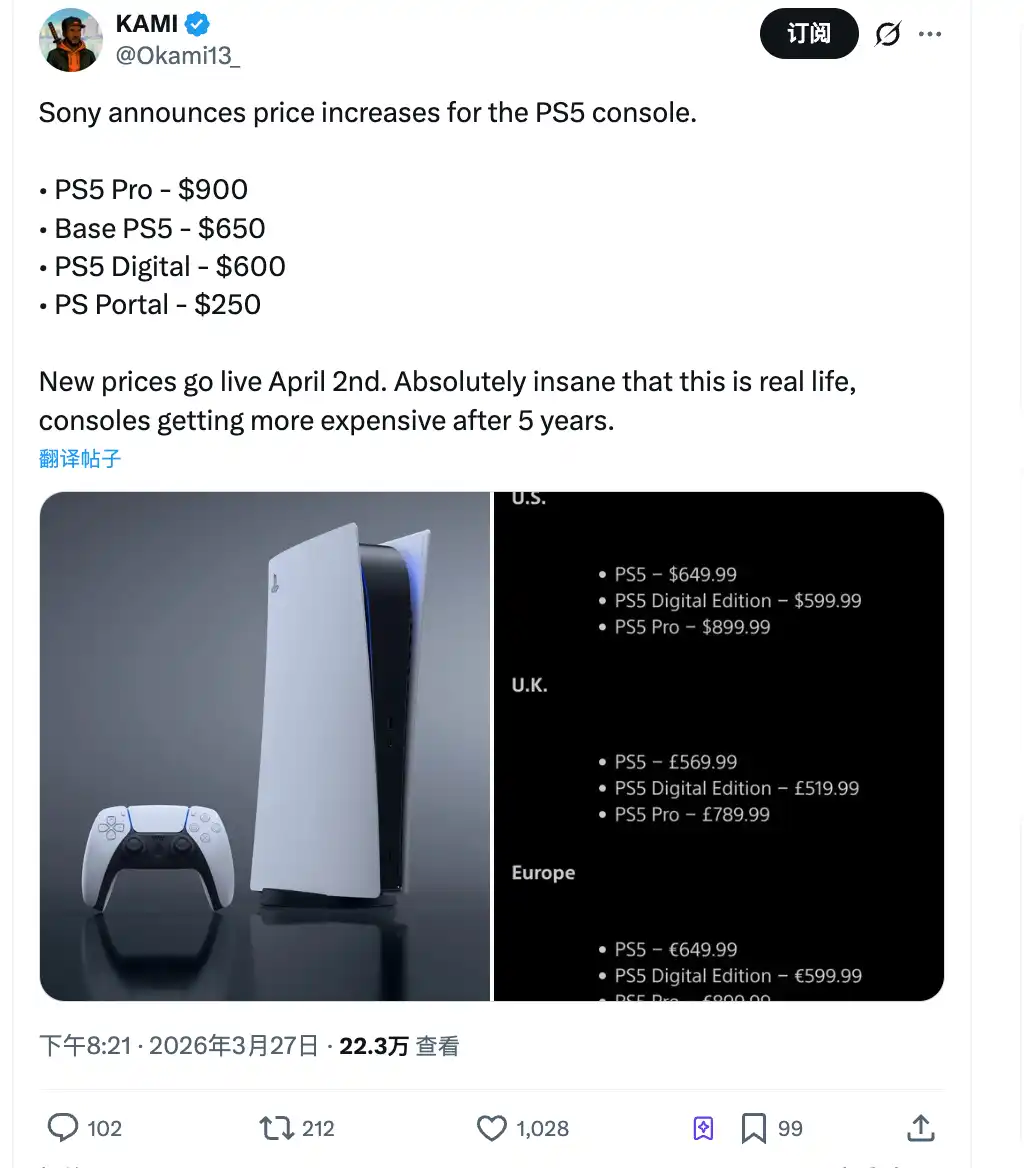
On March 27, Sony announced a price increase for all PS5 models, effective April 2.

In the US market, the PS5 Disc Edition rose from $549 to $649, the Digital Edition from $499 to $599, and the PS5 Pro jumped directly from $749 to $899.

This is the second increase within a year. The last one was in August last year, with only a $50 hike in the US, a market Sony deliberately shielded. This time, it's at least $100, with the PS5 Pro up by $150, and it's global—no market is exempt.

The pressure to raise prices has become too great for Sony to absorb alone.

Gamers know there's an ironclad rule in the console industry: consoles only get cheaper over time. Component costs decline, and manufacturers recoup early R&D through later profit improvements.

The PS5 is the first console in history to break this rule. Launched in 2020 at $399 for the Digital Edition. Six years later, the same machine costs $599.

Sony's official explanation is six words: "global economic pressures."
The AI Tax

Sony didn't elaborate much. But multiple analysts point to the same thing: memory chips.

The PS5 contains memory and a custom SSD, both requiring DRAM and NAND flash memory chips. These two components began rising significantly in mid-2025, for reasons entirely unrelated to the gaming industry: the construction of global AI data centers is snatching away memory production capacity, squeezing the share available for consumer electronics.

Your game console and AI use memory from the same production lines. AI can afford to pay more; you can't.

Piers Harding-Rolls, Research Director at Ampere Analysis, told CNBC that Sony had likely signed price protection agreements with suppliers, locking in procurement costs for a period. But after these agreements expired, memory prices showed no signs of easing, forcing Sony to pass the cost on to consumers.

According to Fox Business, Sony also admitted during its February earnings call that it was dealing with rising memory costs and planned to offset hardware losses with revenue from software and network services.

Translating for Sony: Hardware is no longer profitable, maybe even losing money. Sony intends to make up for it by selling games and subscriptions.

This is the first cut. The extra money you pay isn't for a better console; it's because AI took your memory.

Missile Strikes, Aluminum Prices Soar

The memory price hike was painful enough. Then came the missiles.

On March 28, the day after Sony's price announcement, Iran's Revolutionary Guard Corps launched several missiles at the UAE and Bahrain. Their target wasn't military bases; it was aluminum plants.

Emirates Global Aluminium (EGA) is the largest aluminum producer in the Middle East. According to its website, 1 out of every 25 tons of aluminum produced globally comes from this factory. Aluminium Bahrain (Alba) has an annual capacity of 1.62 million tons. Combined, they account for 6% of global aluminum production capacity.

According to EGA's website, the company's products are sold to over 400 customers in more than 60 countries, spanning various industries.

Hours after the missiles landed, aluminum prices jumped on the London Metal Exchange. According to the Securities Times, overseas aluminum spot premiums surged to a 19-year high. Alba subsequently declared force majeure, suspending deliveries to some customers.

Citibank analysts predict that if supply continues to deteriorate, aluminum prices could rise from the current ~$3,300 to $4,000 per ton.
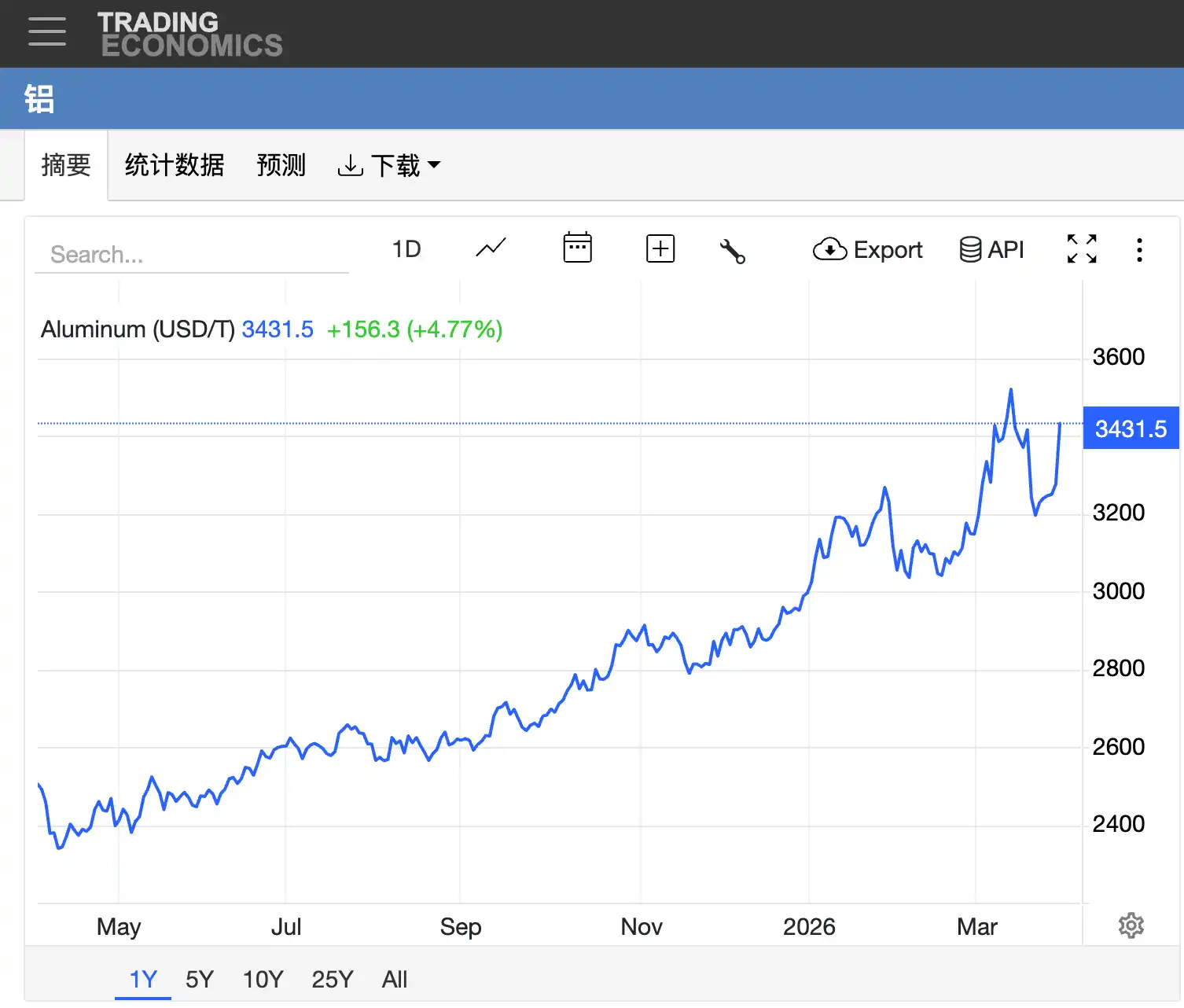
The PS5's heat sink module, structural components, and electromagnetic shielding layers all require aluminum alloy. Memory dealt the first blow; aluminum delivered the second.

And the bombing of these two plants was no accident.

The Revolutionary Guard stated in a declaration that these factories were "linked to the U.S. military and aerospace industry." In May last year, RTX, the American aerospace giant that makes Patriot missiles and F-35 radars, had just signed a memorandum of understanding with EGA to develop a production line for extracting gallium, a core material for military radars, at the Abu Dhabi plant.

According to an RTX press release, Paolo Dal Cin, Senior Vice President of Operations & Supply Chain, said at the signing ceremony that the agreement was to ensure the supply of critical minerals for the aerospace and defense industries.

Iran was targeting the supply chain of the U.S. military-industrial complex.

But bombing a military base means the loss is borne by a nation's defense department. Bombing an aluminum plant means the bill is split by the whole world, from airplanes to cars to phones to your PS5.

The Revolutionary Guard's statement also included a line: future retaliations will no longer be limited to tit-for-tat military responses but will aim for "more deadly blows" to the enemy's economic system.

According to Sina Finance, last month Saudi Arabia's largest chemical company, SABIC, already declared force majeure on its styrene and methanol production.

From aluminum to chemical raw materials, "force majeure" is spreading across the Middle East.

Paying for a Changing World

Hidden within the $200 price increase of the PS5 is actually a third cut, though that one landed last year.

In August 2025, Sony first raised US prices by $50. That move came against the backdrop of the U.S. imposing additional tariffs on global trading partners, increasing the import cost of electronics. The PS5 is designed in Japan, with components produced and assembled across multiple Asian countries—every step was skimmed by tariffs.

Tariffs, AI snatching capacity, missiles bombing aluminum plants.

Three bills, from three completely different sources. One from Washington, one from Silicon Valley, one from the Middle East. $399 to $599—each part of the increase has nothing to do with the console itself getting better.

You just want to buy a game console. But your price tag is分担 (sharing the cost) for U.S. trade policy,分担 for the AI arms race, and分担 for war in the Middle East.

And the PS5 might be the most honest one.

Sony issued an announcement, clearly stating the price hike. But aluminum isn't only used for game consoles, and memory isn't only in PS5s. Your phone, your laptop, the electric scooter you ride—all use the same aluminum and the same chips.

Traditionally, how was war paid for? Government taxes, or printing money. The U.S. issued war bonds during WWII; Truman raised taxes during the Korean War. You knew you were paying, and you knew where the money was going.

The next time these products quietly get more expensive, there might not be an announcement.

In 2020, you paid $399 for a PS5—you paid for a game console. In 2026, you pay $599 for the same PS5. The extra $200 isn't paying for better performance.

In the end, we all pay for what has happened in the world over the past six years.

Related Questions

QWhy did Sony increase the price of the PS5, according to the article?

ASony increased the price of the PS5 due to rising costs of memory chips (DRAM and NAND) driven by AI data center demand, increased aluminum prices following missile strikes on Middle Eastern aluminum plants, and the impact of US tariffs on global trade.

QWhat specific global events contributed to the increased cost of aluminum used in the PS5?

AThe price of aluminum increased after Iran's Revolutionary Guard fired missiles at major aluminum plants in the UAE (Emirates Global Aluminium) and Bahrain (Alba), which together account for 6% of global aluminum production. These plants are also linked to the US military-industrial supply chain.

QHow did the demand for AI infrastructure impact the price of the PS5?

AThe massive construction of AI data centers created high demand for memory chips (DRAM and NAND), which are also used in the PS5. This competition for memory production capacity increased prices, and Sony passed these higher costs on to consumers.

QWhat was unique about the PS5's pricing strategy in the context of console history?

AThe PS5 is the first console in history to break the industry rule that consoles become cheaper over time. Instead, its price increased from $399 at launch in 2020 to $599 in 2026 for the same digital edition model.

QWhat does the article suggest consumers are ultimately paying for with the $200 price increase on the PS5?

AThe article suggests that the $200 increase is not for improved console performance but rather represents a hidden tax where consumers are paying for US trade policies, the AI industry's resource competition, and the economic impact of conflict in the Middle East.

Related Reads

How to Automate Any Workflow with Claude Skills (Complete Tutorial)

This is a comprehensive guide to mastering Claude Skills, a feature for creating permanent, reusable instruction sets that automate specific workflows. Unlike simple saved prompts, Skills function like trained employees, delivering consistent, high-quality outputs by defining the entire task process, standards, error handling, and output format. The guide is structured in four phases: **Phase 1: Installation (5 minutes).** Skills are folders containing a `SKILL.md` file. The user is instructed to find a relevant Skill online, install it, test it on a real task, and compare its performance to one-off prompts. **Phase 2: Building Your First Custom Skill.** Start by rigorously defining the Skill's purpose, trigger phrases, and providing a concrete example of perfect output. The `SKILL.md` file has two parts: a YAML frontmatter with a specific name/description/triggers, and a detailed, step-by-step workflow written in natural language with examples and quality standards. **Phase 3: Testing & Optimization for Production.** Test the Skill in three scenarios: 1) a standard, common task; 2) edge cases with missing or conflicting data; and 3) a pressure test with maximum complexity. Any failure indicates a needed instruction. Implement a weekly optimization cycle to continuously refine the Skill based on real usage. **Phase 4: Building a Complete Skill Library.** The goal is to create a team of Skills for all repetitive tasks. Examples are given for industries like real estate, marketing, finance, consulting, and e-commerce. The user should list their tasks, prioritize them, and build one new Skill per week, maintaining a master document to track their library. The conclusion emphasizes the compounding time savings: ten Skills saving 30 minutes each per week reclaims over 260 hours (6.5 work weeks) per year, fundamentally transforming one's work system.

marsbit20m ago

How to Automate Any Workflow with Claude Skills (Complete Tutorial)

marsbit20m ago

Dialogue with Vitalik, Xiao Feng, Aya Miyaguchi, and Joseph Chalom: From the 'Subtraction Principle' to the Agent Economy

Conversation with Vitalik Buterin, Xiao Feng, Aya Miyaguchi, and Joseph Chalom: Highlights from the Ethereum Application Summit on key future directions. Vitalik Buterin discussed the concept of "Full Stack Open Source Security," extending security from the protocol to hardware layers like wallets and chips. He predicted AI will simplify blockchain interaction, enabling natural language commands for complex operations. He emphasized that Ethereum's future focus should be on security, decentralization, and trustless infrastructure—the areas where it holds its core competitive edge. The fusion of AI, Fully Homomorphic Encryption (FHE), and blockchain is seen as crucial for real-world applications requiring privacy, such as healthcare. Xiao Feng underscored the importance of simplifying technology for mass adoption. He drew parallels to the evolution from command lines to GUIs and apps, suggesting that AI-driven natural language interfaces will be key to bringing more users into Web3. He stressed that while performance is important, Ethereum must continue to uphold its foundational principles of decentralization and user sovereignty. Aya Miyaguchi, Chair of the Ethereum Foundation, explained the evolving role of the Foundation through the "Principle of Subtraction." As the ecosystem matures, the EF is stepping back from areas where the community can take the lead, acting as one of many "gardeners" rather than a central driver. She highlighted that real applications are built on Ethereum's core values: censorship resistance, open source, security, and privacy. The concept of "Local-first" initiatives, like the Ethereum Applications Guild (EAG), was also emphasized for leveraging regional strengths to create global impact. Joseph Chalom, CEO of SharpLink, positioned Ethereum as the future infrastructure for global capital markets, differentiating it from Bitcoin through its "productivity" via staking yields. He envisioned the rise of an "Agent Economy" by 2027, where AI agents, powered by Web3 wallets, will autonomously manage financial tasks like yield optimization and RWA investments. The summit concluded that with core infrastructure maturing, the application layer is now the key driver for Ethereum's next phase of growth and real-world adoption.

marsbit22m ago

Dialogue with Vitalik, Xiao Feng, Aya Miyaguchi, and Joseph Chalom: From the 'Subtraction Principle' to the Agent Economy

marsbit22m ago

Cerebras IPO: A $48.8 Billion Valuation—Is the 'Nvidia Challenger' a Bubble or a New King?

Cerebras Systems, positioning itself as an NVIDIA challenger, is going public with a $48.8 billion valuation despite several underlying paradoxes revealed in its S-1 filing. While 2025 revenue grew 76% to $510M and GAAP net income was $237.8M, this profitability relies heavily on a one-time, non-cash accounting gain. Adjusting for this, the company's non-GAAP net loss actually widened to $75.7M. Furthermore, customer concentration remains extreme: 86% of 2025 revenue came from two Abu Dhabi-based entities, MBZUAI (62%) and G42 (24%). Its landmark deal with OpenAI, valued at over $20 billion, creates a complex, nested relationship where OpenAI is simultaneously a major customer, lender, warrant holder, and strategic partner with exclusivity clauses. Cerebras's technical edge in latency-sensitive AI inference is real, with its wafer-scale chip outperforming competitors in benchmarks. However, this advantage is confined to a specific niche, not the broader AI training market dominated by NVIDIA's CUDA ecosystem. With a 95x price-to-sales ratio, the valuation demands flawless execution of the OpenAI contract and massive future revenue growth. Key long-term risks include intense competition from giants like NVIDIA and AMD, a dual-class share structure granting insiders near-total voting control, and ongoing geopolitical uncertainties regarding export controls. The IPO is a pivotal capital markets event for AI infrastructure. As an investment, it represents a high-risk, high-reward bet on the "inference-first" narrative and Cerebras's ability to dominate its specialized segment, underpinned by a valuation that highlights the current fervor in the sector.

marsbit1h ago

Cerebras IPO: A $48.8 Billion Valuation—Is the 'Nvidia Challenger' a Bubble or a New King?

marsbit1h ago

Trading

Spot
Futures

Hot Articles

Discussions

Welcome to the HTX Community. Here, you can stay informed about the latest platform developments and gain access to professional market insights. Users' opinions on the price of AI (AI) are presented below.

活动图片















