Forget DOGE and ADA, Zero Knowledge Proof Is Already Running Tech Endorsed by the ETH Founder! Analysts Predict 700x Gains Ahead

TheNewsCryptoPublished on 2026-01-06Last updated on 2026-01-06

Abstract

Recent market activity shows Dogecoin reclaiming the $0.13 support level, though momentum remains weak, while Cardano consolidates near $0.37 with cautious sentiment. In contrast, Zero Knowledge Proof (ZKP) is gaining attention for its focus on verifiable computation and privacy-preserving infrastructure, aligning with Ethereum founder Vitalik Buterin’s vision. ZKP’s presale auction and Proof Pod hardware adoption reflect growing engagement, positioning it as a potential high-utility crypto project with analysts predicting significant long-term gains.

Recent market behavior shows familiar patterns across large-cap cryptocurrencies. The Dogecoin current price has moved back above a long-watched support level, yet the recovery remains technical rather than conviction-driven. At the same time, Cardano news continues to focus on whether key support zones can hold, with price action suggesting consolidation instead of a clear trend shift.

In contrast, Zero Knowledge Proof reflects ideas long emphasized by Ethereum’s founder, Vitalik Buterin. He has consistently argued that zero-knowledge proofs allow verification without exposing underlying data, a principle that closely aligns with ZKP’s core design.

The ZKP network focuses on verifiable computation and privacy-preserving AI workloads rather than price-driven activity. Rising participation in the presale auction and the fast sale of Proof Pods point to active involvement, positioning ZKP within the next big crypto narrative centered on infrastructure and cryptographic trust.

Dogecoin Current Price Reclaims $0.13 Support

Dogecoin has recently moved back above the $0.13 level after a prolonged decline that erased 57% of its value from earlier highs. This area has historically acted as a key support zone, making the recovery in the Dogecoin current price technically relevant, though not yet decisive. Trading volume increased during the move, suggesting renewed participation.

From a technical perspective, holding above $0.13 could help stabilize the Dogecoin current price. Failure to maintain this level would reopen downside risk toward the next support area around $0.096. Momentum indicators point to a strong directional move, but they do not confirm a sustained trend change on their own.

Derivatives data shows more long positions than shorts, reflecting cautious positioning rather than strong conviction. Overall, the setup suggests tentative stabilization under current market conditions.

Cardano News: $0.36 Support in Focus

Cardano is trading near the $0.37 level after pulling back from a recent high around $0.48. Current price structure still reflects a sequence of lower highs and lower lows, suggesting that downside pressure has not fully cleared.

From a Cardano news perspective, attention remains on whether the $0.36 support zone can hold, as a break below this area could expose a move toward the previous low near $0.348. On the upside, a recovery above the $0.38–$0.39 range would be needed to shift short-term sentiment, with broader resistance sitting between $0.42 and $0.44.

Momentum indicators point to easing selling pressure, but they stop short of signaling a confirmed trend reversal. Derivatives positioning continues to show higher short exposure than longs, reflecting cautious trader expectations. Overall, Cardano news suggests consolidation remains the more likely scenario until clearer confirmation emerges.

Ethereum Founder’s Zero-Knowledge Vision Fuels Interest in ZKP Network

Zero-knowledge proofs are gaining attention as a practical way to improve trust and privacy in decentralized systems. Vitalik Buterin, Ethereum’s co-founder, has often pointed to this technology as a method for verifying outcomes without revealing sensitive data. His view is that cryptographic proof can reduce dependence on centralized platforms by making results transparent while inputs remain private. This idea applies not only to finance but also to data platforms and algorithmic systems.

That approach was already applied months ago by ZKP. The Zero Knowledge Proof network is built around verifiable computation and privacy-preserving collaboration, especially for AI workloads. By embedding zero-knowledge verification into its core design, ZKP is being watched as a potential next big crypto focused on infrastructure rather than short-term price movement.

Interest is becoming visible through ZKP’s presale auction, which is seeing steady participation across daily sessions. The auction distributes 200 million tokens per day based on proportional contribution, creating a clear and transparent allocation process. This structure also sets the reference pricing used for Proof Pod rewards.

At the same time, Proof Pods are selling quickly. These plug-and-play devices connect directly to the network to perform and verify computation and generate ZKP tokens as a reward.

Together, rising presale auction activity and fast Proof Pod adoption suggest growing engagement. As zero-knowledge systems gain relevance, ZKP’s traction explains why it is increasingly discussed as the next big crypto, with analysts predicting 700x ROI potential for early holders.

The Bottom Line

Overall, broader market signals remain mixed. The Dogecoin current price has recovered a key support level, but momentum remains limited. Similarly, recent Cardano news shows consolidation, with the price held by nearby resistance and support levels. Both assets reflect a market that is active but cautious, where participation has not yet translated into sustained momentum.

In this context, Zero Knowledge Proof represents a different path. Instead of relying on price recovery, the project builds around verifiable computation and privacy-preserving infrastructure inspired by principles emphasized by Ethereum’s founder. Its presale auction structure and the growing adoption of Proof Pods show measurable engagement.

This contrast highlights why ZKP is increasingly discussed within the next big crypto narrative focused on execution, transparency, long-term utility, and massive returns rather than short-term price movement.

FAQs

Q1. What is Zero Knowledge Proof (ZKP)?

A: ZKP is a blockchain network that verifies computation without revealing underlying data, aligning with privacy-focused ideas promoted by Vitalik Buterin.

Q2. How is ZKP different from Dogecoin and Cardano?

A: While Dogecoin current price and Cardano news focus on market levels, ZKP emphasizes verifiable computation and infrastructure-driven participation.

Q3. How does the ZKP presale auction function?

A: The presale auction releases 200 million tokens daily, with allocations based on proportional participation and fully transparent pricing.

Q4. What role do Proof Pods play in the ZKP network?

A: Proof Pods are hardware units that perform and verify computation, allowing participants to earn rewards through real network contribution.

Q5. Why is ZKP considered the next big crypto candidate?

A: ZKP is viewed as the next big crypto due to its focus on privacy, verifiable execution, and growing engagement beyond price speculation.

Join Presale Auction Now:Website: www.zkp.com

Disclaimer: TheNewsCrypto does not endorse any content on this page. The content depicted in this Press Release does not represent any investment advice. TheNewsCrypto recommends our readers to make decisions based on their own research. TheNewsCrypto is not accountable for any damage or loss related to content, products, or services stated in this Press Release.


TagsPress ReleaseZero Knowledge Proof

Trending Cryptos

Related Questions

QWhat is the main focus of the ZKP network according to the article?

AThe ZKP network focuses on verifiable computation and privacy-preserving AI workloads, building infrastructure for cryptographic trust rather than price-driven activity.

QWhat key support level has Dogecoin recently reclaimed?

ADogecoin has recently reclaimed the $0.13 support level after a prolonged decline that erased 57% of its value from earlier highs.

QHow does Vitalik Buterin view zero-knowledge proof technology?

AVitalik Buterin views zero-knowledge proofs as a method for verifying outcomes without revealing sensitive data, which can reduce dependence on centralized platforms by making results transparent while keeping inputs private.

QWhat are Proof Pods in the ZKP ecosystem?

AProof Pods are plug-and-play hardware devices that connect to the ZKP network to perform and verify computation, generating ZKP tokens as rewards for participants.

QHow does the ZKP presale auction function?

AThe ZKP presale auction distributes 200 million tokens per day based on proportional contribution, creating a transparent allocation process that sets the reference pricing for Proof Pod rewards.

Related Reads

DRAM ETF Issuer: Samsung, SK Hynix, Micron All Surpass $1 Trillion, the AI Era of Memory Chips Has Only Just Begun

Authors: Dave Mazza, Thomas DiFazio | Source: Deep Tide TechFlow The article, written by Roundhill Investments (issuer of the DRAM ETF), responds to Morningstar's caution about investing in memory chip stocks. Morningstar warns of the sector's history of boom-bust cycles, a lack of economic moats, and potential momentum-driven overvaluation. Roundhill argues the current situation is structurally different due to AI. Key points in Roundhill's rebuttal include: * **Changed Demand & Supply Dynamics:** AI infrastructure, not consumer electronics, is now the primary growth driver for memory demand. New, strict long-term supply agreements with hyperscalers reflect the high capital intensity of advanced manufacturing. * **Existence of a Moat:** High-Bandwidth Memory (HBM), essential for AI, has extremely high manufacturing barriers. The market is dominated by Samsung, SK Hynix, and Micron, with new entrants blocked by technological complexity and long lead times for equipment like ASML's EUV machines. * **Strong Fundamental Outlook:** Analyst consensus projects the three companies will rank among the world's most profitable by 2027, with combined profits of $704 billion on over $1 trillion in revenue. Their operating margins have already reached record highs. * **Valuation Re-rating:** Despite significant stock price gains, memory stocks trade at attractive valuations (e.g., a median NTM P/E of 8.37x for the DRAM ETF) relative to projected explosive EPS growth. Roundhill suggests historical valuation frameworks may no longer apply given the new profitability paradigm. Conclusion: Roundhill contends the rally is justified by fundamentals, marking a structural shift for the memory industry into a new era of sustained, AI-driven demand against constrained supply, rather than a repeat of past cycles.

marsbit17m ago

DRAM ETF Issuer: Samsung, SK Hynix, Micron All Surpass $1 Trillion, the AI Era of Memory Chips Has Only Just Begun

marsbit17m ago

EF's Epic Reorganization: 20% Layoffs, Budget Halved, Is Ethereum Gearing Up for a Leaner Future?

The Ethereum Foundation (EF) has announced a major organizational restructuring, involving a 20% staff reduction (approx. 54 employees) and a division into functional clusters like Protocol, Access, User, Community, and Institutional layers. Co-founder Vitalik Buterin further revealed plans to cut the EF's budget by around 40% over the coming years, aiming to reduce its annual spending rate from about 15% to roughly 5% by 2030, transitioning to an endowment-driven model. This overhaul is seen as a long-overdue correction to the EF's ambiguous role. As Ethereum grew, the foundation faced persistent criticism over ETH sales, perceived lack of execution, and unclear strategy, often becoming a focal point for community frustration amid ETH's price stagnation. The reform aims to redefine the EF's boundaries, narrowing its focus to core protocol research, public goods funding, and ecosystem coordination, while offloading more applied development work to the broader market. Concurrently, ecosystem forces like the newly formed Ethlabs (founded by ex-EF researchers) and other independent groups are stepping in to fill the space, signaling a shift from a centralized model to a more distributed, collaborative ecosystem structure. The move was notably praised by Solana co-founder toly, who viewed a "leaner" EF as potentially more decisive and agile.

Odaily星球日报58m ago

EF's Epic Reorganization: 20% Layoffs, Budget Halved, Is Ethereum Gearing Up for a Leaner Future?

Odaily星球日报58m ago

Dragonfly Partner Haseeb: The Fastest-Growing Companies of the Future May All Get Stuck at 149 Employees

Dragonfly partner Haseeb explores the distorted economics of AI model pricing, drawing parallels to tax policy. He notes that startups and small teams (under 150 users) enjoy heavily subsidized, fixed-price AI subscriptions (like Claude Code), where the marginal cost of an additional token is effectively zero. This creates a powerful incentive for them to maximize token usage ("token-maxxing") and innovate aggressively with AI automation. In contrast, large enterprises (over 150 users) are forced onto "Enterprise" plans, paying per-token API fees with high (~75%) markups. This acts like a steep "tax" on AI-powered labor, disincentivizing marginal automation and experimental use, and encouraging them to retain more human workers. Haseeb argues this pricing creates a "150-person cliff," a regulatory notch similar to labor laws in France that discourage firms from growing past 50 employees. He predicts the fastest-growing future companies may deliberately cap their headcount at 149 to avoid the punitive enterprise pricing. This would foster an "AI-first" management philosophy obsessed with automation and outsourcing to stay lean. While not intentionally designed, this bifurcated pricing could become one of the most influential de facto tax policies, shaping how AI replaces labor—not through mass layoffs at big firms, but through agile, AI-native startups outcompeting them.

marsbit1h ago

Dragonfly Partner Haseeb: The Fastest-Growing Companies of the Future May All Get Stuck at 149 Employees

marsbit1h ago

How xBubble Breaks Through in the VC-Heavily-Backed OPC Economy

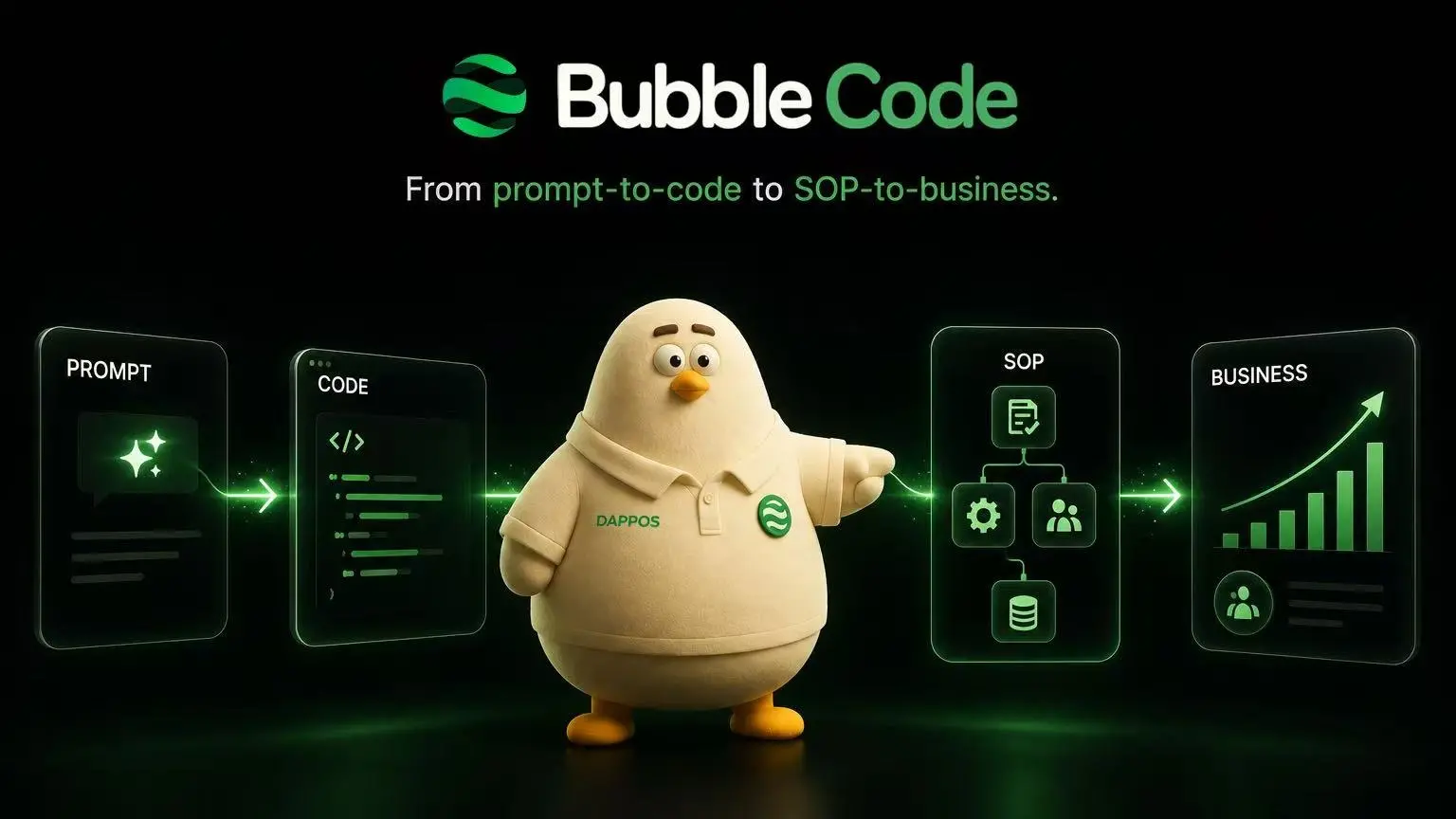
xBubble: Addressing the Structural Gap in the VC-Backed OPC Economy The concept of OPC (One Person Company) is evolving from a buzzword to a significant AI-driven market. While AI coding tools like Replit and Lovable have validated demand from non-technical users wanting to build applications, a key gap remains: the leap from creating a demo to running a stable, evolving business. These tools still require users to manage the development process, including technical judgments for integrations, modifications, and deployments—a major hurdle for OPCs. xBubble, by DAPPOS, tackles this by shifting from "Prompt-to-Code" to "SOP-to-Business." Instead of generating code from instructions, its core is a system of pre-organized SOPs (Standard Operating Procedures) that translate business goals—like "sell World Cup merchandise"—into complete, executable workflows. This includes generating cohesive assets, pages, payment systems, and backend logic. The platform is augmented by a network of third-party service providers who handle infrastructure (hosting, domains, payment setup), acting like "on-site service engineers." Users can pay for these services directly with xBubble credits, simplifying onboarding. This ecosystem aims to deliver not just an app, but a complete, modifiable business launch path. xBubble targets a clear OPC segment: small commercial nodes (e.g., creators, merchants) with existing products, customers, or channels, but for whom a full tech team is unjustifiable. Its potential lies in SOPs accumulating expertise from real cases, improving reliability and reducing delivery costs over time. Additionally, its native support for crypto payments caters to global or digital-native OPCs. In summary, as AI democratizes software creation, xBubble's opportunity is to prove that "SOP-to-Business" provides more immediate value for launching a real, operational business than a powerful but unstructured AI coding tool.

链捕手1h ago

How xBubble Breaks Through in the VC-Heavily-Backed OPC Economy

链捕手1h ago

Trading

Spot
Futures

Hot Articles

What is DOGE M

Doge Matrix ($doge m): The New Breed of Community-Driven Cryptocurrency Introduction In the ever-evolving landscape of cryptocurrency, new projects constantly emerge, each aiming to capture the interest of investors and enthusiasts alike. One of the latest entrants to this domain is Doge Matrix, represented by the ticker symbol $doge m. This project has attracted attention thanks to its roots in the popular meme culture surrounding Dogecoin, establishing its place within the web3 space. This article aims to provide a comprehensive analysis of Doge Matrix, covering its overview, creator, investors, functionality, timeline, and notable aspects. What is Doge Matrix ($doge m)? Doge Matrix is a community-driven cryptocurrency project that seemingly builds upon the widespread appeal of Dogecoin, a digital currency known for its Shiba Inu mascot and its meme origins. While the overarching objectives of Doge Matrix are not extensively defined, it is characterized by a commitment to harnessing community involvement and support. Unlike traditional cryptocurrencies that often emphasize utility or intrinsic value through underlying technologies, Doge Matrix positions itself within a space that embraces the cultural phenomenon of cryptocurrencies, particularly appealing to those who resonate with the ethos of meme-based assets. Drawing on the strengths of the Dogecoin community, Doge Matrix operates as part of a broader ecosystem, inviting participation and engagement from users who share an interest in cryptocurrency and the digital landscape. Who is the Creator of Doge Matrix ($doge m)? The identity of the creator of Doge Matrix remains unknown. This lack of transparency is not an uncommon occurrence in the cryptocurrency space, where some projects are launched without revealing the identities of their founders. The absence of information regarding the founding team can raise questions among potential investors about the project’s accountability and direction. Who are the Investors of Doge Matrix ($doge m)? As it stands, there is no publicly available information detailing the investors or investment foundations that back Doge Matrix. The project appears to rely primarily on community support rather than institutional investment. This model aligns with the community-driven nature of the initiative, fostering an environment where the direction of the project is shaped by its participants rather than being dictated by a select few financial backers. How Does Doge Matrix ($doge m) Work? The specifics regarding the operational mechanisms of Doge Matrix are somewhat vague, reflecting a broader trend of projects in the meme coin space where innovative functionalities are not always clearly articulated. Nonetheless, Doge Matrix seems designed to tap into the existing cryptocurrency ecosystem by encouraging user participation while tapping into the familiar cultural references associated with Dogecoin. Its potentially unique characteristics derive from community interactions rather than technological advancements, emphasizing shared experiences and collaboration among token holders. While the exact innovations have not been explicitly outlined, the project appears to create a space where community members can engage, share ideas, and propel the project's potential forward. Timeline of Doge Matrix ($doge m) Reflecting on the project’s timeline reveals notable events that have defined its journey thus far: November 25, 2024: Doge Matrix reached its all-time high value, marking a significant milestone in its early history. January 1, 2025: Conversely, Doge Matrix hit its all-time low value, illustrating the volatility often associated with cryptocurrencies, especially in the early stages of a project's lifecycle. Ongoing: The project continues to be actively traded and supported by its community, although specific future milestones or objectives have yet to be disclosed. Key Points About Doge Matrix ($doge m) Community Focus At the heart of Doge Matrix is a commitment to community engagement. The project thrives on the premise of collaboration and shared objectives among its members, emphasizing the importance of collective effort. Unlike centralized projects that often have a defined leadership structure, Doge Matrix at present showcases a more fluid approach to governance, where every community member's voice matters. Volatility The cryptocurrency market is notorious for its volatility, and Doge Matrix is no exception. Its price history reflects significant fluctuations between high and low values, which is typical of many new cryptocurrencies but underscores the risks associated with investment in emerging tokens. Lack of Detailed Information One of the most striking features about Doge Matrix is the scarcity of detailed information regarding its technological underpinnings and operational mechanisms. This ambiguity necessitates that potential investors conduct thorough due diligence before engaging with the project. Conclusion In summary, Doge Matrix ($doge m) illustrates a new wave of cryptocurrency projects that lean heavily on community engagement and cultural relevance. While lacking in certain specifics—such as clear leadership, defined objectives, and detailed functionality—the project has managed to generate interest within the crypto community, leveraging the established appeal of meme culture. As with any investment in the cryptocurrency space, understanding the inherent risks and conducting comprehensive research is essential for potential participants. Doge Matrix stands as a reminder of the dynamic, sometimes unpredictable nature of the crypto industry, marked by constant evolution and enthusiasm for community-driven initiatives.

3.8k Total ViewsPublished 2025.02.03Updated 2025.02.03

What is DOGE M

Discussions

Welcome to the HTX Community. Here, you can stay informed about the latest platform developments and gain access to professional market insights. Users' opinions on the price of DOGE (DOGE) are presented below.

活动图片